Key Takeaways
- A usable RFQ should define capacity, steel grade, logo method, packing, Incoterm, and target quantity from 1,000 units upward
- Pre-production samples usually take 7–12 days after artwork and sample fee approval
- For stainless vacuum flasks, specify 304 inner steel, 201 or 304 outer steel, and 0.4–0.5 mm wall thickness
- Bulk lead time is typically 30–45 days after deposit and approved PP sample
You do not buy vacuum flask promotional products by choosing a nice bottle from a catalog and pushing for the lowest FOB Ningbo price. That is how we see 201 steel quoted as 304 stainless, 6-hour insulation sold as 12-hour insulation, cartons missing the side-mark, and a logo that looked clean in the PDF but stretched on the curved cup body. QC catches this with a caliper and a salt-spray note. Too late.
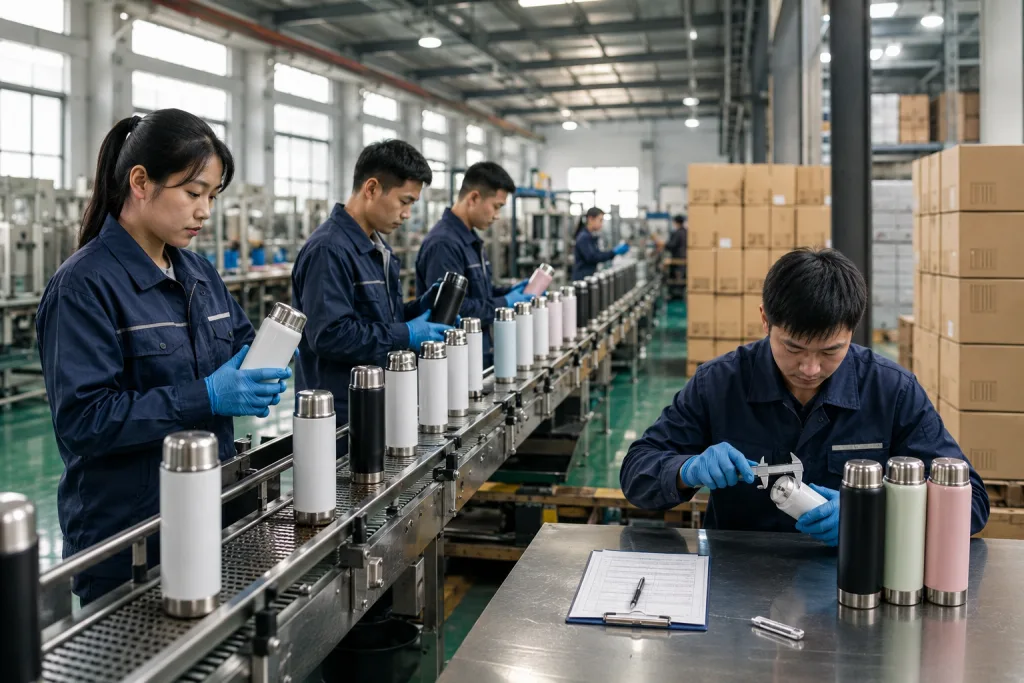
If you are an outdoor retailer or promotional brand, the job is to turn a campaign idea into a controlled bulk thermos order. On our factory thermos line in Hangzhou, Zhejiang, clear RFQs get accurate pricing within 24–48 hours; vague RFQs get padded pricing because the math does not work without capacity, coating, logo method, carton spec, and delivery date. We run this path every week: RFQ, 3D artwork, pre-production sample, bulk PO, then AQL 2.5 inspection before shipment.
Start With a Quote-Ready RFQ
A quote-ready RFQ for vacuum flask promotional products does not need 3 pages. It needs the right specs. Give the thermos manufacturer enough detail to price the actual item, not a stock bottle with your logo pasted on a PDF. For a stainless custom thermos, send capacity, shape reference, lid style, insulation target, logo process, packaging, testing requirement, order quantity, delivery market, and Incoterm. We run quotes faster when the buyer attaches one front-view image and one lid photo; last week our costing clerk caught a PO typo where “matte black” became “mate black” before the sample room mixed the wrong powder.
Capacity changes tooling, carton size, steel weight, and unit price more than buyers expect. A 500 ml flask and a 750 ml flask can look close in a rendering, but the carton CBM, stainless steel usage, and vacuum line cycle time are not close. Common sizes for outdoor retail and promotional thermos programs are 350 ml, 500 ml, 750 ml, and 1,000 ml. A 500 ml double-wall bottle is usually the safest promotional size because it fits commute and desk use without making the freight math ugly. On the line, QC pulled a 750 ml sample last month that passed appearance, then failed the 6-hour heat test by 4°C because the buyer changed the body diameter by 6 mm after artwork approval.
Put quantity in tiers: 1,000, 3,000, 5,000, and 10,000 units. A supplier thermos quote at 1,000 units often carries heavier logo setup and packing cost, while thermos bulk pricing at 5,000 units lets the factory spread fixed labor across the run. Our Zhejiang line capacity is about 450,000 stainless drinkware units per month across thermos, tumbler, and sports bottle styles, but MOQ still matters. Decoration setup is not magic. For laser logo, the jig still needs adjustment, the first 20 pcs still get checked under the caliper, and the carton team still has to set the same 5-layer export box whether you order 1,000 or 10,000 units.
Your first PO planning sheet should already include line items: model code, capacity, body color, lid color, logo method, packaging type, quantity per SKU, FOB port, requested ship date, compliance documents, and barcode requirements. If you sell through distributors thermos channels, add carton marking rules early. Waiting until final inspection to mention mixed-carton labels or FNSKU stickers is the wrong way to run it; we have seen this go sideways when 62 cartons had to be opened, relabeled, and retaped with 48 mm BOPP tape two days before loading. The buyer flagged it, but the math did not work.
Lock the Product Construction
Once the RFQ is signed off, we move from concept to construction. This is the point where a custom thermos either ships as a solid daily-use flask or comes back with leak complaints. On our line, we ask the factory to lock seven things first: inner material, outer material, wall thickness, vacuum result, cap material, gasket material, coating, and food-contact papers.
For export orders, 304 stainless steel is the safe call for the inner wall. The outer wall can stay at 201 stainless for price-sensitive promotional flask projects, or move to 304 when the buyer wants stronger retail positioning. We usually work at 0.4–0.5 mm wall thickness. Go thinner and the carton may survive, but the bottle dents faster in transit and on the shelf. QC pulled a 0.35 mm sample once; the buyer flagged it after one carton test. The math did not work.
The lid gets more abuse than most buyers expect. A screw lid with a silicone gasket is plain and dependable. A one-touch drinking lid is easier for the end user, but it adds springs, seals, and more leak points for us to inspect. For European and North American programs, ask for LFGB or FDA documents for stainless steel, silicone, and PP parts. If REACH or California Prop 65 is in play, say so before quoting. Otherwise we may choose the wrong resin and the whole order goes sideways.
For PO lines, write numbers, not praise. Use “304 SS inner, 201 SS outer, powder coating, matte black, 500 ml, leak test 100%, heat retention 60°C after 6 hours from 95°C start” instead of “good quality black flask.” A thermos factory can control a caliper reading to 0.1 mm and a torque spec on the cap. It cannot work from adjectives.
- Retail outdoor positioning: 304 inner, 304 outer, powder coat, individual color box.
- Campaign giveaway: 304 inner, 201 outer, silk screen logo, white box or kraft box.
- Distributor thermos stock: neutral body colors, laser logo option, master carton barcode.
Choose Decoration Before Sampling
Decoration changes the look and the scrap rate. A customizable thermos can take laser engraving, silk screen printing, heat transfer, water transfer, UV printing, or debossed accessories. Do not sign off on a blank sample and “pick the logo later” unless the order has no schedule pressure. We fix the decoration method before the first serious sample, because once the laser head or screen plate is set, the line follows that path.
Laser engraving stays clean on stainless steel and powder-coated bodies. We use it a lot for outdoor brands because it does not peel, and it holds small logos well at 18 mm or 22 mm width. The catch is simple: laser tone depends on coating and base metal, so this is not a Pantone-match process. Silk screen printing is the cheaper call for one- or two-color logos, especially on thermos promotional orders above 3,000 units. It can look sharp, but curved bodies need artwork adjusted on the jig, and a flat proof often lies.
Heat transfer and UV printing open the door to more colors, gradients, and full campaign graphics. They fit promo brands that want a lifestyle look, but the inspection bar goes up. We usually set logo position tolerance at ±1.5 mm for standard body printing; tighter than that only makes sense when the artwork truly needs it. Over-tight tolerance on a tapered bottle body is the wrong question to ask, because it pushes rejection rate up and the math stops working.
At the sample PO stage, list the artwork file name, logo size in mm, logo location from base or rim, Pantone code if printed, surface finish, sample quantity, and approval criteria. A clean line reads like this: “2 pcs 500 ml thermos customized sample, matte forest green, laser logo 45 mm wide, centered 80 mm from base, individual kraft box.” We’ve seen one PO typo on “centered” turn into a 20 mm shift, so the buyer flagged it before QC pulled the sample. Basic? Sure. It saves a lot of back-and-forth.
A factory thermos sample is not only for your client presentation. It is the physical contract for production workers, QC inspectors, and the packing team.
Read the Sample Like QC
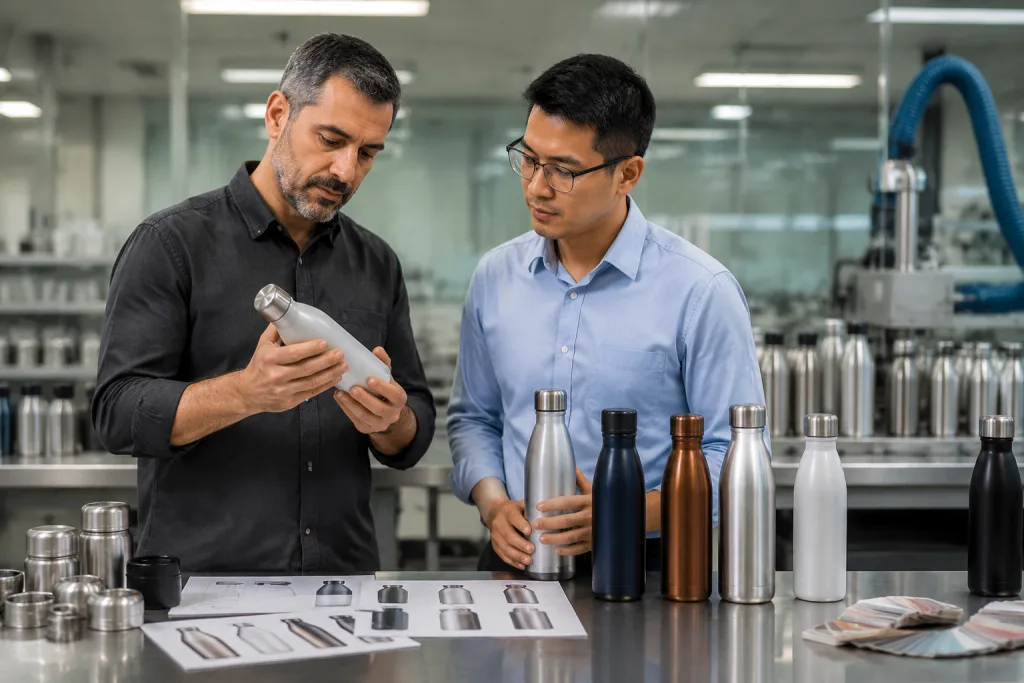
When the sample lands, don’t ask only, “Does it look nice?” Wrong question. Read it like incoming QC on our line. For a customized thermos sample, we check net weight on a 0.1 g scale, real capacity, lid thread bite, coating, logo position, smell, leakage, insulation, carton fit, and barcode scan if the buyer supplied an EAN label. If the team checks only the logo, bulk will bite later; we’ve seen 3,000 pcs held because the cup passed artwork review but the lid rocked 1.5 mm on the neck.
Start with simple tests. Fill the flask with hot water, close it, flip it upside down for 30 minutes, then check seepage around the lid and gasket with a dry tissue. For insulation, fill with 95°C water, close for 6 hours at room temperature, then measure the remaining temperature with a probe thermometer. A decent 500 ml stainless vacuum flask should often keep water above 60°C after 6 hours, depending on structure and lid type. If the supplier thermos sample sits at 48°C, don’t accept “normal tolerance” too fast; ask whether the issue is vacuum leakage, lid design, or thinner wall construction.
Check the coating under normal retail lighting, not only under a desk lamp. Powder coating should look even, with no pinholes, heavy orange peel, or exposed metal near the base radius where the hanging jig sometimes leaves marks. For silk screen logos, rub gently with a dry cloth 20 times and inspect the edges. For laser logos, check whether the mark is deep enough and not burned around the edges. If the product is meant for outdoor use, ask whether the coating passed cross-hatch adhesion testing, or send your own requirement before we run bulk paint.
Your sample approval note should read like PO-ready data. Write “PP sample version B, dated May 18, logo raised 3 mm versus version A, gasket changed to translucent silicone, box dieline approved,” not “sample ok.” Small words create expensive arguments. For manufacturers thermos teams in Zhejiang, clear version control protects both sides; last year one buyer flagged a PO typo where “matte black” became “metal black,” and the approved sample photo saved the order. It also gives your final inspection company a practical reference.
Build the Bulk PO Properly
The bulk PO is where 7 out of 10 promotional orders start to get messy. A purchase order for vacuum flask promotional products should not stop at item, price, and quantity. It needs the same technical details signed off at sampling, plus the commercial and logistics terms we use to open the job card on the line. If your distributor thermos order has five colors and two logo versions, each SKU needs its own line; otherwise QC pulled the sample on Monday and nobody knows whether “blue” means PMS 296C or the darker navy from the last proof.
A clean PO line looks like this: item code BF-VF500, 500 ml stainless vacuum flask, 304 inner/201 outer, matte navy powder coating, laser logo 40 mm, black screw lid, individual kraft box, 24 pcs per master carton, 3,000 units, FOB Ningbo, target ex-factory date July 20. Add unit price, total price, deposit amount, balance payment term, carton mark, barcode or FNSKU requirement, and inspection standard. We also like to see carton size in mm and gross weight in kg because the warehouse will measure it with a tape and scale anyway, and one buyer once sent “FNSKU” on the PO but attached UPC artwork.
For most custom thermos programs, payment is 30% deposit and 70% before shipment after inspection. Bulk lead time is usually 30–45 days after deposit and approved pre-production sample, but 30 days vs 45 days is not a small gap when the coating oven already has 18,000 mugs queued. If you need 10,000 units before a trade show or seasonal launch, build in at least 12 days of shipment buffer. A factory in China can move fast, but stainless forming, welding, vacuuming, coating, printing, assembly, and packing must run in order. Air freight can save a launch date. The math often doesn’t work.
Clarify whether pricing is FOB Ningbo, FOB Shanghai, EXW Hangzhou, or DDP destination. FOB is common for North American and European importers with their own forwarder; we ship 38–42 cartons per CBM depending on bottle shape, so the forwarder needs real packing data, not a guess from the sales sheet. DDP looks simple for smaller promotional brands, but ask what is included: duty, VAT, customs clearance, local delivery, and insurance. A thermos vendor offering a low DDP price may be using weak freight assumptions, and we’ve seen this go sideways when the buyer flagged a surprise warehouse surcharge after arrival.
Freeze changes after the PO is signed. After deposit, a color change is not a small note; it can affect powder purchase, production slot, and sample approval. After printing, a logo change usually means scrap, especially when the pad-printing plate is already made and 1,200 lids are sitting beside the line. Treat the PO as a production document, not an email placeholder.
Inspect Before the Balance Payment
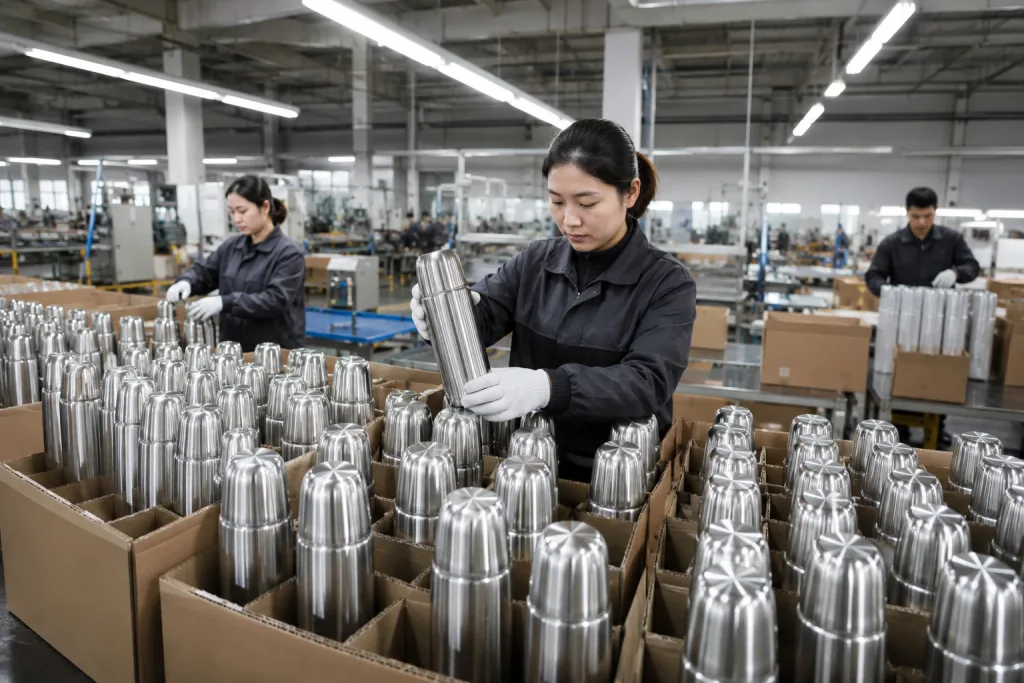
Plan inspection before production starts, not after 312 cartons are taped and stacked by the loading door. For a bulk thermos order, we usually write pre-shipment inspection into the PI and PO, using AQL standards unless your company has a stricter internal protocol. A common setting is AQL 2.5 for major defects and 4.0 for minor defects, with critical defects at 0. Critical defects mean no debate: unsafe sharp edges found with a cotton-swipe test, serious leakage after inversion, wrong material claims, oil contamination, or failed food-contact basics.
The inspection checklist should match your PO and approved sample. Use a digital caliper for body height and diameter, weigh the bottle on a 0.1 g scale if the spec calls it out, confirm capacity, check logo size and location, compare color against the signed sample under the light box, test lid assembly, run random leak testing, and review carton markings. For Amazon or marketplace programs, scan FNSKU labels from at least 5 cartons, not just the top case. For outdoor retailers, verify inner box condition because a dented retail box can trigger a chargeback even when the bottle is fine; we have seen buyers flag a 3 mm crushed corner.
Final inspection alone is the wrong question to ask if the order has mixed colors, gift boxes, or 2 lid types. For large thermos custom projects above 10,000 units, we run a during-production inspection at 20–30% completion to catch color drift, wrong lids, or packing mistakes before the full batch is finished. QC pulled a sample last season where the black powder coat was 1 shade off the approved chip, and stopping 2,000 units saved the buyer from sorting 10,000 units at the warehouse. The math doesn't work the other way.
As a thermos supplier in Zhejiang, we prefer buyers who define inspection points early. It cuts the drama in the last week. If goods pass, you pay the balance and release shipment. If goods fail, the corrective action needs a clear work order: reprint affected SKUs, replace silicone gaskets, repack cartons, or sort defects under supervision on the line. “Improve quality” is not a corrective action; we need SKU numbers, defect limits, and who signs the recheck sheet.
Ship With Fewer Surprises
QC does not end when the inspector signs the report. A stainless thermos can survive daily use, then arrive with a dented shoulder because one carton corner collapsed in transit. We run a 76 cm drop test on packed master cartons before shipment, and QC pulled the sample last month after 3 gift boxes showed scuffed coating near the lid. Lock the inner box, polybag rule, 5-ply carton spec, pallet pattern, and container loading plan before the goods leave the thermos factory.
For export cartons, 5-ply corrugated board beats thin local board for 24 pcs per carton and sea freight. No debate there. We ship 500 ml flasks in cartons around 48 × 33 × 28 cm when the gift box is standard, but the size can move 20–35 mm once a molded insert or handle box is added. If your customer wants plastic-free packaging, write kraft box, paper sleeve, and molded pulp insert on the PO before mass packing starts. The buyer flagged this late on one order, and the math didn’t work: changing from foam tray to pulp insert added 12 days, not 3 days, because the carton needed a fresh compression test.
Documents slow shipments when nobody checks them until the forwarder asks. Standard paperwork includes commercial invoice, packing list, bill of lading, and certificate of origin if requested. Compliance files may include FDA food-contact declaration, LFGB test report, REACH declaration, BSCI audit summary, ISO 9001 certificate, and material safety information. Not every promotional flask order needs the full file, but retail buyers often ask before warehouse booking; we once saw a booking held 4 days because the PO typed “304 stainess” and the material declaration said “304 stainless.” Small typo. Real delay.
If you are building a long-term thermos distributors program, track claims after delivery by SKU. Count leakage rate, coating complaints, lid breakage, and carton damage, then send the numbers back before the next RFQ. We like seeing a simple sheet with 1,200 pcs sold, 9 lid claims, 6 coating scratches, and 14 cartons crushed at the retailer DC. That data beats general feedback. The best supplier thermos relationships in China improve over 2–3 orders because the PO, QC checklist, and packing standard get tighter each time.
Send Your Thermos RFQ for Factory Review
Share capacity, quantity, logo artwork, packaging, and delivery market. Our Zhejiang sales engineers will return a practical quote and sampling plan.
Frequently asked questions
What MOQ should I expect for vacuum flask promotional products?
For standard stainless models, a practical MOQ is usually 1,000 units per color for simple logo work. Some factory thermos lines can accept 500 units for laser engraving on stock colors, but the unit price will be higher because setup, packing, and admin cost do not shrink much. For custom powder coating, Pantone color matching, or retail packaging, plan around 3,000 units per SKU. If you need a fully customized thermos with new mold, special lid, or unique body shape, MOQ may move to 5,000–10,000 units. Ask for tier pricing at 1,000, 3,000, 5,000, and 10,000 units so you can see where the cost curve actually changes.
How long does a custom thermos order take from RFQ to shipment?
A realistic timeline is 24–48 hours for a clear RFQ, 7–12 days for logo or color samples, 2–3 days for sample review and revisions, then 30–45 days for bulk production after deposit and approved PP sample. Sea freight to Europe or North America often adds 25–40 days depending on port and season. If you are planning a promotional thermos campaign for a fixed event, start at least 90 days before your required delivery date. Rush orders are possible, but coating, vacuum testing, printing, and inspection still need proper sequence.
Which logo method is best for outdoor retail stainless flasks?
Laser engraving is usually the safest choice for outdoor retail because it is durable, clean, and resistant to abrasion. It works well on powder-coated stainless steel and avoids ink adhesion problems. Silk screen printing is better when you need a specific Pantone color or a lower-cost logo for thermos bulk orders above 3,000 units. UV printing or heat transfer is suitable for full-color campaign graphics, but inspection should include adhesion and scratch checks. For curved flask bodies, keep large logos moderate in width, often 35–60 mm, to avoid distortion.
What should be included in a bulk thermos purchase order?
Your PO should include model code, capacity, steel grade, wall construction, body color, lid color, logo method, logo size, packaging, carton quantity, barcode rules, Incoterm, unit price, total quantity, payment terms, lead time, and inspection standard. For example, specify “304 inner/201 outer, 500 ml, matte black powder coating, laser logo 45 mm, individual kraft box, 24 pcs/carton, FOB Ningbo.” Add AQL 2.5/4.0 if that is your inspection rule. A PO with these details gives the thermos manufacturer a production document, not just a buying intention.
How do I compare thermos suppliers without only chasing price?
Compare the full offer: steel grade, wall thickness, lid design, coating type, logo process, compliance documents, sample speed, AQL support, carton quality, and payment terms. A USD 0.20 cheaper thermos vendor may be expensive if it uses thinner outer steel, weak cartons, or poor gasket material. Ask each thermos supplier for the same RFQ format and request photos or video of welding, vacuum testing, coating, and packing lines. For China sourcing, also check export experience, BSCI status if needed, and whether the supplier can hold consistent color and logo placement across repeat orders.