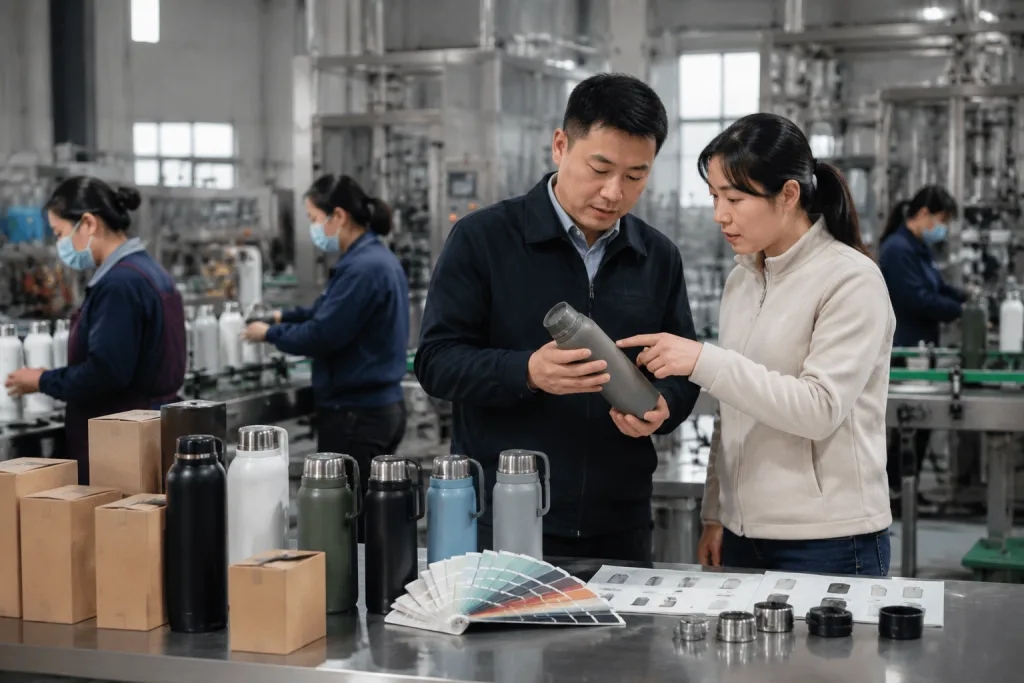
Key Takeaways
- A practical MOQ for vacuum flask private labeling starts at 1,000 pcs per color for standard molds
- 304 stainless steel at 0.45-0.55 mm body thickness is the usual balance for outdoor retail
- Laser engraving is slower but avoids the 3-5% scratch risk seen with some printed coatings
- Plan 35-45 days production after sample approval, plus 7-10 days for custom packaging proofing
If you sell outdoor gear or promotional products, a stainless thermos looks simple until you approve the wrong one. A 500 ml flask can land as a USD 9.90 retail item or a return headache, depending on 304 stainless thickness, vacuum loss after 6 hours, lid tolerance at ±0.2 mm, powder coating thickness, 5-ply carton strength, and logo adhesion after a 3M tape test. Samples lie. Last month QC pulled 12 black flasks from the line; 2 looked fine under office lights but showed pinholes under the inspection lamp.
Vacuum flask private labeling means choosing the failure rate you can live with, the shelf price your buyer will accept, and whether custom tooling adds 12 days or 18 days to the schedule. From our Hangzhou, Zhejiang export desk, we see orders go smoother when buyers lock four items before artwork release: product platform with MOQ, decoration method with test standard, compliance file, and packing route. The wrong question is “Can you put my logo on it?” We ship that every week. The better question is “Will this flask still look sellable after 3 months in a warehouse and 1 dropped carton?”
Start with the selling channel
Your sales channel should set the thermos spec. Not the reverse. A giveaway bottle for a bank’s winter promo does not carry the same cost logic as a private-label flask sitting on an outdoor shelf at USD 29.99. Before you ask a thermos supplier for a quotation, decide if the order is built for giveaway volume, retail margin, or distributor replenishment. We see this go sideways when the PO says “premium bottle” but the artwork file is a 72 dpi JPG and the buyer still expects a 12-day sample approval.
For promotional brands, the pressure is unit cost and delivery date. A standard 500 ml or 750 ml factory thermos with one-color silkscreen logo, white box, and export carton usually works. Tooling stays at zero, approval steps stay short, and the campaign date is easier to protect. On the line, we run these with a fixed logo jig and check print position to ±1.5 mm before packing. For outdoor retailers, the bottle has to stand up to daily use, shelf comparison, and customer reviews. That means stronger powder coating, tighter lid fit, proven insulation data, and packaging that does not arrive with crushed corners.
A distributor thermos program sits between those two channels. You may need 3-5 colors, mixed cartons, barcode labels, and one stable model for two seasons. Chasing the lowest FOB price from every thermos vendor is the wrong question to ask here. You need repeatability. If the first order is 3,000 pcs and the second is 8,000 pcs, the manufacturer thermos platform must stay consistent in cap thread, color, and carton dimensions. QC pulled one reorder last year because the cap thread gauge showed a 0.4 mm shift after a subcontracted lid change; the math on cheap lids did not work after airfreight replacement parts.
- Promotional route: standard mold, fast logo setup, simple white box, 25-35 day production if steel bodies and lids are already in stock.
- Retail route: better coating with cross-hatch tape test, tested insulation, custom box, barcode and country labeling, 40-55 day realistic timeline.
- Distributor route: stable SKU system, color continuity checked against a Pantone card, spare lids, pallet planning, reorder discipline.
At BottleForge Industrial in Zhejiang, China, our stainless thermos line can produce about 450,000 units/month across standard bottle and flask models. Capacity only helps when your brief is clean. A vague request for a “custom thermos, premium quality, best price” usually creates three quotes nobody can compare. We prefer a one-page spec with capacity, lid type, coating, logo method, packing, MOQ, and target ship date; even a typo like “mat black” on the PO can cost 2 days while sales, artwork, and spraying confirm whether the buyer meant matte black.
Choose the flask platform first
Start with an existing mold. It is the cheapest clean decision. We’ve seen projects go sideways when a buyer asks for a new body shape before one retail test; the first PO says 1,000 pcs, then the tooling invoice makes the math look ugly. For most vacuum flask private labeling jobs, we run standard manufacturer thermos platforms: 350 ml, 500 ml, 750 ml, 1,000 ml, and sometimes 1,200 ml. Those sizes already cover outdoor retail shelves, employee gift tenders with 2,000 pcs MOQ, winter sports club orders, and distributor thermos catalog programs.
The real trade-off is capacity against carry comfort. A 500 ml flask packs easily and usually weighs 270-330 g depending on wall thickness and lid design; QC pulled one 500 ml sample last month at 318 g with the silicone seal installed. A 1,000 ml flask gives better shelf value and holds heat longer, but the carton weight jumps, and the bottle feels clumsy for subway commuting. If you sell to hikers, campers, or fishing shops, 750 ml is the safer middle ground. Not exciting. It sells.
Check the construction before you talk logo. Most stainless vacuum flasks use 304 stainless steel inside and outside, double-wall vacuum insulation, and a copper or aluminum reflective layer between walls on better models. For food-contact safety in Europe and North America, 304 stainless steel is the normal pick. Some low-cost suppliers thermos offers use 201 stainless outside to cut the quote by USD 0.18-0.35 per piece. That can pass for dry indoor promotions, but it is the wrong question to ask for wet outdoor use because rust complaints show up after one season in a backpack side pocket.
Body thickness matters more than buyers expect. A 0.38 mm outer wall cuts cost, but it dents when the line does a 1.2 m drop check onto the rubber mat. A 0.45-0.55 mm outer wall is the better range for outdoor retailers. Inner wall thickness is often 0.30-0.40 mm. For thermos bulk programs, ask the thermos factory to state steel grade and wall thickness in the proforma invoice or quality file, not only in a sales email. We’ve had a buyer flag this after a PO typo listed “304 inside / 201 outside” while the approved sample was full 304.
Private tooling makes sense only when the shape supports your brand position. A new lid mold may cost USD 1,500-4,000. A full body mold can run USD 6,000-18,000 depending on complexity, especially if the drawing needs a tapered shoulder or special cup thread. If your first order is 1,000 pcs, that tooling cost hurts. If your annual plan is 30,000 pcs, a distinctive customizable thermos may pay back, but we would still test one existing platform first and check sell-through after 60 days.
Set insulation claims you can defend
Insulation claims are where private label programs get sloppy. “Keeps hot 24 hours” looks nice on a color box, but the test method decides whether that line survives a complaint. Was the fill water 95°C on a calibrated probe, or did someone read the kettle display? Was the room held at 20°C or closer to 25°C near the packing area? Was the lid opened once for a photo? What was the final water temperature in °C? We had one buyer flag a carton claim after their lab got 42°C at 12 hours while the approved artwork promised 55°C. Print a big claim, and you own it.
A workable baseline for a 500 ml stainless vacuum flask is simple: 95°C hot water, 20°C ±2°C room temperature, lid closed, readings at 6, 12, and 24 hours with the same digital thermometer. We run this on retained samples from each batch, not just the golden pre-production sample. A solid 500 ml flask should hold above 65°C after 6 hours and above 45°C after 12 hours. Size matters. A 1,000 ml flask has a better volume-to-surface-area ratio, so it will normally beat a slim 350 ml model at 24 hours if the vacuum gap and lid seal are the same.
Cold retention is easier to sell cleanly. With chilled water, 120 g of ice, and the cap kept shut, a good vacuum flask can keep drinks cold for 18-24 hours depending on fill level and how often the user opens it. Outdoor buyers do not want lab poetry; they want a bottle that still feels cold after a day in a backpack. We have seen this go sideways when a brand used “ice cold all day” and the buyer’s store team tested half-filled bottles on a sunny shelf. A safer retail box claim is “hot up to 12 hours, cold up to 24 hours,” backed by batch records.
For quality control, vacuum failure must be caught before shipment. We use hot water hold testing on the line, temperature-drop checks with a probe, and thermal spot checks when QC pulls the sample from packed cartons. At our Hangzhou facility in China, we normally pair production-line vacuum checks with final AQL inspection. For retail orders, we suggest AQL 2.5 for major defects and AQL 4.0 for minor defects. Critical defects, such as leakage or wrong material, stay at zero tolerance; one sharp burr on a drinking lip is already too many.
Do not approve a bulk thermos order based only on one perfect sample. Ask how the thermos manufacturers control vacuum consistency across 1,000, 5,000, or 20,000 pcs.
Insulation performance also changes with lid design. A cup-style lid suits camping and gift sets, but it adds a threaded cup, inner stopper, and silicone ring, so QC has more places to find leaks. A push-button stopper feels convenient, yet the silicone fit must be checked in mm because a small molding shift can cause seepage in the tilt test. A screw cap is the safer choice for promotional thermos orders where the math is driven by cost and defect rate, not fancy opening action.
Pick decoration without pretending it is free
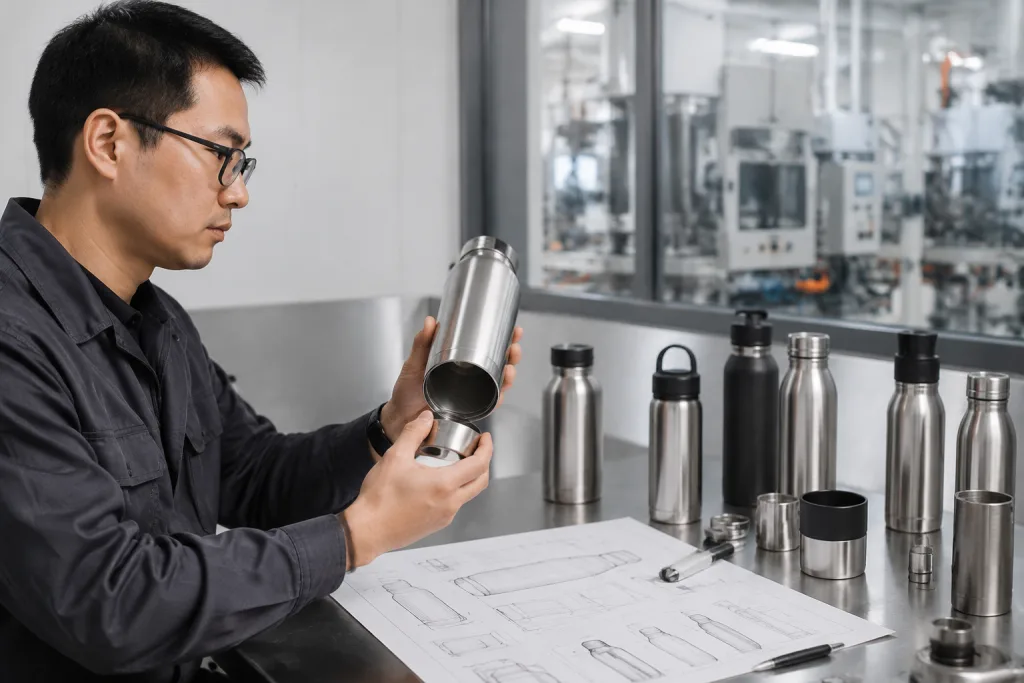
Decoration is not just artwork on a bottle. It changes reject rate, lead time, hand feel, carton scuffing, and whether the flask still looks acceptable after 6 months on a store shelf. For vacuum flask private labeling, we normally run silkscreen printing, laser engraving, heat transfer, water transfer, full-color UV printing, or debossed and embossed details on PP lids and silicone boots. QC pulled one 500 ml sample last month because the logo sat 3 mm too close to the lower radius; it looked fine on the PDF, not on the line.
Silkscreen printing is the economical choice for simple logos. On a smooth powder-coated bottle, one-color print can add roughly USD 0.08-0.18 per pc depending on logo size and order volume. It is fast enough for thermos promotional campaigns; a normal one-color job on 3,000 pcs usually adds 2-3 production days after artwork approval. The weak point is scratch resistance. If the coating or ink is soft, the logo can rub off during sea freight or retail handling. Ask for 3M tape testing and alcohol rub testing when the order is for retail. We use 3M 600 tape and a 500 g pressure rub fixture; if the buyer skips this, we have seen it go sideways in the outer carton.
Laser engraving costs more, often USD 0.18-0.45 per pc, but it is durable and clean. It works best on powder-coated stainless bottles because the laser removes the coating and exposes 304 stainless underneath. For outdoor retailers, laser is usually the safer choice. The trade-off is simple: the logo color is the metal color. You cannot match a Pantone ink unless you print. One buyer once asked for “laser in PMS 186C” on the PO; we flagged it before mass production because the math does not work.
Heat transfer and UV printing allow more colors, gradients, and large wraps. They fit lifestyle designs, resort merchandise, and brands that need artwork around most of the body. They also need tighter artwork control. A wrap design on a tapered flask can distort if the dieline is off by 1.5 mm at the top diameter. For a thermos custom project, ask for a production pre-sample, not only a digital mockup. This is the wrong question to ask: “Can you print the image?” The better question is whether the print still lines up after the bottle passes through the jig, oven, and final AQL 2.5 inspection.
Color also has cost and risk. Standard factory colors are cheaper because we keep powder in stock for black, white, navy, and 6-8 repeat shades. Custom Pantone powder coating usually needs MOQ of 1,000-3,000 pcs per color depending on the coating supplier. Matte finishes look premium but show oil marks and scratches faster; gloss finishes resist fingerprints better but can feel less “outdoor.” For a distributors thermos range, choose colors you can reorder for at least 12 months. Zhejiang coating suppliers can match most common Pantone targets, but small batch color drift of Delta E 1.5-2.5 is normal unless you pay for tighter control. We check plaques under a D65 light box before spraying; if the approved plaque gets lost, the next batch becomes a debate instead of a shipment.
Price the whole landed program
FOB unit price is the wrong first question. We have seen a USD 0.25 cheaper stainless vacuum flask lose the buyer USD 0.62 per pc after double-wall dents, extra inner cartons, 3% replacement stock, repacking labor, late vessel cutoff, and customer service credits. Price the landed program in layers. Last month QC pulled 80 pcs from a 2,000 pc run and found 6 lids with silicone flash over 0.8 mm, so the cheap lid was not cheap by the time the line reworked it.
For a standard 500 ml 304 stainless steel flask, a realistic FOB China range is USD 3.20-5.80 depending on body design, lid, coating, logo, and packaging. A 750 ml model may sit around USD 4.20-7.20. Premium retail packaging, such as a printed rigid box or kraft gift box with molded pulp insert, can add USD 0.35-1.20 per pc. A simple white box may add only USD 0.12-0.25. Use these as sanity checks when a thermos vendor quotes far below the pack. We run the numbers with carton CBM, not just the unit price, because one buyer once saved USD 0.18 on the bottle and paid USD 410 more on a 40HQ due to a box that was 12 mm too tall.
MOQ trips up buyers. A factory thermos standard model with available color stock may start at 500 pcs, but real private label production usually starts at 1,000 pcs per color. Custom Pantone coating, custom lids, and retail boxes push MOQ higher. If you want 4 colors at 500 pcs each, confirm whether the thermos manufacturer treats that as one 2,000 pc order or four small color runs. The math does not work if the coating line must wash guns 4 times for 500 pc batches, and we have had buyers flag this only after the PO said “assorted colors” with no Pantone codes.
Lead time should be quoted from confirmed deposit, approved sample, and final artwork, not from the first WhatsApp message. For our Zhejiang, China production, a normal vacuum flask private labeling order runs 35-45 days after sample approval for standard molds. Add 7-10 days for packaging proofing, and more if you require third-party lab testing. Peak season before Q4 can add 10-15 days if you wait to book coating and carton materials. We ship cleaner when the buyer locks the AI logo file, barcode size, and color chip before deposit; a 1 mm barcode quiet zone error can hold packaging approval for 3 days.
Price spare parts too. Outdoor retailers should consider 1-2% spare lids or stoppers, especially for models with push-button mechanisms. Distributors thermos programs need a small spare parts policy because it avoids full bottle replacements when one lid spring fails. For Amazon or marketplace shipments, include FNSKU labeling, carton drop testing, and master carton weight under 15-18 kg when possible. Our packing table uses a 30 kg scale, and QC will reject cartons at 19.6 kg because warehouse teams complain first, then the buyer asks why the pallet plan changed.
Control compliance before shipment
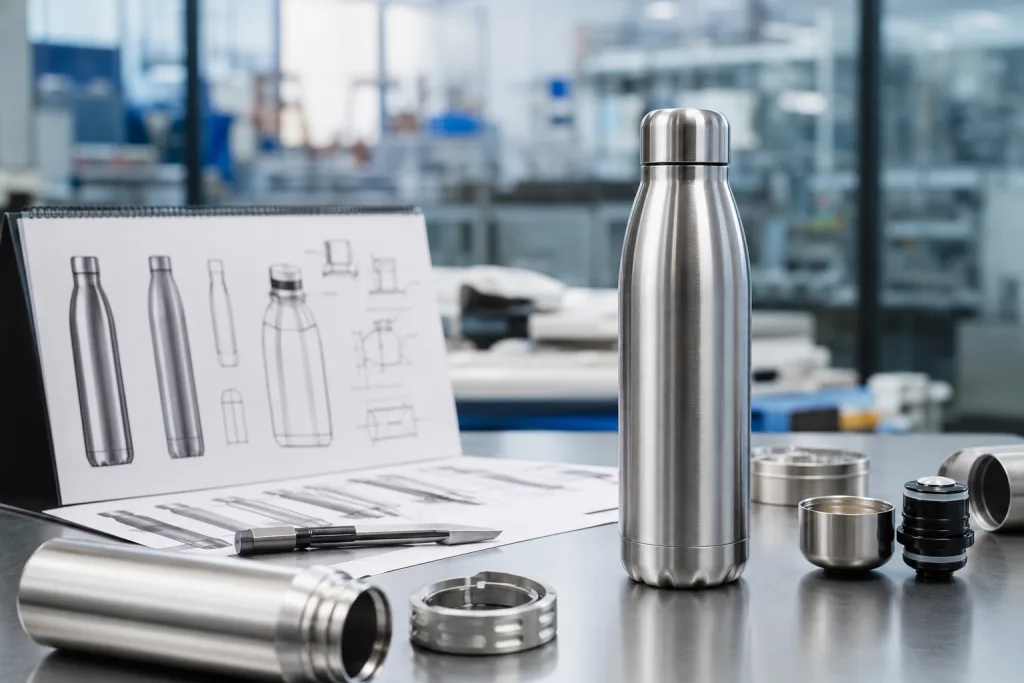
Compliance feels like paperwork until the container sits at Ningbo port and the buyer asks why the file is missing. For Europe, we confirm REACH scope, LFGB food-contact expectations, plus packaging waste labeling if the selling country asks for it. For the United States, our buyers usually request an FDA food-contact material statement, a California Proposition 65 review, and CPSIA coverage when the flask is sold as a children’s item. Paint, silicone, plastic parts, and printing ink all need their own check. QC pulled one lid sample last year where the silicone ring passed fit testing but failed the smell check after 24 hours in a sealed PE bag.
An adult stainless thermos is easier than a kids bottle. Still, “stainless steel” is the wrong shortcut. The body might be 304 stainless, but the lid may use PP, Tritan, silicone, or a mixed plastic part from a second supplier. Gaskets can fail odor tests. Coatings may need heavy metal screening, especially bright red, yellow, and metallic finishes. If you sell through outdoor retailers, ask before production starts for the material declaration, test reports from similar models, BSCI or Sedex audit status if required, plus the inspection checklist. We run this file review before the 30% deposit whenever possible because fixing a missing test after logo printing costs 7 days, sometimes 12.
A proper pre-shipment inspection should cover appearance, logo position, barcode scanning, carton marks, leak testing, capacity check, coating adhesion, lid fit, smell check, and insulation sampling. For a 5,000 pc order, an inspector may pull samples under ANSI/ASQ Z1.4 using general inspection level II. You can specify AQL 2.5 major and 4.0 minor, but leakage and sharp edges belong in critical defects. No debate there. On the line, we use a 3M tape cross-hatch test for coating adhesion and a digital scale to catch short capacity claims, like a “500 ml” cup that only fills to 465 ml under the rim.
Packaging controls damage, not just shelf appearance. A powder-coated vacuum flask can rub inside a loose color box during ocean freight, especially when the carton spends 28 days moving from Hangzhou to Rotterdam. For retail, we prefer an individual polybag or tissue wrap, a snug paper insert, 5-ply export master carton, plus carton marks the warehouse can read from 2 meters away. For thermos bulk shipments to a promotional agency, a white box may be enough, but the carton still needs to survive stacking. A basic drop test from 76 cm is a reasonable requirement for finished cartons. We have seen this go sideways when a buyer approved a thin B-flute box to save USD 0.06 per set.
If your brand requires recycled packaging, say it at quotation stage. Kraft boxes, FSC paper, molded pulp inserts, and plastic-free packing all work, but they need the right insert drawing and MOQ check. The math is fine when planned early. Changing from EVA foam to molded pulp after mass production starts means new tooling, another packing trial, and usually 10 to 15 days lost. The buyer flagged this once after the PO had “EAV foam” typed in the packing line, and yes, that typo still became a production argument.
Build a repeatable ordering file
The strongest private label buyers treat the first order as the start of a product file, not a one-off PO. We build one folder for approved sample photos, Pantone chips, coating finish, logo artwork, barcode list, packaging dielines, test requirements, carton dimensions, gross weight, spare parts list, and inspection standards. Put dates on approvals. Last month QC pulled a 500 ml sample with the right logo but the old matte coating because the buyer’s reorder email had “same as before” and no finish code. This file saves you when your merchandiser leaves or when you reorder six months later.
For a customized thermos range, use a SKU matrix. List capacity, color, lid type, logo method, packaging, MOQ, FOB price, and target retail price, then add one column for actual sell-through if you have it. The math gets clearer. In 2024, 6 of our outdoor retail buyers asked for seasonal colors, but every extra color adds MOQ exposure and warehouse risk. If your data is thin, we’d run black, white, navy, and one seasonal color first. Do not launch eight colors because a catalog page looks empty; we’ve seen that go sideways when the line has 3,000 pcs of slow-moving mint green left after summer.
For promotional buyers, keep artwork rules tight. Define minimum logo line width in mm, print area, color tolerance, and whether our thermos team is allowed to adjust files before proofing. A rushed logo file causes more trouble than buyers expect. Curved bottle surfaces punish small text; on a 70 mm diameter body, 4 pt legal copy often fills in during pad printing. Laser handles fine detail better, but thin lines can disappear on powder coating after the line runs through the curing oven.
When comparing thermos manufacturers, ask the same questions in the same format. What is the MOQ per color? What is the sample lead time? What is the production lead time after approval? What inspection standard is included? What tests are already available? What is the carton size and CBM per 1,000 pcs? What is the warranty policy for leakage? We usually spot the difference in 2 email rounds: a real thermos factory answers with carton mm, AQL level, and test names; a catalog forwarder sends 12 glossy photos and avoids the leakage question.
A good supplier relationship is practical, not romantic. You need clear drawings, realistic timelines, honest defect handling, and stable reorders, with each approval tied to a file name and revision date. If a thermos suppliers quote is vague on steel grade, coating test, or AQL, push back before paying the deposit. QC once flagged a PO typo where “304 stainless” became “201 stainless” in the attachment, and that is exactly the kind of mistake boring documents catch. A reliable customizable thermos program is built with disciplined approvals, not attractive renderings alone.
Build your private label flask specification with us
Send capacity, target FOB price, logo method, and sales channel. We will return a practical thermos quote and sample plan.
Frequently asked questions
What MOQ should I expect for vacuum flask private labeling?
For standard stainless thermos molds, 1,000 pcs per color is the practical MOQ for private labeling. Some China factories can accept 500 pcs if the bottle color is in stock and the logo is simple, but custom Pantone powder coating normally starts at 1,000-3,000 pcs per color. Custom retail boxes may also have a 1,000 pc print MOQ. If you need four colors, ask whether the thermos manufacturer can combine the total quantity for better pricing or whether each color is treated separately.
How long does a custom thermos order take from sample to shipment?
For a standard mold custom thermos, plan 7-12 days for logo sample production, 2-4 days for your approval, and 35-45 days for mass production after deposit and final artwork. Custom color coating and retail packaging can add 7-10 days. Third-party testing for REACH, LFGB, or Prop 65 screening may add another 5-12 working days depending on the lab. Before Q4, book earlier because coating, carton, and inspection capacity in Zhejiang and other China manufacturing areas gets tight.
Is laser engraving better than printing for outdoor retail thermos products?
Laser engraving is usually better for outdoor retail because it does not peel, and it handles abrasion better than most printed logos. It adds roughly USD 0.18-0.45 per pc depending on logo size and production speed. Silkscreen printing is cheaper, often USD 0.08-0.18 per pc for one color, and it works well for promotional thermos orders with simple artwork. If your flask will be clipped to backpacks, used around campsites, or sold at USD 25-40 retail, laser is the safer private label choice.
What tests should I require before accepting a bulk thermos shipment?
At minimum, require leak testing, capacity check, visual inspection, logo adhesion test, odor check, barcode scan, carton marking review, and insulation sampling. For AQL, many buyers use 2.5 for major defects and 4.0 for minor defects under ANSI/ASQ Z1.4 general inspection level II. Treat leakage, sharp edges, wrong material, and contamination as critical defects with zero tolerance. For Europe or North America retail, request food-contact material documents and coating test history before production, not after the goods are packed.
Can one thermos supplier handle both promotional and retail packaging?
Yes, but confirm the details. Promotional packaging may be a white box, bulk carton, or simple kraft box with logo label. Retail packaging needs stronger design control: printed dieline, barcode, country of origin, warning text if needed, insert fit, carton drop resistance, and sometimes FSC paper. A capable thermos supplier should quote both options separately. For 1,000 pcs, retail packaging can add USD 0.35-1.20 per pc, so do not compare it against a bulk thermos quote packed in plain white boxes.