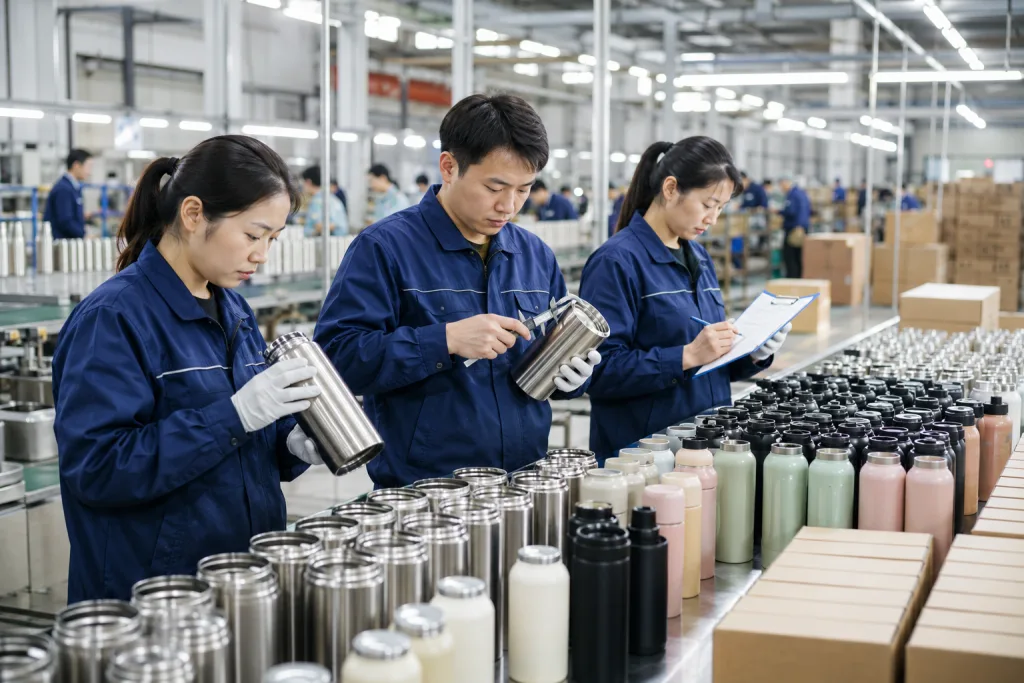
Key Takeaways
- MOQ is usually 1,000 units per color for powder coated custom stainless thermos orders
- 18/8 stainless steel should be confirmed for inner wall, outer wall, and food-contact lid parts
- A practical insulation target is 60°C or higher after 6 hours for a 500 ml flask filled at 95°C
- AQL inspection should separate critical, major, and minor defects before shipment
A stainless thermos looks simple on a retail shelf. Six months later, the spec sheet is what decides whether an outdoor buyer sends a reorder or a complaint spreadsheet. Capacity, 304 stainless thickness, vacuum loss rate, powder coating, lid torque, carton burst strength, and the test method all hit margin. QC pulled one 500 ml sample last week with a 0.35 mm mouth-roundness drift; that small gap was enough to make the flip lid feel loose.
If you are comparing a vacuum flask oem manufacturer in China, the lowest FOB quote is the wrong place to start. Start line by line. At BottleForge Industrial in Hangzhou, Zhejiang, we treat a custom thermos as an engineered product, not a logo job. We run stainless thermos capacity up to 450,000 units/month, with typical MOQ from 1,000 units per color and 35-45 days production after approved samples; one buyer flagged a PO typo on “matte sand beige” versus “matte sandy beige,” and catching that before the coating line saved 3,200 wrong-color bottles.
Capacity, shape, and real use
The first spec line is usually capacity: 350 ml, 500 ml, 750 ml, 1,000 ml, or 1,200 ml. Outdoor retailers often push for a 750 ml or 1,000 ml bulk thermos because it looks strong on the shelf; one German buyer told us the 500 ml sample “felt too small for camping.” Promotional brands usually settle on 500 ml because freight, unit price, and gift-box size stay under control. Fair enough. Match the capacity to the real drinking scene, not the nicest catalog photo.
A 500 ml customized thermos fits most car cup holders and office bags. A 1,000 ml factory thermos is a different build: larger diameter, stronger handle, thicker carton, and higher drop energy when it is filled with hot water. We run the filled-weight check on a digital scale before quoting cartons, because the math changes fast. If your channel is hiking, camping, fishing, or workwear retail, ask for actual filled weight, body diameter, mouth diameter, and total height. A product that is 83 mm wide can miss cup holders; a product above 300 mm tall can cause shelf height and master carton trouble.
Shape affects manufacturing cost more than new buyers expect. A straight-wall cylinder is easier to form, polish, and coat on the line. A tapered body or shoulder detail needs tighter tooling control and can increase scrap by 2-4% during forming; QC pulled 37 dented shoulder samples from one trial run last year. If you need a thermos custom shape for a private label line, ask the thermos manufacturer for tool cost, tool life, and whether the mold is exclusive. In Zhejiang, tooling for a stainless vacuum flask body commonly takes 20-30 days before pre-production samples.
One practical rule: if you are building a distributor thermos range, keep two body platforms and change lids, colors, and decoration. This is where we push back a little. Six body molds sound good in a range plan, but they mean six vacuum validation cycles, six packaging fit tests, and six chances for a PO typo on lid code or carton size. Two platforms keep the range clean, and we ship fewer surprises.
Steel grade and wall thickness
Buyer disputes usually start with lazy material wording on the PO. “Stainless steel” is not a spec. We write the grade line by line: inner wall 304 stainless, outer wall 304 or 201 stainless, lid insert food-contact 304 if it touches water, tea strainer 304 if included, and screw-contact parts marked separately on the BOM. For North America and Europe, 304 stainless steel, often called 18/8, is the safe default for the inner wall. Some price-driven thermos suppliers quote 201 stainless steel for the outer shell. It saves money, but the math gets ugly after coating damage. Last May, QC pulled 80 powder-coated samples from a 3,000 pcs trial lot, and the scratched 201 shells showed rust dots after 24 hours in our salt-spray cabinet. Coastal buyers flag that fast.
Wall thickness deserves its own quotation line. Not a catalog footnote. For 500-750 ml bottles, we run roughly 0.4 mm inner wall and 0.5 mm outer wall before forming, then check the stretched body with a Mitutoyo thickness gauge at the shoulder, waist, and base. Final thickness changes after drawing. Thinner steel can cut cost by USD 0.08-0.18 per unit, but dent complaints rise fast in outdoor retail. If your customers clip bottles to packs or throw them into pickup trucks, saving 9 cents on gauge is the wrong question to ask. We have seen a buyer reject 312 pcs at AQL 2.5 because the sidewall dents showed under matte black coating.
Ask your vacuum flask oem manufacturer for material certificates by batch and confirm whether the stainless steel is tested against LFGB, FDA food-contact expectations, or REACH-related restricted substances for coatings and plastics. China factories can provide these documents, but request them before quotation, not after mass production. Our sales team has had POs arrive with “SS bottle” typed in the material field, then the buyer asked for LFGB reports after the goods were packed. That goes sideways. For a manufacturer thermos quote, steel grade and thickness belong directly in the quotation sheet, beside MOQ, logo method, and carton packing.
For premium promotional thermos programs, we recommend 304 inner and outer walls, 0.4/0.5 mm starting gauge, BPA-free PP or Tritan contact parts, and silicone seals checked after a 95°C hot-water soak for 2 hours. Small upgrade. Fewer headaches. On the line, QC opens the sample, smells the lid area, and checks the silicone ring for whitening or oil marks before we sign the pre-production sample. This prevents the common “metal smell” and “cheap feel” complaints buyers send after the first 500 pcs reach their warehouse.
Vacuum performance, not marketing claims
Insulation claims are cheap ink. “Keeps hot 12 hours” means almost nothing unless the PO spells out the test method; we had one buyer flag this after their carton artwork promised 12 hours but the spec sheet showed only a 6-hour reading. A workable spec states water fill temperature, room temperature, fill volume, cap closing time, and measurement points. Example: fill a 500 ml flask with water at 95°C, close within 60 seconds, hold it at 20°C ambient, then record temperature after 6 hours and 12 hours with a calibrated probe inserted 30 mm below the water surface.
For a solid stainless thermos manufacturer target, 60°C or higher after 6 hours is reasonable for 7 out of 10 500 ml models we run on the standard line. Larger 1,000 ml flasks often hold heat better because the surface-area-to-volume ratio is lower. The lid can ruin the body’s good work. A wide-mouth soup flask loses heat faster than a narrow-mouth beverage flask, and a push-button lid adds seals, plastic parts, and heat bridges; if the buyer asks for “best insulation plus one-touch lid,” this is the wrong question to ask unless they accept the trade-off.
Vacuum quality comes from welding, cleaning, evacuation, copper plating or reflective layer choices, and leak detection. In our Zhejiang production workflow, every vacuum body goes through thermal screening before final assembly; QC pulled one 500 ml sample last month after the bottom weld showed a 0.4 mm discoloration ring and the heat-loss curve went off by 8°C at 6 hours. The job is not to build a pretty lab report around one golden sample. We catch weak vacuum bodies before your thermos bulk order lands in a warehouse in Canada, Germany, or the UK.
If you are a thermos distributor, request the production test standard and sample retention rule. Keep at least 2 approved golden samples and 3 mass-production samples per SKU, with the SKU code and PO number written on the sample bag; we once saw a “matte blcak” typo on a PO turn into two different retained color samples. For retailers, test after dishwasher exposure only if the product is sold as dishwasher safe. Plenty of powder coated vacuum flasks are not. If your label says dishwasher safe without validation, the math does not work when claims start coming back.
Good insulation specs are measurable. Bad insulation specs sound impressive, then fail when a customer posts a thermometer photo online.
Lids, seals, and drinking parts
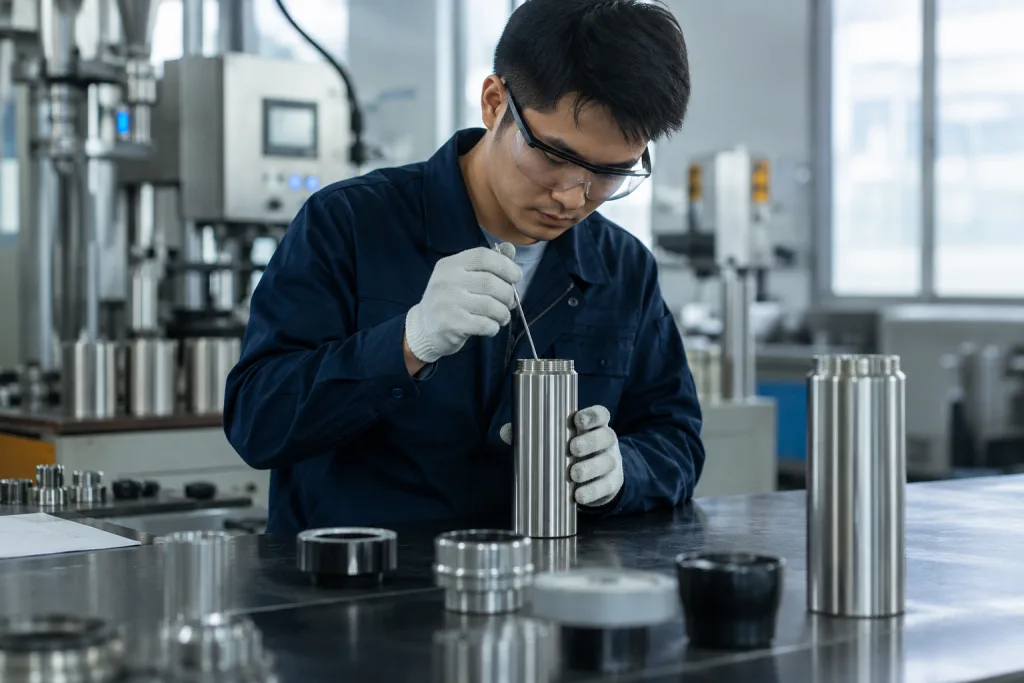
The lid is where 7 out of 10 customized thermos complaints start, at least in the projects we run. Buyers spend two calls on Pantone body color and logo size, then the buyer flagged leaks, cross-threading, loose handles, plastic odor, or no spare caps after retail launch. Wrong focus. Treat the lid as a separate assembly, with its own PP or Tritan grade, closing torque, leak pressure, drop result, and cycle test record from the line.
For a screw lid, ask for thread engagement length in mm and the leak test pressure. Our QC usually checks cap torque with a digital torque meter before the carton is sealed. For a push-button lid, ask how many open-close cycles are tested; 3,000-5,000 cycles is a practical range for promotional and outdoor use. Silicone gasket hardness is usually around 50-60 Shore A, but the groove design matters more than the number. Too soft and the gasket rolls. Too hard and it stops sealing after 20 dishwasher-style wash checks.
A thermos customizable program often uses one body with several lid options: cup lid, carry handle lid, straw lid, or direct-drink lid. Good for shelf planning, risky for production control. We once had a 0.25 mm thread tolerance difference hold 4,800 lids at incoming inspection. If you source from multiple thermos manufacturers, do not assume lids are interchangeable even when the drawings look close. Chinese factories may run different thread pitch, gasket groove depth, or plastic shrinkage allowance after mold trial T1.
For kids, sports, and outdoor retail, ask about ASTM-related drop expectations where relevant, small parts risk, and spare gasket supply. QC pulled the sample after a 1.2 m drop test more than once because the flip button cracked, not the bottle body. A serious thermos vendor should quote spare seals with the finished goods, not after the first complaint email. For distributor thermos programs, we recommend ordering spare lids or seals equal to 1-2% of the PO quantity. The math works. Replacing a 3 g silicone ring is cheaper than shipping a full bottle across the country.
Coating, logo, and color control
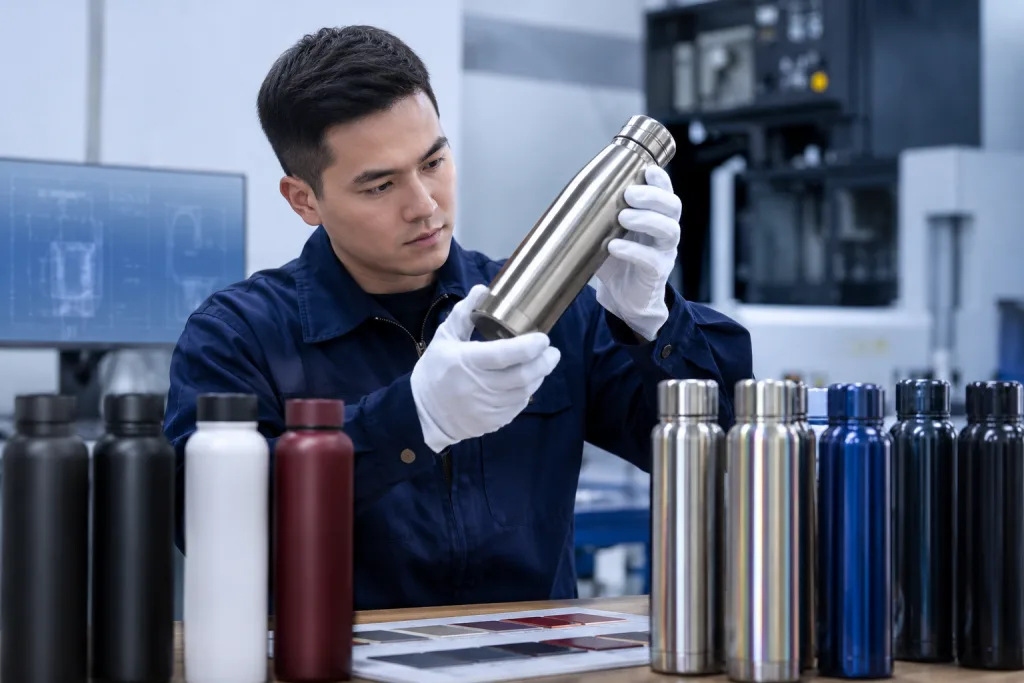
Decoration is not just branding; it changes process risk on the line. A stainless body can be mirror polished, spray painted, powder coated, rubber coated, water-transfer printed, or laser engraved. Powder coating is the safer pick for outdoor retail because the grip passes a wet-hand check better, and small scratches do not shout like they do on glossy paint. For 10,000-unit promotional thermos runs, silkscreen printing keeps the math clean; laser engraving gives a permanent mark with almost no color dispute, but it looks more subdued. QC pulled one black powder sample last month with orange peel at the shoulder radius, about 18 mm below the neck. That is where coating problems usually show first.
Specify Pantone target, finish type, logo size, logo position tolerance, and abrasion expectations in the PO, not only in the artwork file. A normal logo position tolerance might be ±1.5 mm on a cylindrical body, and we run a simple height gauge check before packing. For wraparound artwork, seam alignment must be agreed before sampling because bottles rotate during printing and heat curing. If the artwork includes fine text below 5 pt, expect trouble on textured powder coating. Small letters fill in. We have seen a buyer flag a 3.2 mm warning line because the designer approved it on a screen, not on a coated cup body.
Color matching should be approved on metal, not paper. The same Pantone code looks different on powder-coated stainless steel than on a PDF proof, especially under D65 light versus a warehouse LED lamp. For a thermos promotional campaign, ask for pre-production samples in the exact coating and logo method, then sign one sealed sample for the line. A digital mockup is fine for layout, but it is the wrong approval tool for mass production. We once had a PO typo, “Pantone 186C” typed as “168C,” and the sample rack caught it before 5,000 lids were matched to the wrong red.
Durability testing can include cross-hatch adhesion, 3M tape pull, 300-cycle rub test, and basic drop checks. If your customized thermos will sell through outdoor retailers, push the test harder: 1 m drop onto plywood or concrete edge simulation, then inspect coating chips and lid function. The math does not work if the first real drop happens in a store aisle. On our bench, the inspector uses a 1 kg drop fixture and checks the lid thread with a go/no-go gauge after impact. Better to find brittle coating during sampling than after a 20,000-unit shipment.
At BottleForge Industrial in Hangzhou, Zhejiang, common logo MOQ starts at 1,000 units per design. Laser engraving setup is usually lower than multi-color printing, but the per-unit visual result is different. Choose the method based on channel expectations, not only price. For retail gift sets, we ship more powder coat plus laser because returns are lower; for event giveaways, 1-color silkscreen often wins. The buyer may ask, “Can you make it cheaper?” Sometimes yes. Sometimes the coating change saves USD 0.06 and creates a complaint file 12 days later.
Packaging, cartons, and logistics specs
Packaging should not sit as the last line on the quote. That is the wrong question to ask. We usually ask the buyer first where the flask will land: a Costco-style pallet display, Shopify warehouse, Amazon FBA, distributor shelf, or a corporate gift kit. Last month QC pulled a 500 ml sample where the color box looked fine, but the 128 barcode was 6 mm too close to the fold line and the scanner missed it.
For outdoor retail, a color box with a hangtag or shelf-ready carton often beats a fancy gift box. For promotional jobs, a white box or kraft box works if the bottle goes inside a larger campaign kit with notebook, pen, and insert card. For ecommerce, the inner box needs real drop protection; we run 80 cm corner-drop checks before carton approval when the buyer asks for parcel-ready packing. A standard export carton may use 5-ply corrugated board, but flute grade and edge crush test matter when 42 cartons are stacked in a container for 28 days at sea.
Ask for master carton size, gross weight, units per carton, pallet loading estimate, and barcode position before artwork sign-off. Do it early. A 1,000 ml thermos bulk order can push carton weight above 15 kg after you add the color box, polybag, divider, and silica gel. If the carton is too heavy, warehouse teams complain and the tape seam opens on the line. If it is too light but oversized, the math doesn't work because you pay for air in the container.
For North American ecommerce programs, lock FNSKU labels, suffocation warnings for polybags, carton labels, and drop-test rules before production. We have seen this go sideways when a PO said “single FNSKU sticker,” but the buyer later flagged outer-carton FBA labels after 2,400 pcs were packed. For Europe, check packaging waste markings, language requirements, and REACH-related declarations. FOB Ningbo or FOB Shanghai are common shipping terms for Zhejiang and broader China drinkware exports. If you compare supplier thermos prices, make sure the quote uses the same incoterm, carton spec, and inner packing method. A USD 0.12 cheaper bottle can cost more once freight cube and repacking are counted.
Inspection, compliance, and order control
A professional vacuum flask oem manufacturer should be comfortable with inspection. If a factory pushes back on AQL, carton drop checks, or material documents, slow the order down. We run defect sorting in 3 buckets: critical defects that can hurt the user, major defects that hurt function or shelf sale, and minor defects that stay inside the signed cosmetic limit. Critical means sharp rim burrs found by the cotton glove test, oil contamination inside the cup, unsafe material, or a leak after the cup is inverted for 30 minutes. Major means weak vacuum performance, dents over 3 mm, wrong logo, wrong Pantone color, or a lid button that sticks after 50 presses. Minor means small coating dots or hairline marks that QC already approved on the golden sample board.
A common inspection setup is AQL 0 for critical, 2.5 for major, and 4.0 for minor, but the buyer’s channel decides how tight we set it. For a 10,000-unit thermos manufacturer order, pre-shipment inspection should cover random carton selection from at least 8 pallet positions, appearance check under a 600 lux lamp, capacity check with a measuring cylinder, leak test, lid torque/function, logo position, barcode scan, carton drop, and a small insulation verification. Full 6-hour thermal testing on every inspection sample will block the line; agree the sample count before mass production. We have seen this go sideways when a buyer asks for 32 thermal samples at PSI, then complains that shipment moves 1 day later.
Compliance depends on market. For the US, buyers often request FDA food-contact documentation and sometimes CA Prop 65 review. For the EU and UK, LFGB, REACH, and food-contact migration testing are common. If your retail account asks for BSCI, ISO 9001, or factory social audit documents, confirm the valid report date before placing the PO; one expired audit can hold a container for 7 to 14 days. Not every thermos suppliers China factory has current audit coverage. QC pulled a sample last month where the inner liner was marked 304 stainless, but the supplier’s file only showed an old 201 stainless test report, and the math does not work for a chain-store buyer.
Order control starts before deposit. Freeze the spec sheet: item number, capacity, material, wall gauge, lid material, coating, logo method, packaging, carton, inspection standard, spare parts, incoterm, sample approval date, and delivery date. Also lock the artwork file name and PO wording; we once caught a 500 ml order typed as 550 ml on line 6 of the PO, and the buyer flagged it after the color sample was already sprayed. When those lines are clear, a manufacturers thermos project is manageable. When they are vague, you are not sourcing; you are gambling.
Send your stainless thermos spec sheet for review
We will check material, lid, coating, packaging, MOQ, and lead time before you commit to a custom vacuum flask order.
Frequently asked questions
What MOQ should I expect from a vacuum flask OEM manufacturer?
For stainless thermos projects, a realistic MOQ is 1,000 units per color for existing molds and standard coatings. Custom colors, new lids, or exclusive body tooling may push the MOQ to 3,000-5,000 units because coating lines, material purchasing, and QC setup need stable volume. At BottleForge Industrial in Zhejiang, sample lead time is usually 7-12 days for existing molds and 20-30 days if new tooling is involved. Mass production normally takes 35-45 days after sample approval and deposit. If a thermos vendor offers 100 units with full custom color, custom logo, and retail packaging at factory pricing, check whether it is trading-stock decoration rather than true OEM production.
How much does a custom stainless thermos cost in bulk?
For a 500 ml custom thermos using 304 stainless steel, powder coating, one-color logo, and individual box, many China FOB quotes fall around USD 3.20-5.80 depending on lid type, gauge, finish, packaging, and inspection requirements. A 1,000 ml outdoor flask may run roughly USD 5.50-9.50 FOB. These are working ranges, not promises, because steel price, exchange rate, order quantity, and logo method move the number. Laser engraving may add USD 0.10-0.35 per unit. Multi-color printing, retail gift boxes, and spare lids add more. Always compare supplier thermos quotes using the same material grade, carton spec, incoterm, and AQL requirement.
Can you make a thermos customized for outdoor retail, not just promotion?
Yes, but the spec should be tougher than a basic promotional thermos. For outdoor retail, we would look at 304 inner and outer walls, stronger powder coating, practical lid grip, spare gasket availability, carton drop resistance, and insulation testing at 6 and 12 hours. A 750 ml or 1,000 ml body usually fits hiking, camping, fishing, and workwear channels better than a small desk bottle. We also recommend real-use checks: gloved-hand opening, backpack side-pocket fit, 1 m drop evaluation, leak testing after impact, and label durability. Retail customers punish weak lids and dent-prone bodies quickly, so do not build the product only around logo area and FOB price.
What documents should a thermos supplier provide before shipment?
Before shipment, request the final invoice, packing list, approved sample reference, material declaration, food-contact test reports where required, coating or plastic compliance documents, and pre-shipment inspection report. For EU programs, buyers often ask for LFGB, REACH-related declarations, and packaging compliance information. For US programs, FDA food-contact documentation and sometimes CA Prop 65 review may be needed. If your customer requires BSCI, ISO 9001, or social audit documents, confirm them during supplier selection, not during loading week. A serious thermos factory should also provide carton measurements, gross weight, HS code guidance, and product photos from mass production for your logistics and listing teams.
Should I choose laser engraving or silkscreen printing for my logo?
Laser engraving is durable, clean, and good for outdoor or premium distributor thermos programs. It removes or marks the coating and will not peel like ink, but color options are limited. Silkscreen printing is better for large promotional thermos orders where brand colors must match closely and the logo is simple. For textured powder coating, very fine text and thin lines can lose sharpness, so keep small letters above 5 pt when possible. Heat-transfer or water-transfer printing works for full-wrap designs but needs stricter adhesion and abrasion testing. For 1,000-5,000 units, ask for physical samples using the exact coating and logo method before approving mass production.