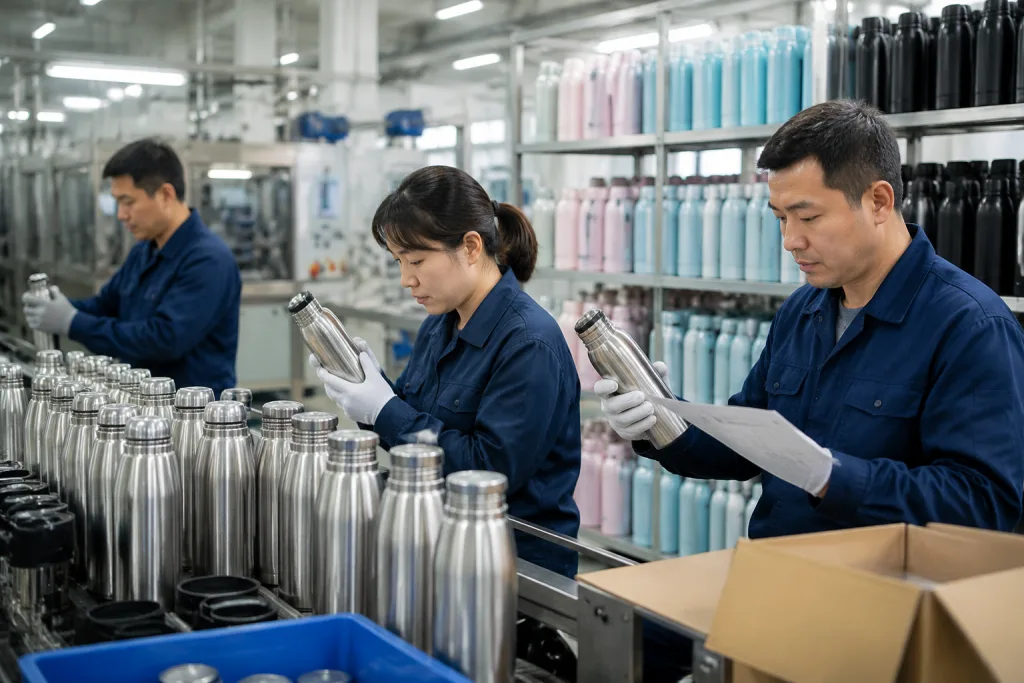
Key Takeaways
- A practical custom stainless thermos MOQ starts at 1,000 units, with better pricing above 3,000 units
- Logo decoration typically adds USD 0.08-0.65 per unit depending on method and position count
- Standard production is usually 30-45 days after deposit and approved pre-production sample
- For EU and North America, plan REACH, LFGB, FDA, or CPSIA review before mass production
Outdoor retailers and promotional brands usually do not lose margin over a USD 0.20 bottle gap. They lose it when the custom thermos sample sits 9 days in artwork approval, the carton mark says “THERMO CUP” instead of the PO item name, or the supplier quotes a thin FOB price and adds logo, insert card, and testing charges after the buyer has shown the line sheet to sales.
If you are comparing vacuum flask manufacturers in China, ask for cost and lead-time on the same call. A 500 ml stainless flask can be USD 3.20 FOB Ningbo or USD 6.80 depending on steel grade, lid tooling, coating, decoration, and inspection level. We have seen the same shape run 25 days with stock lids and 70 days when a new PP lid mold needed T1 correction by 0.3 mm. That gap is not luck; it is specification control, and asking “who is cheapest?” is the wrong question to ask.
Start With The Real Unit Cost
A factory thermos quote only means something after the spec is locked. For a 500 ml double-wall vacuum flask, BottleForge Industrial in Hangzhou, Zhejiang usually sees base FOB ranges like this: USD 3.10-4.20 for 201 outer and 304 inner stainless steel, USD 3.80-5.40 for full 304, and USD 5.20-7.80 when the buyer adds a complex lid, powder coating, gift box, and retail-ready inserts with barcode stickers. These are working ranges before freight and duty, not a promise. Last month QC pulled the sample on a 500 ml job because the PO said “matte black” but the approved swatch was Pantone 426C with 18-22 gloss units.
The main cost drivers are stainless grade, wall thickness, vacuum performance target, cap construction, surface finish, and packaging. On the line, a common wall thickness is 0.40-0.50 mm for the inner tank and 0.45-0.60 mm for the outer shell; our tech checks it with a Mitutoyo digital caliper before necking. Thicker steel feels stronger in hand, but the math does not always work. It raises material cost, wears the forming dies faster, and can slow output from 2,800 pcs/day to about 2,300 pcs/day on some shapes. For a rugged outdoor line, pay for it. For a promotional thermos tied to a two-week campaign, do not overbuild it.
Buyers use different words on RFQs: bulk thermos, thermos bulk, manufacturer thermos, thermos manufacturer, supplier thermos, thermos supplier, or thermos vendor. We still need the same buying data before we quote: capacity and lid type, steel grade and wall thickness, color and logo method, packaging style and destination port, test standard and order quantity. Without that, any low price from vacuum flask manufacturers is a placeholder. We have seen this go sideways when a buyer asked for 10,000 pcs “with logo,” then flagged the first pre-production sample because the logo was laser-etched instead of 1-color silk screen.
MOQ Tiers Change The Math
MOQ is where about 7 in 10 outdoor retailers and promo buyers start pushing back. For a standard stainless model already in our tooling library, a realistic MOQ is 1,000 units per color. For a customized thermos with a new silicone grip, special lid color, or non-standard coating, expect 3,000 units because the line has to book separate spraying, pad-printing, and packing slots. For a fully new mold, 5,000-10,000 units is more sensible because tooling and setup costs need somewhere to go. We had one PO last month that said “matte sand” in the artwork file and “matte stone” on the order sheet; QC pulled the pre-production sample before spraying, or that typo would have cost 1,200 pcs of rework.
At 1,000 units, the unit price carries more labor setup, coating loss, carton setup, and inspection overhead. The math doesn't work if the buyer expects mass-production pricing on a trial run. At 3,000 units, you may see a 5-9% reduction. At 10,000 units, another 3-6% is possible if the SKU is stable and packaging is not split into too many versions. Our Zhejiang line capacity for stainless vacuum items is about 450,000 units per month across standard shapes, but capacity does not remove MOQ logic. A color change still means cleaning the spray gun, checking the wet film gauge, and losing 30-50 pcs during line adjustment.
A distributor thermos program is often split across 4-6 logos or territories. Be careful. Five logos at 600 units each is not the same as one logo at 3,000 units. We’ve seen this go sideways when each sales region asks for its own lid insert and gift box barcode. Thermos distributors and distributor brands can control cost by using one bottle body, one lid, two stock colors, and variable belly-band artwork. That gives the market some customization without forcing the thermos factory to restart the coating line and carton packing station for every small batch.
Decoration Costs Are Often Underquoted
Logo pricing looks harmless until we multiply it by print positions, ink colors, and the pieces QC rejects at the packing table. For a custom thermos, single-color silk screen printing usually lands at USD 0.08-0.18 per unit; we run a 120-mesh screen and still see scratches if the bottle hits the conveyor rail before curing. Laser engraving is usually USD 0.18-0.35, depending on logo size and whether the surface is powder coated. Heat transfer can run USD 0.35-0.65 for full-color graphics. 3D embossed stainless badges or custom metal plates need tooling and can add USD 300-800 before unit cost. The math gets ugly fast.
For outdoor retail, powder coating is usually the right call because it gives better grip and looks more expensive than basic spray paint. Ask for coating thickness, adhesion testing, and a cross-hatch result, not just a clean studio photo. A common target is 60-80 microns for powder coating; our QC team checks it with a film thickness gauge before the line releases the batch. For promotional thermos orders, silk screen on powder coating is fine, but PMS color matching can shift after curing. If your brand color is strict, approve a sprayed color chip before the pre-production sample. We have seen a buyer flag a navy logo that turned almost black after 180°C curing.
Terms like thermos custom, thermos customized, thermos customizable, customizable thermos, and thermos promotional all point to the same issue: how much change are you asking the factory to make? A logo on a stock bottle is fast. A new coating, custom lid, molded logo, and retail box is a product development job with separate sampling, mold review, and carton drop testing. Good vacuum flask manufacturers price those items one by one instead of hiding them inside a neat unit quote. If a quote shows one flat price for all of it, this is the wrong question to ask; ask where the tooling, failed samples, and 2 extra QC checks went.
Lead Time Starts Before Production
The production clock does not start when the RFQ lands in our inbox. It starts after deposit, artwork confirmation, packaging dielines, and the signed pre-production sample. For a standard manufacturer thermos using an existing mold and one-color logo, we run 7-10 days for sample work and 30-35 days for mass production. If the customized thermos needs a new lid color, new powder coating, and retail packaging, plan 12-18 days for sampling and 40-55 days for production. Small files slow big orders. Last month QC pulled the sample because the PO said Pantone Black 6C, but the AI file showed 7C, and that one typo cost 2 days before the line even started.
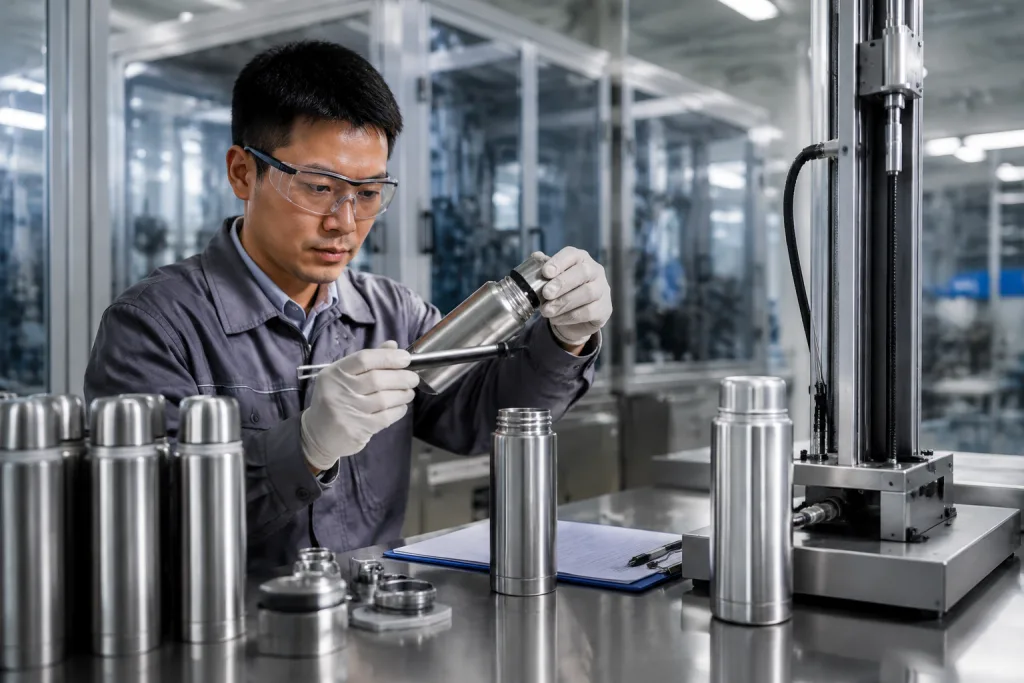
New tooling changes the schedule. A new plastic lid mold can take 25-35 days before first trial. A new stainless body shape can take 35-50 days, and the math does not work if the buyer expects that to move like a logo job. If insulation performance fails the first validation, add a rework loop, not a promise. Vacuum retention is not magic; welding current, vacuum pumping time, copper plating if used, and bottom sealing pressure all need control. On our floor, the operator checks the bottom seam under a 10x magnifier before the leak test tank. A typical heat retention target for a 500 ml flask is 6 hours above 65°C when tested from 95°C water at 20°C ambient, but your exact claim should match your market and test method.
Shipping adds another layer. From Ningbo or Shanghai, sea freight to the US West Coast may be 16-25 days on water, while Europe is often 28-38 days. Add 5-10 days for consolidation, customs, and inland trucking; we see this slip when cartons miss the forwarder’s VGM cutoff by half a day. Air freight can be 5-9 days, but it can add USD 1.20-2.80 per unit on a 500 ml bottle. Use air for samples and launch emergencies. Do not build your normal margin plan around it, because we have seen that go sideways when a buyer suddenly asks for 3,000 pcs by air after labels are already packed.
Testing And Compliance Add Days
For Europe and North America, compliance is not optional paperwork. Stainless food-contact parts usually need FDA or LFGB-style review, and coatings need REACH screening before the line starts spraying. Kids-related SKUs can trigger CPSIA, ASTM, or extra migration and mechanical safety checks; we had one buyer flag a 0.8 mm straw tip radius as too sharp during pre-production review. Larger retailers also ask for BSCI, ISO 9001 factory records, AQL inspection reports, and packaging drop tests, usually before they release the final PO.
Third-party lab testing commonly takes 5-10 working days after samples arrive. Miss the material check and the calendar gets ugly. If the first sample fails because a coating pigment, silicone gasket, or printed ink is not compliant, you can lose another 10-20 days finding an alternative material and re-testing. We run FTIR checks on incoming silicone and keep the gasket supplier’s FDA file with the order folder, because testing after 6,000 pcs are packed is the wrong question to ask.
For inspections, most buyers use AQL Level II, with critical defects at 0, major at 2.5, and minor at 4.0. On stainless thermos products, major defects include leakage, poor vacuum performance, sharp edges, wrong logo position, severe coating scratches, or barcode errors; QC pulled the sample last month for a logo sitting 3 mm off the approved artwork. A supplier thermos order for retail should also check carton compression, master carton labels, FNSKU or EAN placement, and inner box scuffing. China factories can move quickly, but rework on packed goods is slow and expensive. Build inspection time into the calendar.
Packaging Can Break The Budget
Packaging is where we see buyers miss the real cost. A plain white box may be USD 0.12-0.25. A printed retail box can be USD 0.35-0.80 depending on paperboard gauge, lamination, insert, and order quantity. A magnetic gift box can exceed USD 1.20 and usually needs a higher MOQ because the box supplier has its own setup rules. Last month our carton supplier asked for 3,000 pcs MOQ on a 1.5 mm greyboard gift box, and the buyer flagged it after the PI was already signed. Bad timing. If you sell through outdoor retailers, stronger packaging can earn its space on the shelf. For a corporate giveaway, the math usually says plain box, clean print, no fancy insert.
Carton configuration affects freight more than buyers expect. A 500 ml flask may pack 24 units per master carton, around 10-13 kg gross weight. Add a bulky handle lid or a gift box and we may have to run 12 or 16 units per carton, not 24, after QC checks the drop-test corner crush. CBM jumps. We have seen the landed cost increase more from the bigger carton than from a laser logo. Always compare FOB and estimated CBM together, carton size in mm included.
For a distributors thermos program, packaging version control matters. One carton mark for Canada, another for Germany, another for Amazon FBA, and another for a retail chain creates warehouse risk. We ship mixed-channel orders often, and this is where things go sideways: one PO had “DE manual” in the email but “EN manual” on the attachment, so the line stopped for 4 hours while sales confirmed it. Thermos suppliers should provide a packing list template before production. If you need FNSKU labels, suffocation warnings, language-specific manuals, or recycled-content claims, send those files before sample approval. Do not expect the factory to guess your channel requirements from a purchase order.
How To Compare Factory Quotes
Do not compare vacuum flask manufacturers by the first number in the email. This is the wrong question to ask. Put every quote into one sheet with steel grade, capacity tolerance in ml, wall thickness in mm, lid material, gasket material, coating, logo method, packaging, MOQ, sample fee, tooling fee, lead time, payment terms, FOB port, test standard, and inspection allowance. We run this check in Excel before quoting back; last month QC pulled a 500 ml sample marked 304 stainless, but the supplier’s sheet showed a 0.36 mm inner wall instead of the 0.40 mm the buyer approved. If one thermos manufacturer is USD 0.50 cheaper but excludes gift box, REACH testing, and barcode labeling, it is not cheaper.
Ask each thermos factory for three price breaks: 1,000, 3,000, and 10,000 units. Ask what changes at each break. Be blunt. Sometimes the reduction comes from buying 2 tons of coil at a better price. Sometimes it comes from skipping a leak-test station or cutting the carton from 5-ply to 3-ply, and we have seen that go sideways after the buyer flagged crushed master cartons at inspection. A serious manufacturers thermos quote states assumptions clearly, including coating loss rate and spare gasket count. A vague suppliers thermos quote says “best quality, fast delivery” and leaves the missing costs for your PO review.
For BottleForge Industrial in Zhejiang, China, a normal project path is simple: 2-3 days to confirm RFQ details, 7-18 days for samples depending on customization, 30-55 days for mass production, and inspection before shipment. That is the honest planning range for most stainless thermos bulk orders. The line cannot turn a new powder-coated 750 ml bottle with laser logo in 12 days when the lid mold still needs T1 sampling. If your launch date is fixed, tell the factory your retail delivery date, not just your preferred ship date; we once caught a PO typo where “ETD May 18” should have been “ETA May 18,” and the math did not work. The best thermos vendor says no early enough when the calendar does not work.
Send Your Thermos Specification For A Costed Timeline
Share capacity, quantity, logo, packaging, destination, and compliance needs. We will return a practical FOB quote and lead-time range.
Frequently asked questions
What MOQ should I expect from vacuum flask manufacturers?
For existing stainless thermos models, expect 1,000 units per color as a practical MOQ. Some factories may accept 500 units, but the unit price is usually 12-25% higher and color choice may be limited to stock inventory. For a custom thermos with a new lid color, special powder coating, or retail box, 3,000 units is more realistic. For new molds, 5,000-10,000 units is the range where tooling cost starts to make commercial sense. If your order has five logos, ask whether MOQ applies per logo or total quantity.
How long does a custom stainless thermos order take?
A standard logo order usually needs 7-10 days for sampling and 30-35 days for mass production after sample approval and deposit. A customized thermos with new coating, packaging, or lid parts usually needs 12-18 days for samples and 40-55 days for production. Add lab testing time if you need FDA, LFGB, REACH, or CPSIA documents. Sea freight from China adds roughly 16-38 days depending on destination. If you need goods in a warehouse by a fixed date, work backward from that date and include customs clearance.
Is 304 stainless steel necessary for every thermos?
For the inner wall that touches liquid, 304 stainless steel is the safer default for EU and North American drinkware. Some low-cost products use 201 stainless steel for the outer wall and 304 for the inner wall, which can be acceptable if the product is positioned correctly. Full 304 construction costs more, often USD 0.40-1.00 extra per unit depending on size and market steel prices. For outdoor retail, full 304 is easier to explain. For promotional use, 201 outer and 304 inner may be a reasonable cost balance.
Which logo method is best for promotional thermos orders?
For one-color logos, silk screen printing is the lowest-cost option at about USD 0.08-0.18 per unit. Laser engraving costs more, often USD 0.18-0.35, but it looks cleaner on powder-coated bottles and will not peel. Heat transfer is better for full-color artwork, gradients, or large wrap designs, usually USD 0.35-0.65 per unit. For corporate gifting, laser is usually worth the extra cost. For event giveaways where budget matters more than long-term wear, silk screen is fine if the coating and ink are tested.
What should I check before paying the deposit?
Confirm the exact capacity, stainless grade, lid material, gasket material, coating type, logo size, logo position, packaging artwork, carton marks, test requirements, AQL level, payment terms, FOB port, and lead time trigger. The lead time should start after approved sample, not after your first email. Ask for a proforma invoice that lists tooling, sample, testing, and packaging charges separately. If you are buying for Amazon, retail chains, or distributors, also confirm barcode, FNSKU, carton label, and manual requirements before production starts.