Key Takeaways
- A realistic MOQ for a customized thermos is 500-1,000 pcs per color, depending on finish and logo method
- For retail outdoor use, 304 stainless steel with 0.4-0.5 mm inner wall is the normal baseline
- Lead time is usually 25-35 days after sample approval for repeatable thermos bulk production
- Use AQL 2.5/4.0 inspection plus 100% leak testing if the order is promotional or retail boxed
Buying a vacuum flask in bulk looks easy until the first quote sheet hits your inbox. One supplier puts the thermos price at USD 3.20, another at USD 6.80, and both stamp “304 stainless steel, 24 hours hot.” On the line, we have seen the gap come from a 0.2 mm wall difference, a loose lid gasket, or powder coating that scratches after one carton move. For outdoor retailers and promo brands, the real problem is not price alone. It is a leaky cap, a weak finish, a delayed shipment, or a logo that looks off when the buyer opens the box.
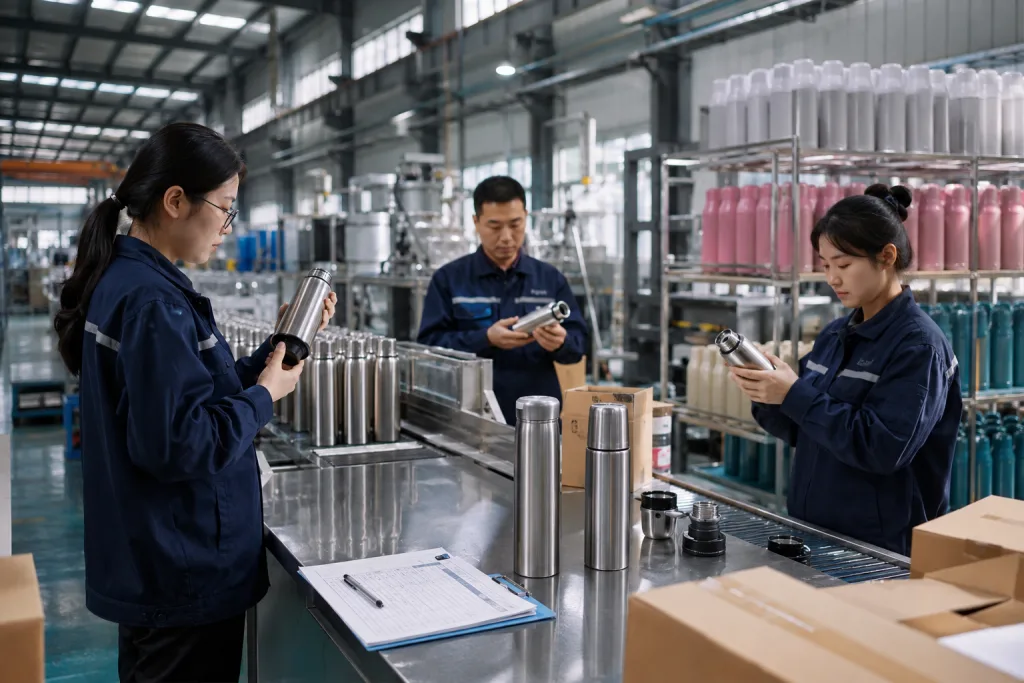
We manufacture stainless drinkware in Hangzhou, Zhejiang, and ship bulk thermos orders from China every month. The buyer usually asks the wrong question first: “What is the lowest price?” The better questions are capacity, MOQ, tooling cost, and inspection before balance payment. QC pulled the sample last week and found a lid thread error on a PO with the wrong neck size, so this part is not theory. Here is the straight version.
Start With The Real Use Case
A vacuum flask in bulk for a mountain shop is not the same item as a promotional thermos for a bank event. A buyer writes “500 ml stainless bottle” on the PO, then the real use case decides the wall thickness, lid build, powder coating, 1.2 m carton drop test, and the warning label. We saw one order nearly go sideways because the PO said “matte black” but the approved sample card was Pantone 426C gloss.
For outdoor retailers, we run 500 ml, 750 ml, and 1,000 ml most often. A 500 ml flask fits day hikes and commuter packs. A 750 ml body gives better shelf value without making the packed carton jump over 15 kg. A 1,000 ml vacuum flask works better for camping, fishing, truck drivers, and winter sports, especially with a wider cup lid. Don’t launch six capacities. That is the wrong question to ask at the start. Pick two bodies and two colors, then reorder after 30 days of sell-through data; QC pulled samples last month where the 1,000 ml body measured 86 mm diameter, too fat for a buyer’s standard bike-bottle shelf.
For promotional brands, the brief changes. You care about printable area, gift box paper thickness, logo position, and the delivery date on the contract. A thermos promotional project usually has a fixed event date, so we avoid special caps or custom molds unless the schedule gives us at least 45-60 days. For a 2,000 pc customized thermos order, a standard body with laser logo and color gift box is safer than a new shape with a three-week promise. We ship this type all the time; the buyer usually flags logo size first, not the steel grade, so we confirm the artwork on a 1:1 AI file before the line starts.
Ask your thermos supplier for product weight, steel grade, lid material, coating type, and the tested heat retention curve. “Keeps hot for 12 hours” is weak copy, not a test report. Use wording like this: water filled at 95°C, ambient 20°C, remaining above 55°C after 12 hours in a 500 ml flask. That gives you a real comparison between thermos manufacturers instead of a slogan. On our side, QC checks it with a calibrated probe thermometer and logs the reading at 2, 6, and 12 hours; if one sample drops to 51°C, the math doesn’t work for a premium listing.
What Specifications Actually Matter?
Most price gaps in a factory thermos quote come from steel grade, coating, lid parts, and packing. No mystery. A proper manufacturer thermos spec sheet should name the steel, wall thickness, vacuum process, lid material, gasket material, coating, logo method, and carton packing. We still see POs that say “silver bottle, 500 ml, logo black” with no Pantone code or inner steel grade; that is where claims start later. If a thermos vendor cannot send those details, you are buying blind.
For stainless vacuum flasks, the common build is 304 stainless steel inside and 201 or 304 stainless outside. Full 304 inside and outside costs more and fits premium retail shelves better. For most outdoor orders and corporate gift programs, 304 inner with 201 outer works if the coating passes the cross-cut tape test and the weld line is clean under a 10x loupe. The inner wall is often around 0.4 mm; thinner walls cut cost but dent faster when cartons take a corner hit. Outer wall thickness around 0.5 mm gives better hand feel and strength on larger models.
The vacuum layer is the part buyers cannot see, so QC has to catch it before loading. We run vacuum performance tests, not just visual checks; QC pulled one 750 ml sample last October that looked fine but lost 18°C after 6 hours, so the line stopped before packing. At BottleForge Industrial in Zhejiang, our stainless thermos line capacity is about 320,000 units/month, with standard repeat-order lead time of 25-35 days after approved sample and deposit. That capacity matters when a distributor thermos program needs replenishment before winter season, especially when the buyer asks for 40,000 pcs split across 4 colors.
- Steel: 304 inner steel for food contact; confirm LFGB, FDA, or REACH needs by market, and ask for the mill test report before mass production.
- Lid: PP or Tritan contact parts, silicone gasket, no strong odor after a 95°C hot water test for 30 minutes.
- Finish: powder coating for grip with better scratch resistance, spray paint for lower cost, mirror polish for premium gift sets where fingerprints are acceptable.
- Performance: request a heat curve with starting water temperature, room temperature, test hours, and sample size, not a marketing claim.
Do not over-specify every part just to feel safe. This is the wrong question to ask. Overbuilding a 500 ml flask can push your FOB cost from USD 4.10 to USD 5.60 with no clear retail benefit, and the math does not work if the shelf price stays at USD 12.99. Spend money where your buyer notices it: coating feel, lid reliability, logo clarity, and packaging that survives a 12 kg master carton drop test.
How MOQ And Pricing Work
MOQ is where new buyers often push back first. This is the wrong question to ask if it starts with “what is your lowest MOQ?” A supplier thermos MOQ comes from coating line setup, logo fixture time, carton printing, color powder minimums, and whether 304 stainless bodies or lids are already on the rack. If you ask for one body, one lid, one stock black color, and laser engraving, 500 pcs can work; we run that with a fiber laser jig and a 30-minute logo position check. If you ask for four Pantone colors, custom lid, color box, and retail barcode labels, 500 pcs total usually breaks the math.
For a standard stainless vacuum flask in bulk, our working range is often 500 pcs per SKU for laser logo or one-color silkscreen, and 1,000 pcs per color for custom powder coating. A new mold or special cap can require 3,000-5,000 pcs to make commercial sense. Tooling can run from USD 800 for a simple plastic lid insert to USD 6,000 or more for a new body shape. Last month QC pulled a cap sample with a 0.4 mm fit gap at the silicone gasket seat, and that tiny miss was enough to hold the line before packing.
FOB Ningbo or Shanghai pricing for a 500 ml stainless vacuum flask commonly lands around USD 3.80-6.20 depending on steel grade, coating, lid, packaging, and order volume. A 750 ml model may sit around USD 4.60-7.50. These are guardrails, not promises. If someone quotes far below the range, ask what changed: 0.38 mm steel instead of 0.45 mm, cheaper gasket, skipped vacuum testing, weak 5-layer carton, or a thinner powder finish. We have seen buyers flag this after drop testing showed dented cartons at 18 kg gross weight.
For distributors thermos programs, price breaks usually become meaningful at 3,000 pcs, 5,000 pcs, and 10,000 pcs. Below 1,000 pcs, admin work and line setup eat a larger share of the cost; one PO typo on “matte sand beige” versus “matte sandy beige” can burn half a day in artwork approval. Above 10,000 pcs, material purchasing and coating efficiency improve. If you are testing a market, start with two colors instead of four, because forcing the factory into a bad MOQ arrangement is how we have seen quality go sideways.
Logo, Color, And Packaging Choices
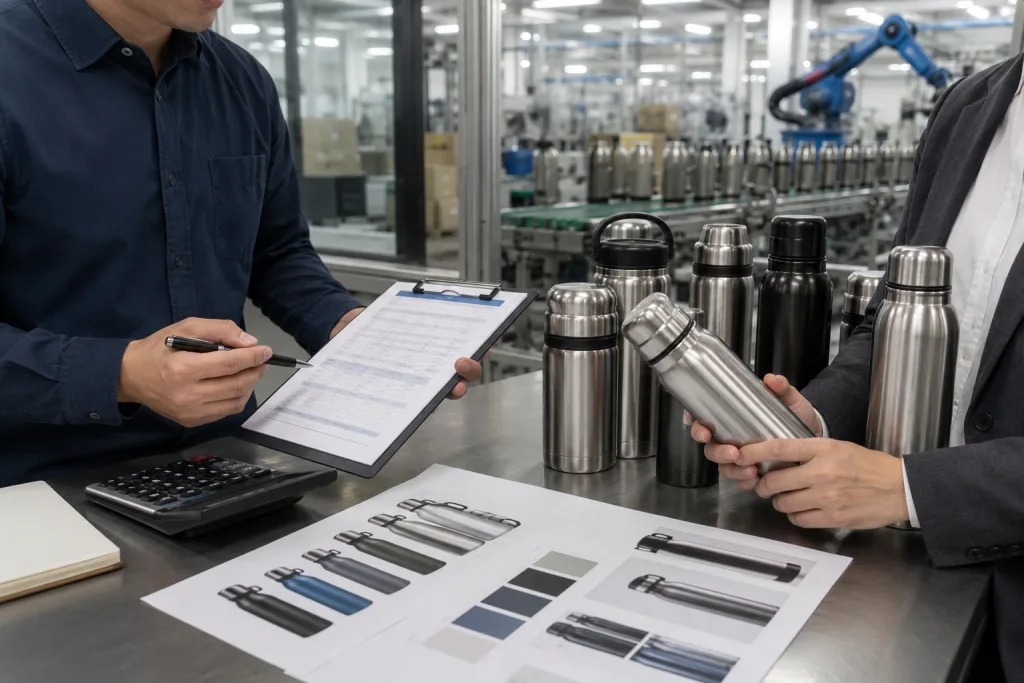
A customizable thermos usually gives you 6 decoration routes, but the wrong one can ruin a bulk order. Laser engraving is still our safest pick for outdoor retail because it cannot peel after rubbing in a backpack pocket. We run a 20W fiber laser on the line, and QC checks the logo depth with a 0.02 mm feeler gauge when the buyer asks for a sharper cut. It works best on powder coating, painted surfaces, and bare stainless finish. Clean look. Single-tone only. For full-color brand marks, silkscreen or heat transfer can work, but ask for a 3M tape test and 60-cycle rub test, especially on matte powder coating.
For a thermos custom project under a tight schedule, use existing body molds and stock color finishes. Custom Pantone powder coating normally adds 7-10 days because the powder must be matched, sprayed, cured, and approved. Last month a buyer pushed for 5 days on a custom beige finish; the math did not work after two spray panels came out 1.8 Delta E apart under the light box. Small color differences are normal between metal, paper packaging, and digital artwork. If your brand book demands Delta E control, say that before sampling and put the target on the PO, not in a late email.
Packaging is not decoration only. Outdoor retailers need cartons that survive warehouse handling and pallet stacking. Promotional brands need gift boxes that still look presentable after 28 days at sea or 4 courier transfers. A single-wall color box may pass for 500 local giveaways, but retail distribution often needs a stronger E-flute box or color sleeve over a kraft structure. We have seen this go sideways: QC pulled a sample after a 1.2 m drop test and found the corner crushed through to the cup lid. For Amazon-style fulfillment, add FNSKU labels, carton labels, suffocation warnings if polybags are used, and drop-test expectations.
Useful checklist before approving artwork:
- Confirm logo size in millimeters, not “make it bigger”; 38 mm wide and 12 mm from the bottom gives the line something real to set.
- Send vector AI, EPS, or PDF files; low-resolution PNGs often print with broken edges on a curved cup wall.
- Approve one physical pre-production sample before mass production; QC should sign it and keep it at the packing table.
- Check barcode scanability on the final box surface with a handheld scanner, not only on the PDF proof.
- Decide whether spare gaskets or instruction leaflets are included, and list the count on the packing spec.
A thermos customized with smart packaging can sell for more. A thermos customizable only by adding a tiny logo feels like a cheap giveaway, and this is the wrong corner to cut if the buyer sells through retail shelves. Match the finish and pack to the channel. We ship smoother when the artwork file, carton mark, and sample tag all say the same SKU.
Quality Checks You Should Require
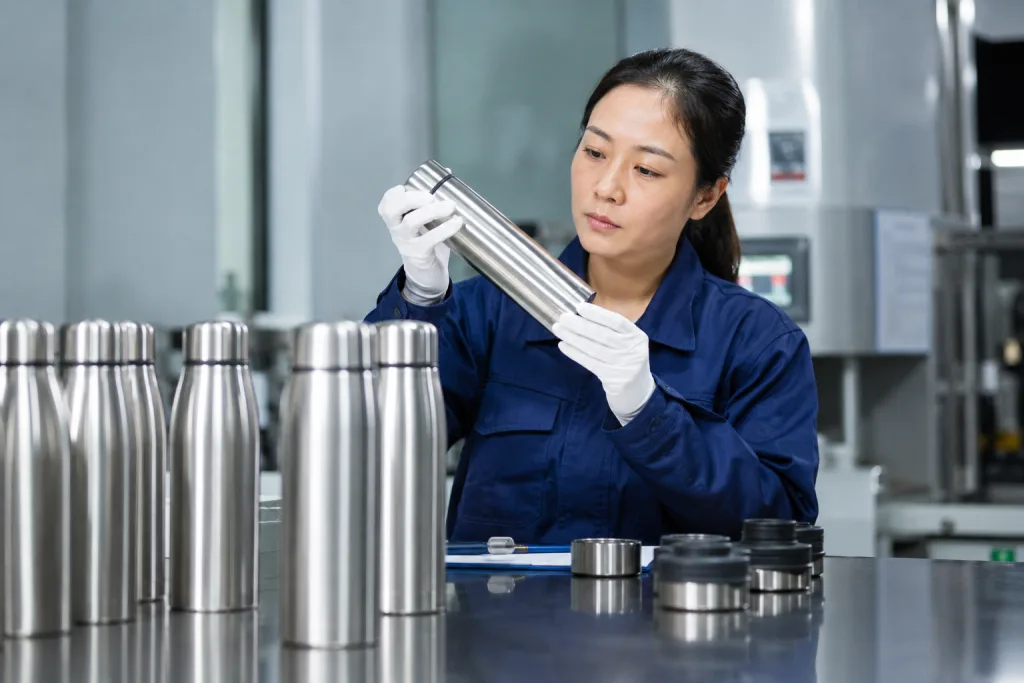
Quality control for a vacuum flask in bulk should look dull on paper and strict on the line. Nice photos from the factory thermos team do not count as QC. Ask for the inspection flow before the purchase order is signed; we had one buyer flag this after a PO typo listed “matte black” while the artwork file said “sand black.” The basic checkpoints should cover incoming 304 stainless sheet inspection with a micrometer, weld bead check, vacuum test, polishing or coating review, logo position check, leak test, final packing check, and AQL inspection.
For stainless thermos production in China, a normal final inspection can use AQL 2.5 for major defects and AQL 4.0 for minor defects. Critical defects should be zero tolerance. No debate there. Critical means sharp edges found by a cotton-glove swipe, leaking, wrong food-contact material, heavy odor, or contamination inside the flask. Major defects include heat retention missing the agreed spec, broken lid function, serious dents over 3 mm, wrong logo position by more than 2 mm, or carton quantity errors. Minor defects include small paint specks, light scratches under agreed viewing distance, or slight box scuffs within the signed sample limit.
Leak testing should not be skipped. For our bulk thermos production, lids are assembled and checked with water inversion or pressure-based methods depending on the model; QC pulled the sample from line 3 last month after 2 caps seeped at the silicone ring. A 100% leak test makes sense for retail and distributor thermos orders because one leaking bottle creates more customer anger than 10 slightly scuffed boxes. This is the wrong place to save 0.03 USD. Heat retention can be tested by sampling, but leaking must be controlled at unit level.
Certifications depend on market. Europe buyers often ask for LFGB, REACH, and sometimes BSCI factory audit documents. North America buyers may ask for FDA food-contact compliance, CPSIA if marketed to children, and ASTM-related packaging or use tests depending on the product. Do not assume one certificate covers every model. A report should match the material, model family, and date range; if the cup body is 304 stainless but the lid changed from PP to Tritan, the old report may not cover it. Good thermos suppliers will say what their report covers. Weak suppliers just attach a random PDF, and we have seen that go sideways during customs document review.
Questions To Ask Before Deposit
Before you send the 30% deposit, stop and ask blunt questions. A real thermos manufacturer will answer them without drama; our sales desk gets 18-25 of these checks every week before PI approval. The answers show whether the vendor runs export production or is only forwarding catalog photos from another line. This matters if this is your first China order, or if your Christmas shelf date leaves no space for a container that ships on May 18 instead of May 6.
Use this procurement checklist; we print the same points on our pre-production sheet and QC signs it with a caliper reading beside the sample:
- Product: What are the exact steel grades, inner and outer wall thickness in mm, lid resin, and gasket material?
- Compliance: Which test reports match this item code, and do they cover the destination market named on my PO?
- MOQ: Is the MOQ counted per order, per color, per logo position, or per carton design? One buyer once flagged this after seeing “MOQ 500” but learning it meant 500 pcs per Pantone color.
- Sample: How many days for a logo sample, and will the line use the same laser, silk screen, or powder-coating process planned for bulk?
- Production: What is the lead time after sample approval, not after inquiry? Ask for the packing date, not a soft “about 30 days.”
- Inspection: Can I book a third-party AQL inspection before balance payment, and will packed cartons be ready at least 24 hours before the inspector arrives?
- Shipping: Is the quote FOB Ningbo, FOB Shanghai, EXW Zhejiang, or DDP to my warehouse? Check the port name on the PI; we have seen “Ningbo” typed as “Shanghai” on a rushed PO.
For a 1,000 pc promotional thermos order, air freight may work, but the math often hurts; for 5,000-10,000 pcs, sea freight is the normal route. If you need mixed cartons, pallet labels, FNSKU, or distributor SKU stickers, put that in the purchase order before packing starts. Last-minute labeling requests can delay loading by 2-4 days. Sounds small. We have seen this go sideways when QC pulled the sample carton at 4 p.m. and found the FNSKU label 6 mm off the buyer’s template, right before vessel cutoff.
The best supplier thermos relationship is not built on the lowest first quote. That is the wrong question to ask if the quote hides thin steel, loose lid tooling, or a factory that cannot hold the same vacuum test result across 20 cartons. It is built on locked specs and a production date the factory can repeat. A good thermos factory in Zhejiang should remove uncertainty before the order goes live, not explain leaks after the cartons are sealed with 48 mm tape.
Send Your Vacuum Flask Bulk Brief
Share capacity, quantity, logo file, target market, and delivery date. We will reply with MOQ, FOB pricing, sampling plan, and QC options.
Frequently asked questions
What is the normal MOQ for a custom stainless vacuum flask?
For a standard body with laser engraving, 500 pcs per SKU is often workable. For custom powder coating, expect 1,000 pcs per color because coating setup and powder matching have minimum batch costs. A fully customized thermos with a new cap or body shape can require 3,000-5,000 pcs, plus tooling. If you only need a promotional thermos for one campaign, choose an existing 500 ml or 750 ml model and spend your budget on logo, packaging, and inspection instead of new tooling.
How long does bulk thermos production take after sample approval?
For repeat models, typical production is 25-35 days after sample approval and deposit. Add 7-10 days for Pantone powder coating approval and 3-5 days for logo sampling if artwork is clean. New molds or special lids can push the project to 45-60 days before shipment. Shipping is separate: sea freight to Europe or North America often takes 25-40 days port to port, plus customs and inland trucking. For seasonal outdoor retail, start sourcing at least 90 days before your required warehouse date.
Which logo method is best for outdoor retailers?
Laser engraving is usually the safest for outdoor retailers because it does not peel under normal use and handles abrasion better than ink. It is also clean for a premium custom thermos look. Silkscreen is cheaper for simple one-color logos and works well on many promotional thermos orders, but adhesion should be tested on powder coating. Heat transfer supports more colors, but it adds cost and needs rub testing. For a 1,000 pc launch, request one physical logo sample and test it with hot water, hand rubbing, and dish soap before approving mass production.
What certifications should I request for Europe or North America?
For Europe, ask for LFGB food-contact testing, REACH-related material compliance, and BSCI audit documents if your retailer requires social compliance. For North America, FDA food-contact documentation is common, and CPSIA may apply if the flask is marketed for children. The important point is model relevance. A test report for another bottle family is not strong evidence for your order. Ask the thermos supplier to confirm the model number, material list, and report date. If the order is large, budget USD 300-800 for updated third-party testing.
Can I mix colors and logos in one thermos bulk order?
Yes, but the MOQ structure must be clear. A 1,000 pc order split into two standard colors and one logo is usually manageable. Four custom Pantone colors at 250 pcs each is harder because every color needs line setup, powder handling, and QC adjustment. Multiple logos also add fixture and artwork control risk. For distributor thermos programs, we recommend fewer body colors and more packaging variation if you need account-specific SKUs. Confirm whether the quote is per color, per logo, and per carton design before paying the deposit.