Key Takeaways
- A 500 ml bulk thermos usually quotes around USD 3.20-5.80 FOB Ningbo at 3,000 units
- MOQ is commonly 1,000 units for stock shapes and 5,000-10,000 units for private mold lids or bodies
- Real lead time is sample 7-12 days plus mass production 25-40 days, not just the factory production slot
- Powder coating, leak-proof lid design, AQL inspection, and retail packaging can move cost by 8-25%
If you sell outdoor gear or run promo campaigns, a stainless thermos looks simple until the first bulk quote lands in your inbox. The price moves with capacity, 304 stainless thickness, lid mold, powder-coating color, carton spec, AQL 2.5 inspection level, and logo method. Print, laser engraving, and full-wrap artwork do not cost the same. We see buyers ask, “Why is the 750 ml only USD 0.18 cheaper than 1 L?” Wrong question. The lid set, inner tank draw depth, and coating line setup often matter more than volume; QC pulled one 1 L sample last month because the silicone ring sat 0.6 mm off the groove.
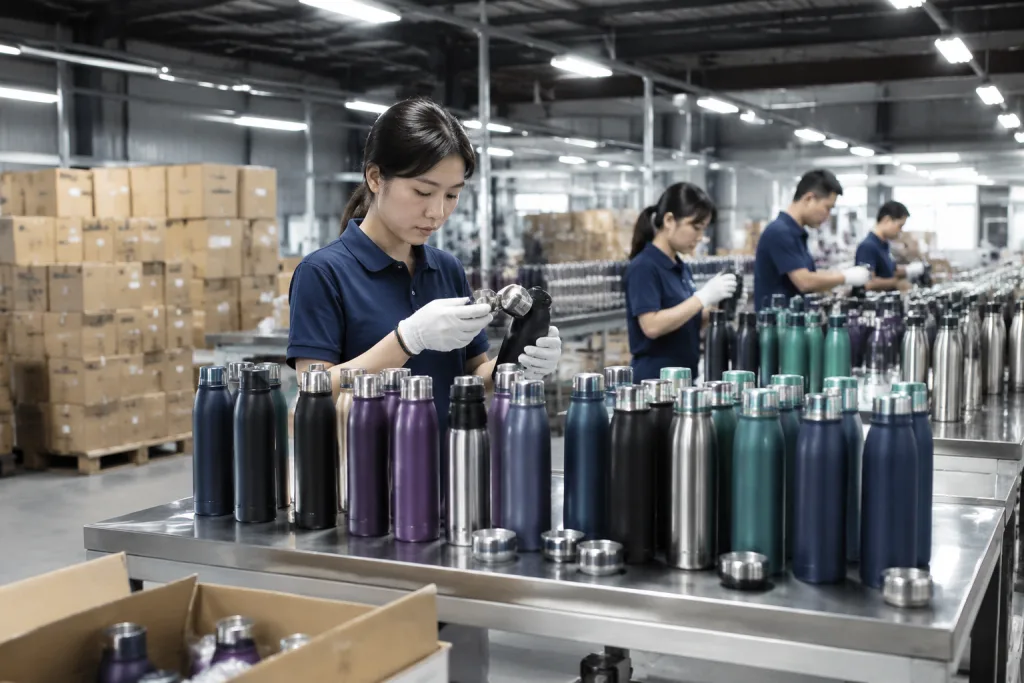
BottleForge Industrial is based in Hangzhou, Zhejiang, and we build custom thermos programs for distributors, outdoor retailers, and brand owners shipping to Europe and North America. Our stainless line runs about 450,000 units/month in China, with standard MOQ from 1,000 units per model and normal production lead time of 25-40 days after sample approval. On the line, we run vacuum leak testing before packing, then spot-check logo position with a height gauge because a 2 mm drift looks cheap on a matte black bottle. We have also seen orders go sideways from small paperwork mistakes, including one PO that said “gunmetal” while the approved sample tag said “graphite grey.”
Start With The Real Unit Cost
Do not ask a vacuum flask factory, “what is your cheapest 500 ml bottle?” That question gets a number, not a buying decision. Ask for the unit cost split: bottle body, lid, surface finish, decoration, packing, and testing requirement. We run quotes from a BOM sheet, and if the lid gasket is marked as “standard silicone” with no test line, QC will flag it before sampling. If those items stay hidden, the real cost shows up after artwork approval or during pre-shipment inspection.
For a typical 500 ml double-wall stainless vacuum flask using 304 inner steel and 201 or 304 outer steel, a sensible FOB Ningbo range is USD 3.20-5.80 at 3,000 units. At 1,000 units, expect USD 3.70-6.60 because setup labor, coating loss, and carton handling are spread over fewer pieces. At 10,000 units, a clean design may drop 6-12%, assuming the lid is not complicated and the color count is limited. On the coating line, we usually allow 3-5% loss for powder changeover; one buyer once pushed for 800 pcs per color, and the math did not work.
The wrong move is comparing supplier thermos quotes without matching specifications. One thermos manufacturer may quote 0.45 mm outer wall thickness, another 0.38 mm. One lid may use a silicone seal rated for food-contact testing, another may use a cheaper ring with higher odor risk. QC pulled the sample after a 24-hour hot-water test because the lid smelled sharp at 60°C. On paper, both are “stainless thermos.” In use, they are not the same product.
For promotional thermos orders, the lowest price usually comes from cutting things your customer will notice: thinner paint, loose lid threads, weak heat retention, or a carton that crushes during sea freight. We have seen this go sideways. A 12 kg master carton looked fine in the office, then failed the drop test at the corner seam before loading. A serious thermos supplier should tell you where cost can be reduced safely and where it should not be touched.
MOQ Tiers That Actually Matter
MOQ is not just a factory rule. It comes from real costs on the line: 304 stainless coil booking by kg, powder booth cleanup, logo jig setup on the pad printer, and carton flow at the packing table. For a standard customizable thermos shape from our Zhejiang production network, 1,000 units per model is usually workable if you accept existing lid tooling and standard colors. We run this tier when the buyer wants to test a distributor thermos program without locking cash into 12 colorways. Last month QC pulled the sample at 1,000 pcs because the logo was 1.5 mm off-center, and that is exactly the kind of small issue you want to catch before a bigger PO.
At 3,000 units, the economics improve. Powder coating is easier to schedule, logo printing waste drops, and carton production stops feeling like a handmade job. This is where 7 out of 10 promotional brands place thermos bulk orders for seasonal campaigns in our factory. Stay tight on SKU count. Three colors at 1,000 pieces each is usually better than six colors at 500 pieces each, because the math doesn't work once each color needs its own spray test, Pantone check, and first-article approval sheet.
At 5,000-10,000 units, you can start discussing stronger customization: exclusive color matching with a signed color chip, special lid texture from existing insert tooling, retail gift box with EAN sticker position, barcode labeling, insert cards, and country-specific compliance documents. If you want a private mold lid or a fully customized thermos body shape, MOQ can move to 10,000-30,000 units because tooling, trial runs, and mold amortization need volume. We've seen this go sideways when a buyer asks for a new push-button lid at 3,000 pcs; the mold shop will quote it, but the unit cost looks ugly after the first T1 trial.
For distributors thermos programs, the smarter path is a staged order. Start with 1,000-3,000 units using a proven thermos factory model, validate the sell-through, then lock the next purchase order at 5,000 units with improved packaging or an exclusive color. We ship this way because it reduces the risk of being stuck with 12 pallets of a product your market did not ask for. One buyer flagged a PO typo where “matte black” became “metal black”; catching that at 1,000 pcs saved 18 days of rework and a lot of awkward emails.
What Changes The Price Fast
Capacity moves the price, but the math is not straight-line. A 350 ml customized thermos is often only USD 0.12-0.25 below a 500 ml unit because we still run the same lid set, vacuum brazing, coating jig, AQL 2.5 inspection, and inner polybag packing. A 750 ml or 1,000 ml outdoor flask is different: more steel, taller body drawing, and a larger 5-layer export carton show up in both FOB cost and freight cost. QC pulled one 1,000 ml sample last month with a 0.6 mm body dent after drop testing, and the buyer flagged the carton spec before price approval.
Material specification matters. Most export orders use 304 stainless steel for the inner wall because it holds up for coffee, tea, and acidic drinks under normal use. Some buyers request 316 inner steel for a premium outdoor line, but expect higher material cost and about 3-5 extra days for mill certificate confirmation. Outer wall steel can be 201 or 304, depending on shelf price and corrosion risk. We had one PO typed as “304 inside / 201 outside” while the approved sample card said “304 inside / 304 outside”; that one typo stopped the line for half a day.
Surface finish changes cost fast. Spray paint is cheaper on most runs, but powder coating gives a better grip and stronger abrasion resistance for outdoor retail. A single-color powder coat may add USD 0.35-0.70 per unit compared with basic stainless finish. Gradient coating, rubberized paint, metallic paint, or full-body wrap adds more, and we usually push MOQ to 1,000-3,000 pcs per color because the curing oven and color panel need to stay consistent across batches. We check this with a 3M tape test and a 500 g rub test; cheap coating is where we have seen projects go sideways.
Decoration has trade-offs. Silk screen works for simple logos and promotional thermos orders, especially when the logo sits under 60 mm wide. Laser engraving looks clean and lasts, but it runs slower on coated bottles because the fixture must hold the bottle straight within about 1 mm. Heat transfer gives strong shelf impact for lifestyle brands, but artwork files must be accurate and color matching leaves less room for adjustment. A thermos custom project with four decoration methods is usually not “premium”; it is harder to inspect consistently, and the line will find every small registration problem.
Lid design is where buyers often miss the real cost. A simple screw lid is predictable. A push-button lid, cup lid, carry handle, tea filter, or multi-part sealing system adds injection mold work and leak-test risk. If your thermos vendor says a new lid is cheap and fast, ask for the mold plan, cavity count, trial date, and failure rate from the first T1 samples. This is the wrong place to save USD 0.08. We run leak testing with 95°C water, 30 seconds upside down, and a bad silicone ring can turn a clean-looking sample into a claim batch.

Lead Time From Sample To Ship
A clean custom thermos schedule has four parts: quote, sample, production, shipment. Buyers often count only the 25-40 production days, then the launch date moves. Wrong question. For a stock manufacturer thermos body with one logo and one color, quotation and artwork confirmation usually take 1-3 working days if the AI file, Pantone code, logo size in mm, and packing request are ready. We had one PO last month with “matte balck” typed on the color line; that alone cost 1 day because QC would not release the sample card. Pre-production samples usually take 7-12 days, or 12 days vs 18 days if you need Pantone powder coating or a special lid mold.
Mass production normally takes 25-40 days after sample approval and deposit. During peak China export months, usually March-June and August-October, add 5-10 days of buffer. Zhejiang factories move fast, but the line still has limits: coating racks, vacuum ovens, leak-test stations, and the inspection room cannot all double output overnight. If a supplier promises 15 days for 20,000 units with custom color and retail packaging, ask what step they plan to skip. The math doesn't work. QC pulled a sample from a rushed lot once and found 6 lids with gasket flash in 80 pieces, so the whole carton run had to be rechecked.
A practical timeline for a 3,000-unit thermos promotional order is: 2 days for quotation and specification lock with a 0.5 mm logo position tolerance, 3 days for artwork, 10 days for sample, 2 days for approval, 30 days for mass production, 2-4 days for final inspection and export documents, then shipping. Air freight to North America takes 5-9 days after pickup in most lanes we ship. Sea freight takes 25-38 days port-to-port, depending on routing. Simple enough. If the buyer changes from a white box to a 350 gsm color box after the sample is signed, the print shop slot moves and the schedule moves with it.
If you need Amazon or 3PL preparation, add time for FNSKU labels, carton marks, master carton limits, drop-test requirements, and pallet instructions. These small files slow orders down more than people admit. On a 3,000-unit job, we usually need 1 working day just to check label size, scan rate, carton weight under the buyer’s kg limit, and pallet height. 8 out of 20 delays we tracked this spring were not caused by the thermos factory; they came from late barcode files, missing importer details, or carton dimensions changed after mass production had started. We’ve seen this go sideways.
Compliance And Inspection Costs
Compliance is not a decoration option. If you sell stainless drinkware in Europe or North America, put food-contact testing and incoming inspection into the landed-cost sheet from day one. For the EU, 7 out of 10 retail buyers we deal with ask for LFGB reports, REACH-related material declarations, plus migration testing tied to the actual lid, gasket, and coating. For the United States, FDA food-contact expectations and California Proposition 65 screening can apply. Kids bottles need a tighter look: small parts, straw tips, paint, and claims may trigger CPSIA or ASTM-related requirements depending on design and market. QC pulled one sample last year because the silicone gasket supplier changed a batch code by 1 digit, and the buyer flagged the traceability gap before shipment.
A responsible thermos manufacturer should show ISO 9001-style process controls, material traceability, and inspection records that match the PO, not a neat folder made for visitors. Social audits such as BSCI are required by 3 larger retailers we ship to each season. BottleForge works from Hangzhou, Zhejiang, with China partner workshops that support AQL inspection, pre-shipment photos, and carton drop checks before loading. On the line, we run material incoming checks with a handheld XRF gun and keep coil tags with the work order; if the tag is missing, the math doesn't work for traceability.
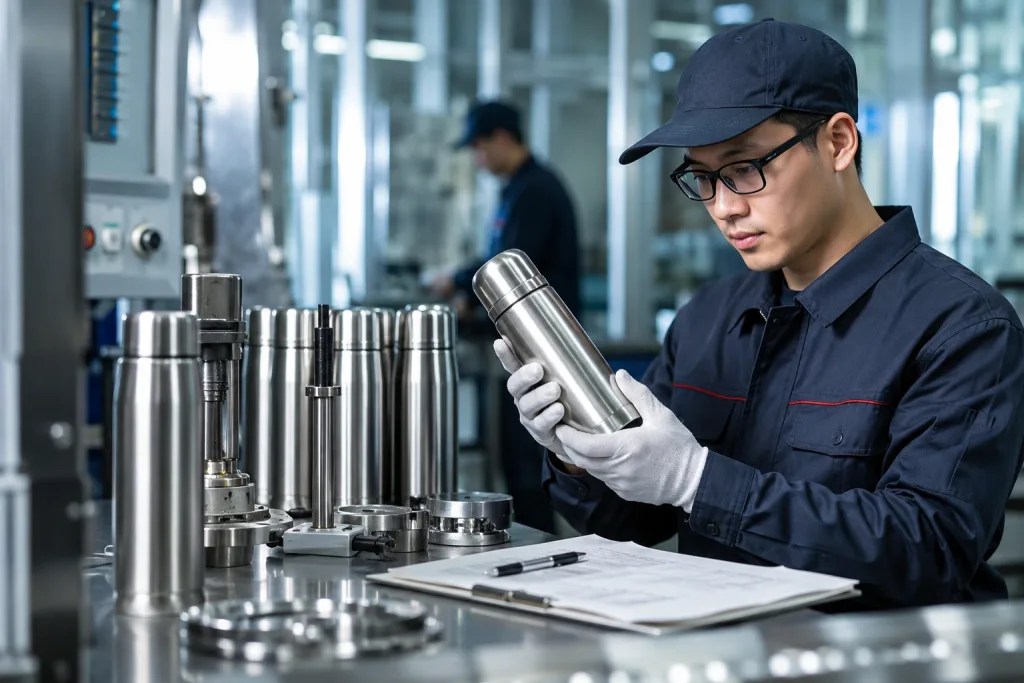
For AQL, most distributors we see use General Inspection Level II with AQL 2.5 for major defects and 4.0 for minor defects. For vacuum flasks, the inspection sheet should spell out leak testing, lid torque in N·cm, coating scratches by viewing distance, dents by size in mm, odor after hot-water rinse, logo position tolerance, color deviation against the approved Pantone chip, carton strength, and heat retention. A typical heat-retention check may test 95°C water over 6, 12, or 24 hours depending on the product claim. QC pulled the sample at hour 12 on a 500 ml flask when it landed 4°C under the spec; that is when a buyer stops caring about the nice render.
Inspection cost depends on location and scope, but a third-party pre-shipment inspection in China usually lands around USD 250-400 per man-day. Use it on first orders, new molds, or high-value customized thermos runs. Skipping inspection to save USD 300 on a USD 15,000 order is poor purchasing discipline. We have seen this go sideways: 48 cartons passed the factory’s visual check, then the outside inspector found mixed matte and gloss lids because one PO line had a typo in the finish code.
Packaging And Freight Arithmetic
Packaging changes unit cost and landed cost faster than buyers expect. A white box may cost USD 0.18-0.35 per unit. A printed retail box can be USD 0.35-0.80 depending on paper weight, finish, and quantity. A rigid gift box looks sharp on a shelf, but it can add USD 1.00 or more and push carton CBM up 15-25%. We’ve seen this go sideways: QC pulled 30 samples after a drop test and 4 gift boxes had crushed corners before the bottle had a scratch. For outdoor retailers, stronger packaging beats prettier packaging because dented boxes create returns before the customer even tests the bottle.
Carton design belongs before mass production, not after the line is packing. A common export master carton for 500 ml stainless flasks may hold 24 pieces, with gross weight around 10-14 kg depending on packaging. If your distributor warehouse has a 15 kg handling limit, tell the factory before cartons are printed. We run carton trials with a digital scale and tape measure, and a 6 mm change in inner tray height can decide whether the carton stays under the warehouse limit. If you need palletization, give pallet height, label side, and carton stacking rules early.
FOB pricing does not include ocean freight, duty, local trucking, customs brokerage, or warehouse receiving. A thermos supplier can estimate carton size and gross weight, but your forwarder should calculate landed cost. For sea shipment, volume can matter more than weight. This is the wrong question to ask if you only compare FOB by USD 0.10 per unit; a bulky gift box can burn that saving once the forwarder charges by CBM. Last month a buyer flagged our packing list because the PO showed 24 pcs/carton, while the artwork file said 20 pcs/carton, and that typo changed the container count.
For promotional deadlines, buyers often split shipping: air freight 10-20% for launch stock, sea freight the balance. It costs more, but it protects the campaign date. We ship the air portion in tighter cartons when the buyer accepts plain inner boxes, because air freight math punishes wasted space. For a national outdoor promotion, this is safer than gambling the full order on one vessel schedule; the math doesn’t work if 18 days at sea becomes 26 days and the retail launch is already printed on 80,000 flyers.
How To Brief The Factory
A good brief saves more money than hard negotiation. Send the vacuum flask factory a clean spec sheet with capacity, body shape, lid type, inner and outer steel grade, color, logo method, logo size, packaging, compliance market, target order quantity, shipping term, and target delivery date. Put the target FOB price on the sheet if you have one. We run costing in RMB down to the lid gasket and powder-coating loss; if the brief says “premium bottle, best price,” the line has to guess, and the math usually breaks by USD 0.20 to USD 0.45 per piece.
Use reference samples with care. Showing the style you like is fine, but asking a manufacturer thermos team to copy another product blindly is the wrong question to ask. Ask which existing mold is closest, which changes fit the current CNC tooling, and which parts need a new mold. A proven 500 ml body with your own finish and lid color often sells better than a private mold that takes 35 days for tooling and misses the buyer’s spring shelf date.
For outdoor retailers, state the performance claims plainly: leak-proof when closed, cup-holder fit if needed, coating abrasion expectation, handle load, and heat-retention claim. QC pulled one sample last month where the handle passed 8 kg static load but failed after the buyer asked for a 12 kg swing test after sampling. For promotional brands, give the event date, artwork approval deadline, carton labeling, and whether individual polybags are acceptable. A thermos customizable program runs smoothly only when the sales deadline and packing rules are visible before we open the sample order.
Ask for a quote sheet that lists MOQ, sample cost, sample lead time, mass production lead time, payment terms, FOB port, carton dimensions, gross weight, and inspection standard. Simple sheet. No mystery. If a thermos factory avoids those details, the price is not ready for purchasing approval; we have seen POs delayed 6 days because “FOB Ningbo” was typed as “FOB Shanghai” and the carton weight was missing.
Send Your Thermos Brief For A Costed Quote
Share capacity, logo, quantity, market, and deadline. We will return MOQ, FOB price, sample timing, and packing details without guesswork.
Frequently asked questions
What is a realistic MOQ for a custom stainless thermos order?
For existing factory molds, 1,000 units per model is a realistic starting MOQ, especially if you choose a standard lid and one body color. At 3,000 units, the unit price is usually better and color coating is easier to schedule. For a private mold body or special lid, expect 10,000-30,000 units because tooling, trial production, and plastic injection setup must be amortized. If you are a distributor testing a new outdoor line, start with 1,000-3,000 units rather than forcing a full private mold too early.
How much does logo customization add to the price?
Simple one-color silk screen printing may add around USD 0.08-0.20 per unit depending on size and quantity. Laser engraving often adds USD 0.15-0.45 per unit, with higher cost on coated bottles because setup and positioning take longer. Full-wrap heat transfer or multi-color artwork can add USD 0.35-0.90 per unit and may require higher MOQ. For thermos custom orders, also budget USD 30-80 for screen or fixture setup unless the factory waives it at higher volume.
Can a vacuum flask factory match our exact brand color?
Yes, but exact color matching needs time and tolerance. For powder coating, provide Pantone or RAL references and expect 7-12 days for a color sample. On mass production, a Delta E tolerance of around 1.5-2.0 is reasonable for many retail programs, but lighting and surface texture can affect perception. Small orders under 1,000 units may be limited to standard factory colors. If your campaign depends on a strict brand color, approve a physical sample, not only a photo.
What inspections should we require before shipment?
For first orders, use a pre-shipment inspection under AQL General Level II, commonly AQL 2.5 for major defects and 4.0 for minor defects. Check leak performance, vacuum insulation, lid fit, coating scratches, dents, logo position, odor, carton strength, and barcode accuracy. For a 3,000-unit order, inspection may sample about 125-200 units depending on the standard selected. Heat-retention testing should be defined clearly, such as starting water temperature, room temperature, and measurement after 6 or 12 hours.
Should we buy FOB China or delivered to our warehouse?
FOB Ningbo or FOB Shanghai is usually cleaner for experienced importers because you control the forwarder, customs broker, insurance, and delivery schedule. If you are new to thermos bulk imports, delivered terms can be convenient, but compare the total landed cost carefully. A vacuum flask order has meaningful carton volume, so sea freight, port charges, duty, and local trucking can change the real cost by 15-35%. Always ask the factory for carton dimensions, gross weight, and HS code guidance before confirming pricing.