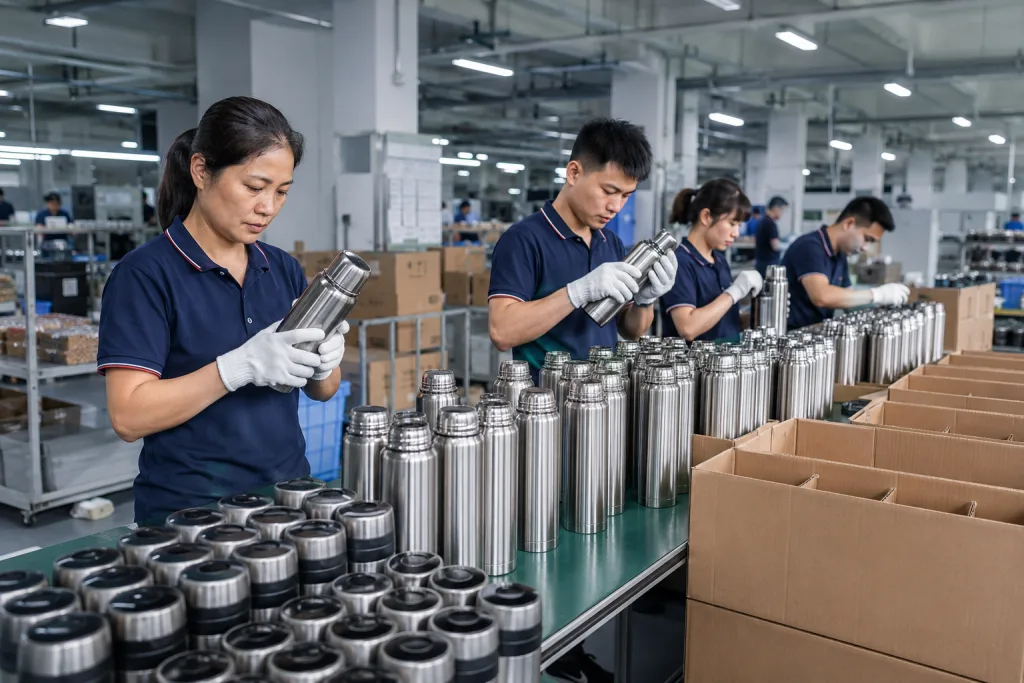
Key Takeaways
- A practical RFQ should include capacity, steel grade, MOQ, logo method, packaging, and 12-24 hour heat retention targets
- For custom thermos orders, approve a pre-production sample before releasing bulk production
- Typical stainless vacuum flask MOQ is 1,000-3,000 units per size and color
- Write AQL, FOB port, carton marks, and spare parts into the PO instead of handling them by email
Vacuum flask distributors usually lose margin before the line even opens. The RFQ says “500 ml thermos, custom logo,” but skips the carton drop test, logo height in mm, spare lid ratio, FNSKU label size, and whether the inner carton needs a barcode. QC pulled one pre-production sample last month where the logo was 6 mm off center; the buyer flagged it after the PO was already signed. That is where rework, air freight, and retail returns start.
If you sell to outdoor retailers or promotional brands, your stainless thermos program should be boring in the right places: 304 or 316 steel confirmed by material report, vacuum performance checked after 12 hours, packaging spec locked with carton weight, and AQL written into the order. We run this from Hangzhou, Zhejiang, and we see the same 7 sourcing mistakes every season. China can ship clean and fast. The math doesn’t work when the buying process stays loose.
Start with a commercial RFQ
A good RFQ for vacuum flask distributors is not a product mood board. It is a buying document. If you send only “500 ml stainless thermos, logo printed, best price,” we run into trouble before the quote sheet is opened. Last month QC pulled two 500 ml samples from the shelf: one used 201 stainless on the outer shell, the other used 304, and the weight difference was 18 g on our bench scale. One quote may include copper coating inside the vacuum wall, another may skip it. You are not comparing the same flask.
Start with the commercial frame. List your target channel, expected annual volume, launch date, and delivery country. Outdoor retail usually needs tougher powder coating and tighter leak testing; promotional thermos orders live or die on logo clarity and the ship date. Different math. We have seen this go sideways when a buyer asked for “retail quality” but the PO said bulk polybag, then flagged carton damage during AQL 2.5 inspection.
Your RFQ should specify:
- Capacity: 350 ml, 500 ml, 750 ml, 1,000 ml, or your exact mold target in mm if the shelf height is fixed.
- Material: 304 stainless inner and outer, or 316 inner if your retail price can carry the premium.
- Wall construction: double-wall vacuum, usually 0.4-0.5 mm inner wall and 0.5-0.6 mm outer wall, checked with a digital thickness gauge on the line.
- Performance: hot water at 95°C, measured after 6, 12, and 24 hours, with the lid closed to normal torque.
- Finish: powder coating, spray paint, brushed steel, or electroplated finish; tell us if the buyer rejects orange peel under 60 cm light inspection.
- Logo: laser engraving, silkscreen, heat transfer, water decal, or 3D badge, with Pantone code and artwork size in mm.
- Packaging: white box, kraft box, color box, gift tube, or Amazon-ready carton, including drop-test needs and barcode position.
For a bulk thermos program, state your target MOQ by SKU. At BottleForge Industrial in Zhejiang, a normal MOQ is 1,000 units for an existing stainless thermos model and 3,000 units per color for a customized thermos with special coating. Our monthly capacity is about 450,000 stainless drinkware units across thermos, tumblers, and sports bottles. Capacity sounds impressive, but it does not reserve the line. A clean RFQ lets us block a coating booth, book lid assembly, and hold a production window instead of guessing from a PO with a typo like “matte balck.”
Convert the quote into PO lines
We see about 6 out of 10 buyers treat the quotation as a price sheet. Risky habit. The quote is where the PO should start taking shape, line by line. A manufacturer thermos price should state what is included, what is excluded, and which terms add cost. Last month QC pulled the pre-production sample and found the buyer’s PO missed the laser logo position by 8 mm; the quote had it correct, but the PO did not. If you leave this loose, the supplier thermos quote can change after artwork, sampling, or packaging confirmation.
Ask your thermos manufacturer to quote in a table that can drop straight into PO line items. We run this format because it stops 3 common arguments: carton mark, sticker charge, and spare gasket packing. For example:
- Item 1: 500 ml double-wall vacuum flask, 304 stainless inner and outer, powder coated, laser logo, 2,000 pcs, FOB Ningbo.
- Item 2: 750 ml double-wall vacuum flask, 304 stainless inner and outer, same color and logo, 1,500 pcs, FOB Ningbo.
- Item 3: retail color box with barcode sticker, 3,500 pcs, included in unit price.
- Item 4: spare silicone gaskets, 1% of order quantity, packed separately.
- Item 5: FNSKU or EAN sticker application, USD 0.03-0.06 per unit if required.
A realistic FOB China price for a 500 ml custom thermos in 304 stainless is often USD 3.20-5.80, based on cap structure, coating, logo method, packaging, and order volume. A 1,000 ml outdoor flask may land around USD 5.80-9.50 FOB if the lid includes a cup or push-button stopper. Do not chase the lowest number without checking net weight. This is the wrong question to ask. On the line, a 40 g lighter body may pass the caliper check at the mouth, but we have seen it dent faster when cartons are stacked 5 layers high before container loading.
For distributors thermos programs, payment terms also belong in the quote. Common terms are 30% deposit and 70% before shipment, or 30/70 against copy Bill of Lading for established buyers. If you need credit terms, say so before sampling. We had one PO last quarter with “70% after arrival” typed into the remarks box, and the buyer flagged it only after we had booked coating powder. The math does not work if the thermos supplier in China is asked to carry payment risk after the PO is already drafted.
Sample before you trust renderings
Renderings sell ideas. Samples expose problems. We’ve had a buyer approve a nice 3D image, then QC pulled the sample and found the lid button had a hollow click and the logo climbed 3 mm on the curved body. For vacuum flask distributors, this is where you check hand feel, coating scratch resistance, lid fit, and logo position with a caliper, not with a PDF. This is the wrong place to save money. A USD 150 sample round beats a container of wrong goods every time.
Separate the sample work into three buckets. A stock sample checks shape, lid structure, grip, mouth diameter, and basic insulation; we run this from shelf inventory when the model is already open. A logo sample checks process, Pantone color, artwork size, and placement, especially on tapered cups where a 45 mm logo can look stretched. A pre-production sample confirms the exact build before the line starts bulk work. For a customizable thermos, skipping the pre-production sample because the stock sample looked fine is how projects go sideways.
Typical sample timing is 3-5 days for a stock sample, 7-10 days for laser or silkscreen logo, and 12-18 days for custom coating or special packaging. If a new mold is required, add 25-45 days depending on the cap, cup, handle, or body profile. Zhejiang factories can move fast, but the math doesn’t work if the buyer asks for a new injected lid on Monday and wants approval photos by Friday. Coating still needs curing time, and CNC tooling for lid parts does not care about your ship date.
Your sample approval sheet should read like PO lines, not like a design chat screenshot:
- Sample code: BF-500V2, 500 ml, matte black, laser logo at 45 mm width.
- Approved material: 304 stainless steel inner and outer, food-contact silicone gasket.
- Approved packaging: 350 gsm color box, 5-layer export carton, 24 pcs per carton.
- Approved test: 95°C water, 12 hours above 55°C under room temperature testing.
Keep one approved sample with you and one sealed sample at the factory. Simple rule. When bulk goods are inspected, both sides need the same reference on the table, ideally with the seal label signed across the box flap. We’ve seen a PO typo change “matte black” to “metal black,” and nobody caught it until the buyer flagged the gloss under inspection lights. The sealed sample cuts arguments over shade, gloss, print density, and lid fit.
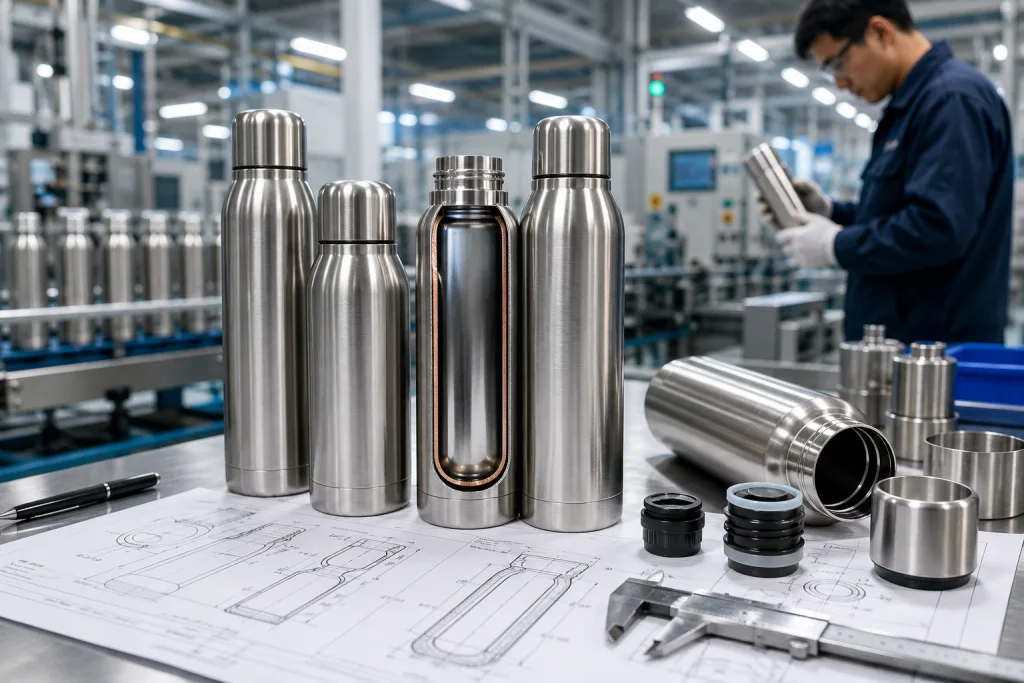
Lock branding and packaging early
Promotional brands often treat branding like a small add-on. We’ve seen a 3,000 pcs thermos order get stuck because the slogan had 0.25 mm strokes, the buyer asked for Pantone 186C, and the delivery date was tied to a trade show in Dubai. That is where orders go sideways. Outdoor retailers face a different fight: the color box has to survive 6 warehouse touches and still sit clean on shelf. QC pulled one sample last month with a crushed corner after a 1.2 m drop test. Lock the artwork early.
For logo work, laser engraving is still the safest choice on stainless steel and powder coating when a single-color mark or metal-reveal finish works for the brand. Silkscreen is fine for simple color logos, but we run 3M tape testing on textured coating before mass production. Heat transfer handles gradients and detailed graphics, but the math does not work on every order because film cost and rejects climb fast, sometimes 4% vs 1% on laser. Water decal works for full-wrap artwork, though the line needs proper curing time and a scratch test with a 500 g load before we release it.
Ask your thermos factory to confirm logo size in millimeters, not just “centered.” A common front logo on a 500 ml flask is 35-55 mm wide. If your brand book says 70 mm, the logo can wrap too far around the cylinder and look bent from the front. This is the wrong place to guess. For a customized thermos, request a 1:1 artwork proof on the actual product outline, and ask the factory to mark the print area from the seam line with a caliper reading.
Packaging is part of the product, not a shipping afterthought. A promotional thermos may use a kraft box to hold cost down, often 350 gsm paper with single-color printing. A retail distributor thermos needs color box artwork, barcode, recycling marks, importer address, country of origin, and sometimes REACH or food-contact statements depending on market. For Amazon or marketplace shipments, carton weight and dimensions matter. Keep master cartons under 15 kg when possible; we’ve seen 18 kg cartons split at the tape line during courier handling.
Put packaging into PO lines: box material and printing method with specs, carton ply with burst strength, unit per carton with barcode and label positions, plus warning labels, FNSKU labels, and pallet requirement. One buyer sent a PO saying “standard export carton” and later flagged the carton as too soft for 12 pcs of 750 ml bottles. Ask for the actual carton size and burst strength before deposit. Standard is not a specification.
Define tests before production starts
Do not start QC after the goods are packed. Too late. At that point the choices are usually discount, rework, or pushing ETD by 7-12 days while the line opens cartons again. For thermos distributors, the better move is to lock the tests before production starts and put them on the PO, including sample quantity, pass/fail limits, and who signs the inspection report. We once had a buyer flag “keep warm well” on a PO; our QC team had to ask whether that meant 6 hours at 60°C or 12 hours at 50°C.
The core tests for stainless vacuum flasks are not complicated, but they need numbers. Vacuum performance checks heat retention over time, usually with 95°C water and a calibrated probe after 6, 12, or 24 hours. Leak testing checks the cap, stopper, gasket, and thread fit; we run inverted samples on the bench and look for seepage around the silicone ring. Coating tests check adhesion with a cross-cut knife, scratch resistance, and color consistency against the approved Pantone chip. Carton drop testing checks whether retail boxes and master cartons survive normal logistics, not a perfect lab dream. For food contact, you may need LFGB, FDA, or EU food-contact documentation, plus REACH for coatings or surface treatments when relevant.
Use AQL instead of loose wording like “good quality.” The math does not work if nobody defines the reject line. A common inspection plan is AQL 2.5 for major defects and AQL 4.0 for minor defects under ISO 2859-1. Critical defects, such as leaking, sharp edges, wrong material, or contaminated interior, should be zero tolerance. QC pulled one 304 stainless sample last year with black polishing dust inside the cup; that is not a minor defect. If you sell to children or family outdoor channels, check ASTM-related requirements for components based on the product design and target market.
For a thermos custom order, specify the inspection stage:
- Incoming material check: 304 stainless steel grade certificate, silicone gasket material, paint batch number, and sheet thickness in mm.
- During production: vacuum pull rate, weld bead appearance under LED inspection, coating thickness in μm, and logo position measured from the bottom edge.
- Final inspection: AQL sampling, 100% leak test for suspect lots, heat retention record, carton drop test, and barcode scan against the buyer’s SKU list.
At BottleForge Industrial, final inspection is normally booked 2-3 days before shipment. For large thermos bulk orders above 20,000 units, we recommend an in-line inspection at 30-50% production. This is the wrong question to ask: “Can we check everything at the end?” We have seen this go sideways. A lid torque issue found halfway can be adjusted with a torque meter on the capping station; the same issue found after 800 cartons are sealed means cutters, tape guns, repacking labor, and a shipment that misses the vessel.
Release bulk production carefully
Once the pre-production sample is approved, the bulk PO should stop being a WeChat chat. Put every locked item into the document: product spec, order quantity, unit price, incoterm, payment term, delivery date, inspection standard, packaging, shipping marks, and who pays if QC finds a serious deviation. We once had a PO with “matte balck” typed in the color line; QC pulled the golden sample before coating, or 6,000 pcs would have gone out in the wrong finish.
A clean PO for a manufacturers thermos order may include these lines:
- Product: 750 ml double-wall stainless vacuum flask, model BF-750T, 304 inner and outer.
- Quantity: 6,000 pcs, split into 3 colors, 2,000 pcs per color.
- Branding: laser logo, 50 mm width, opposite seam, according to artwork file V3.
- Unit price: USD 5.35 FOB Ningbo, including color box and barcode sticker.
- Lead time: 35 days after deposit and final artwork approval.
- Inspection: final random inspection, ISO 2859-1, AQL 2.5/4.0, critical defects not accepted.
- Spare parts: 1% spare gaskets and 0.5% spare lids, packed in carton 1.
Lead time depends on the season and the line schedule. In normal months, we run existing-model stainless thermos orders in 30-40 days after deposit; that is injection, coating, logo, assembly, 24-hour leak test, and carton packing. From August to November, 8 out of 10 China drinkware factories are packed with holiday and Q1 retail programs, so 45-60 days is the safer number. If your launch date is fixed, waiting for perfect internal approval is the wrong question to ask. Pay the deposit and reserve the slot.
Bulk production also needs change control. If your marketing team changes the logo after coating starts, the math doesn't work: the laser jig is already set, coated shells are on the rack, and rework can add 12 days vs 18 days if cartons have already been sealed. If your distributor asks for a different carton mark after packing begins, the warehouse will charge re-labeling by carton, not by kindness. A thermos manufacturer can bend a little, but we've seen this go sideways when materials are already cut, printed, or packed.
Prepare shipment and after-sales data
The shipment stage is where 7 out of 10 supplier thermos programs get messy in our factory files. The flask is fine. Then QC pulls the loading sample and finds the carton mark says “500ML BLACK,” while the buyer’s warehouse PO says “17oz matte charcoal.” Labels, pallets, and carton marks have to match the receiving system, not just the product spec. For outdoor retailers and promotional brands, one wrong routing label can hold a container for 3-5 days at the DC gate.
Before booking shipment, confirm the commercial invoice, packing list, HS code, carton count, gross weight, net weight, and CBM against the final packing photos. We run a carton re-weigh on a 150 kg platform scale when the forwarder questions CBM, because a 0.02 m³ error per carton becomes a cost problem on 800 cartons. Stainless vacuum flasks are often shipped by sea under drinkware-related HS classifications, but your broker should confirm the exact code for your market. If you ship to the United States, check duty exposure before quoting your customer. If you ship to the EU, confirm importer documentation, packaging waste requirements, and food-contact declarations before the ETD is locked.
For Amazon-style or retailer DC shipments, PO line items should spell out the carton label format, maximum pallet height in mm, mixed SKU rules per pallet, and whether cartons need FNSKU, SKU, EAN, or retailer routing labels. We have seen this go sideways when a buyer wrote “barcode on carton” on the PO, then flagged us because the EAN was scannable but the FNSKU was missing. A clean thermos supplier handover file includes product photos, carton photos, a barcode scan report from a Honeywell scanner, the inspection report, packing list, and loading photos by container number. These files cut arguments when 12 cartons arrive crushed or 3 cartons are routed to the wrong DC.
After-sales data matters for your next order. Track leak claims, dent rate, coating scratches, missing parts, and lid breakage by SKU and batch number, not by vague customer emails. If returns exceed 1.5-2.0% for a distributor thermos program, review the carton drop-test result, cap thread fit, and warehouse handling before blaming only the factory. The math doesn’t work if you change suppliers every season but keep the same thin divider and loose spare parts bag. Sometimes the fix is a 5-layer carton divider or a spare gasket kit, not a new manufacturer.
The goal is not to find the cheapest thermos vendor every season. Wrong question. The goal is to build a repeatable program where your RFQ, sample, PO, inspection, and shipment data get cleaner with each order. On the line, that means the same approved lid sample, the same 304 stainless body spec, and the same carton mark template stay attached to the batch record. That is how vacuum flask distributors protect margin while still offering thermos customized options to retailers and promotional clients.
Send your stainless thermos RFQ for review
Share capacity, logo, packaging, MOQ, and delivery market. We will return a practical quote with sample timing and FOB China options.
Frequently asked questions
What MOQ should vacuum flask distributors expect for custom stainless thermos orders?
For existing stainless thermos models, a realistic MOQ is usually 1,000 units per SKU, sometimes 500 units if you accept stock colors and simple laser engraving. For custom coating, Pantone color, or retail color box, plan on 3,000 units per color. If you need a new lid mold or special body shape, 5,000-10,000 units is more realistic because tooling and production setup must be amortized. A promotional thermos order with mixed colors can sometimes be arranged at 2,000 units total, but the unit price will be higher. Always ask whether MOQ is per model, per color, or per logo version.
How long does a custom thermos project take from RFQ to shipment?
For an existing factory thermos model with logo and standard packaging, budget 45-60 days from RFQ to shipment booking. The quote stage may take 1-3 days, logo sample 7-10 days, pre-production approval 3-5 days, and bulk production 30-40 days after deposit. If you add custom coating, new packaging artwork, or retailer compliance review, add 10-20 days. New mold projects can take 75-120 days depending on tooling complexity. China production can be fast, but artwork approval, deposit timing, and freight booking often cause more delay than the factory line itself.
Which logo method is best for a promotional thermos?
Laser engraving is usually the safest method for a promotional thermos when the logo is simple and you want durability. It does not peel, and it handles dishwasher exposure better than many printed logos, although dishwasher claims should still be tested. Silkscreen is cheaper for one-color logos on smooth coating, but fine details below 0.3 mm may fill in. Heat transfer works for multi-color artwork and gradients, but it costs more and needs scratch testing. For 1,000-3,000 pcs, laser is often the practical choice. For 10,000 pcs or more, printing economics can improve if the artwork is stable.
What should be included in a stainless thermos inspection?
A proper inspection should include appearance, dimensions, capacity, logo position, packaging, barcode scan, leak test, and heat retention test. For AQL, many buyers use ISO 2859-1 with AQL 2.5 for major defects and 4.0 for minor defects. Critical defects should be zero tolerance: leaking, sharp burrs, wrong material, dirty interior, loose cap, or unsafe edges. Heat retention can be tested with 95°C water and checked after 6 or 12 hours during inspection. You should also include carton drop testing if the order is retail packed. For outdoor channels, check coating adhesion and scratch resistance because field returns often start there.
How should distributors compare thermos supplier prices fairly?
Compare supplier thermos quotes only after the specification is equal. Confirm capacity, 304 or 316 stainless grade, wall thickness, lid structure, coating type, logo method, packaging, carton count, FOB port, and included testing. A 500 ml flask at USD 3.35 may not be cheaper than one at USD 4.10 if the lower quote excludes color box, uses thinner steel, or has weaker heat retention. Ask for net product weight and carton size. For thermos bulk orders, freight can change the landed cost by 5-12%. The best comparison is FOB unit price plus packaging, inspection, inland handling, and estimated ocean freight per unit.