Key Takeaways
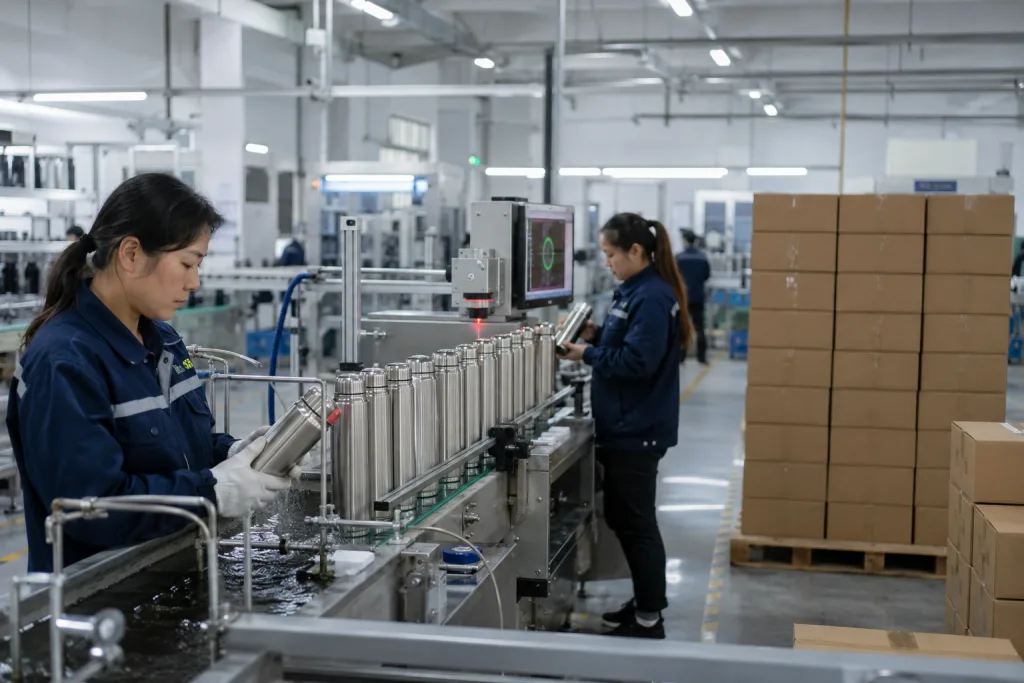
- A practical MOQ for a vacuum flask customized order is 1,000 pcs per color, with 25-35 day production after sample approval
- 304 stainless steel at 0.45-0.55 mm body thickness is the normal baseline for retail-grade bulk thermos programs
- Laser engraving is stable for 10,000+ pcs runs, while silkscreen needs tighter artwork and rub testing
- Use AQL 2.5 for major defects and require 100% leak testing before carton packing
You have a real order to place: 3,000 stainless vacuum flasks for an outdoor retail launch or a promotional thermos campaign. The buyer wants a clean logo, the sales team is pushing for USD 0.18 off the unit price, and your warehouse does not want 42 cartons showing up with leaking lids or powder coating scratches wider than 2 mm. We see this on the line.
A vacuum flask customized project is not hard. The wrong question is “how cheap can we make it?” At our Hangzhou, Zhejiang factory, we quote, sample, produce, and QC factory thermos orders every week; QC pulled one pre-shipment sample last month because the silicone ring sat 0.6 mm proud and failed the upside-down leak test. The difference between a smooth shipment and a claim usually comes down to 12 details locked before the deposit is paid.
Start With The Actual Selling Use
Do not start with the logo. Start with where the bottle will sit and how the buyer will beat it up. An outdoor retailer usually needs a vacuum flask customized for shelf impact, dent resistance, and fewer returns after the first winter season. A promo brand is often fighting a ship date, a 42 mm imprint window, and carton marks that match the PO exactly. Same stainless thermos category. Different build sheet.
For a 3,000 pc custom thermos order, we ask the sales channel before we quote: retail store, online marketplace, corporate gift, event giveaway, or distributor thermos inventory. If the flask goes into outdoor stores, we normally push 750 ml or 1,000 ml with a powder coated 304 stainless body; the math doesn't work on a cheap 500 ml unit after one drop test and two bad reviews. For conference thermos promotional stock, 500 ml can be enough, and freight cost per carton matters more. We run the carton cube on a tape measure before the price sheet goes out.
Decide the user context early. Hiking and camping buyers expect a lid they can open with gloves, a cup cap that does not feel like 0.4 mm tin, and heat retention that survives real use. Office gift buyers usually flag laser logo sharpness and color drift between approved sample and bulk. QC pulled one matte black sample last month because the coating showed a scratch after 20 rubs with 3M tape. A customizable thermos for retail needs a stronger finish test than a one-day event giveaway.
Our first working spec usually includes capacity, finish, lid type, logo method, packaging style, target FOB price, compliance market, and delivery date. For Europe and North America, we also ask whether you need LFGB, FDA, REACH, Prop 65 screening, or BSCI documentation. China can make almost any thermos customized design, but a loose brief creates loose costing; we've seen this go sideways when the PO says “blue” and the approved sample is Pantone 2965C. Zhejiang factories are fast, not magic.
Lock The Stainless Steel Specification
The body material is where 6 thermos supplier quotes can stop matching each other. One low quote may hide thinner steel, a lighter PP lid, or a vacuum gap squeezed by 1-2 mm. For a serious manufacturer thermos program, write the inner wall and outer wall in the PO, not just “stainless steel.” The common retail baseline is 304 stainless steel inside and outside, with about 0.45-0.55 mm body wall thickness before forming. Some budget thermos bulk orders use 201 stainless steel outside. We don’t like it for outdoor retail; QC pulled 3 salt-spray samples last season with rust dots around the bottom seam, and the buyer’s chargeback killed the saving.
For vacuum performance, define the test condition instead of accepting “keeps hot 12 hours” on a sales sheet. We run it this way: fill the flask with 95°C water, close the cap, leave it at 20°C ambient temperature, then measure after 6 hours with a probe thermometer through the mouth. For a 750 ml double-wall vacuum flask, a well-built unit should hold above 65°C after 6 hours. Bigger capacity often performs better than smaller capacity because the surface-to-volume ratio works in its favor. Short answer: test it. We’ve seen this go sideways when a buyer compared our 750 ml result against another factory’s 1000 ml lab photo.
Weight tells the truth. If two suppliers thermos quotes differ by USD 0.35 and one sample feels light in hand, ask for the gram weight and steel thickness before approving the counter sample. A 750 ml flask might be around 420-520 g depending on lid, coating, and cup cap. Light is not always bad, but unexplained lightness means material was removed somewhere. On the line, we check random samples on a 0.1 g digital scale; one PO even had “450 g” typed as “405 g,” and the buyer flagged it before deposit.
For outdoor retailers, we recommend a powder coated finish with a 3M tape adhesion test, a 50-cycle dishwasher discussion if the channel needs it, and a drop test from 90 cm on packed product. Mirror polish looks good in a sample room but scratches fast in a warehouse carton, especially when 24 pcs rub against divider edges during truck transfer. The math doesn’t work for outdoor retail returns. A thermos manufacturer that sells into North America should be comfortable putting these tests into the purchase order, including AQL 2.5 and the exact drop-test corner sequence.
Choose Logo Method Before Pricing
Logo decoration moves unit cost, lead time, and reject rate, so choose the logo process before you compare FOB quotes on a vacuum flask customized order. Laser engraving is the safest choice on powder coated 304 stainless because the beam cuts through the coating and shows the metal below, with no ink adhesion fight later. On our Hangzhou line, we check logo depth with a 10x loupe after the first 20 pcs, then QC pulls 5 samples from each carton stack for position drift. For 3,000 pcs, laser is usually USD 0.08-0.18 per position depending on logo size and machine time.
Silkscreen costs less for plain one-color artwork, often USD 0.05-0.12 per position, but curing is where orders go wrong. Thin lines, 2 mm legal text, or a logo sitting near the bottle shoulder can turn a cheap print into a headache because the screen does not sit flat on that curve. We run a 3M tape test and an alcohol rub test after oven curing, and QC pulled the sample last month when black ink lifted after 12 rubs. If ink lifts at sample stage, betting that mass production will behave better is the wrong question to ask.
For a premium custom thermos retail program, debossed silicone patches and metal badges can look good, but MOQ, tooling, and assembly risk move up fast. A new metal badge mold can cost USD 120-300, and we normally ask for 1,000 pcs MOQ because the press fixture and glue jig need setup time. Full-wrap sublimation is possible too, but seam control is strict; the buyer flagged a 1.5 mm misalignment on a trial run and the math did not work for a rush launch. If your launch date is locked, keep the first order simple and tune the second order after sell-through data.
Send AI, PDF, or EPS vector files, not a logo copied from a website header. Pantone codes beat screenshots every time because the spray room and print room both need a target, and a PO typo like “Panton 186C” can cost 2 days while we confirm the shade. For a promotional thermos, confirm imprint size in millimeters, not “large logo.” A sensible front logo on a 750 ml flask may be 45 mm wide; a vertical outdoor brand mark may be 70-90 mm high. We can make samples fast when the artwork is production-ready.
Build A Quote You Can Compare
A clean quote for a bulk thermos order should not be one line. Ask each thermos supplier to quote against the same sheet: 304 stainless inner and outer body with wall thickness noted in mm, exact capacity by fill test, lid construction with gasket material, surface finish, logo method, inner box artwork, carton quantity, compliance documents, Incoterm, and sample cost. If one supplier’s thermos price is 12% lower, check what changed. QC pulled a sample for a buyer last month and found the “same” lid had a thinner PP insert and a 0.4 mm lighter silicone ring.
At BottleForge Industrial in Hangzhou, Zhejiang, a normal MOQ is 1,000 pcs per color for standard stainless thermos models. For private color powder coating, 1,000-2,000 pcs per color is more realistic because the coating line needs setup time, powder recovery, and color-change cleaning in the spray booth. We run a 45-60 minute purge before switching from matte black to light cream, or the line gets specks. Our monthly capacity for stainless vacuum flasks is about 450,000 units/month across standard drinkware lines, but Q3 space still needs booking 6-8 weeks ahead for shipments from China.
For guidance, a 500 ml standard customized thermos may sit around FOB Ningbo or Shanghai USD 3.20-4.80, mostly driven by lid tooling, coating type, and logo process. A 750 ml retail-grade vacuum flask may be USD 4.20-6.50. A 1,000 ml flask with cup cap, handle, and heavier coating can move into USD 5.80-8.20. These are working ranges, not promises. Steel price, exchange rate, and packaging move; the math does not work if a quote ignores a 320 g body weight that our line checked on the digital scale.
Packaging is often underestimated. A plain white box might add USD 0.12-0.20. A printed color box can add USD 0.25-0.55 depending on paper grade and quantity. Retail hangtags, barcode labels, FNSKU labels, warning inserts, and master carton marks all need to be specified on the PO. Small detail, big headache. We have seen this go sideways when the buyer flagged one digit wrong on an FNSKU label after QC pulled the packed carton. A thermos distributor that sells to multiple retailers should confirm 76 cm carton drop strength and pallet height early, not after production.
Approve Samples Like A QC Inspector
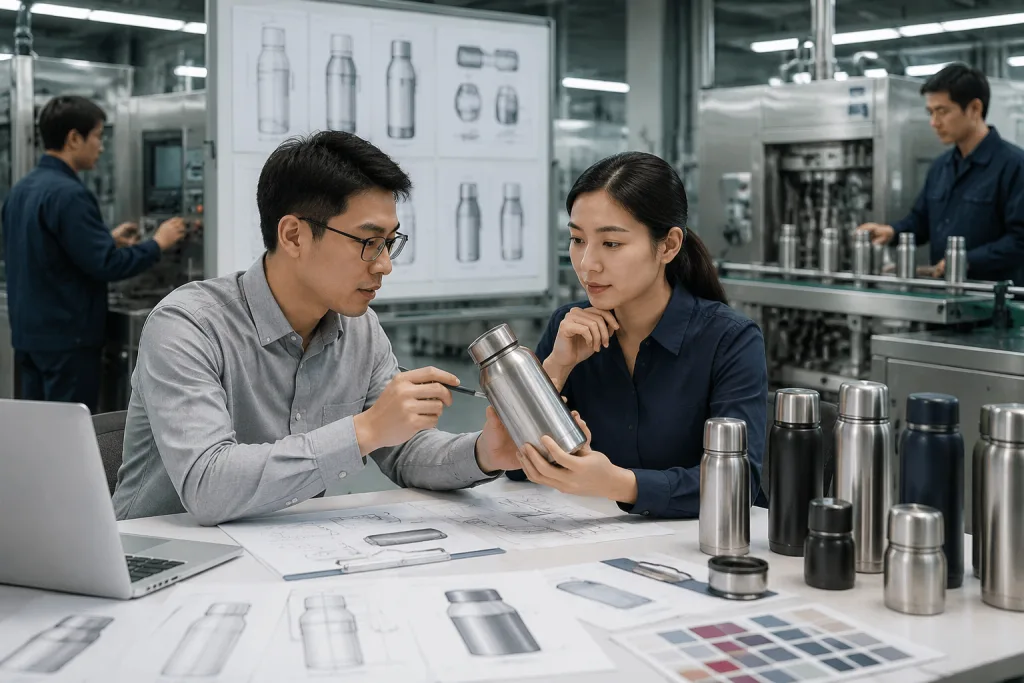
The pre-production sample is not a souvenir. It is the control sample for the whole thermos custom order. When it lands on your desk, put calipers on it: height in mm, body diameter, mouth opening, empty weight, filled weight, lid thread feel, cup cap fit, logo position, coating texture, and color in normal daylight. We run this check with a 0.02 mm digital caliper and a 5 kg bench scale. Photos miss too much. If your team approves by photo only, you just accepted risk nobody checked.
For color, use a Pantone reference or a physical color chip. Powder coating on stainless steel does not always match paper Pantone perfectly, so write the tolerance on the approval sheet. For 500 outdoor retail bottles, Delta E below 1.5-2.0 is a tight target; below 3.0 is more realistic for commercial production depending on color. Matte black is easy. Cream and sand are where we see trouble. Last month QC pulled a pale blue sample under the light box and the buyer flagged it as “too gray” even though the PO only said “blue.”
Heat retention should be tested on the sample before deposit if performance is a selling point. Fill with 95°C water, leave at 20°C room temperature, and record at 1 hour, 6 hours, and 12 hours. Do not open the lid every 20 minutes. For cold retention, use chilled water or ice water and keep the method consistent. If the sample fails, ask whether it is a one-off vacuum issue or a structural issue in that model; this is the wrong question to leave until 3,000 pcs are packed in export cartons.
Ask for a signed golden sample or at least a dated sample approval sheet with photos and measurements. Our China QC team keeps one approved sample at the factory and asks the buyer to keep one. During production, the line supervisor compares first pieces against the approved sample before mass packing. Simple habit. It prevents arguments about what “approved” meant, especially when the buyer’s PO has a typo like “logo 38 mm from bottom” but the artwork file shows 48 mm.
Control Production And Shipment Risk
After the deposit lands, we run the order by checkpoints, not by hope. For a manufacturer thermos order, normal lead time is 25-35 days after sample approval for 3,000-10,000 pcs, with standard molds and regular packaging. Add 7-10 days for custom color boxes, new straps or lids, or third-party lab testing. Before Christmas or spring promotion peaks, book at least 45 days ahead. The line gets tight fast in Zhejiang. Last November, one PO came in with “matte black” in the email and “gloss black” on the attachment; our merchandiser caught it before the paint shop mixed 18 kg of powder.
For QC, ask for incoming material check, first-piece approval, in-line inspection, 100% leak test, vacuum performance sampling, appearance inspection, and final AQL inspection. Do not skip the leak tank. For final inspection, about 8 out of 10 overseas buyers we work with use AQL 2.5 for major defects and AQL 4.0 for minor defects. Critical defects such as leaking, sharp burrs, wrong material contact surface, or unsafe packaging need zero tolerance. QC pulled the sample from cavity No. 4 last month because the lid thread gauge felt rough after 20 turns.
Common major defects include leaking caps, poor vacuum, logo position over 2 mm from tolerance, coating chips, visible dents, dirty inner wall, loose handle, and barcode mismatch. Minor defects include tiny dust points, slight color variation inside tolerance, or small carton scuffs. Put these in the QC checklist. No checklist, no argument. A thermos factory cannot follow standards that were never stated, and we have seen this go sideways when a buyer says “premium finish” but gives no Pantone number, no gloss range, and no approved golden sample on the packing table.
For logistics, decide FOB, CIF, DDP, or FCA before packing starts. Outdoor retailers often choose FOB Ningbo or Shanghai and use their own forwarder. Promotional brands sometimes ask for DDP to one warehouse, but the math does not work without carton dimensions, HS code, and destination postal code. If you ship to an online warehouse, FNSKU labels, suffocation warnings, carton weight limits, and master carton dimensions must match platform rules. We check this before goods leave Zhejiang; one buyer flagged a 16.8 kg carton limit after packing, and repacking 312 cartons cost 2 extra days.
Send Your Flask Brief For A Factory Quote
Share capacity, logo, quantity, market, and delivery date. We will return a practical Zhejiang factory quote with MOQ, lead time, and QC options.
Frequently asked questions
What MOQ should I expect for a vacuum flask customized order?
For standard stainless thermos models, expect 1,000 pcs per color as a practical MOQ from a China factory thermos supplier. If you need a custom powder coating color, 1,000-2,000 pcs per color is more realistic because the coating line has setup loss. For a fully new mold, the MOQ often starts at 5,000-10,000 pcs, plus tooling cost from USD 1,500 to USD 8,000 depending on body, lid, and accessories. If your first order is for market testing, use an existing mold and customize logo, color, packaging, and inserts. That gives you a real customized thermos without spending 60 days on tooling.
How long does a custom thermos order take from sample to shipment?
A normal thermos customized order takes about 7-12 days for logo sample preparation and 25-35 days for mass production after sample approval and deposit. Add 5-10 days for printed retail boxes, special accessories, or third-party tests such as LFGB, FDA, REACH, or Prop 65 screening. Sea freight to the US West Coast may take around 18-28 days port to port, while Europe often takes 30-40 days depending on route. If you are planning a promotional thermos campaign with a fixed event date, do not count backward from the event only. Leave at least 10 extra days for inspection, customs, and warehouse receiving.
Which logo method is best for outdoor retail stainless flasks?
For outdoor retail, laser engraving is usually the safest logo method because it will not peel, crack, or fail an ink adhesion test. It works especially well on matte powder coated stainless steel and costs around USD 0.08-0.18 per position on common order sizes. Silkscreen can be fine for a simple one-color promotional thermos logo, but you should require a tape test and alcohol rub test before production. Full-wrap artwork and multi-color printing can look attractive, but they add setup cost and defect risk. If the bottle will be handled in shops, packed in backpacks, and washed often, choose durability over clever decoration.
How do I compare quotes from different thermos manufacturers?
Make every thermos manufacturer quote the same written specification. Include capacity, 304 or 201 stainless steel, wall thickness, lid material, powder coating type, logo method, packaging, carton quantity, compliance documents, FOB port, and lead time. A USD 0.40 difference may come from thinner steel, cheaper lid gasket, lighter coating, smaller carton, or no inspection cost. Ask for unit weight in grams and packed carton dimensions. For a 750 ml manufacturer thermos, a quote without material grade, logo cost, and packaging detail is not a real comparison. You are not buying a photo; you are buying a controlled production result.
What QC tests should I require before paying the balance?
Require a final inspection before balance payment and shipment release. For a 3,000 pc thermos bulk order, use AQL 2.5 for major defects and AQL 4.0 for minor defects, with zero tolerance for critical safety defects. The checklist should include 100% leak testing, vacuum performance sampling, lid torque or fit check, logo position measurement, coating adhesion, barcode scan, carton drop condition, and quantity count. Pull random units from packed cartons, not only from the production line table. If you are buying for retail, keep approved golden samples in both your office and the factory. That makes disputes much easier to solve.