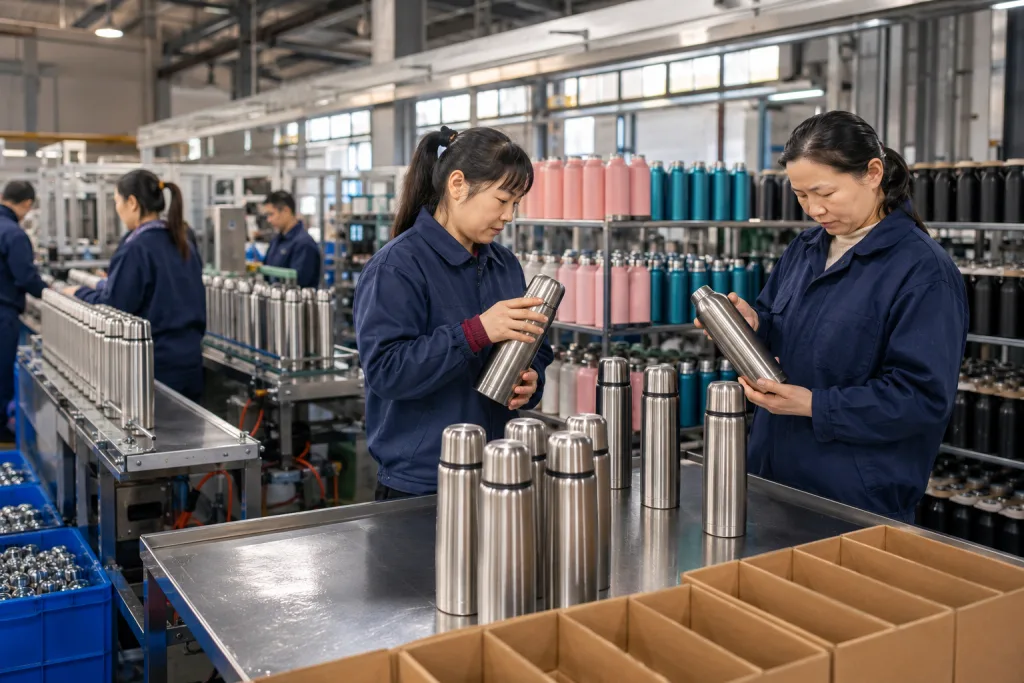
Key Takeaways
- 304 stainless inner wall at 0.4 mm is the normal baseline for export vacuum flask customizable projects
- MOQ is usually 1,000 pcs per color for powder coating and 500 pcs for laser logo on stock colors
- Retail outdoor programs need 12-24 hour insulation testing, not just a catalog claim
- FOB Ningbo or Shanghai lead time is typically 30-45 days after artwork and deposit approval
A vacuum flask customizable for retail shelves is not the same item as a giveaway bottle with a logo. Outdoor retailers ask us about lid drop tests, 12-hour heat claims, color ΔE under 1.0, 5-layer export cartons, and spare gaskets. Promotional buyers usually push on FOB price, 7-day logo proofing, and whether the artwork file matches the PO. Buy both the same way and the math doesn’t work; one channel pays for parts it will never sell.
From our Hangzhou, Zhejiang factory work, “best thermos” is the wrong question to ask. We look at wall gauge, 500 ml or 750 ml capacity, powder coating, lid structure, logo process, and the test standard your buyer will check. China can make low-cost flasks every day. The harder job is keeping a custom thermos on schedule when QC pulled the sample and found a 0.3 mm lid gap two days before carton drop testing.
Spec table before artwork
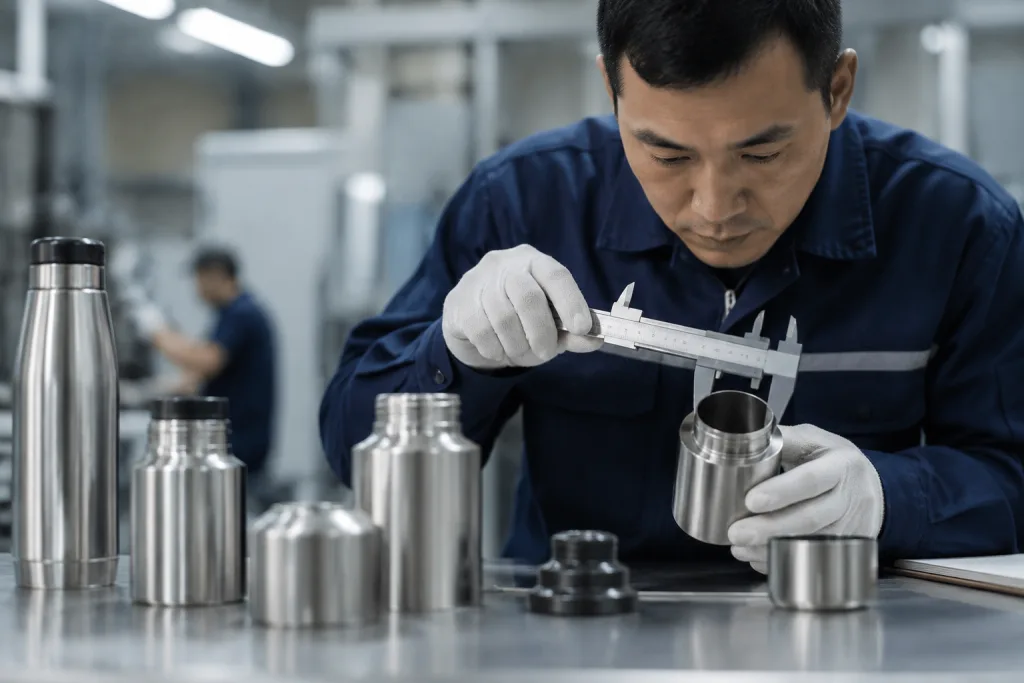
Most new buyers open the brief with the logo. Wrong question. For a vacuum flask customizable project, the base spec sets the cost, lead time, vacuum reject rate, and whether the bottle feels like an outdoor retail item or a giveaway thermos. We run this check before artwork: caliper on wall thickness, magnet check on 201 outer shells, and one drop test from 1.2 m on the packed carton. Use the table below before asking any thermos supplier for pricing.
| Spec choice | Outdoor retail fit | Promotional brand fit | Factory comment |
|---|---|---|---|
| 304/304 stainless steel | Best for premium retail and food-contact confidence | Good, but may push price up USD 0.25-0.45 | Common for EU and North America; QC checks material certs before mass production |
| 304 inner / 201 outer | Acceptable for price-sensitive ranges | Strong cost option | Keep salt-spray expectations realistic; we have seen buyers reject this after coastal use complaints |
| 0.4 mm inner wall | Better dent resistance and vacuum stability | Good for courier handling and rough warehouse loading | Below 0.35 mm saves money but feels light; the line checks this with a digital thickness gauge |
| Powder coating | Best grip and shelf appearance | Good for brand colors | MOQ usually 1,000 pcs per color; Pantone mismatch is the buyer pushback we hear most |
| Laser engraving | Premium, permanent, low defect risk | Good for small logo runs | Works well from 500 pcs on stock colors; QC pulled the sample when the logo file had a 2 mm line gap |
| Silkscreen print | Fine for simple marks | Lowest decoration cost | Needs abrasion testing for retail; 3M tape and 500-cycle rub tests catch problems early |
For a factory thermos quote, ask the vendor to price the table line by line. A manufacturer thermos team in China can build 20+ variations from the same bottle shape, but some specs do not make commercial sense. If a thermos vendor says every option is “no problem,” ask for test data, carton size, insert material, and packing method. Serious thermos manufacturers answer with wall thickness, lid material, vacuum loss rate, and AQL level; if they only send a logo mockup, the math doesn't work.
Retail flask versus promo flask
An outdoor retailer and a promotional buyer can both ask for a custom thermos, but they score the sample on different things. Retail needs repeat purchase confidence. A hiker uses it on a wet trail, a van customer leaves it rolling under the seat, and a winter commuter checks the cap with gloves on. They notice a squeaky lid pin, powder coating chipped 2 mm above the base ring, or hot water dropping from 95°C to 58°C after 6 hours. QC pulled one sample last month because the lid hinge had a dry rub sound after 300 open-close cycles. Small issue. Big complaint risk.
A promotional thermos has another job. It goes into a conference bag, employee gift kit, insurance campaign, or December giveaway. The logo needs clean edges, the price has to sit inside the buyer’s budget, and the delivery date cannot slide from the 12th to the 18th because the event hall will not wait. A 500 ml thermos promotional order with one-color silkscreen may be acceptable at USD 3.20-4.20 FOB China, while the same capacity retail model with 304/304 steel, powder coating, retail box, and leakproof push lid may land at USD 5.80-8.50 FOB. We run both, but the math changes fast when the buyer asks for PMS-matched coating, individual barcode stickers, and 1,000 pcs per design MOQ.
This is where a head-to-head comparison earns its place. If you need a distributor thermos for outdoor shops, choose a stronger lid hinge, thicker coating, and a retail carton with EPE inserts that survived a 76 cm drop test in our packing room. If you need distributors thermos stock for corporate resellers, choose standard molds and stock colors, then use fast laser engraving on the 20W fiber machine. For thermos bulk orders, the hidden cost is not unit price alone. Rework, late vessel booking, failed barcode labels, and carton crushing can wipe out more margin than saving USD 0.18 on steel gauge; we have seen this go sideways when a PO typo changed “matte black” to “metal black.”
Good sourcing is not buying the most expensive flask. It is cutting the wrong features before the line starts.
Materials and safety standards
For a stainless vacuum flask customizable order, we usually quote 304 stainless steel for the inner wall, 304 or 201 stainless steel for the outer shell, a silicone sealing ring, and PP lid parts. For EU and North America, ask for LFGB or FDA food-contact testing based on the sales market. Europe needs REACH screening on coating and printed inks, especially bright colors and soft-touch finishes; last month QC pulled a matte green sample with a 0.18 mm coating build-up near the logo edge, and the buyer flagged it before shipment.
Outdoor brands often ask whether 316 stainless steel is necessary. For most drinkware, this is the wrong question to ask. 316 makes sense in harsher corrosion conditions, but for coffee, tea, water, and soup, 304 inner steel is the working standard we run on the line. Put that budget into tighter lid tooling or stronger powder coating instead; the math works better. We have seen 316 add 12-18% to the steel cost while the real complaint on a PO was a lid gasket gap of 0.6 mm.
For children’s or family outdoor lines, check ASTM-related mechanical safety where applicable, and avoid small detachable parts. For adult retail flasks, focus on leak testing, coating adhesion, lid torque, and heat retention. A reasonable QC protocol is AQL 2.5 for major defects and AQL 4.0 for minor defects, with 100% leak testing at the thermos factory before final packing. We run the leak station at 0.6 MPa air pressure, and if 3 pieces fail in a 200-piece inspection lot, QC stops packing.
Our Zhejiang production partners typically run 300,000-500,000 stainless drinkware units per month across bottle and flask lines, with vacuum loss checks during assembly. Scale matters because a customizable thermos order needs repeatable welding, polishing, pumping, and coating. China has plenty of thermos suppliers, but not every supplier thermos offer comes from controlled production. Ask who owns the mold, who performs vacuum testing, and where final inspection happens; we have seen this go sideways when a PO had the color code typed as PMS 186C instead of PMS 185C, and 8,000 shells were already in coating.
Logo method head-to-head
Decoration is where buyers burn time. The right thermos custom logo method depends on surface finish, order quantity, artwork detail, and real use. We had a buyer push for full-wrap print on a rough powder coat; QC pulled the sample after 50 tape pulls because the edge started lifting near the seam. For outdoor retail, abrasion matters. For a corporate gift, the unboxing look may beat 5 years of trail scratches.
Laser engraving
Laser is the safe pick for most stainless models we run. It is permanent, clean, and avoids ink compliance questions. On powder coated bodies, the laser head removes the coating and shows 304 stainless underneath, usually with a 0.08-0.12 mm line width depending on the artwork. MOQ can be 500 pcs if you accept stock body colors. It fits a thermos customized with a simple logo, club mark, or outdoor retailer private label. The catch is color. You usually get a metallic mark, not Pantone print.
Silkscreen printing
Silkscreen keeps the math clean for one- or two-color logos. We ship plenty of promotional thermos orders this way when the buyer needs a sharp unit cost. Setup is modest, but curved bodies, 180 mm wrap designs, and textured coatings raise the reject rate fast. Ask for 3M tape testing and abrasion testing if the product will sit in retail; on one order, the buyer flagged 7 pcs from a carton because the white ink rubbed at the thumb position.
Heat transfer and digital print
Use heat transfer or digital print when the artwork has gradients, full-color graphics, or a bigger print area. They cost more and need tighter artwork control. A 300 dpi file is not optional here. For a thermos customizable with seasonal graphics, the result can look strong, but confirm color tolerance before mass production. Pantone variation of ΔE 1.5-2.5 is realistic on many coatings; exact paper-to-metal matching is the wrong promise to make.
A serious manufacturer thermos quotation should list logo size in mm, setup charge, per-piece decoration cost, and sampling time. We also add print position from the bottom, usually like “logo center 95 mm above base,” because one PO typo of 59 mm vs 95 mm can send the line sideways. If the thermos suppliers quote only “logo included,” you do not have a workable quote yet.
Capacity and lid choices
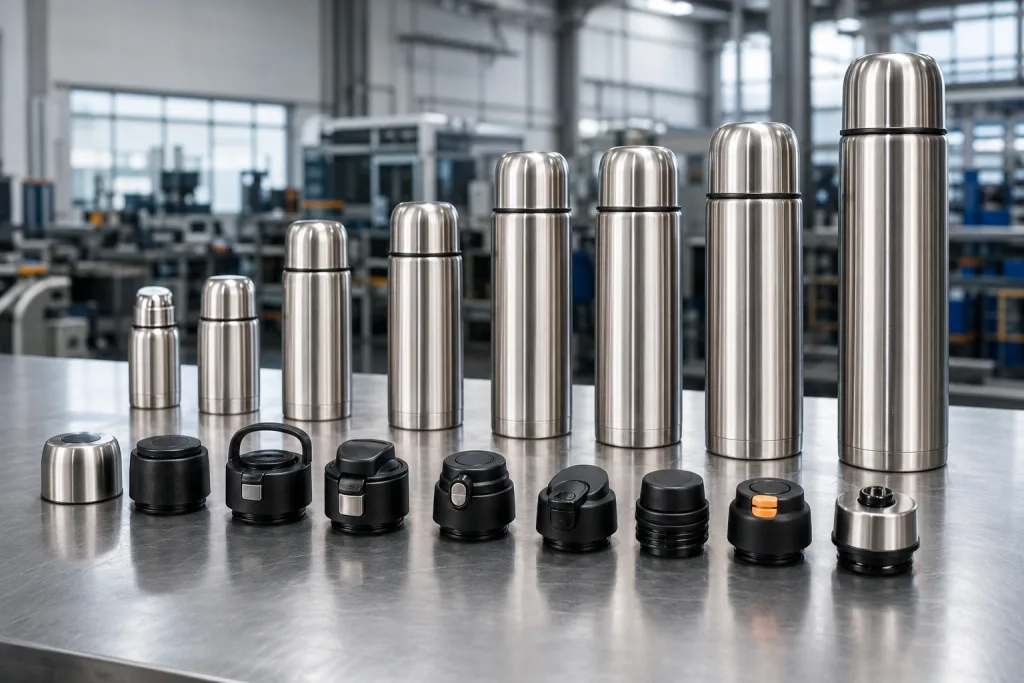
Capacity is not just a label on the sales sheet. It changes gram weight, carton CBM, shelf price, and the heat test result QC writes down after the 12-hour check. A 350 ml flask works for commuting and event gifts; our line usually packs it in a 7.2 cm gift box, 50 pcs per export carton. A 500 ml bulk thermos is still the size buyers ask for most in retail and promo orders. Once you move to 750 ml or 1,000 ml, the product fits camping, fishing, field work, and winter sports, but the freight math gets tougher because the carton turns bulky before it turns heavy.
For outdoor retailers, lid design deserves more attention than body shape. This is where we have seen projects go sideways. A screw cap with an internal stopper is reliable, and the cleaning brush reaches the seal groove without drama. A push-button lid feels convenient, but it adds springs, silicone seals, and at least 3 more inspection points on the QC table. A cup lid suits classic vacuum bottles, especially 750 ml and 1,000 ml models. For a distributor thermos line, we usually push back if the first-season PO asks for 4 lid systems; 2 is cleaner. Too many spare parts make after-sales messy, and the buyer flags it six months later when one gasket code is typed wrong on a reorder.
Typical insulation targets should be written into the purchase order, not agreed by chat screenshot. For a 500 ml double-wall vacuum flask, a practical benchmark is hot water at 95°C remaining above 55-60°C after 12 hours at 20°C room temperature, depending on mouth diameter and lid design. We run this with a digital probe thermometer and record the mouth size in mm because a 42 mm opening and a 58 mm opening do not behave the same. For cold retention, 12-24 hours is realistic with ice water, but marketing claims should match your test method.
If you are building thermos bulk stock for distributors, choose proven capacities: 500 ml for retail turnover, 750 ml for outdoor shelves, and 1,000 ml for family or worksite use. If you are building a promotional campaign, 350 ml and 500 ml keep freight and gift box cost under control; we ship these sizes with fewer carton complaints. Custom mold development is possible, but it normally adds USD 2,000-8,000 tooling cost and 25-35 days before first samples. Use existing molds unless shape is central to your brand. Most of the time, the math doesn't work for a new mold under 3,000 pcs per color.
MOQ, pricing, and lead time
For a vacuum flask customizable order from Zhejiang, MOQ comes down to what we must change on the line. Simple laser logo on stock black, white, or navy can run from 500 pcs per SKU; our laser operator checks logo size on a 110 mm print window before we quote. Custom powder coating usually needs 1,000 pcs per color because the spray booth, curing oven, and color change cleanup take half a shift. Full custom packaging, Pantone body color, or a special lid is safer at 2,000-3,000 pcs. Below that, the math doesn't work after carton plate cost, component purchasing, and coating line setup.
Indicative FOB China pricing for a 500 ml stainless custom thermos is usually USD 3.20-4.50 for a basic promotional build, USD 4.80-6.50 for a stronger retail-grade model, and USD 6.80-9.50 for premium coating, 304/304 steel, upgraded lid, and retail box. These are working ranges, not promises. Steel price, RMB/USD rate, peak-season capacity, and inspection level can move the quote by USD 0.15-0.40 per piece. QC pulled one sample last month where the buyer wanted AQL 2.5 plus 100% vacuum testing, and that changed labor cost. If a thermos manufacturer quotes far under market, check steel grade, wall thickness in mm, vacuum test rate, and 5-ply carton spec first.
A normal timeline is 5-7 days for digital artwork approval, 7-12 days for pre-production sample, 30-45 days for mass production after deposit and sample approval, and 3-7 days for final inspection and export paperwork. Artwork is where we see delays: one PO typo changed “matte sand beige” to “matt sand begie,” and the buyer flagged it after the sample was already sprayed. FOB Ningbo is common for our Hangzhou, Zhejiang location; FOB Shanghai also works. For North America, add ocean freight time and send Amazon FBA labels or FNSKU files before carton printing. For Europe, confirm EAN labels, carton marks, and language requirements before we release the box dieline.
Payment terms are commonly 30% deposit and 70% balance before shipment for new buyers. Established distributor thermos programs can discuss better terms after 2-3 clean repeat orders, but first orders should focus on control, not credit. We've seen this go sideways when a buyer pushes for open account before the factory has even verified the bank details and packing list format.
Inspection before shipment
A thermos factory can make a clean sample and still ship a weak bulk order if inspection is loose. We have seen this go sideways on a 3,000 pcs run: the pre-production sample passed, then QC pulled 32 pcs from bulk and found 6 lids with a soft silicone ring. Your PO should lock the inspection standard before the line starts welding. For stainless flasks, check appearance, capacity, weight, coating adhesion, logo position, barcode scan, carton drop result, lid fit, odor, and leak performance. Photos are not enough. Ask for measured results from a scale, caliper, 3M tape test, and 100% leak test station.
For AQL inspection, use AQL 2.5 major and 4.0 minor as a practical baseline. Critical defects need zero tolerance: leaking, sharp burrs, wrong material, unsafe odor, broken lid, unreadable compliance marking, or incorrect customer logo. For a thermos promotional order, wrong logo color is usually a major defect; one buyer flagged Pantone 186C printed closer to 199C, and the math did not work for a giveaway deadline. For outdoor retail, coating chips and lid leakage are major because they create returns within 7 days of shelf arrival. QC should run a 3M tape pull on the powder coat and a 30-minute upside-down leak check, not just twist the cap twice.
Ask your thermos supplier for a retained golden sample, signed color chip, approved logo position drawing, and packing method photos. Keep them on one approval sheet if possible. If the order is for a distributor thermos warehouse, carton strength matters. A 500 ml flask packed 24 pcs per master carton may need 5-ply export carton, edge protection for gift boxes, and clear shipping marks on two sides. We ship cartons under 15 kg when the buyer’s 3PL asks for hand-carry limits; last month QC rejected 18 cartons because the side mark had a PO typo, “NIGNBO” instead of “NINGBO.” If you ship to Amazon or a 3PL, confirm FNSKU labels and carton weight limits before mass packing.
China sourcing works best when both sides are specific. “Good quality” is the wrong question to ask. “500 ml, 304 inner, 0.4 mm inner wall, powder coat, laser logo 45 mm wide, leak test 100%, AQL 2.5/4.0, retail box, FOB Ningbo, 1,000 pcs per color” is a specification a serious factory thermos team can price and control. We run this against the BOM, logo jig drawing, and carton spec before booking material, because changing a 45 mm laser logo to 52 mm after coating means rework, delay, and a buyer asking why shipment moved from 12 days to 18 days.
Send your thermos spec for a factory quote
Share capacity, logo, color, MOQ, market, and packing needs. We will return practical FOB options from Zhejiang production.
Frequently asked questions
What MOQ should I expect for a vacuum flask customizable order?
For stock body colors with laser engraving, 500 pcs per SKU is often workable. For custom powder coating, plan on 1,000 pcs per color. If you need Pantone coating, printed retail box, custom insert, and a modified lid, 2,000-3,000 pcs is more realistic. The reason is not only factory preference. Coating lines, component purchasing, carton printing, and QC setup all have minimum efficient runs. For a first order, outdoor retailers usually test 1-2 capacities and 2 colors rather than launching 8 SKUs.
Is 304 stainless steel enough for an outdoor custom thermos?
Yes, 304 stainless steel is the normal export standard for the inner wall of a custom thermos used for water, coffee, tea, or soup. A strong build is 304 inner, 304 outer, and 0.4 mm inner wall thickness. 316 stainless steel can be used, but it usually adds cost without much benefit for normal drinkware. For outdoor retail, spend the extra budget on better lid sealing, coating adhesion, and drop-tested packaging. Always request food-contact documentation such as FDA or LFGB, depending on your target market.
Which logo method is best for a promotional thermos?
For most promotional thermos projects, laser engraving or one-color silkscreen is the practical choice. Laser is permanent and low risk, especially on powder coated stainless bodies, and works from around 500 pcs on stock colors. Silkscreen is cheaper when you need a specific logo color, but it should pass tape and abrasion testing if the flask is expected to be reused often. Full-color heat transfer or digital print is better for complex artwork, but it adds cost, sampling time, and tighter color approval work.
What lead time should distributors plan for thermos bulk orders?
A normal thermos bulk order takes 30-45 days for mass production after deposit and sample approval. Add 7-12 days for pre-production samples if the color, logo, or packaging is new. Final inspection and export paperwork usually need another 3-7 days. For FOB Ningbo or FOB Shanghai shipments from Zhejiang, ocean freight time must be planned separately. If the order is for a seasonal outdoor launch, start at least 90 days before your required warehouse date, especially during China holiday periods.
How do I compare thermos manufacturers without only chasing price?
Ask every thermos manufacturer for the same specification sheet: capacity, steel grade, wall thickness, lid material, coating type, logo method, MOQ, sample time, mass lead time, AQL level, and packing details. Then compare FOB price against those exact points. A USD 0.40 cheaper flask may use 201 outer steel, thinner walls, weaker carton, or no 100% leak test. For distributor thermos programs, also ask about spare lids, retained samples, barcode control, and monthly production capacity. Price matters, but uncontrolled returns cost more.