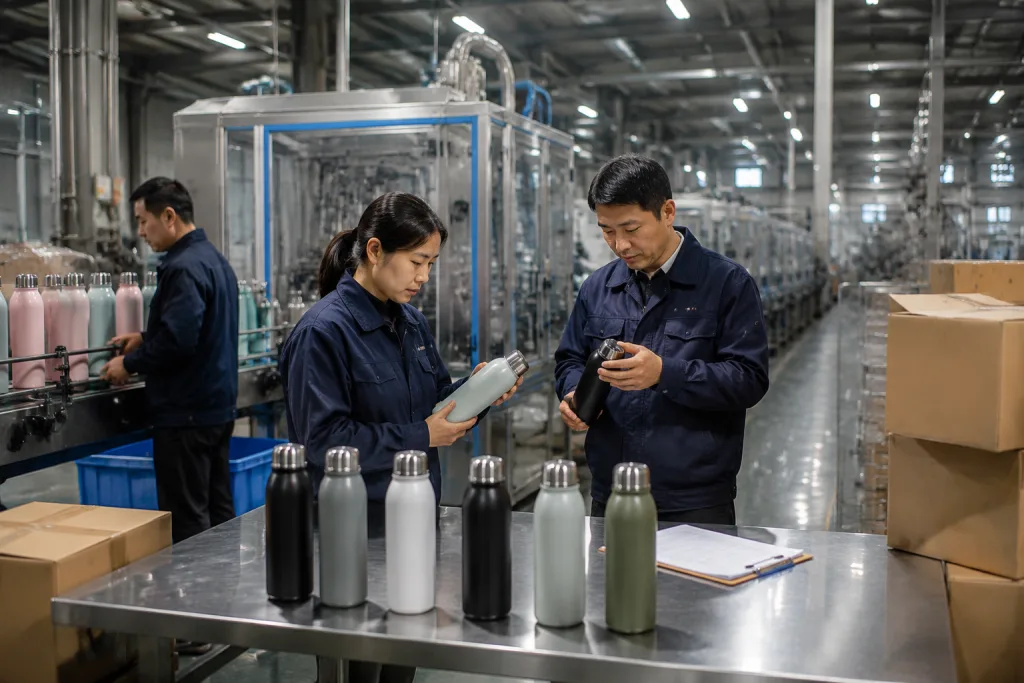
Key Takeaways
- A realistic vacuum flask custom MOQ starts at 1,000 pcs per color for standard 500 ml models
- 304 stainless inner wall at 0.4 mm is common; cheaper 201 interiors are a bad shortcut
- Plan 25-35 days for mass production after sample approval and deposit
- Use AQL 2.5 for major defects and carton drop testing before FOB release
You are not just buying a bottle. You are putting retailer margin and a fixed campaign delivery date into one stainless steel vacuum flask custom order. If the cap leaks at 0.6 MPa on the air-pressure tester, the powder coat shows scratches after 20 passes on the abrasion jig, or the master carton splits in a 76 cm drop test, the argument starts after the goods have crossed the ocean. We have seen this go sideways.
Here is the buyer scenario we see in Zhejiang about 3 times a month: an outdoor retailer or promotional brand needs 8,000 pieces of a 500 ml custom thermos for a Q3 launch. You want a practical brief, not factory poetry. Fair. From our Hangzhou export desk, we turn a loose idea into a supplier thermos order the line can run, QC can measure with calipers, and the buyer can approve before shipment.
Start with the sales job
The first mistake is asking a thermos factory for “your best 500 ml flask” before you decide where the product must win. Wrong question. Outdoor retail and promotional thermos programs fail for different reasons. Retail buyers care about shelf pull, coating that survives a 3M tape test, barcode labels that scan at 300 mm, and repeat quality when they reorder 6 months later. Promo buyers push us on logo position, artwork sign-off in 24 hours, outer-carton marks, and delivery before the event date. We’ve had QC pull a sample because the laser logo sat 2 mm off center; the buyer noticed before we did.
For this buyer scenario, assume you need 8,000 pieces of a 500 ml stainless vacuum flask custom model for an outdoor chain in Europe, with 4,000 pieces matte black and 4,000 pieces forest green. The target is not the cheapest factory thermos. The target is a customized thermos that can retail without embarrassing your brand after two camping weekends. On the line, matte black usually behaves better than forest green; one green batch last season needed 2 extra spray-panel checks because the color drifted under the D65 light box.
The commercial brief should include capacity, lid type, finish, logo method, packing, market, compliance documents, and delivery term. “FOB Ningbo” is cleaner than mixing product price with freight guesses. From Zhejiang, Ningbo port is practical for most stainless drinkware exports, and it cuts the inland trucking bill compared with factories 600 km deeper in China. We run Hangzhou to Ningbo as a normal lane; if the PO says “FOB Shanghai” by mistake, yes, that typo can add a day and make the math ugly.
If you are a thermos distributor or outdoor buyer, write the spec like a purchase order, not a mood board. A serious supplier thermos quote needs this: model capacity, stainless grade, insulation target, color count, logo size, packaging type, inspection level, and shipment deadline. Without those, every thermos vendor can quote a different product and make their price look clever. We’ve seen this go sideways: one buyer asked for AQL 2.5 inspection after price approval, then flagged gift-box dents that should have been defined at carton drop-test stage.
Lock the flask construction
For stainless thermos custom work, the hidden build matters more than the nice 3D rendering. A standard 500 ml vacuum flask we run on the line uses double-wall construction: 304 stainless steel inside, with 201 or 304 outside depending on target price and buyer market. For food contact, 304 inner wall should be the default. No debate there. For mainstream retail, 0.4 mm inner wall plus 0.5 mm outer wall is a workable spec; our caliper check usually allows about ±0.03 mm before QC pulls the sample. Go thinner and you may save USD 0.08 to USD 0.15 per piece, but the math does not work if cartons arrive with dents.
The vacuum layer is made after welding and evacuation, then sealed at the bottom point. You cannot judge that process by looking at a shiny sample on a desk. We use a simple retention test: fill a 500 ml flask with 95°C water, keep the room around 20°C, then read the probe after 12 hours. A reasonable target is above 60°C after 12 hours. Premium models can beat that, but do not accept “keeps hot 24 hours” unless the supplier thermos factory gives the test method, starting temperature, room temperature, and lid status. We have seen this go sideways when a buyer flagged a 24-hour claim printed on the color box, but the lab report only tested 6 hours.
Lids are where small problems become customer complaints. A screw lid with silicone gasket is safer than a complicated push-button lid for outdoor use, especially if the flask goes into backpacks or car cup holders. Push buttons sell well, but every spring, pin, and sliding lock adds leakage risk. For a promotional thermos giveaway, the simpler lid is usually the better call. For retail, test one-hand opening and cleaning access with real samples, not just CAD files; last month QC pulled 3 lids from a 20-piece pre-shipment sample because the gasket sat 1 mm proud after hot-water cycling.
Ask whether the silicone is LFGB or FDA grade, based on your sales market. For Europe, buyers often request REACH and LFGB declarations. For North America, FDA food-contact conformity and sometimes California Proposition 65 documentation may be required. Cheap quotes get dangerous here. If a manufacturer thermos quote ignores these documents, it may be missing the correct gasket compound, ink control, or batch paperwork; we have caught POs where “FDA silicone” was typed in the email but not written on the approved spec sheet.
Choose finish before logo
Buyers often start with logo placement. Wrong order. Pick the finish first, because the coating decides how the logo cuts, sticks, and looks after 30 days in a retail bin. Powder coating is what we run for outdoor retail flasks because the hand feel is better and it handles key scratches better than basic spray paint. On a bulk thermos order, powder coating may add USD 0.25-0.45 per piece versus plain stainless or basic paint, but the math works if it avoids 2 cartons of ugly shelf returns. QC pulled a matte sample last month with a 12 mm scratch from the carton divider, and the buyer flagged it before we even discussed logo size.
Matte black gets approved fast, but it punishes sloppy production. Dust, pinholes, and thin coating around the bottom curve show under a simple LED inspection lamp. Forest green or beige can shift between sample and mass production if the line mixes powder batch numbers, so we write the powder lot code on the sample tag. For 8,000 pieces split across two colors, ask the thermos manufacturer to keep one approved color chip and one signed pre-production sample for each color. Do not accept “same as sample” on the PO without a color chip number. We have seen that go sideways.
Logo method depends on the finish and the job. Laser engraving is durable and clean on powder coating, but the mark color depends on the coating thickness and the 304 stainless base under it. Silk screen gives brighter brand colors and is common for thermos promotional programs, but we still run a 3M tape test and 50-cycle rub check before packing. Heat transfer can handle gradients, though it adds cost and creates more rejection points at the sleeve seam and bottom curve. On one 3,000-piece promo run, QC rejected 74 bottles because the transfer edge lifted after cooling.
For a 500 ml custom thermos, keep a front logo within 45 mm wide unless you have checked curvature distortion on a real printed sample. Round bodies lie. Large horizontal logos can look bent once the bottle turns 20 degrees in the customer’s hand. If you sell through outdoor retailers, subtle laser engraving usually looks more premium. If you sell through campaigns, silk screen or transfer is often the better call because the client wants the logo visible from three meters away. We check this with a paper logo wrap and calipers before opening the screen.
A practical thermos customizable spec should include Pantone color, logo artwork in AI or PDF vector format, logo size in millimeters, position from bottom edge, and acceptable tolerance. Better yet, write “logo center 92 mm from bottom edge” instead of “middle position.” We normally use ±1.5 mm for logo position on cylindrical drinkware, measured with a height gauge on the packing table. Anything tighter needs a real discussion, not a casual promise, because the line will not hold ±0.5 mm on a curved powder-coated body at normal speed.
Price the order honestly
For a standard 500 ml stainless vacuum flask custom project from China, a workable FOB Zhejiang/Ningbo price usually lands around USD 3.20-5.20 per piece. The spread comes from real choices: 201 or 304 stainless inner wall, powder coating thickness around 60-80 μm, push-button or screw lid, laser logo or 1-color print, plain white box or 350 gsm retail box, plus FDA/LFGB paperwork and leak testing. If a quote drops under USD 2.80 while still claiming 304 inner wall, powder coating, retail box, and compliance documents, ask for the BOM. QC pulled a sample last month where the buyer paid for 304/304, but the outer shell tested as 201 on our XRF gun. Cheap had a reason.
MOQ is not one magic number. We run 1,000 pcs per color on an existing mold, but custom Pantone powder needs about 2,000 pcs because the coating line wastes 12-18 kg of powder during color change and oven cleaning. Special caps, silicone colors, or private carton printing can push the working MOQ higher. For BottleForge Industrial in Hangzhou, Zhejiang, a typical MOQ is 1,000 pcs per color for stocked 500 ml and 750 ml bodies, with monthly output around 300,000 stainless bottles and flasks across standard lines. Lead time is commonly 25-35 days after deposit and approved pre-production sample; if the buyer approves the sample on day 6 instead of day 2, the line does not magically stay open.
Tooling only belongs in the quote if you change the body shape, lid structure, capacity, or base design. A new lid mold can cost USD 2,000-6,000 and take 25-45 days before mass production even starts. For a first thermos bulk order, this is often the wrong question to ask. We have seen it go sideways when a retailer spends 38 days arguing about a new flip cap, then misses the spring shipment window. Use a proven body first. Customize the finish, logo, packaging, and accessories after the leak test passes at 100°C water fill and the pre-production sample sits overnight without pressure loss.
Your payment and trade terms change the real cost too. A common structure is 30% deposit and 70% balance before shipment after inspection. For larger distributor thermos programs, we can split production or shipment lots, but do not make the first order messy. The math does not work when a 1,000 pcs trial order has 3 carton marks, 4 mixed colors, and a PO typo showing “matte black” on page 1 but “gloss black” on page 3. FOB Ningbo or Shanghai is usually cleaner than EXW if you are comparing suppliers thermos quotes from China, because it includes local export handling and port delivery.
Low unit price only works when the flask, documents, and cartons match what you approved.
Sample like you mean it
A sample is not a souvenir. It is the control document for the whole order. For a vacuum flask custom order, approve the sample chain if the schedule allows: stock sample for shape, hand feel, lid torque, and insulation; artwork sample for logo size, Pantone match, print position, and rubbing result; pre-production sample for the same 304 stainless, powder coating batch, silicone ring, and assembly process we will run on the line. This is where the math gets real. QC pulled one 500 ml sample last month that looked fine in photos, but the lid thread felt gritty after 20 open-close cycles.
Sample timing is usually 3-5 days for a stock sample, 7-10 days for a logo sample using an existing color, and 10-15 days if custom powder color is required. International courier cost is normally paid by the buyer or charged into the order; DHL to Germany for 2 sample bottles often lands around USD 45-65, depending on carton size. If your launch date is tight, approve the stock construction first and keep artwork development moving at the same time. We run this often: the buyer signs off the body shape on day 4, while our designer fixes the logo file because the PO says “mat black” and the artwork says matte black.
When you receive the sample, test it like a consumer with less patience than you. Fill it with hot water, invert it for 30 minutes, shake it, open and close the lid 50 times, put it in a backpack next to fabric, then check coating marks under desk light. Do the ugly test. A lab can test it with gauges and a temperature logger, but your desk test catches obvious problems early. We have seen this go sideways when a sample passed insulation, then the buyer flagged powder coating scratches after one subway commute with keys in the same bag.
For retail packaging, approve the dieline and barcode before mass printing. If you ship to Amazon or a third-party warehouse, FNSKU or item label placement must be specified in mm, not described as “near the barcode.” If you ship to outdoor retailers, they may require carton markings, PO numbers, inner carton quantities, and pallet height limits, so put those details on the carton artwork before plates are made. The wrong question is “can we fix packaging later?” We ship cartons every week, and 8 late label changes can burn 2 days in the packing area while finished bottles sit wrapped on pallets.
Keep one signed sample at the supplier and one at your office. During inspection, compare mass production against the signed sample, not against a photo buried in an email thread. On AQL 2.5 inspection, the inspector should put the signed sample beside the random cartons and check coating gloss, logo position within 1-2 mm, lid fit, and weight on a digital scale. Photos lie. A signed sample on the table stops arguments fast.
Inspect before cartons leave
Run final inspection when at least 80% of the goods are packed and 100% are produced. For an 8,000-piece thermos customized order, use ANSI/ASQ Z1.4 sampling with General Inspection Level II. We usually run AQL at 0 for critical defects, 2.5 for major defects, and 4.0 for minor defects. If your retailer’s manual says tighter, follow it from the first pre-production sample, not after QC pulled 200 cartons into the inspection area.
Critical defects mean unsafe sharp edges, contamination, broken glass components if any, and serious leakage. Major defects mean failed insulation, wrong logo, coating scratches over 10 mm, loose lids, wrong carton marking, or barcode scan failure on the Honeywell scanner. Minor defects are small dust points, slight color shade variation within the signed tolerance, or tiny packaging rub marks. We’ve seen this go sideways when a buyer treats a wrong logo as “minor”; for retail shelves, that math does not work.
Do not skip thermal testing. Pull a sample set, fill each flask with hot water at a recorded temperature, close the lid, and measure again after the agreed time with a probe thermometer. A 6-hour factory test catches weak vacuum units; a 12-hour test gives better confidence before the line seals cartons. Leakage testing should include inversion, horizontal resting, and shaking. For outdoor use, I also like a lid thread check with a go/no-go gauge, because sand and grit expose weak cap design fast.
Cartons need the same respect as the bottle. A 24-piece master carton of 500 ml flasks can weigh around 12-15 kg depending on packaging. Use 5-ply export cartons for retail-boxed goods when possible, especially for North America. Ask for a carton drop test based on ISTA-style handling: one corner, three edges, and six faces. QC should check compression marks, tape width, and carton dimensions in mm; crushed retail boxes at the distributor thermos warehouse cost more than a stronger carton.
If inspection fails, do not bargain by mood. Separate reworkable defects from non-reworkable defects, set a reinspection date, and hold balance payment until corrective action is finished. A serious thermos supplier will understand this. A weak one will say every defect is “normal.” We had one PO typo list matte black while the artwork said glossy black; the buyer flagged it at inspection, and 600 lids had to be reworked before we could ship.
Ship without creating new problems
Inspection passed does not mean the job is finished. Shipping can still bite. Before we release cartons from the line, we recheck final carton quantity against the packing list, measure carton size with a tape in cm, confirm gross weight on the floor scale, and match the HS code, commercial invoice, shipping marks, and consignee details. For stainless vacuum flasks, the HS classification often falls under vacuum vessels, but your customs broker should confirm the exact code for your destination; we have seen one shipment held 5 days because the PO said “mug” while the invoice said “vacuum bottle.”
If you are a thermos distributors group shipping mixed SKUs, do not let the factory combine cartons casually. This is where the math doesn't work. Each SKU, color, and barcode needs its own carton trail, so QC can pull carton A17 and know it is the 500 ml matte black unit with barcode ending 4826. For a promotional brand, event deadlines matter more than saving USD 0.08 per piece on freight, so book sailing space early. Ocean freight from Ningbo to major European ports may take roughly 30-40 days on water, while to the US West Coast can be around 16-25 days depending on route and congestion.
For Amazon FBA or retail distribution, label rules must be locked before packing. FNSKU labels, carton labels, suffocation warnings for polybags, and pallet requirements are not decorations; the warehouse scanner decides whether your goods move. Last month QC pulled the sample carton and the buyer flagged a 2 mm label offset from their FBA template. Small miss. Big delay. If those labels are wrong, your goods can be delayed even when the custom thermos itself is perfect.
After shipment, keep a production file: approved samples with signed date stickers, QC report with AQL 2.5 photos, material declarations, artwork files, invoice, packing list, and corrective action notes from the line. We keep the same file name as the buyer’s PO, because one typo like “THR-750” instead of “TH-750” can waste half a day during reorder checking. This file becomes your shortcut for the next customizable thermos reorder. Reorders are where sourcing gets efficient. The first order builds the control system; the second order should remove uncertainty, not repeat every argument.
That is how a manufacturer thermos project should run: clear brief with capacity and lid spec, controlled sample signed by both sides, price that includes the real packaging, documented QC, and shipping documents that match carton labels. Not glamorous. It works. We ship for outdoor retailers and promotional buyers every month, and this boring checklist is what keeps expensive surprises out of the container.
Send your vacuum flask custom brief for review
Share capacity, quantity, logo, market, and delivery date. We will return a practical Zhejiang factory quote with MOQ, lead time, and QC notes.
Frequently asked questions
What MOQ should I expect for a vacuum flask custom order?
For an existing 500 ml or 750 ml stainless body, expect around 1,000 pcs per color as a practical MOQ from a China thermos factory. If you need custom powder coating, retail box printing, or a special lid color, the supplier may ask for 2,000-3,000 pcs per SKU because coating and component suppliers also have minimums. For a first order, avoid new molds unless you need a truly exclusive shape. A thermos custom project using a proven body is faster, cheaper, and easier to QC. At BottleForge Industrial in Zhejiang, typical production lead time is 25-35 days after deposit and sample approval.
How do I compare quotes from different thermos suppliers?
Compare the same specification line by line: capacity, 304 or 201 steel, wall thickness, coating type, lid structure, logo method, packaging, compliance documents, AQL level, and FOB port. A USD 0.40 price gap may be real, but it may also hide thinner steel, basic spray paint, no retail box, or no inspection allowance. Ask every thermos supplier to quote FOB Ningbo or Shanghai, with MOQ, sample time, mass lead time, carton quantity, and payment terms. If one quote is unusually low, ask for a cutaway photo, material declaration, and thermal test method before you treat it as comparable.
Is laser engraving better than silk screen for a promotional thermos?
Laser engraving is more durable and works well on powder-coated stainless flasks, especially for outdoor retail where a subtle premium look matters. Silk screen is better when your promotional thermos needs a bright color logo or a large campaign mark. For curved 500 ml bodies, keep the logo width around 45 mm unless the factory confirms distortion is acceptable. For heavy-use giveaways, laser usually survives abrasion better. For short campaign visibility, silk screen may be more effective. Either way, request an artwork sample and run a simple tape test and rub test before approving mass production.
What quality tests should I require before shipment?
Use AQL inspection with 0 critical, 2.5 major, and 4.0 minor defects unless your retailer requires stricter limits. Check appearance, coating, logo position, barcode scan, capacity, lid fit, leakage, and insulation. For insulation, fill the flask with 95°C water and record temperature after 6 or 12 hours at about 20°C room temperature. For leakage, test upright, inverted, horizontal, and after shaking. Also inspect cartons: 5-ply export cartons, correct shipping marks, and drop testing for one corner, three edges, and six faces. Do this before balance payment and before goods leave the China factory.
Can I use one thermos vendor for both retail and promotional orders?
Yes, but the vendor must understand that retail and promotional orders are not the same job. Retail needs stable color, better coating durability, barcode accuracy, retailer carton labels, and lower defect tolerance. Promotional orders usually care more about logo accuracy, event deadline, and budget. A good thermos manufacturer can handle both by changing the control points, not by guessing. For retail, ask for signed pre-production samples and stricter cosmetic standards. For promotion, lock artwork approval and delivery date early. If your supplier treats both orders as simple logo printing, you will eventually pay for that shortcut.