Key Takeaways
- Pantone powder coating usually adds USD 0.18-0.55 per unit at 3,000-10,000 pcs
- A realistic custom thermos timeline is 35-60 days after artwork and sample approval
- MOQ for a standard factory thermos shape starts around 1,000 pcs per color
- New cap or body tooling can add USD 1,200-8,000 and 20-35 extra days
A vacuum flask custom Pantone order looks simple until the buyer asks for a firm ship date and landed cost. Then the quote breaks into 304 stainless thickness, cap mold choice, powder coating vs spray paint, logo process, 5-layer carton spec, AQL 2.5 inspection, and FOB Ningbo or Shanghai. Margin gets decided here. Last month, QC pulled a 500 ml sample with a 0.6 mm body wall and the buyer flagged the Pantone as one shade too blue under the D65 light box.
At BottleForge Industrial in Hangzhou, Zhejiang, we run stainless thermos orders for Europe and North America with typical output around 480,000 units per month. China still works for bulk thermos sourcing, but the math doesn't work if specs move after sampling. Lock Pantone, MOQ tiers, and sample approval dates early; we have seen a PO typo from “matte black” to “metallic black” add 6 days to pre-production approval and push a 20,000-unit line slot from May 12 to May 18.
Start With The Real Unit Cost
For a vacuum flask custom Pantone project, the base unit price is the wrong number to chase first. Ask for the finished, packed, inspection-ready FOB cost. For a 500 ml double-wall stainless flask in 304 inner steel and 201 or 304 outer steel, a normal FOB Ningbo or Shanghai price may sit around USD 3.20-5.80 at 3,000 pcs. A 750 ml bottle often runs USD 4.20-7.20. A 1,000 ml outdoor flask with handle cap or cup lid can move into USD 5.60-9.50 depending on cap structure. On our line, QC pulls 12 pcs from the first carton and checks the actual Pantone panel under a D65 light box before we talk about “final price.”
The price changes because a custom thermos is a stack of components, not one item. The body gauge may be 0.4 mm or 0.5 mm. The vacuum performance may be 6 hours above 60°C or 12 hours above 60°C. The lid may use PP with a silicone ring, Tritan with a flip button, stainless trim, or a separate tea filter packed in a polybag. Each choice changes material cost, assembly speed, defect rate, and testing time. We have seen one buyer approve 0.4 mm on the PO, then flag dents after a 76 cm carton drop test. The math does not work that way.
For outdoor retailers, I quote three versions only when the buyer gives a target shelf price. The entry version uses an existing manufacturer thermos body, one Pantone powder coat, one laser logo, and standard white box. The upgraded version moves to 304/304 steel, a coating thickness around 60-80 μm, plus printed retail carton. The retail-ready version adds color master carton labels, barcode, hangtag, REACH documentation where needed, and AQL inspection before shipment. Small detail, big headache: last month a buyer typed “Pantone Black C” with two spaces on the PO, and prepress stopped the artwork file for 1 working day.
Do not compare a USD 3.40 supplier thermos quote with a USD 4.15 quote until you know the steel grade, coating thickness, leak test method, packaging drop-test expectation, and whether the vendor included logo setup. A low first price from thermos suppliers can vanish once Pantone coating, artwork handling, and export carton specs are added. We run into this every spring: the buyer wants 3,000 pcs at the cheap price, then asks for 5-layer K=K cartons, 13 kg max gross weight, and individual barcode labels. That is a different quote.
Pantone Matching Has A Price
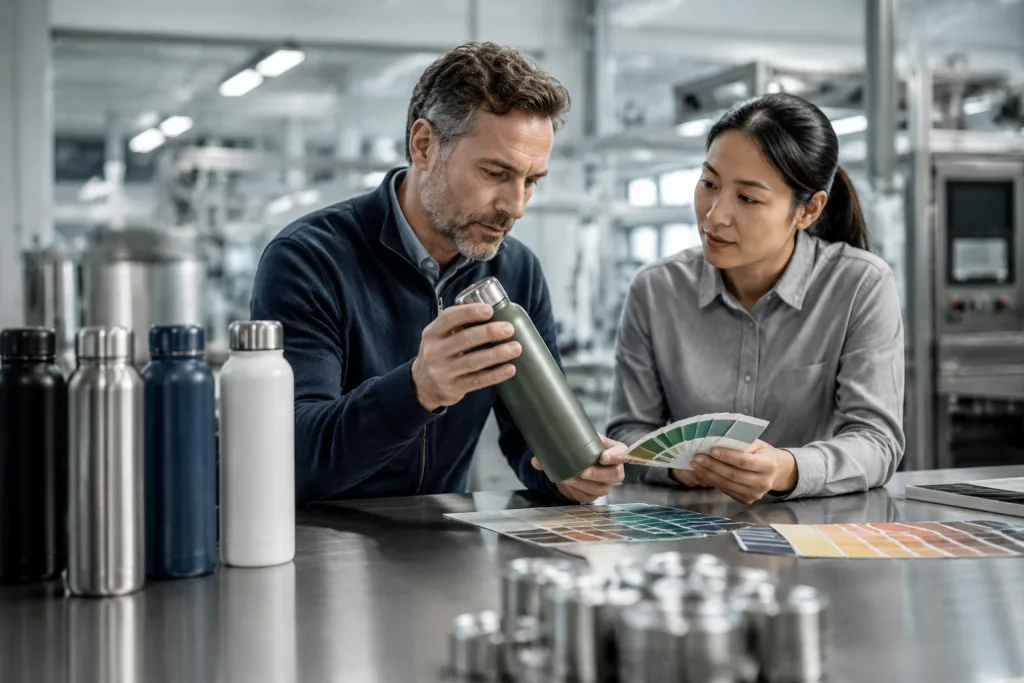
Pantone color is where 6 out of 10 customized thermos projects lose 5-7 days. Powder coating and spray painting do not read like paper printing. A Pantone 186 C red on coated paper can look heavier on a curved 304 stainless body under 6500K warehouse lamps, and QC will see it before the buyer does. Matte texture, gloss level, and 60-80 μm film thickness all move the color. Ask for a coated metal chip. A PDF rendering is the wrong approval tool here.
For stocked colors like black, white, navy, army green, and stainless steel, we usually do not charge color setup once the PO reaches the line MOQ. For a vacuum flask custom Pantone color, expect a color matching fee of USD 80-250 per color, depending on whether the powder supplier already has a close formula. At 1,000 pcs, the per-unit coating premium may be USD 0.35-0.70. At 5,000 pcs, it often falls to USD 0.18-0.40. At 10,000 pcs and above, the premium can be lower if production runs without line change. Last month the buyer flagged Pantone 3435 C as “too blue” after we sprayed 12 sample cups, so we adjusted the powder ratio before mass production.
There is also a practical MOQ. Most coating workshops we use in Zhejiang want 1,000-2,000 pcs per Pantone color because the powder booth, spray gun, and curing oven need cleaning before the next shade. If you ask for 300 pcs each in six colors, the factory thermos price will not scale nicely. The math doesn't work. You may pay small-batch surcharges or wait 18 days instead of 12 days because the line will group your color with another run.
- Matte powder coat: durable, good hand feel, common for outdoor retail; we run it at about 60-80 μm film thickness and it adds about USD 0.20-0.55.
- Gloss spray finish: brighter color, higher scratch visibility; QC pulled the sample last week after carton dividers left rub marks on the shoulder.
- Rubberized soft touch: premium feel, but fingerprints show fast and abrasion testing needs attention, especially after 500 cycles on the RCA tape tester.
- Raw stainless: cheapest finish, but weak for brand color blocking unless the logo area is large enough, usually 35 mm or wider.
If your campaign depends on exact shelf color, approve a pre-production sample under the same lighting your retail team uses, not under our office LED panel. For promotional thermos orders, a close commercial match usually passes. For outdoor brand owners, I would not skip the physical Pantone approval; we have seen this go sideways after a PO typo changed 186 C to 186 U.
MOQ Tiers Change Everything
MOQ is not a punishment from the thermos manufacturer. It is production math. Stainless bottle lines make money when welding, vacuuming, polishing, coating, printing, packing, and inspection keep moving without fresh setup every hour. On our Hangzhou line, one color change means cleaning the powder booth, checking the spray gun, and losing 8-15 kg of powder before the finish reads clean under the D65 light box. For BottleForge in Hangzhou, Zhejiang, a realistic MOQ is 1,000 pcs per model for standard shapes, 1,000 pcs per Pantone color for simple coating, and 3,000 pcs when you add multiple decoration steps or special packaging.
At 1,000 pcs, you are buying a line slot. That is the honest version. The unit price is higher because setup labor, sample work, coating loss, carton plate cost, and QC time sit on fewer bottles. We run this tier for distributor thermos trials or first retail tests, especially when the buyer is still checking sell-through. Expect fewer choices: existing cap, existing body, one logo position, standard packaging. Last month QC pulled the first 32 pcs after silk screen and found 2 logos sitting 1.5 mm off center; at 1,000 pcs, that rework still hurts the cost sheet.
At 3,000-5,000 pcs, your thermos custom project gets easier to run. Pantone coating is simpler to schedule, logo charges spread out, and printed cartons stop looking silly on the quote. A common outdoor-retail split is 2,500 pcs matte forest green and 2,500 pcs sand beige for one SKU. We ship that kind of order often. FOB pricing can drop 6-12% compared with 1,000 pcs if the design is stable and the PO does not arrive with a Pantone typo, like “PMS 7499C” in the artwork but “PMS 7490C” on the purchase order.
At 10,000 pcs and above, manufacturers thermos pricing improves, but only if you do not cut the order into too many small pieces. A 10,000 pc order divided into ten colors behaves like ten small orders. The math doesn't work. A 10,000 pc order in two colors keeps the coating line, laser jig, and carton packing table in rhythm. If you need four sizes, three caps, five colors, and four packaging languages, plan the MOQ by SKU, not by total PO quantity; the buyer flagged this once after asking for 80 carton versions on a “single” 10,000 pc PO.
For buyers new to China sourcing: ask for MOQ per model, per color, per logo method, and per carton version. Those four numbers prevent most quote misunderstandings.
Thermos distributors often ask whether they can mix colors in one MOQ. Sometimes yes, but the price must show it. If the powder color changes four times, the thermos factory still pays for four setups, four booth cleanings, and four first-article checks with the colorimeter.
Logo And Packaging Cost Drivers
Decoration is where a custom thermos turns into brand stock. It is also where the quote starts moving. On stainless and powder-coated flasks, we usually run a CO2 laser for a one-position logo. That adds about USD 0.08-0.20 per unit, with a low setup fee and solid wear resistance. Silk screen print is cheaper on paper at USD 0.06-0.18 per color per position, but the line has to control ink match, curing time, and adhesion, or QC pulls the sample. Heat transfer and water transfer work for bigger artwork, though curved bottles push up labor and scrap.
For outdoor retail, I pick laser for technical brands and one-color screen print for promo logos. That is the right question, not “can we print everything?” Full-wrap art looks good in a mockup, but on cylindrical stainless the seam needs tight control. Our normal registration tolerance is ±1 mm. If your art has a thin line crossing the seam, the buyer will flag it in approval, and we have seen that go sideways fast.
Packaging can bite harder than buyers expect. A plain white box usually lands at USD 0.12-0.25. A printed color box with 350 gsm paperboard runs USD 0.25-0.55. A retail box with insert, matte lamination, and barcode area can reach USD 0.60-1.20. If you sell on marketplace channels, FNSKU labels, carton labels, polybag warnings, and master carton weight limits need to be locked before the line starts. Reworking 5,000 packed bottles is ugly, and the math does not work.
For a custom thermos program, packaging also changes damage rate. A 1,000 ml flask in a thin box may pass the drop check on the factory table and still fail in distributor handling. We usually push 5-ply export cartons for heavier stainless thermos bulk orders, especially once cartons go past 14 kg. For North America, get carton dimensions early so the warehouse can estimate pallet count. For Europe, confirm whether the importer wants REACH declarations, LFGB food contact documents, or a specific recycling mark before we ship the first carton.
A serious thermos supplier splits logo, packaging, labeling, and inspection costs in the quote. If everything sits inside one number, you cannot see where the money goes. We had a buyer once send a PO with the logo line missing the Pantone code; that turned into a two-day delay on the pad print plate. Clear cost lines save time.
Sample Approval Adds Calendar Days
The fastest custom thermos project is the one with fewer sample revisions, not the one with the shortest sample lead time. Small difference. A blank stock flask can ship in 3-7 days after we pull it from the sample room. A logo sample normally takes 7-12 days after artwork confirmation, assuming the AI or PDF file has clean curves and the logo size is locked in mm. A vacuum flask custom Pantone sample often takes 10-18 days because the coating supplier has to match powder, spray a 60 x 90 mm test panel, cure it in the oven, and let the buyer sign off against the Pantone book under daylight.
International courier time adds 3-6 days to Europe or North America. If your team spends one week reviewing the sample, the calendar has already used 20-30 days before mass production starts. That is normal. It is not a factory delay. The problem starts when buyers approve the shape, then change the cap color, then resize the logo from 38 mm to 42 mm, then ask for a second Pantone match. We have seen this go sideways on a PO where “PMS Black C” was typed with an extra space and the buyer flagged the coating only after DHL delivered the sample. Each revision can add 5-12 days.
For manufacturer thermos projects, we run samples in three buckets. The structure sample checks the real drinking experience: height, cap thread, one-hand opening, filled weight, and whether the mouth edge feels sharp after polishing. The color and logo sample checks the Pantone finish, laser depth, silk-screen position, and whether the logo sits straight on the curved body. The pre-production sample uses mass production materials, inner carton, master carton, barcode label, and the same foam bag the line will pack. Not every order needs all three, but outdoor retail launches should not skip the final pre-production sample. The math does not work if 5,000 pcs arrive and QC pulled the sample with the wrong hangtag.
Sample costs vary. A blank existing flask may be USD 20-50 plus courier. A custom logo sample may be USD 50-120. A Pantone coated sample may be USD 100-250 depending on color work and quantity, especially when the coating mill asks for a 5 kg trial powder batch before spraying one bottle. These fees are often refundable against a bulk thermos order, but confirm the rule before paying. Some factories refund after the deposit; some only refund after shipment. We ship both ways, but it needs to be written on the PI.
Approve samples in writing with clear photos, Pantone code, logo size in millimeters, packaging dieline version, and any test standard required. Verbal approval creates trouble when the China factory team, your designer, and your warehouse are working from different assumptions. A proper approval note should say something like “approve 500 ml body, Pantone 7462C, logo 35 mm wide, dieline V3, carton mark as PO 240516.” Simple, but it saves days when the line is waiting for a green light.
Mass Production Timeline By Stage
For a custom thermos order, a realistic mass production timeline is 25-45 days after deposit and final sample approval. Add 5-10 days in peak season: the 6 weeks before Chinese New Year, the Canton Fair rush, or the June-August outdoor bottle run. If we need tooling for a new lid, handle, silicone base, or body profile, add 20-35 days for mold work and testing; our mold room usually cuts the first T1 sample on a CNC, then QC checks the lid fit with a 0.2 mm feeler gauge. Don’t count mold days as production days. We’ve seen this go sideways.
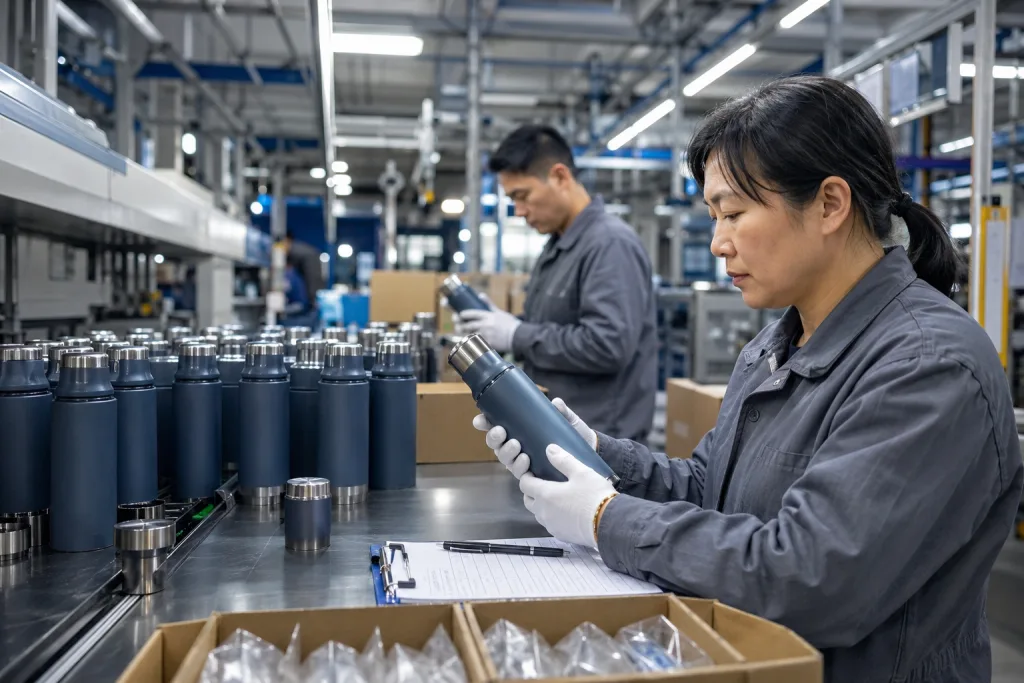
The sequence matters. Stainless sheets are cut, formed, welded, and shaped on the line. Inner and outer shells are assembled, vacuumed, and tested. Bodies are polished or prepared for coating. Coating is sprayed and cured. Logos are laser engraved or screen printed. Caps run on a separate bench with silicone rings pressed in by hand. Finished units go through leak testing, appearance inspection, packing, and carton sealing; last month QC pulled 32 pcs from a 1,200 pc lot because powder coat built up around the bottom seam. If one early step slips by 2 days, the packing date usually moves by 2 days too.
For a 5,000 pc thermos supplier order with one Pantone color, one laser logo, and printed box, a clean schedule looks like this: 3 days for deposit and material confirmation, 7-10 days for raw body production, 5-7 days for vacuum and thermal testing, 4-6 days for coating, 2-4 days for logo work, 3-5 days for packing, and 1-2 days for final inspection. Total: roughly 30-37 production days before vessel booking. The math changes fast if the PO says “Pantone 186C” but the artwork file says “186U”; the buyer flagged that typo once, and we lost 2 days waiting for written confirmation.
Shipping is separate. FOB Ningbo or Shanghai means the thermos vendor delivers to port and clears China export customs, but ocean freight, destination duty, and inland delivery sit with you or your forwarder. Ocean transit to the US West Coast may be around 18-25 days port to port; East Coast can be 30-40 days. Northern Europe is often 32-45 days depending on routing. Air freight works for urgent promotional thermos launches, but it can add USD 1.50-4.50 per unit for stainless drinkware depending on weight and volume; on a 500 ml flask, our forwarder usually bills by carton volume after they measure the master carton with a tape, not by the neat weight on the packing list.
If your retail launch date is fixed, work backward from the shelf date, not the factory finish date. Leave at least 7 days for inspection, customs documents, and booking changes. This is the wrong question to ask: “Can the factory finish by Friday?” Ask whether the goods can pass AQL, get the SI filed, and make the CY cut-off; one missed VGM upload can hold a container even when all 5,000 pcs are packed.
Quality Checks Worth Paying For
Quality control costs less at our packing table than after 10,000 thermos cartons land in a warehouse in Germany, Canada, or Colorado. For stainless vacuum flasks, we check capacity with a 1,000 ml graduated cylinder, unit weight on a 0.1 g scale, coating finish, logo position in mm, lid fit, leak resistance, odor, carton burst strength, and thermal performance. AQL inspection is common, with Level II and AQL 2.5 for major defects and 4.0 for minor defects on many commercial orders. Retail buyers sometimes set tighter limits, especially when the carton has a barcode typo or a Pantone mismatch already flagged on the PO.
Thermal testing needs numbers. “Keeps hot 12 hours” is the wrong line to approve unless the test method is written down. Specify fill temperature, room temperature, preheating or no preheating, probe position, and pass threshold. A workable line item: 95°C water filled to rated capacity, tested at 20°C ambient, with temperature above 60°C after 6 hours. On the line, QC pulls 3 samples per batch and logs readings with a digital probe; for premium outdoor flasks, we often push the pass mark higher because the math does not work if marketing promises 24 hours from a thin 350 ml bottle.
Food contact compliance matters before artwork sign-off, not after deposit. For Europe, ask about LFGB or EU food contact documentation and REACH for coating or accessible materials. For the United States, buyers often request FDA food contact statements and sometimes ASTM-related packaging or safety checks depending on channel. BSCI or ISO 9001 audit status helps your internal supplier approval, but it does not replace product testing. We have seen this go sideways when a buyer approved 304 stainless body material but forgot to check the silicone gasket; QC pulled the sample, and the lid insert became the hold point.
At BottleForge Industrial in Zhejiang, our normal process includes 100% leak testing on vacuum flask production and random thermal retention checks by batch. We run leak checks with air pressure and water bath stations before final packing, then recheck samples after the powder coating oven because heat can expose a weak weld. For larger thermos manufacturers orders, we recommend third-party pre-shipment inspection 2-3 days before loading. It usually costs USD 250-450 per man-day in China. That fee is small compared with sorting 10,000 coated bottles after arrival, especially when the buyer’s team rejects cartons for 2 mm logo drift or scuffed lids.
Good quality control is not about mistrusting the factory. It is about making the acceptance standard visible before the order starts. Put the checklist on the PI, match it to the golden sample, and make sure the packing line has the same version, not an old PDF from last season.
Get a Pantone thermos quote with real timelines
Send capacity, Pantone code, logo file, packaging needs, and target quantity. We will return MOQ, FOB cost, and sample schedule.
Frequently asked questions
What is the MOQ for a vacuum flask custom Pantone order?
For an existing stainless thermos shape, a practical MOQ is 1,000 pcs per model and per Pantone color. At 500 pcs, some thermos suppliers may accept the order, but the coating surcharge and setup cost are usually high. For better pricing, plan 3,000-5,000 pcs per SKU. If you need four colors, treat each color as its own production batch. A 4,000 pc order split into four Pantone colors will not price like one 4,000 pc run.
How much does Pantone color matching add to the unit price?
For powder-coated stainless vacuum flasks, Pantone matching usually adds USD 0.18-0.55 per unit at 3,000-10,000 pcs, plus a color development fee around USD 80-250 per color. At 1,000 pcs, the premium can rise to USD 0.35-0.70 because line cleaning and powder loss are spread across fewer bottles. Matte finishes and difficult colors such as bright orange, neon tones, or very pale beige may need extra sampling.
Can we use one thermos custom order for both retail and promotional channels?
Yes, but specify packaging and labeling by channel before production. The bottle body can be the same, while retail units use printed boxes, barcodes, hangtags, and stronger carton packing. Promotional thermos units may use a white box or bulk divider carton to reduce cost. If you need FNSKU labels, language stickers, or mixed cartons, add 2-5 days for packing work and confirm label placement with photos before mass packing starts.
What lead time should outdoor retailers plan for a new customized thermos?
For an existing factory thermos model with custom Pantone color, logo, and printed box, plan 35-60 days after artwork confirmation. That includes 10-18 days for Pantone sample work and 25-45 days for mass production. Ocean freight adds roughly 18-45 days depending on destination. If you require a new cap mold or body tooling, add 20-35 days. For seasonal outdoor launches, start sourcing at least 120 days before your needed warehouse date.
What should be included in a supplier thermos quotation?
Ask for FOB port, steel grade, capacity, body weight, coating type, Pantone fee, logo method, packaging cost, MOQ per color, sample cost, production lead time, payment terms, and inspection standard. A useful quote should also state whether leak testing is 100%, what AQL level is used, and whether documents such as REACH, LFGB, FDA food contact statement, BSCI, or ISO 9001 are available. Without these details, two thermos vendor prices are not comparable.