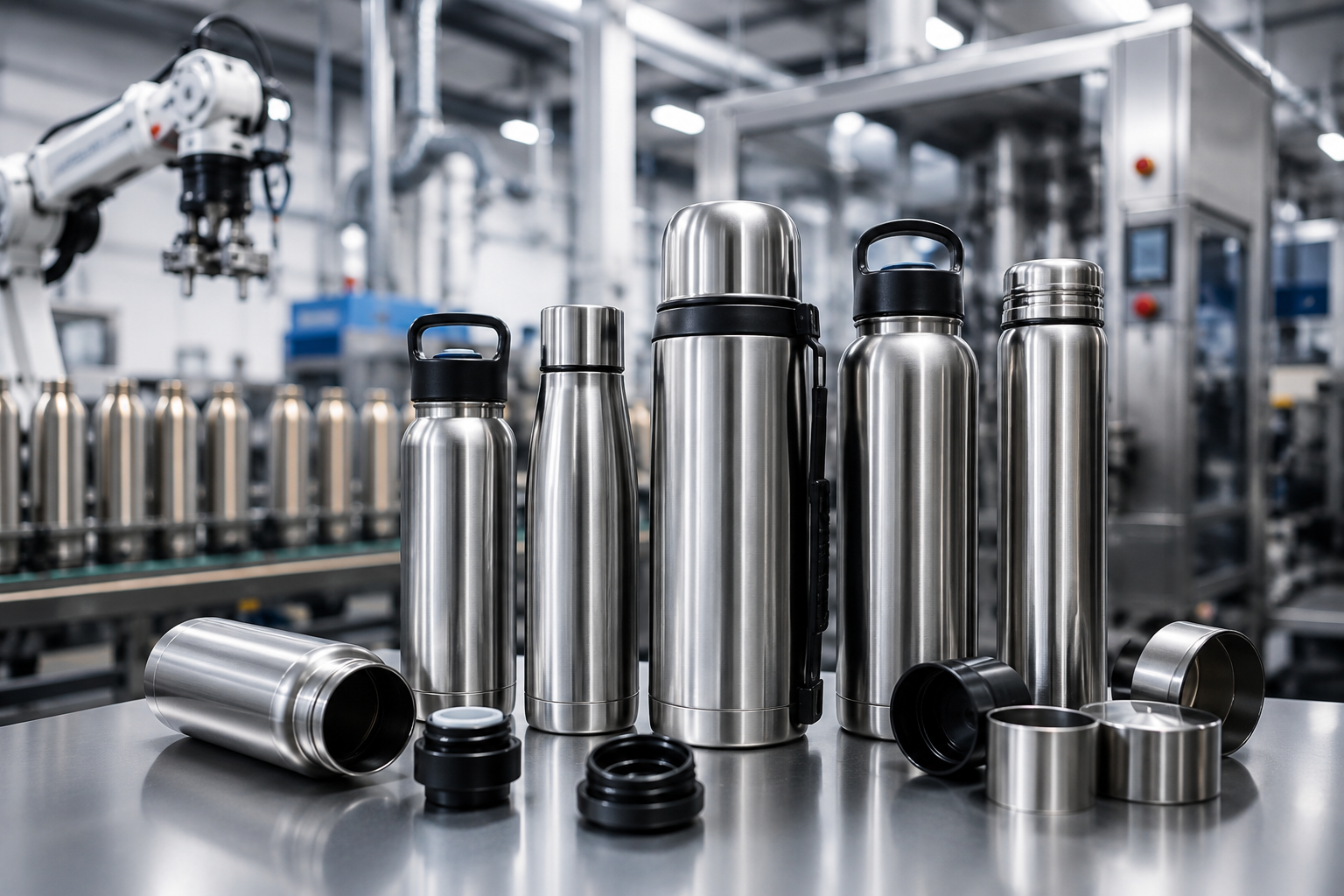
Key Takeaways
- 304 inner steel with 0.35-0.45 mm wall thickness is the normal safe range for food-contact stainless thermos orders
- A real custom thermos quote should separate mold cost, logo cost, packing cost, and FOB unit price
- For 1,000-3,000 pcs, lead time is usually 30-45 days after sample approval and deposit
- AQL 2.5/4.0 inspection catches most visible coating, leakage, and assembly issues before shipment
A vacuum flask custom made project often lands in our inbox as four words on a PO: 500 ml, stainless steel, logo, gift box. Not enough. We run quotations from a spec sheet, not a product photo, because two bottles can look the same in a PDF and still differ by USD 0.80 on steel grade, 0.4 mm vs 0.5 mm inner wall, vacuum bake time, lid tooling, powder coat thickness, 5-layer export carton, and whether QC tests to FDA, LFGB, or only an in-house hot water check.
If you buy for outdoor retailers or promotional brands, the wrong question is “what is your best price?” The better question is “which spec controls returns without killing margin?” BottleForge Industrial manufactures in Zhejiang, China, and our normal stainless thermos line runs 300,000 units/month with MOQ from 1,000 pcs per model. Last month QC pulled the sample on a 750 ml order because the buyer’s logo file said matte black, while the PO typo said “matt back.” Small line. Big risk. Here is how each spec line changes buyer risk.
Capacity, Shape, And Real Use
Capacity is usually the first line on the RFQ, but volume alone does not tell us how the flask will sell. A 500 ml vacuum flask custom made for commuter gifting is not the same job as a 750 ml outdoor retail flask. Bigger bodies need a deeper vacuum section, a wider inner box, higher CBM per piece, and shelf height checked before tooling. We see this mistake 6-8 times a month: the buyer writes “500 ml stainless thermos,” then the supplier thermos team quotes the nearest stock body from the sample rack instead of the body the channel needs.
For outdoor retail, 600 ml and 750 ml work because they cover day hikes and still fit most vehicle cup holders when we keep the base at 70-75 mm. For a promotional thermos, 350 ml and 500 ml move faster because gift budgets usually sit between USD 3.20 and USD 6.80 FOB China depending on finish and packaging. The math changes fast on a 1 L bottle. We usually pack roughly 12-18 pcs per export carton instead of 24 pcs for smaller bodies, and the buyer often flags the freight after seeing the 5-ply carton size on the PI.
Shape decides decoration. A straight cylindrical body gives a cleaner 360-degree wrap, fewer silk screen rejects, and easier barcode placement; our line checks this with a 0.5 mm registration mark before mass printing. A tapered body feels better in hand, but the logo printable area can shrink by 20-35%. If you need thermos custom artwork for events, retail, or club merchandise, ask the factory thermos vendor for the maximum flat printable area in millimeters. A mockup is not enough.
Our Zhejiang engineering team usually locks capacity tolerance at nominal volume plus 0-5%, measured to the bottom of the mouth thread with a graduated cylinder during sample QC. This stops the usual argument later when a buyer expects 500 ml usable drinking volume but the technical drawing defines 500 ml brimful volume. We have seen this go sideways on repeat orders, especially when the PO says “500ml” but the approved drawing says “500 ml brimful.”
Steel Grade And Wall Thickness
The steel line is where cheap quotes hide. For a customized thermos, we run 304 stainless steel on the inner wall, with 201 or 304 on the outer shell depending on the target price. For Europe or North America, do not put 201 inside the flask. The math does not work. QC pulled 8 inner cups last month after a salt-spray check showed light rust at the neck seam, and every one was 201. Tea, sports drinks, and 30-day warehouse storage make weak steel show up fast. For food-contact confidence, specify 304 inner steel on the PO and ask for LFGB, FDA food-contact rules, and REACH documents when coatings are used.
Wall thickness controls dent resistance and keeps vacuum performance stable after handling. For most bulk thermos orders, inner wall thickness around 0.35-0.45 mm and outer wall around 0.45-0.55 mm is the sensible range. Go thinner and you might save USD 0.10-0.25 FOB, but our drop-test table tells the truth: 0.38 mm outer shells dent faster at the shoulder when a loaded carton hits the floor from 76 cm. Thicker steel feels better in hand, but it adds weight, and freight buyers notice when a 24-piece carton jumps from 13 kg to 15 kg.
Ask whether the steel is measured before or after stretching. This is the wrong question to leave vague. Some thermos manufacturers quote coil thickness, which looks stronger than the finished body we check with a Mitutoyo micrometer after forming. A proper manufacturer thermos drawing should state finished wall thickness tolerance, such as ±0.03 mm, and material grade by part: inner cup and outer shell, base and neck, infuser and lid insert.
For outdoor retail, a powder-coated 304/304 body earns its cost when the bottle is sold as durable gear. We ship that spec for hiking brands with 1,000-piece color runs because the buyer will test scratches, not just read the catalog. For a one-time promotional thermos, 304 inner plus 201 outer is acceptable if the positioning is honest. We have seen this go sideways: the buyer flagged “premium outdoor bottle” on the artwork proof, then rejected the 201 outer sample after a simple magnet check. Returns cost more than the steel saving.
Vacuum Performance And Heat Claims
Any thermos supplier can print “keeps hot 12 hours.” That is the wrong question to ask. Ask for the setup: starting water temperature, room temperature, fill level, lid status, and test method. On our line, a proper test means 95°C hot water, 20°C ±2°C room temperature, full fill, lid closed, then readings at 6, 12, and 24 hours with a probe thermometer. For a 500 ml double-wall stainless vacuum flask, we look for above 65°C after 6 hours and above 45°C after 12 hours. A 1 L bottle usually performs better because the surface area grows slower than the water volume.
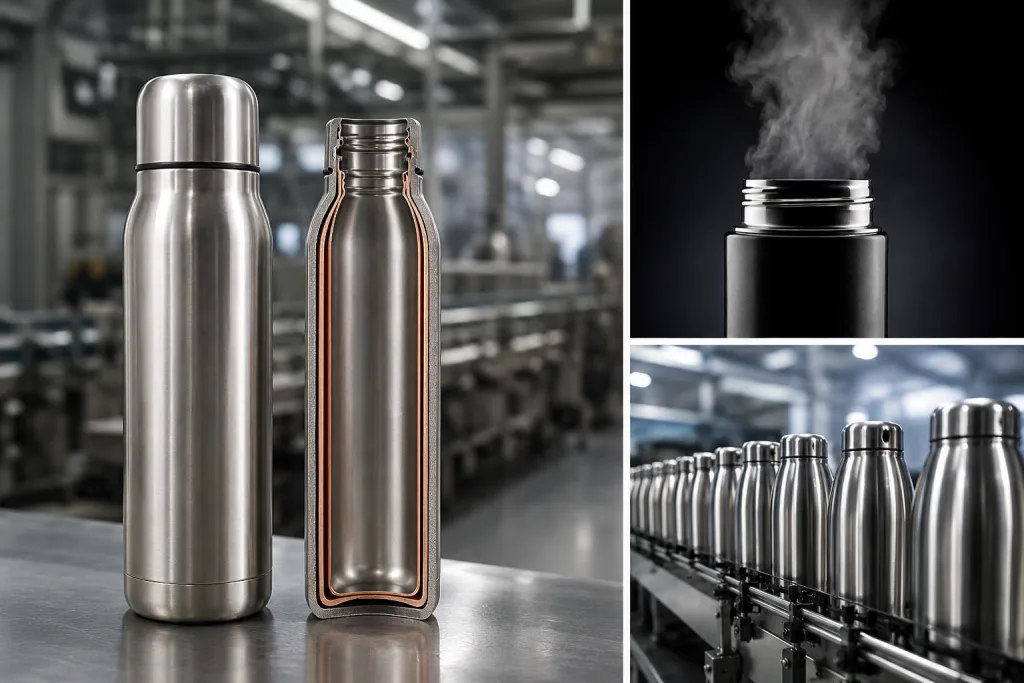
Vacuum quality comes from welding, degassing, copper plating if used, vacuum pumping time, and sealing. Shortcuts show up later. A cheap thermos quote may remove the copper lining or cut the vacuum station from 18 minutes to 12 minutes; the sample still looks fine on the buyer’s desk, then QC pulls weak pieces during mass production. For thermos bulk orders, ask for batch insulation testing, not one polished golden sample. At BottleForge Industrial in China, we run random production pieces after vacuum sealing and again after lid assembly, because slow leaks often appear only after the cap torque is set.
Do not overprint heat claims. “24 hours hot” can pass on a 1 L flask in a lab, but the math doesn’t work for a customer filling it halfway at a ski resort in January. We have seen this go sideways with outdoor retailers when packaging promised too much and returns started after the first cold week. For outdoor retail, I prefer a conservative claim: “Hot up to 12 hours, cold up to 24 hours,” backed by the exact model test sheet. For promotional brands, keep it plainer, because the service team usually has 2 lines of product notes, not the full lab record.
If you are comparing thermos manufacturers, ask for a test photo showing thermometer reading, time stamp, and sample ID. Simple request. It is not a full audit, but it tells you whether the vendor measures performance or copies a catalog line. Last month a buyer flagged a PO typo where “500 ml” became “5000 ml”; the same kind of small check catches lazy heat-claim paperwork before it reaches carton artwork.
Lid System, Leak Test, Parts
The lid is where returns start. We’ve had a 5,000 pcs order pass vacuum testing, then QC pulled the sample and found seepage at the silicone ring after the hinge pin sat 0.4 mm off-center. A good vacuum body cannot save a loose hinge, weak button, poor thread fit, or gasket with the wrong Shore hardness. For outdoor use, we run screw lids more often because they have fewer moving parts and survive drop tests better. For office and commuter gifting, a push-button or cup lid is easier to sell, but the inspection standard must be tighter. No shortcut here.
Put the lid material on the spec sheet, not just in an email: PP or Tritan for plastic parts, 304 stainless steel for contact inserts, and food-grade silicone for gaskets. Our molding team checks the gasket groove with a digital caliper; a 0.2 mm mismatch can turn into leakage after hot-fill cycling. If the product is sold in the EU, ask for LFGB migration testing on silicone and plastic. For the US, FDA food-contact declarations are common. If children may use the bottle, check whether ASTM-related requirements apply to small parts, strap strength, and labeling. We’ve seen this go sideways when the PO only said “safe lid” and the buyer flagged the straw cap after shipment.
A leak test should be boring and repeatable: fill with room-temperature water, close the lid, invert for 10 minutes, then shake 30 times and check for seepage. On the line, we mark failed samples with red tape and open the lid assembly to check the ring seat, button spring, and thread start. For mass production, an AQL inspection can include 80-200 pcs depending on lot size. We commonly use AQL 2.5 for major defects such as leakage, coating peel, wrong logo, and loose lid assembly, and AQL 4.0 for minor cosmetic marks. The wrong question is “does it leak today?” The better question is whether the same lid still seals after carton drop, cap removal, and 3 refill cycles.
Spare parts matter for distributor thermos programs. If you sell through outdoor shops, ask for 1-2% spare lids and 1-2% silicone rings packed separately, with item codes printed on the polybag so the warehouse does not mix 480 ml and 750 ml gaskets. A thermos distributor that can replace a gasket in 2 days protects the retailer relationship; waiting 18 days for a replacement lid makes the math ugly on a $12 bottle. A factory thermos supplier that refuses to sell spare lids is telling you the program was not designed for after-sales support.
Finish, Logo, And Color Control
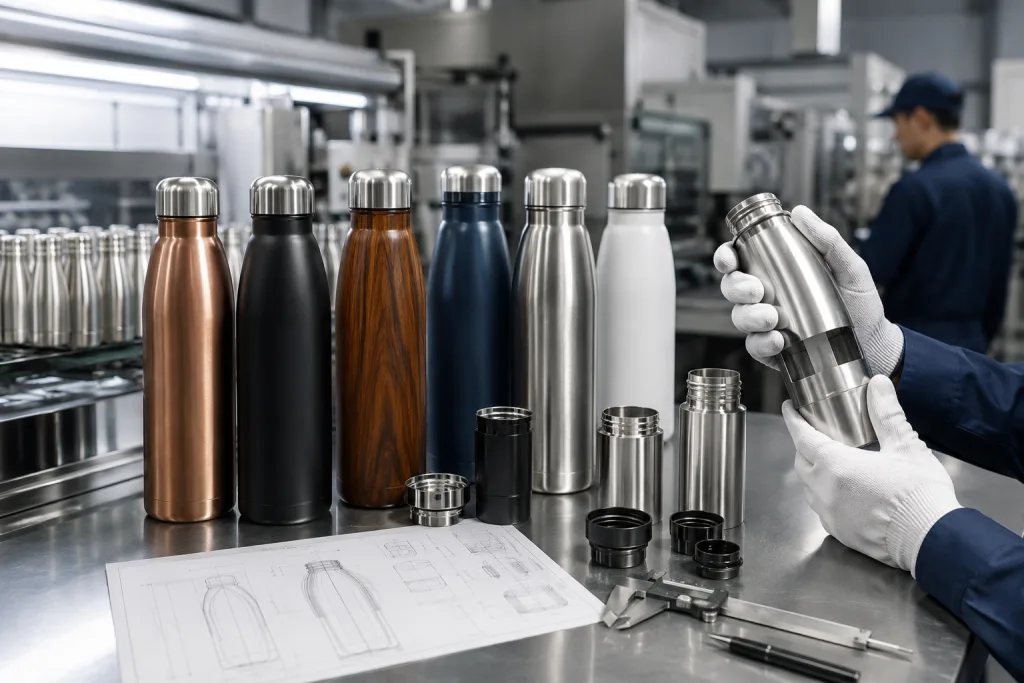
Decoration is where a customizable thermos turns into a retail-ready brand item, and it is also where QC rejects pile up fastest. We usually see the highest visual reject rate at the logo bench, not the welding line. The main options are silk screen printing, laser engraving, pad printing, heat transfer, water transfer, UV print, and powder coating; on one 5,000 pcs run last May, QC pulled 143 bottles for logo tilt over 1.5 mm. For stainless steel thermos custom work, laser engraving lasts best on powder coating or bare steel, but the mark comes out as one metal-colored tone. Silk screen is cheaper for one- or two-color logos and works well on straight bodies. Full-wrap graphics need a cylindrical body and a controlled seam; if the overlap drifts 2 mm, the buyer will see it before they check the carton label.
Powder coating usually adds USD 0.25-0.60 per unit depending on bottle size, color, and order quantity. A matte powder finish feels premium, but it shows fingerprints and oil marks faster than glossy paint; we wipe samples with a white cotton cloth before packing, and matte black still gets flagged. Hammertone and speckled coatings hide scratches better, which works for outdoor retailers selling into camping channels. For promotional thermos projects, standard black, white, navy, and stainless silver reduce risk because we run those colors often on the line. Custom pastel colors look good in a deck, but the math does not work if the MOQ is 1,000 pcs and the powder supplier needs 20 kg per batch.
Color control should not rely on a screen image. Give Pantone codes and accept a tolerance. For powder coating, a Delta E target under 2.0 is strict and may increase rejects; under 3.0 is more practical for most bulk thermos orders. If your product will sit beside other branded items, approve a physical color chip or pre-production sample. A Zhejiang factory can match color well, but not from a JPG pulled from a presentation. We have seen this go sideways when a buyer approved “dark green” by email, then rejected 2,400 pcs because their shelf tray used a different green under store lighting.
Logo position needs dimensions: center height from base, print width, print height, and rotation relative to handle, seam, or lid button. Write it on the artwork file, not only in the email; one PO typo changed 65 mm to 56 mm, and the sample room followed the PO. For distributors thermos programs with several end clients, keep the same body and change only logo and packaging. That protects price and shortens sample approval. We run this setup often: same 500 ml body, same carton, 12 logo films, and one shared AQL 2.5 inspection table.
Packing, Compliance, And Shipment
Packing is not a decoration afterthought; it changes landed cost and damage claims. We normally run one bottle in a 0.03 mm polybag, white box or color box, then a 5-layer K=A master carton with dividers if the finish scratches easily. Gift packaging may add USD 0.20-0.80 per unit, and a rigid box can add 12-18% carton volume, which is where the math starts to hurt on LCL freight. For Amazon or retail distribution, you may need FNSKU labels, suffocation warnings, carton marks, country of origin, and barcode placement that still scans after warehouse handling. We had one buyer flag a 2 mm barcode shift because their 1D scanner missed it on the first inbound check.
For outdoor retailers, I prefer a recyclable kraft box with a printed sleeve if the brand wants a sustainable look without paying for a heavy luxury box. It sells the idea without wasting carton space. For promotional brands, a white tuck box with a label is often enough unless the flask sits inside a premium kit with tea, coffee, or a branded notebook. If you need thermos promotional packaging, state box board gauge, insert type, carton drop-test requirement, and whether the bottle must survive ISTA-style handling. QC pulled the sample after a 76 cm corner drop last month; the bottle passed, but the paper insert split, so the buyer changed from 250 gsm to 300 gsm.
Compliance should be quoted before deposit. For Europe, common requests include LFGB food-contact test, REACH for coating and restricted substances, and sometimes BSCI factory audit for social compliance. For North America, buyers often ask for FDA food-contact documentation, Prop 65 review for California, and CPSIA if the design targets children. Not every order needs every test, but deciding after the goods are finished is the wrong question to ask because the line cannot rewind coating, logo ink, or silicone parts. On one PO, “FDA report needed” was typed into the shipping notes instead of the product spec, and nobody wants that discussion when 62 cartons are already sealed.
FOB Ningbo or FOB Shanghai are common from Zhejiang, China. A 3,000 pcs 500 ml stainless thermos order usually needs around 30-40 days production after artwork and sample approval, plus inspection and vessel booking. In our factory, laser logo approval is often 2 days, spray coating adds about 6 days, and vessel space from Ningbo can be 12 days vs 18 days depending on the sailing and cut-off. Air shipment is possible for urgent promotional deadlines, but freight can exceed the product cost. If timing is tight, simplify the finish and use an existing mold. We’ve seen this go sideways when a buyer insists on a new lid mold 19 days before an event.
Price Lines Buyers Should Separate
A clean quote for a vacuum flask custom made order should not be one blended number. Ask your thermos vendor to show FOB unit price on its own line, then list mold or tooling cost, logo setup, sample fee, packaging cost, testing fee, and inland freight if used. We run this breakdown on our PI because buyers need to see whether the carton is a 3-layer white box or a printed 350 gsm color box with barcode sticker. It saves arguments later. Last April, one buyer flagged a USD 0.28 gap per pc; QC pulled the sample and found the quote used a white box, while the PO said color box.
For reference, a 500 ml stainless steel custom thermos using 304 inner steel, 201 outer steel, powder coating, one-color logo, and white box often sits around USD 3.20-5.20 FOB China at 3,000 pcs. A 304/304 body with a tighter lid fit, retail color box, laser logo, and stronger coating can push it to USD 5.50-8.50. Small trial quantities of 500 pcs usually carry higher unit pricing or stick to stock colors because the coating line still needs wash-down, the pad-printing jig still needs setup, and carton printing plates do not get cheaper just because the order is small. The math doesn't work.
MOQ depends on what is custom. For stock body plus laser logo, 500-1,000 pcs can work. For custom Pantone coating, printed box, and logo, 1,000-3,000 pcs is realistic if the buyer accepts normal coating loss during line start-up, usually 2%-3% on the first run. For a new mold, expect 5,000 pcs or more, plus tooling cost from roughly USD 1,200-6,000 depending on body complexity and lid system. We measure the trial lid with a digital caliper at the hinge and thread area; a 0.20 mm miss there turns into leaks after drop testing.
The lowest quote is not automatically wrong, but it must explain itself. Maybe it uses stock parts and thinner wall, 201 outer steel and no retail box, or skips compliance testing. That can fit a short promotion. The trouble starts when a manufacturers thermos quote hides those choices. We've seen this go sideways after deposit when the buyer expected FDA paperwork and the supplier only priced a basic material report. Your spec sheet should make trade-offs visible before purchase order, deposit, and production slot are locked.
Send your thermos spec sheet for factory review
Share capacity, steel grade, logo, packaging, and target price. We will return a practical Zhejiang factory quote with risks marked clearly.
Frequently asked questions
What MOQ should I expect for a vacuum flask custom made order?
For a stock stainless body with laser engraving, 500-1,000 pcs is often workable. For a real custom thermos with Pantone powder coating, printed carton, and logo, plan on 1,000-3,000 pcs per color. If you need a new lid, new body shape, or private mold, many thermos manufacturers will ask for 5,000 pcs or more because tooling, line setup, and testing take time. At BottleForge Industrial in Zhejiang, China, standard MOQ starts at 1,000 pcs per model for most stainless thermos programs, while new mold projects are quoted case by case.
How long does sampling and production normally take?
A logo sample from an existing body usually takes 7-10 days after artwork confirmation. A custom color sample takes around 10-15 days because powder coating or paint matching needs a trial run. Mass production for 1,000-3,000 pcs normally takes 30-45 days after sample approval and deposit. Add 2-5 days for final inspection and booking. If the order needs LFGB, FDA, REACH, or Prop 65 testing, allow another 7-15 working days depending on the lab and test scope.
Is 304 stainless steel necessary for every thermos bulk order?
For the inner wall, yes, 304 is the practical default for Europe and North America. It handles coffee, tea, and mildly acidic drinks better than 201. For the outer wall, 201 can be acceptable on budget promotional thermos orders if the buyer is not claiming premium all-304 construction. A common cost-controlled build is 304 inner and 201 outer, with wall thickness around 0.35-0.45 mm inner and 0.45-0.55 mm outer. Outdoor retail products usually justify 304/304 because durability claims and user expectations are higher.
Which logo method is best for a distributor thermos program?
Laser engraving is best when you need durability, low setup risk, and many small client logos on the same body. Silk screen is better for larger one- or two-color logos and lower unit cost, usually with setup charges around USD 30-80 per color depending on artwork. UV printing works for full-color logos but needs adhesion testing on the chosen coating. For a distributor thermos or thermos distributors program, keeping one bottle shape and switching only logo files reduces sampling time and protects consistent FOB pricing.
What should I check before paying the deposit?
Confirm the technical drawing, steel grades by part, finished wall thickness, capacity definition, lid material, logo size, Pantone color, packing method, carton marks, compliance tests, AQL level, FOB port, and lead time. Ask for a pre-production sample if the order is above 3,000 pcs or uses custom coating. The proforma invoice should list whether the price includes color box, barcode, FNSKU, test fees, and spare parts. If any supplier thermos quote only says “500 ml customized thermos with logo,” it is not detailed enough for production control.