Key Takeaways
- A practical vacuum flask custom color MOQ starts at 1,000 units per color for powder coating
- Allow 7-10 days for color sampling and 30-40 days for bulk thermos production after approval
- Use Pantone or RAL plus a signed physical sample; screen photos are not a QC standard
- Specify AQL 2.5 for major defects and 4.0 for minor defects on custom thermos orders
Your buyer asked for a 750 ml stainless bottle in muted forest green, not “close enough green.” Sales wants it landed before the spring outdoor season. Finance wants no surprise tooling, rework, or carton repacking costs. This is where a vacuum flask custom color order goes sideways: the color chip, powder thickness, and carton mark get treated like decoration, not production specs. Last March, QC pulled 32 samples from the line and found 7 bottles drifting toward olive under the D65 light box.
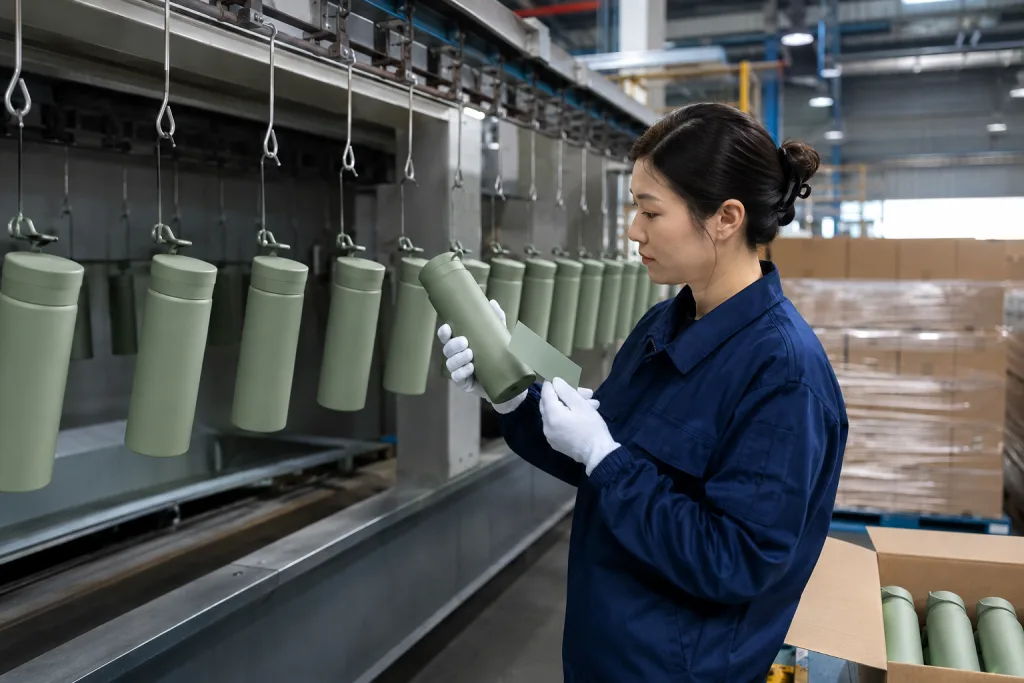
At BottleForge Industrial in Hangzhou, Zhejiang, we run these orders for outdoor retailers and promotional thermos brands, usually 1,000 to 10,000 units per SKU. China can ship a clean custom thermos program, but the math does not work if the buyer approves a phone photo and asks us to “adjust in bulk.” Lock the signed sample, ΔE tolerance, logo method, and AQL before thermos bulk production starts; our coating line checks film build at 60–80 μm before packing starts.
The Order Starts With Use Case
Here is a buyer case we see often. A purchasing team is sourcing a 750 ml vacuum insulated stainless flask for an outdoor retailer’s private label line, with a target retail price of USD 24.99-29.99. The spec looks simple on the PO: matte sage body, black screw cap, laser logo, retail box, and 6-color master carton marking for warehouse intake. Simple on paper. On the line, QC still has to match the powder color against the approved chip under a D65 light box, and the buyer will flag it if sage shifts too gray. Asking only for “custom color thermos, best price” is the wrong question to ask.
Start with the bottle platform. For most outdoor retail programs, we run 18/8 stainless steel inside and outside, 0.45-0.50 mm outer wall, 0.35-0.40 mm inner wall, copper-plated vacuum layer, and a leak-resistant PP lid with silicone seal. For a 750 ml manufacturer thermos, that usually lands around 380-460 g depending on height, mouth width, and cap design. Our wall gauge check is done with a digital micrometer before polishing, not after the bottle is already packed. If your sales sheet says “lightweight,” do not chase every gram. The math does not work when a 20-30 gram steel saving turns into dent claims after a 1.2 m carton drop.
For a promotional thermos giveaway, a simpler cap and thinner retail box can pass if the usage is short-term. For an outdoor retailer, ask your thermos factory for a stronger cap thread, carton drop-test records, and spare gasket availability. We have seen this go sideways when a buyer approved the body color but forgot the spare silicone gasket spec, then the reorder needed a different lid supplier. A distributor thermos program also needs reorder stability: same body mold, same coating process, and same cap material for at least 12-18 months. BottleForge’s Zhejiang line can produce about 450,000 stainless drinkware units per month, but we reserve capacity by confirmed artwork and deposit, not by a verbal forecast scribbled after a trade-show call.
Locking The Custom Color Standard
Color is where buyers lose control fastest. A vacuum flask custom color request should start with a Pantone coated reference, RAL code, or a physical object you want us to match. For powder coating, Pantone is a guide, not a formula. Pigment batch, surface texture, oven temperature, and 304 stainless body prep all move the final shade. We run test panels through the 185°C curing oven, then check them under a D65 light box and warehouse LED. A matte finish looks about half a shade lighter under our packing-area LED and darker once the buyer takes it outside.
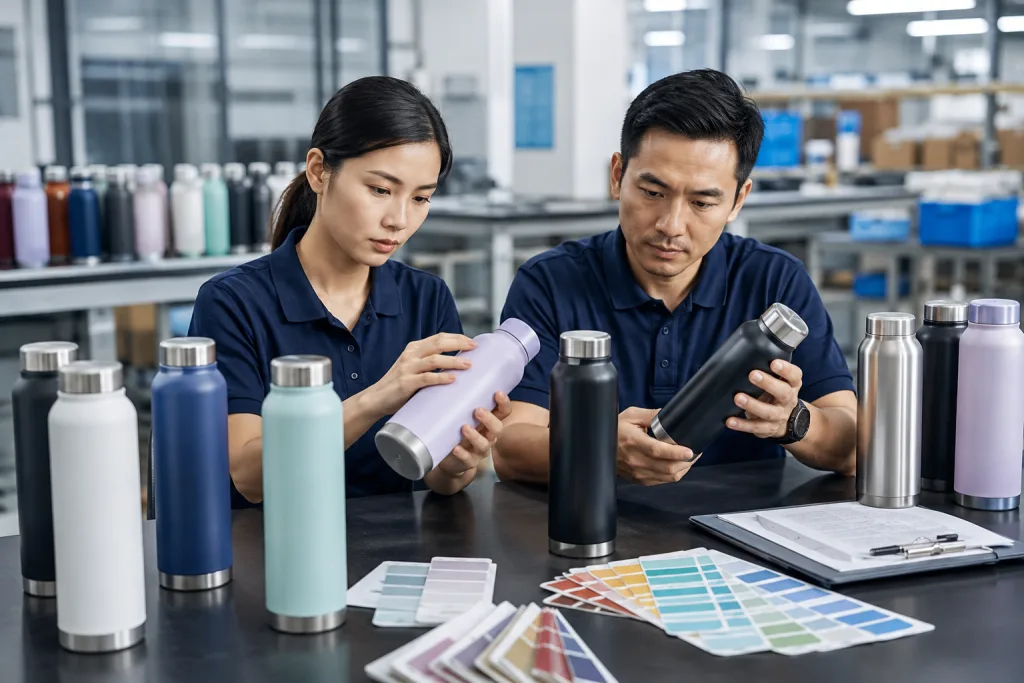
For this 750 ml sage flask, use a tight approval route. Send Pantone 5565 C and 2 target photos, including one taken beside a white sheet of paper. Then the thermos supplier makes 2-3 color plates or bottle body samples. Pick one. Sign it. QC keeps that signed sample beside the Delta E meter, normally Delta E less than 1.5-2.0 for controlled retail programs. We have seen this go sideways when a buyer approved from an iPhone photo; the PO said “sage green,” but the screenshot looked gray on our production monitor.
Powder coating is the default for outdoor bottles because it gives better grip and better scratch resistance than standard spray paint. For a customized thermos order, we normally quote powder coating at 1,000 units MOQ per color, with a USD 80-150 color setup charge if the powder is not a stocked shade. Gloss spray paint can start lower, but the math does not work if the bottle is handled a lot; QC pulled 8 samples from one trial and found fingerprints before carton packing. Rubber paint feels good on day one, then can turn sticky after heat and UV exposure. We do not recommend it for long outdoor shelf life.
For custom color approval, one signed bottle on your desk is worth more than 20 email screenshots.
Logo Method Changes The Finish
Your logo is part of the coating choice. On a matte powder-coated bottle, laser engraving burns off about 0.03 mm of coating and shows the 304 stainless underneath. It holds up. For outdoor brands, this is usually the safe call because there is no ink layer to scratch. We run a 45 mm wide laser logo on one side for this buyer scenario; the cost stays stable, and QC does not have to chase ink adhesion after the line starts.
Silkscreen printing works when the buyer needs white, black, or 2-color artwork on a promotional thermos. The weak point is abrasion. On a coated flask, the screen ink has to match the powder chemistry, and oven curing cannot be rushed. We run a cross-hatch adhesion test, 3M tape pull, and a 50-cycle rub test before bulk approval; last month QC pulled 6 samples because the white ink lifted at the edge after tape pull. If the logo wraps around the curve or sits near the bottom radius, registration will move more. A flat logo area is easier to control.
Heat transfer can handle full-color graphics, but the math does not work for most premium thermos custom color orders unless the artwork needs gradients. It adds cost and lead time, then gives QC more places to reject. For a clean retail SKU, keep the logo method boring: laser for premium outdoor bottles, single-color silkscreen for promotional thermos campaigns. Avoid tiny text below 5 pt. A customizable thermos is still a metal product going through 180°C curing, hand loading, and carton packing. Artwork that looks sharp in Illustrator can go sideways once the jig has 0.5 mm play.
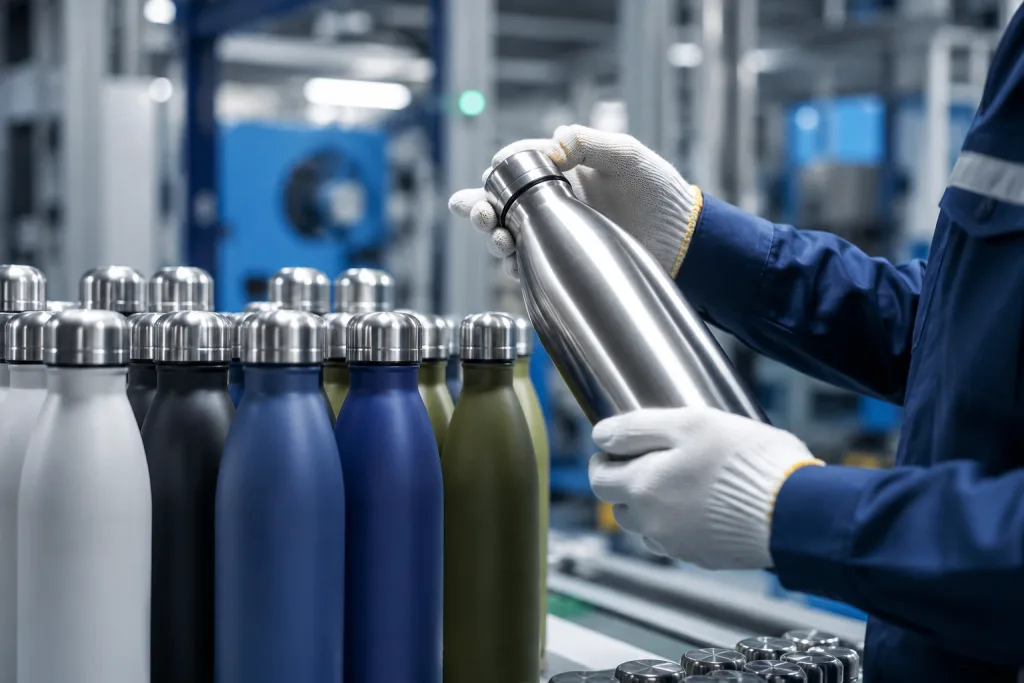
Ask your thermos manufacturer to show pre-production samples with the real coating and the real logo method. A logo printed on a white sample tells you almost nothing about matte sage powder coat. We have seen buyers approve the wrong sample board, then flag the bulk color 12 days later when the PP sample finally arrived.
Price And MOQ Without Games
For a 750 ml stainless vacuum flask custom color order from China, a fair FOB Ningbo or Shanghai price usually lands at USD 4.20-6.80 per unit at 1,000-5,000 pcs. Cap tooling, powder coat thickness, logo process, export carton spec, and FDA or LFGB testing all move the number. We run basic factory thermos jobs with a standard lid and plain white box near the low end. A retail-ready customized thermos with powder coat, laser logo, printed box, insert card, and barcode label sits higher because QC checks the coating with a 60° gloss meter and the packing line scans every EAN label. Buyers sometimes push back with “same bottle on Alibaba is USD 3.60.” The math doesn't work once you add 304 stainless, stable paint, and a box that survives a 12 kg drop-carton test.
MOQ is not just a sales rule. Powder coating eats parts during line cleaning, powder suppliers set minimum powder batches, hanging fixtures take setup time, and the oven schedule is booked in color blocks. That is why 1,000 pcs per color is a practical floor for a thermos supplier that wants stable quality. If you ask for 300 pcs each in 5 colors, someone may say yes, but shade control usually goes sideways; QC pulled samples last month where Pantone 548C shifted by 2.1 ΔE between the first and last rack. For distributors thermos programs, we suggest 2 colors at 1,000 pcs each instead of 6 colors at 300 pcs each. Fewer changeovers. Cleaner output.
A proper quotation should state body capacity, steel grade, coating method, logo size, packaging, FOB port, sample fee, mold fee if any, production lead time, and payment terms. For BottleForge Industrial in Zhejiang, standard terms are 30% deposit and 70% before shipment after inspection, with 30-40 days production after sample approval for most 1,000-10,000 unit orders. If a thermos vendor quotes 15 days for a new custom color, ask which step is missing. It is usually color sampling, pre-production approval, or packing checks. We have seen this start with a PO typo, “mat black” instead of “matte black,” and end with 18 cartons on hold because the buyer flagged the finish at pre-shipment inspection.
Sampling Before Bulk Approval
Sampling is not a souvenir stage. It is the cheapest point to stop a bad bulk thermos shipment. For this outdoor retailer order, we run sample approval in three checkpoints: a blank structure sample for hand feel and lid fit, a color and logo sample checked under a D65 light box, and a sealed pre-production sample packed like bulk goods. Not every order needs the full set. For a first order or a new 304 stainless shape, skipping them is the wrong question to ask; the math does not work when 3,000 bottles arrive with the wrong coating.
The structure sample checks the bottle shape, lid thread fit, mouth diameter in mm, drinking feel, and unit weight on a 0.1g scale. The color and logo sample checks powder coating, spray edge, laser or screen-print position, and rubbing resistance after 50 dry wipes. The pre-production sample locks the exact bill of materials before mass production: bottle body and cap, silicone gasket, coating code, logo placement, packaging, barcode, FNSKU if needed, and carton marks. If you sell through Amazon FBA or a North American 3PL, label placement is not optional. We have seen QC pull a carton because the FNSKU was 8 mm too close to the seam, and intake lost 4 days.
For timing, allow 3-5 days for existing blank samples, 7-10 days for custom color samples, and 5-7 days for printed box proofing. Air freight for samples to Europe or North America usually lands in 3-6 working days after pickup. If your launch calendar is tight, do not spend three weeks debating a shade difference your customer will not see on a campsite table. Set the acceptable range early, approve one physical sample, and move. The buyer flagged Pantone 7499C once after we had already sprayed 12 test cups; the line waited half a day for a decision.
We keep a simple golden sample file: one approved bottle with you, one locked in the China factory sample cabinet, and one with the inspection team if a third party checks final QC. This stops arguments during AQL 2.5 inspection. Small detail, big headache saver. We tape the approved color chip and PO number to the bottle bag, because one typo on a PO can send the wrong vacuum flask custom color to production.
QC Plan For Color Thermos Orders
Color thermos QC is not just a leak check. For a custom color order, we run a control sheet for surface finish, leak performance, heat retention, coating adhesion, logo placement, packing method, and final carton count. Use AQL 2.5 for major defects and AQL 4.0 for minor defects unless your retailer requires stricter limits. For critical defects, use zero tolerance. A bottle that leaks, has exposed sharp metal, or uses the wrong material is a stop-ship issue. Last month QC pulled 8 samples from a 3,000 pcs matte black run because the PO said “Pantone 19-4006 TCX” but the approved sample tag showed “19-4205 TCX.” Small typo. Big argument.
Appearance checks should name the defect, not hide it under “poor finish.” We check color against the signed sample under a D65 light box, then look for dust under coating, orange peel texture, scratches over 3 mm, dents on the shoulder, pinholes around the bottom edge, and uneven gloss between the body and cap. Powder coating is durable, but it is not magic. If the bottle body is oily before coating or the curing oven runs 12 minutes instead of 18 minutes, adhesion suffers. A good thermos manufacturer should run adhesion checks on the line, not only at final inspection. We use 3M tape pull, visual comparison against the signed sample, and random scratch resistance checks with a 1 kg load. For retail orders, logo position tolerance should normally be within ±1.5 mm vertically and horizontally, unless the artwork wraps around a seam or curve.
Functional QC covers the parts buyers complain about after delivery: leak test after inversion, cap torque feel, gasket seating, inner wall cleanliness, capacity check, and heat retention. QC uses a torque meter on sample caps because “too tight” is not a measurement. A common insulation test is filling with hot water at 95°C, closing the lid, and checking temperature after 6 hours. For a decent 750 ml vacuum flask, you should expect around 65°C or higher after 6 hours, depending on mouth size and ambient temperature. If a supplier thermos spec claims 24 hours hot without stating test conditions, the math does not work. Treat it as marketing, not engineering.
Packaging QC matters because matte coated bottles rub inside cartons during a 30-day sea shipment. We ship each bottle in a polybag or tissue wrap, then use a divider or fitted inner tray before loading into a 5-ply export carton for heavier bottles. Carton weight should usually stay below 15 kg for safer handling. We have seen this go sideways: the buyer flagged 46 pcs with shiny rub marks near the logo because the factory skipped the inner tray to save RMB 0.18 per unit.
Shipping And Reorder Control
After QC signs off, the order still needs tight export paperwork. For 2,000 pcs of 750 ml customized thermos bottles with retail boxes, we normally calculate 8-11 CBM after measuring the master carton with a tape at the packing table. Sea freight to Europe or North America fits planned retail stock better: Ningbo to Hamburg might be 32-38 days port to port, while air freight can eat the margin in 4-6 days. Air only works for a launch gap or 30-50 replacement samples. The math does not work for full cartons.
Ask for a packing list that shows SKU, color, carton quantity, gross weight, net weight, and carton dimensions. We run carton weighing on a 150 kg platform scale, and QC pulled one sample last month because the PO said “matte sand” while the carton mark said “sand matte.” Small typo. Big warehouse headache. If you are a distributor thermos buyer shipping to multiple retailers, request carton side marks by SKU and PO number. Mixed cartons save half a CBM on some orders, but they cause pick errors when the warehouse team scans 24 cartons in a hurry. For promotional thermos campaigns, send individual carton labels, pallet labels, and retailer routing guides before production packing starts, not after the container is booked.
For compliance, stainless drinkware bound for Europe should be checked against LFGB or EU food contact requirements, plus REACH-related surface concerns where applicable. For the United States, FDA food contact expectations and California Proposition 65 risk review may apply. Children’s drinkware brings ASTM and CPSIA questions, but this 750 ml outdoor flask is normally treated as adult drinkware. We still check the silicone gasket batch record and inner 304 stainless wall thickness with a caliper, because one buyer flagged a missing gasket material line during document review.
The last piece is reorder control. Keep the approved powder code, cap mold number, gasket material, logo file, carton artwork, and inspection checklist in one spec sheet. We ship reorders 12 months later with the same SKU only when the first order has those details locked; otherwise the line starts guessing, and we have seen this go sideways on cap color and laser logo position. A good thermos manufacturers partner in Zhejiang or elsewhere in China can reproduce the SKU months later, but not from memory. Memory is not a supply chain system.
Send Your Custom Thermos Spec For Review
Share capacity, color code, logo file, MOQ, market, and packing needs. We will return a practical FOB quote and sampling plan.
Frequently asked questions
What is the normal MOQ for a vacuum flask custom color order?
For powder-coated stainless bottles, 1,000 pcs per color is the practical MOQ at our Hangzhou, Zhejiang factory. Below that, powder loss, line cleaning, and setup time push the unit price up quickly. For standard stocked colors, some supplier thermos programs can start at 500 pcs, but custom Pantone or RAL matching is better at 1,000 pcs or more. If you need 3 colors, budget for 3,000 pcs total. For first orders, many outdoor retailers start with 2 colors at 1,000 pcs each, then reorder the stronger SKU.
How long does a custom color thermos order take?
Plan 7-10 days for color sampling, 5-7 days for packaging proofing, and 30-40 days for bulk production after final approval and deposit. Sea freight then adds roughly 25-40 days to most European and North American ports, depending on route and season. If your campaign date is fixed, work backward from the warehouse arrival date, not the factory completion date. A thermos vendor promising 20 days total for new custom color plus retail packaging is likely skipping proper sample approval or running a stock color instead.
Is powder coating better than spray paint for outdoor thermos bottles?
For outdoor retail, yes, powder coating is usually the better choice. It gives a grippier surface, stronger scratch resistance, and a more premium hand feel than basic spray paint. The trade-off is MOQ and setup cost: expect about 1,000 pcs per color and sometimes USD 80-150 for non-stock powder setup. Spray paint can work for lower-cost promotional thermos projects, but it marks more easily in backpacks and display bins. If your product sits in outdoor stores at USD 24.99 or higher, powder coating is the safer specification.
Can we match our brand color exactly on stainless steel?
You can get close, but “exact” needs a defined tolerance. We recommend using Pantone or RAL plus a signed physical sample, then setting Delta E below 1.5-2.0 if your brand team is strict. Matte powder, gloss powder, and spray paint will all reflect light differently, so the same code can look different across finishes. Your inspection team should compare bulk goods against the approved physical sample under consistent light, not against a laptop screen. This is especially important for muted greens, beige, navy, and off-white shades.
What defects should we check before shipping bulk thermos orders?
Use an AQL inspection covering appearance, function, insulation, logo, and packing. For most retail custom thermos orders, AQL 2.5 for major defects and 4.0 for minor defects is reasonable. Check coating scratches, dust spots, dents, color mismatch, laser logo position within ±1.5 mm, cap sealing, gasket fit, odor, inner cleanliness, and carton labeling. For insulation, test random units with 95°C water and record the temperature after 6 hours. Also verify barcodes, FNSKU labels if used, carton marks, and total quantity before paying the final 70% balance.