Key Takeaways
- A basic 500 ml 304 stainless vacuum bottle usually lands at USD 3.10-5.80 FOB China before custom packaging
- Practical MOQ starts at 500 pieces for laser logo and 3,000 pieces for new powder-coated colors
- Normal production lead time is 25-35 days after deposit and approved pre-production sample
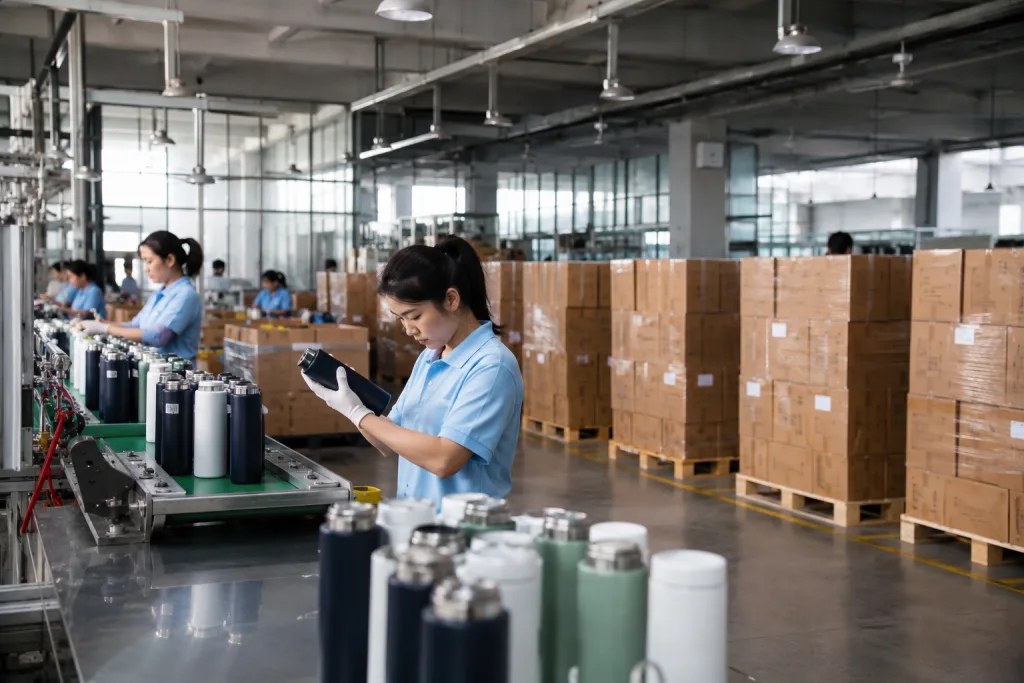
- BottleForge Industrial capacity is about 480,000 stainless thermos units/month in Zhejiang
If you buy vacuum bottle wholesale for an outdoor retail line or a promotional thermos program, finding a thermos supplier is not the hard part. The hard part is reading the quote sheet and knowing why one factory offers USD 3.20 while another sits at USD 7.80 for the same-looking 500 ml stainless bottle. We’ve had QC pull two samples from the line with the same body shape; one used a 0.38 mm inner wall, the other 0.45 mm, and the weight difference was 42 g.
We manufacture in Hangzhou, Zhejiang, and we see this go sideways about 6 times a month: buyers approve artwork and launch dates before checking MOQ, surface finish, packaging, inspection, and sea freight timing. A custom thermos is not complicated. A rushed customized thermos order gets expensive fast, especially when the buyer flags a matte powder coating scratch after the cartons are packed and the PO still says “gloss black” in one line.
Start With The Real Unit Cost
For vacuum bottle wholesale, the quoted unit price only means something after we open up the BOM. A standard 500 ml double-wall stainless thermos with 304 inner and 201 outer steel usually lands around USD 3.10-4.20 FOB Ningbo or Shanghai in our Hangzhou quoting sheet. Change to 304 outer steel, 70-80 μm powder coating, a leakproof push-button lid with a silicone plug, plus a retail color box, and the same size moves to USD 4.60-6.40. Add copper lining for better heat retention and a heavier cap assembly, and USD 6.80-8.50 is normal. The math doesn’t work if a buyer asks for retail shelf quality at giveaway pricing; we’ve seen this go sideways when the PO says “304” but the approved sample only listed 304 inner.
The steel grade matters. For outdoor retailers, we run 304 inner wall as the minimum. Wall thickness is often 0.40-0.50 mm for the inner wall and 0.45-0.55 mm for the outer shell, depending on bottle diameter. Thin shells save a few cents, then QC pulls 3 dented samples after carton drop handling. Not worth it. A supplier thermos quote that is 12% cheaper often hides thinner gauge steel, a lighter lid, or weaker vacuum performance; the vacuum tester on the line will show it before the buyer does.
For promotional brands, the acceptable compromise is different. If the bottle is for a one-time event, 201 outer steel, single-color silk screen, and plain white box may be enough, especially at a 3,000 pcs MOQ. If you sell through outdoor retail, you need stronger coating adhesion, barcode control, drop-test confidence, and carton packing that survives 18 kg export cartons. The correct thermos manufacturer should price both cases separately instead of pushing one catalog model onto every buyer. We had one buyer flag this after the master carton mark missed one digit from their PO.
Ask every thermos factory to separate the quote into bottle, logo, packaging, inland freight, and export carton. It takes five minutes. It also shows fast whether the manufacturers thermos price is built for retail, promotional distribution, or a bare-bones giveaway. On our side, we quote these lines from the same cost sheet because a color box at 0.32 USD and an export carton at 5-ply K=K are not small rounding items.
MOQ Tiers That Change Pricing
MOQ is where 7 out of 10 new buyers read the costing wrong. For an existing factory thermos shape, we can usually run 500 pieces per SKU with laser engraving or one-color silk screen. That is a flexible-production order, not an efficient one. At 500 pieces, the line still needs a logo jig, Pantone check under the D65 light box, first-piece approval, and AQL 2.5 inspection time, so the unit price is usually 8-18% higher than at 3,000 pieces.
At 1,000-2,000 pieces, a custom thermos order starts to behave better on the floor. You can split two body colors if both use standard powder colors, but don’t load the PO with 4 lid variants; we’ve seen this go sideways when QC pulled the sample and found mixed straw lids in the wrong cartons. For thermos bulk programs, 3,000 pieces is the cleaner tier: powder coating lines run with less stop-start, printing waste drops by about 60-90 bottles, and packaging suppliers are more willing to make custom color boxes without a surcharge.
New mold work is a different calculation. A new lid, handle, body profile, or special silicone boot may require 8,000-20,000 pieces before the math works. Tooling can run from USD 800 for a simple silicone part to USD 6,000-18,000 for a lid assembly with several plastic components, and the first T1 samples usually need 12-18 days before we can test fit on the cup mouth at ±0.2 mm. If a thermos vendor says new tooling is free at 1,000 pieces, check the quote line by line. The cost is probably buried in a higher unit price or weaker material choices.
For distributors thermos programs, we often recommend a shared-base strategy. Use one stainless vacuum body across retail, corporate gift, and online channels, then change color, logo, lid, and packaging by channel. Simple works. One buyer once pushed for 5 unique bottle shapes at 600 pieces each; the MOQ looked small on paper, but the carton marks, spare lids, and barcode labels turned the warehouse side messy fast. In China, one stable body with channel-level customization usually ships cleaner than launching five low-volume shapes.
Customization Costs Worth Separating
Logo method is a cost item, not a design item. It changes yield and line time. Laser engraving is our safest choice for stainless or powder-coated bottles; on a 500-3,000 piece order, it usually adds USD 0.08-0.25 per unit depending on logo size and position. We run a 20W fiber laser, and QC checks the first 5 bottles with a 0.5 mm position gauge before the operator keeps going. Silk screen printing suits larger flat-color logos and costs around USD 0.06-0.18 per color, but curved bodies and textured coatings need a real test, not a PDF approval.
Heat transfer and full-wrap graphics look good for promotional thermos campaigns, but the risk is higher. Registration tolerance, scratch resistance, and color consistency need a signed pre-production sample. Full-wrap transfer can add USD 0.35-0.90 per unit. UV printing works for small batches and multicolor artwork, though the line runs slower; last month one buyer flagged 2 mm logo drift on a tapered 750 ml bottle, and QC pulled the sample before mass production.
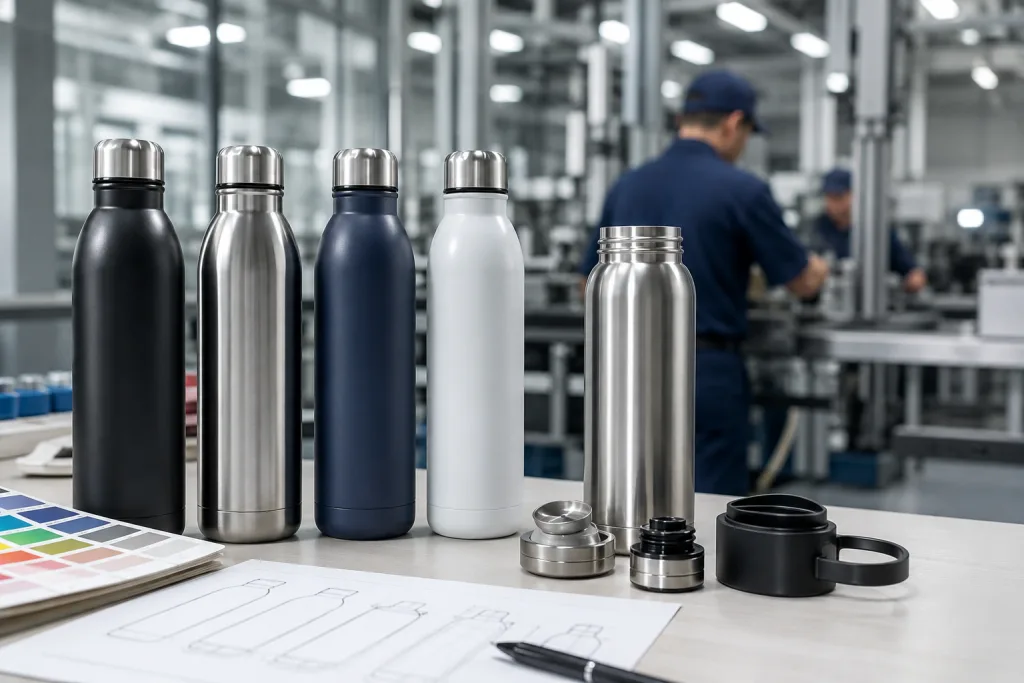
Surface finish drives more cost than most buyers expect. Standard matte powder coating is predictable. Custom Pantone powder coating normally needs 3,000 pieces per color and 7-10 extra days for powder preparation and line scheduling. In real planning, that can mean 12 days vs 18 days before packing starts. Gradient coating, rubberized finish, or metallic coating can add USD 0.30-1.20 per bottle, and we have seen AQL inspection reject more pieces for small scratches near the bottom ring after the bottles pass through the hanging rack.
Packaging is easy to underestimate. A plain egg-crate carton may cost less than USD 0.20 per unit. A printed tuck box often adds USD 0.25-0.55. A retail gift box with insert, manual, barcode label, and hangtag can add USD 0.60-1.40. If you sell through outdoor retailers, do not treat packaging as decoration; this is the wrong question to ask when the carton must survive 18 kg stacking pressure and a 76 cm drop test. It protects margin by reducing returns and crushed boxes, and it cuts relabeling work in your warehouse.
For thermos custom projects, separate every customization line in the proforma invoice. We once saw a PO typo roll “printed box” into the bottle price, and the buyer pushed back 9 days later when they wanted to cut packaging. Keep the lines separate. It gives you room to cut cost without damaging the product itself.
Lead Time From Sample To Ship
A realistic lead-time plan starts before production. Existing sample dispatch from Zhejiang usually takes 3-5 working days, plus 3-7 days by express courier to Europe or North America. If you need a logo sample, allow 7-12 working days before courier time because the line still has to set the laser jig or silk-screen plate. A customized thermos with new color coating, new packaging, or a modified lid can take 12-20 working days for a proper pre-production sample, and QC will check the coating against the approved color chip under a D65 light box before we ship it.
Once the sample is approved and deposit is received, normal mass production is 25-35 days for 1,000-10,000 pieces using an existing bottle. During peak months before summer and Q4 gifting, build in 40-50 days. A factory thermos order is not assembled in one final push. We run steel forming and welding first, then vacuum pumping, coating, curing, printing, lid assembly, packaging, and final inspection all fight for line time. On a 500ml bottle, one blocked vacuum pump station can push a batch from 12 days vs 18 days before coating even starts.
Inspection and shipping need their own calendar space. AQL inspection usually takes 1 day on site, but booking the inspector and correcting minor packing issues can consume 3-5 days. We have seen QC pull a sample carton for a 6mm crushed corner, then the buyer flagged the master carton mark because the PO number missed one digit. FOB China delivery to Ningbo or Shanghai port typically needs 1-3 days after inspection release. Sea freight to the US West Coast is often 18-25 days port to port, while Northern Europe runs 30-40 days depending on routing and congestion.
If you need Amazon FBA preparation, FNSKU labels, carton labels, and pallet requirements must be confirmed before production packing starts. Reworking 3,000 bottles after cartons are sealed is slow and expensive. The math does not work. We ship better when the buyer sends the routing guide before the first inner box is printed, not after the vessel is booked and the warehouse asks for a new 100mm x 150mm pallet label.
For a safe retail launch, count backward from the shelf date and add 10 days of buffer. If the launch date cannot move, simplify the product instead of pressuring the manufacturer thermos line to rush every step. This is the wrong place to save 3 days. We have seen this go sideways when a buyer changed the lid color after deposit, then asked why 5,000 pieces could not still catch the same ETD.
Compliance And Testing Budget
Outdoor retailers and promotional brands should put compliance money in the costing sheet before the artwork file goes to plate-making. For the EU, buyers often ask for LFGB, REACH, and food-contact declarations. For North America, we usually see FDA food-contact suitability on the checklist, and California Proposition 65 screening if the item will touch that market. Kids-related bottles may need CPSIA or ASTM considerations. The test scope follows the BOM line by line: 304 stainless steel body, polypropylene lid, silicone gasket, paint, ink, plastic straw, or carry handle. Last month QC pulled the sample because the PO said “PP lid,” but the approved spec sheet showed Tritan straw; that one typo added 4 days.
Third-party lab testing is not free. A practical test package can cost USD 250-900 per model or material set. If you change the coating, lid plastic, gasket color, or ink chemistry, the old report often stops at the old SKU. We have seen this go sideways. A buyer approved a matte black bottle, then switched to pearl white after the spray line trial; the lab treated it as a new coating system, so the shipment waited 12 days instead of the planned 6. Experienced thermos distributors lock materials after approval because the math does not work any other way.
Factory audits matter as much as lab paper. Many European buyers ask for BSCI, ISO 9001, or social compliance documents. BottleForge Industrial operates from Zhejiang, China, and keeps audit files ready for qualified wholesale buyers, but you should still check report scope, validity date, and factory name. This is the wrong place to be polite. We have seen trading companies send a BSCI file from another production site 38 km away from the actual bottle line; the buyer flagged it during vendor setup and the order sat in ERP for 9 days.
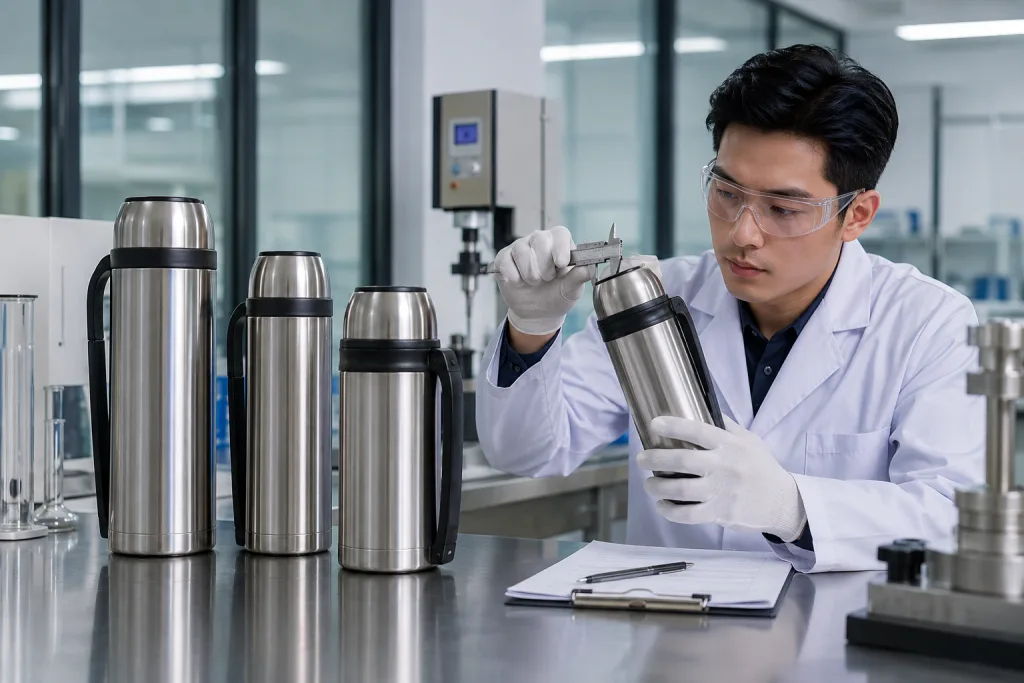
Quality control should be written into the purchase order, not discussed on WeChat after packing starts. Common inspection points include vacuum performance after 6 hours, leakage at inverted position for 30 minutes, coating adhesion by cross-hatch tape test, barcode scan rate, carton drop test, and appearance under AQL Level II. Typical AQL settings are 0 for critical defects, 2.5 for major defects, and 4.0 for minor defects, but retail programs may tighten this. On the line, we run the cross-hatch with a 3M tape pull, check lid torque by hand gauge, and record water temperature with a probe thermometer before QC signs the carton stamp.
Compliance is cheaper when it is planned. It gets expensive when 5,000 bottles are finished, the master cartons are already strapped at 12 kg each, and the buyer discovers the ink report is missing.
Payment Terms And Freight Math
Most vacuum bottle wholesale orders from China still run on 30% deposit and 70% balance before shipment. For a repeat buyer moving 2-3 containers a month, we can talk about partial credit terms after 3 clean orders, but the first PO stays simple. Tooling is paid 100% upfront because our mold shop asks us to pay before CNC cutting and T1 sampling; last month QC pulled a lid mold sample with a 0.3 mm mismatch at the thread, and nobody wants that bill sitting unpaid.
FOB is the cleanest term for distributors because your freight forwarder controls vessel booking and destination charges. We ship FOB Ningbo for most stainless thermos orders. EXW looks cheaper on the quote sheet, then the buyer gets stuck with local pickup, export handling, and customs coordination from our Hangzhou factory gate. DDP works for small promotional thermos orders, say 500-1,000 pcs, but ask whether duties, VAT, and remote delivery fees are inside the number. The buyer flagged it once: a low DDP quote had no proper customs invoice, and the math did not work.
Carton size hits freight harder than new buyers expect. A 500 ml bottle may pack 24 pieces per master carton with a gross weight of 9-12 kg. Add a bulky handle lid or retail gift box, and loading efficiency can drop by 15-25%; we have seen a 58 x 39 x 32 cm carton become 62 x 45 x 38 cm after the gift box was approved. On 10,000 pieces, that gap can add hundreds or thousands of dollars in ocean freight and warehouse handling. Small carton changes bite.
For thermos distributor planning, ask for carton dimensions, gross weight, net weight, HS code, and estimated CBM before you approve packaging. If you plan mixed SKUs, request a loading plan with pallet count and container type; our merchandiser usually checks it against a 20GP or 40HQ loading sheet. A manufacturer thermos quote without packing data is not ready for landed-cost calculation. This is the wrong place to guess.
Currency also matters. Stainless steel, plastic resin, and freight move week by week. We normally hold FOB pricing for 15-30 days, not 90 days, unless the buyer confirms deposit. That sounds strict to some buyers, but we have seen this go sideways when 304 stainless jumps and a PO sits unsigned for 42 days. We run the quote again before production because pretending raw material markets are fixed helps nobody.
How To Keep The Project Controlled
The lowest-risk path is to freeze specs before we buy materials. Confirm capacity, 304 stainless steel grade if required, lid structure, coating, logo method, packaging, barcode rules, carton marks, AQL 2.5 inspection standard, and shipping term before deposit. We run the pre-production checklist in millimeters, not adjectives. A custom thermos program can absorb one or two controlled changes, such as moving a logo 3 mm higher after the sample. It goes sideways when the buyer asks for a new Pantone color, a 12 mm larger logo, and a new box insert after powder coating film and cartons are already ordered.
Use a golden sample. For a thermos promotional order, that can be one signed logo sample with the PO number taped to the bag. For an outdoor retail line, it should include the bottle, lid, coating, printed packaging, barcode label, and carton mark. Keep one sample with the buyer, one with the factory, and one for inspection reference. QC pulled the sample last month because the approved logo sat 48 mm from the base, while bulk production measured 55 mm. That 7 mm gap is much easier to settle when everyone is holding the same signed sample.
Be honest about your channel. If you are building a distributor thermos range for retailers, we will push you toward tougher coating and stronger packaging because shelf returns are expensive. If you need a short-run promotional bottle for a 2-day conference, premium retail packaging is the wrong question to ask. The math does not work. We have seen buyers spend USD 0.38 extra per box, then ship the bottles straight into event cartons where nobody sees the box. A good thermos supplier should protect your margin, not upsell every option.
Our Hangzhou team can quote 500-piece pilot runs, 3,000-piece color programs, and 10,000-piece seasonal wholesale buys. For most new buyers, the smart first order is not the biggest one. It is the order that proves the bottle, packaging, inspection process, and sell-through before you scale thermos bulk purchasing. We ship test orders with the same carton drop check we use on larger runs, usually 1.2 m on the corner, edge, and face. One buyer once had a typo on the PO, “matte balck,” and the line stopped until we confirmed matte black by email. Small checks save big claims.
Send Your Thermos Specs For A Real Quote
Share volume, logo method, packaging, and delivery market. We will return MOQ, FOB price, sample timing, and production lead time.
Frequently asked questions
What is the minimum order for vacuum bottle wholesale?
For an existing stainless thermos model, 500 pieces is usually workable for laser engraving or a one-color logo. For custom powder coating, 3,000 pieces per color is more realistic because coating lines need setup time and material yield. New molds for a special lid, handle, or body shape normally need 8,000-20,000 pieces to justify tooling. If you are testing a new outdoor retail SKU, start with 500-1,000 pieces using an existing body and standard color. That keeps risk low while still giving you a real custom thermos sample for market feedback.
How much does a customized stainless thermos cost?
A standard 500 ml customized thermos usually quotes around USD 3.10-5.80 FOB China, depending on steel grade, lid design, coating, and packaging. Laser logo may add USD 0.08-0.25 per unit. Custom color boxes often add USD 0.25-0.55, while premium retail packaging can add USD 0.60-1.40. Copper lining, 304 outer steel, and complex lids push the price higher. The best way to compare thermos manufacturers is to ask for the bottle, logo, packaging, and carton costs separated instead of accepting one blended number.
How long does bulk thermos production take?
For an existing manufacturer thermos model, mass production normally takes 25-35 days after deposit and approved pre-production sample. Logo samples take about 7-12 working days, while custom coating or packaging samples can take 12-20 working days. Peak season orders may need 40-50 days in production. Add 3-5 days for inspection and port delivery, then sea freight: roughly 18-25 days to the US West Coast or 30-40 days to Northern Europe. For retail launches, plan a 10-day buffer.
Which logo method is best for promotional thermos orders?
Laser engraving is the safest method for most promotional thermos orders because it is durable, clean, and works well from 500 pieces upward. Silk screen printing is cheaper for simple one-color logos and larger artwork, usually USD 0.06-0.18 per color, but curved bottle surfaces need careful setup. UV printing and heat transfer are better for multicolor graphics, although they cost more and need stronger pre-production approval. If the bottle will be used outdoors, prioritize scratch resistance over a complicated graphic effect.
Can one thermos factory supply retail and distributor packaging?
Yes, but the packing rules must be defined early. A thermos factory can usually pack the same bottle in plain bulk cartons, individual white boxes, retail color boxes, or FBA-ready cartons with FNSKU labels. The cost difference can range from under USD 0.20 per unit for simple protective packing to USD 1.40 for premium retail packaging with inserts. Distributor thermos programs should confirm carton dimensions, barcode placement, master carton marks, pallet limits, and AQL standards before production. Repacking after inspection is slow and expensive.