Key Takeaways
- A 500 ml stainless vacuum bottle usually lands at USD 3.20-6.80 FOB China at 3,000-10,000 pcs
- Real custom mold work adds about 25-45 days before mass production
- MOQ for color and logo work is normally 1,000 pcs per SKU, but custom shapes start near 5,000 pcs
- A practical production lead time is 30-40 days after deposit and approved pre-production sample
If you buy for an outdoor retail line or a promotional brand, the vacuum bottle wholesale price is never one clean number. We quote 500 ml bottles at USD 3.20 and USD 8.50 FOB China in the same week, because 304 stainless thickness, vacuum time, lid mold, powder coating, gift box spec, carton drop test, and custom tooling all change the bill. Small parts matter. Last Tuesday QC pulled a 500 ml sample with a 0.38 mm inner wall instead of the 0.40 mm on the drawing, and the buyer flagged it before we even discussed logo color.
Our Hangzhou, Zhejiang team runs stainless vacuum bottle quotes every week for Europe and North America. Finding a thermos supplier in China is the wrong question to ask. The real question is which cost items protect your margin and which ones just look good on a quotation sheet. We’ve seen this go sideways when a PO says “custom thermos” but the artwork file is only a 1-color logo on stock goods; that mistake can mean 12 days for normal printing versus 28 days when the line needs a new lid mold, color panel approval, and an extra AQL 2.5 inspection before shipment.
What The Base Price Covers
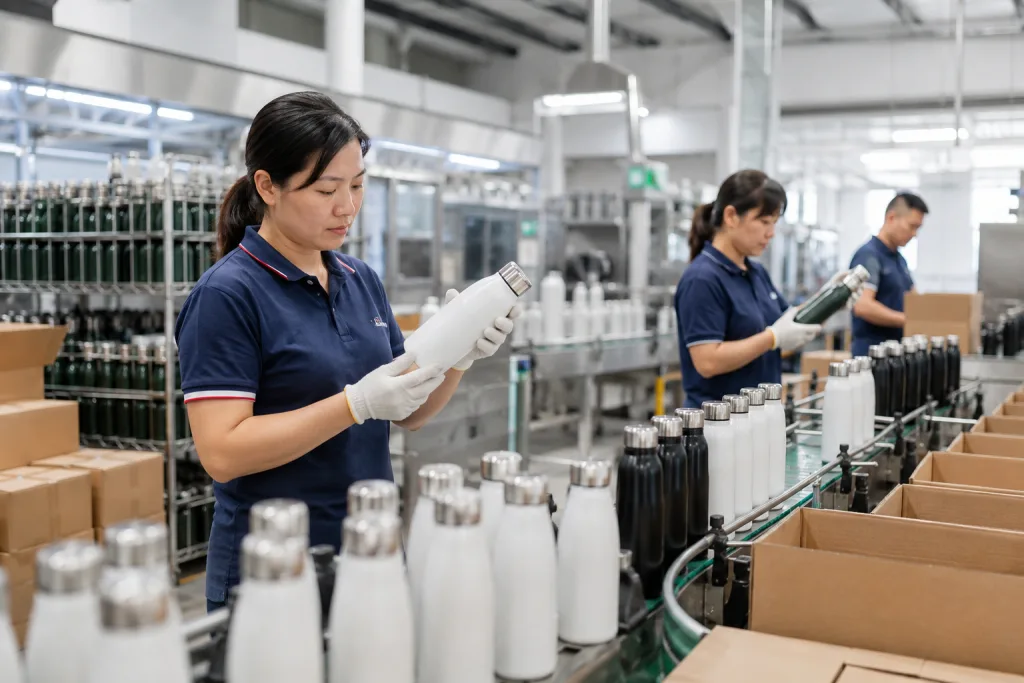
A factory quote for vacuum bottle wholesale price usually covers the inner and outer stainless shell, vacuum insulation, standard lid, 1 stock color, basic polybag or white box, and export carton. For a 500 ml double-wall stainless bottle, a realistic FOB Ningbo or Shanghai range is USD 3.20-4.60 at 3,000 pcs when you choose a mature factory thermos design. We run this costing from the BOM, not guesswork: shell weight in grams, carton CBM, lid set, spray loss, and packing labor all sit on the cost sheet. Simple item. Simple math.
The usual material is 18/8 stainless steel, also called SUS304, for the inner wall. Some lower-price offers use 201 stainless on the outer wall, and that can work for a promotional thermos with a 6-month campaign life. We do not recommend 201 on the inner wall for drink contact. The math doesn't work if the buyer saves USD 0.12 and then gets rust complaints in week 8. For outdoor retail, specify SUS304 inner wall, 0.4-0.5 mm wall thickness, and silicone parts that can pass LFGB or FDA food-contact testing. QC should check wall thickness with a digital caliper, not just read the supplier's spec sheet.
Vacuum performance has its own cost. A proper manufacturer thermos line uses vacuum pumping, copper plating on selected models, and 100% temperature-retention screening before packing. If a supplier thermos quote is USD 0.40-0.80 below the market, ask whether they test every piece or only sample by AQL. On our line in Zhejiang, QC pulled one weak-vacuum sample last month after the 95°C hot-water test dropped too fast at the 6-hour check. BottleForge Industrial in Zhejiang can produce about 420,000 stainless drinkware units per month, but we still reject weak-vacuum units before final inspection because one leaking bottle can damage a distributor thermos program fast.
MOQ Tiers And Price Movement
MOQ matters because stainless bottles carry real setup waste: steel forming scrap, powder coating line changeover, logo jig setup, lid assembly sorting, and carton printing plates. We run the 500 ml body on a 0.5 mm 304 stainless coil, and QC pulled 23 dented shells from the first forming tray last Tuesday before the line settled. For a stock-shape customized thermos, 1,000 pcs per color is a workable MOQ. At that level, expect a 500 ml bottle around USD 4.20-6.80 depending on finish and lid. At 3,000 pcs, the same item drops by 6-12%. At 10,000 pcs, you save another 4-8%, mostly from fewer coating cleanouts and buying cartons by the full pallet instead of mixed bundles.
For thermos bulk orders, the biggest savings come after you cut SKU fragmentation. A 6,000 pcs order split into six colors is not priced like one 6,000 pcs run. It behaves like six 1,000 pcs runs, with six powder changes, six color cards, and six carton labels for the packing team to chase. The buyer flagged this on a PO once: “same total qty, why not same price?” The math doesn’t work. Outdoor retailers often underestimate this. Promotional brands usually push one color and one logo, which gives the thermos manufacturer a cleaner production plan and a sharper price.
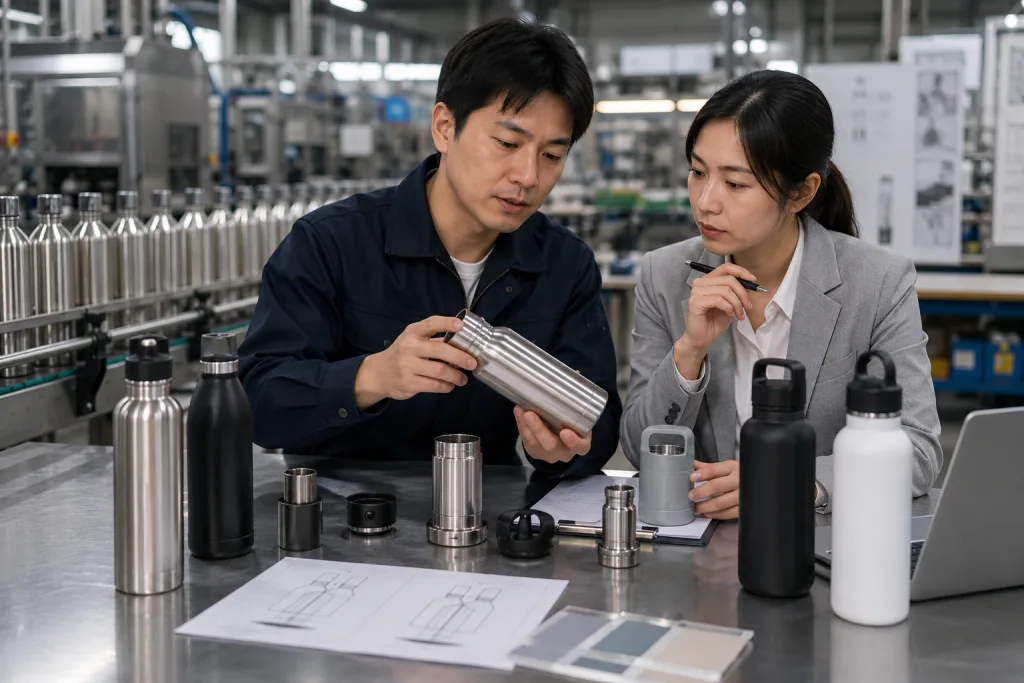
Custom shape work changes the MOQ. A new body mold, new lid tooling, or custom carry handle usually starts at 5,000-10,000 pcs, with tooling charges from USD 800 to USD 4,500 depending on complexity. Our mold room checks the first T0 sample with calipers at the mouth thread, because a 0.3 mm miss there can make the lid feel loose even if the bottle looks fine. A thermos vendor may waive tooling at high volume, but that cost is still sitting inside the unit price. If you need a distributor thermos item for repeat seasonal orders, tooling can make sense. If you need 1,200 pcs for one event, use a proven customizable thermos and spend the budget on decoration.
Decoration Costs Buyers Miss
Logo cost looks small on the quote sheet. It becomes a headache when the PO reaches us 3 days after the artwork deadline. Laser engraving runs USD 0.12-0.35 per position, clean on 304 stainless or powder-coated bottles, and it holds up well for outdoor use. We run it on a 20W fiber laser, and QC checks logo depth with a 10x loupe because shallow engraving looks gray after bead blasting. Silk screen printing is around USD 0.08-0.25 per color per position, but curved bottles need artwork limits, usually 45-60 mm wide before distortion starts to show. Heat-transfer or full-wrap printing can run USD 0.45-1.20 per piece and needs tighter surface control, especially on tapered bodies where the film edge can creep 1-2 mm.
For a promotional thermos, decoration is the product. Ask the wrong question and the math doesn't work. A buyer once pushed us hard on 24-hour heat retention, then rejected the PPS sample because the logo sat 3 mm off-center from the handle line. For an outdoor retail custom thermos, the decoration has to survive abrasion, dishwashing claims if you print them on the PDP, and shelf handling. QC pulled the sample after 50 rub cycles with a 500 g test weight, and that one-color silk screen passed while a cheap metallic ink failed at the rim. We normally recommend laser engraving for premium retail and one-color silk screen for cost-driven promotional programs.
Packaging also moves the vacuum bottle wholesale price. A white box may cost USD 0.12-0.20. A printed color box is often USD 0.35-0.70 at 3,000 pcs. A kraft box with insert and barcode may sit in the middle. If you sell through online marketplaces or retail chains, add barcode label, carton mark, and possibly FNSKU label costs. Small money, until it isn't. Five add-ons can add USD 0.60 per unit, and we have seen this go sideways when the PO says “plain box” but the buyer flags missing Amazon labels during pre-shipment inspection. Ask thermos suppliers to quote decoration and packaging as separate lines. It makes comparison fair and keeps the China factory from burying cost inside the bottle price.
Lead Time From Quote To Ship
A workable schedule starts before the line opens. Quotation and artwork checking take 1-3 working days if the RFQ is complete: size, capacity, target price, logo file, packaging style, certification market, and order quantity. Miss one item and the clock slips. Last month QC pulled a 750 ml sample because the PO said “matte black” but the artwork file showed Pantone 426C glossy; that small mismatch cost 2 days. A stock sample from Zhejiang or another China production area usually ships in 3-7 days. A pre-production sample with logo takes 7-12 days after artwork approval.
Mass production for a stock customizable thermos normally needs 30-40 days after deposit and sample approval. Add 5-10 days during peak months before summer campaigns, Black Friday inventory builds, and year-end gift orders. The buyer often pushes back here, but the math doesn't work if coating, laser marking, vacuum testing, and carton packing all fight for the same 2 lines. If you need a new mold, plan 25-45 days for tooling and test samples before the normal mass-production clock starts; our mold room checks lid thread fit with a 0.05 mm feeler gauge before we release samples. Sea freight to the US West Coast may take 18-28 days port to port; to Northern Europe, 30-40 days is safer. Air freight is faster but often kills the margin on bulk thermos orders.
The cleanest schedule for promotional brands is approval by day 12, production finished by day 45, inspection on day 47, and vessel booking by day 50. We ship smoother when the buyer signs off the dieline before the carton factory cuts the first 500 pcs. Outdoor retailers should add more time for durability checks, retail packaging approval with barcode scan, and internal line review by their QA team. If a thermos supplier promises 15-day production for 5,000 custom units in peak season, this is the wrong question to ask; ask which step they removed. We’ve seen this go sideways. Usually it is coating cure time, vacuum aging, or inspection.
Compliance And Inspection Budget
Compliance has a line cost, but a rejected shipment costs more. For Europe, 7 out of 10 retail buyers we quote ask for LFGB food-contact testing, plus REACH checks on powder coating, silicone gaskets, or painted lids. For North America, FDA food-contact expectations apply, and club-store channels sometimes add ASTM-related packaging or safety checks. A single third-party test can cost USD 180-650 per material or color group. If the PO says five coating colors, do not assume one report covers all five; QC pulled a red sample last month and the lab asked for a separate coating chip in a 50 mm x 50 mm panel.
Factory audits matter once a distributor moves from a trial order to a 10,000 pcs thermos program. BSCI covers social compliance files, Sedex buyers check payroll and working-hour records, and ISO 9001 buyers usually ask for incoming steel inspection records before purchase order release. BottleForge Industrial works from Hangzhou, Zhejiang with partner workshops in China that can support standard export documentation, but audit needs must be stated before pricing. A certified line costs more than a casual workshop. The buyer flagged this on a PO once: the audit clause was added after price approval, and the math did not work.
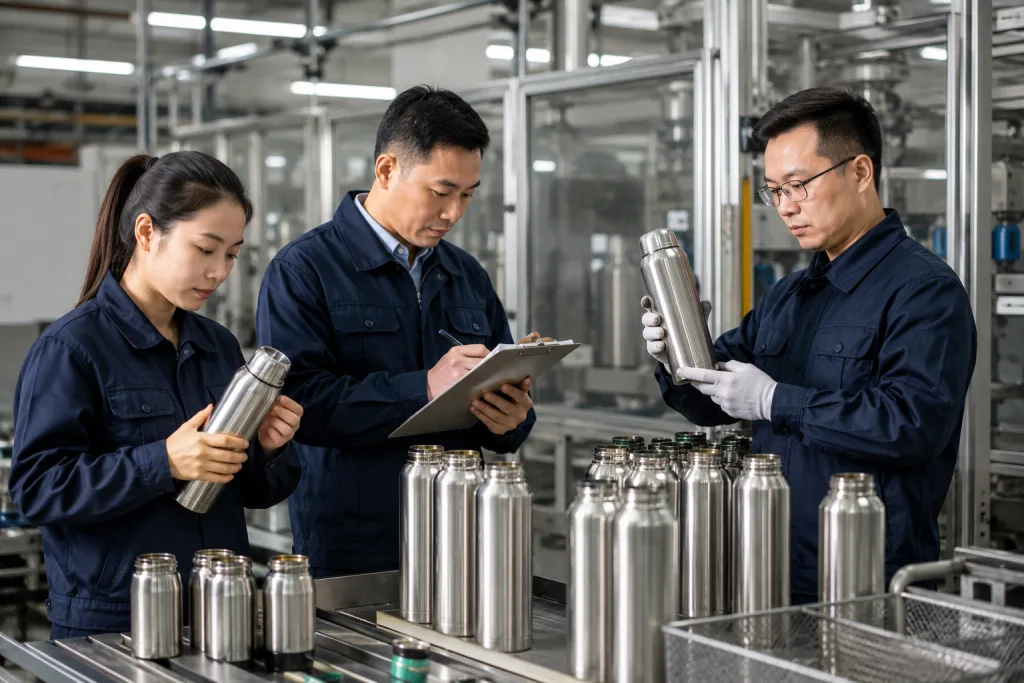
For inspection, most buyers use AQL Level II with critical 0, major 2.5, minor 4.0. A typical third-party inspection costs USD 180-300 per man-day in China. For stainless thermos orders, the inspection sheet should cover appearance, logo position, coating adhesion with 3M tape, capacity by scale, leakage, carton drop test, barcode scan, and random temperature-retention checks. For thermos customized retail goods, we also check lid torque with a torque meter and silicone odor after 24 hours in a closed carton. Skipping inspection to save USD 250 on a 5,000 pcs order is poor math.
How To Compare Supplier Quotes
Do not compare only the headline vacuum bottle wholesale price. Build a grid for every thermos manufacturers quote: capacity in ml, 304 stainless or 316 stainless, inner and outer wall thickness in mm, lid material, powder coating or spray painting, logo method, packaging spec, MOQ, sample fee, tooling fee, lead time, FOB port, payment terms, and test reports. We run this check on a 20-column quote sheet before sales signs back the PI. If one thermos supplier is 15% lower, the reason should show up somewhere: thinner 0.4 mm outer shell instead of 0.5 mm, single-wall lid, cheaper color box, or no third-party test report. If it does not show, ask again.
Watch trade terms. FOB Ningbo at USD 4.90 is not the same as EXW at USD 4.70. EXW leaves inland trucking, customs handling, and export paperwork to you or your forwarder, and we have seen buyers lose USD 180 on a small 38-carton trial order just moving goods from Hangzhou to Ningbo warehouse. For first orders, FOB is cleaner. Payment usually runs 30% deposit and 70% before shipment after passed inspection. Some thermos manufacturers exporters accept letter of credit for larger orders, but the bank cost, couriered documents, and amendment fees will sit inside the quote. The math does not always work.
The best thermos suppliers buyers work with are boring in a good way. They ask exact questions, push back on a 12-day delivery request when the line needs 18 days, and separate one-time tooling fees from unit cost. A good thermos factory will say no when a lid has too many silicone parts, when matte coating fails a 3M tape pull test, or when a 500 pcs MOQ pushes the unit price up. QC pulled the sample for this last month: the cup looked fine, but the black coating scratched at the handle fixture after 30 cycles. For outdoor retailers and promotional brands, that kind of plain talk saves more money than chasing the cheapest thermos vendor on a spreadsheet.
Get a clear stainless thermos quote
Send capacity, quantity, logo file, packaging target, and delivery market. We will return a line-by-line FOB China quote with realistic timing.
Frequently asked questions
What is a fair vacuum bottle wholesale price for 500 ml stainless bottles?
For a standard 500 ml double-wall stainless vacuum bottle, a fair FOB China range is USD 3.20-4.60 at 3,000 pcs with a stock body, one color, and simple packaging. Add USD 0.12-0.35 for laser engraving, USD 0.35-0.70 for a printed retail box, and more if you need copper lining, special lids, or full-wrap printing. At 1,000 pcs, the same bottle may cost USD 4.20-6.80 because coating and setup waste are spread over fewer units. If a quote is under USD 3.00, check steel grade, vacuum testing, lid sealing, and whether the term is EXW instead of FOB.
Can I order a custom thermos below 1,000 pieces?
Sometimes, but it depends on what you mean by custom thermos. For logo-only work on available stock, 300-500 pcs can be possible if the color is already in inventory. For factory production with your own color, logo, and packaging, 1,000 pcs per SKU is a more realistic MOQ. For a customized thermos with a new body shape, new lid, or special handle, expect 5,000-10,000 pcs and tooling costs of about USD 800-4,500. Very low MOQ orders usually carry a higher unit price and fewer packaging choices, so they are better for testing a market than building a retail line.
How long does a bulk thermos order take from China?
For a stock-shape bulk thermos order, plan 45-55 days from confirmed artwork to goods ready for vessel booking. That includes 7-12 days for logo sample approval and 30-40 days for mass production after deposit. Add 18-28 days by sea to the US West Coast or 30-40 days to Northern Europe. New tooling adds 25-45 days before mass production starts. During peak gift and outdoor seasons, add another 5-10 days. If your launch date is fixed, lock the sample, carton marks, barcode, and inspection standard before paying the deposit.
Which logo method is best for promotional thermos orders?
For most promotional thermos orders, one-color silk screen printing is the lowest-cost option at about USD 0.08-0.25 per color per position. It works well for simple logos and campaign giveaways. Laser engraving costs more, usually USD 0.12-0.35 per position, but it looks more premium and resists scratching better on powder-coated or stainless surfaces. Full-wrap heat transfer gives more visual impact but may add USD 0.45-1.20 per piece and needs more sampling. If the bottle will be used outdoors, handled daily, or sold at retail, choose durability over the cheapest print method.
What should I ask a thermos manufacturer before paying a deposit?
Ask for steel grade, wall thickness, lid material, silicone grade, vacuum test method, MOQ by color, lead time, FOB port, packaging details, logo cost, sample timing, and AQL inspection standard. Request photos or video of similar manufacturer thermos production, not only catalog renderings. For Europe, ask whether LFGB and REACH testing is available. For North America, confirm FDA food-contact material support. Also ask if the quoted price includes export carton, barcode label, and carton marks. A serious thermos manufacturer in China should answer these points clearly before you transfer a 30% deposit.