Key Takeaways
- A serious RFQ should include capacity, steel grade, decoration, lid type, packing, target FOB price, and 30-60 day delivery window
- Typical MOQ for a custom thermos with logo is 1,000-3,000 pcs per color, depending on coating and lid tooling
- Pre-production samples usually take 7-12 days; bulk stainless thermos production usually takes 30-45 days after approval
- Use AQL 2.5/4.0 inspection and written PO line items to control leaks, coating defects, carton marks, and barcode errors
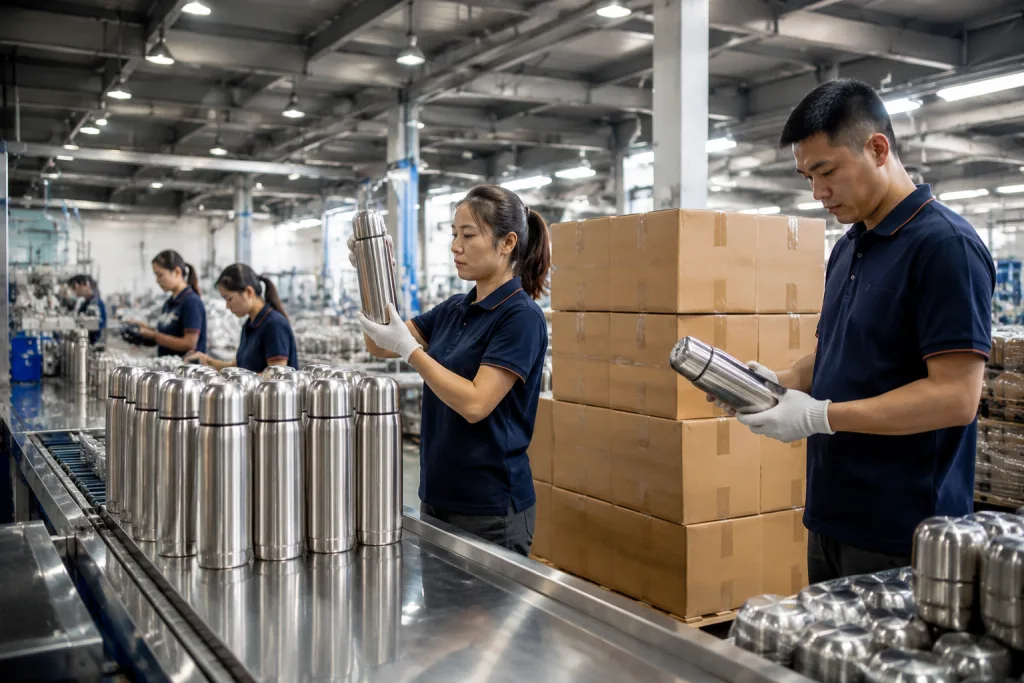
You do not need a glossy catalog first. You need a vacuum bottle vendor who can turn your retail or promo idea into a clean PO, a signed-off sample, and a bulk thermos shipment with no carton-count fight at destination. The usual trouble starts before the line runs: capacity written as “about 500ml,” logo method left open, lid material missing, packing spec blank. QC pulled one sample last month where the buyer approved a 68 mm base on WhatsApp, but the PO showed 72 mm. That is how small errors become 3,000 wrong bottles.
From our factory base in Hangzhou, Zhejiang, we see outdoor retailers and promotional brands lose 10–20 days because the RFQ reads like a mood board. This is the wrong question to ask: “Can you quote this thermos?” We need the bottle body, decoration, compliance, packing, inspection, and shipment terms locked before steel is cut or cartons are printed in China. We run the sample room with calipers, Pantone chips, and a lid torque test, because a loose brief turns into rework fast.
Start with a usable RFQ
Your RFQ should force the thermos vendor to quote the bottle in your head, not a cheaper cousin from the shelf. “500 ml stainless bottle with logo” is too loose. For a manufacturer thermos quote, give capacity in ml and oz, body diameter in mm, lid style, insulation target such as 6 hours above 60°C, exterior finish, logo position, packing, destination port, and annual forecast. Say the sales channel. Outdoor retail shelf? Tell us. Bank gift or race-event promotional thermos? Tell us too, because the line will choose a different coating, carton mark, and logo jig. Last month QC pulled a 500 ml sample that measured 68 mm across the body, while the buyer’s cup holder limit was 65 mm. That is how small RFQ gaps become redesign work.
A usable RFQ line might read: 750 ml double-wall vacuum insulated bottle, 304 inner/outer stainless steel, powder coated matte black, screw cap with stainless carry loop, laser logo 45 x 20 mm, individual kraft box, 24 pcs/master carton, FOB Ningbo, target 3,000 pcs, delivery within 40 days after PPS approval. That single line saves 4 to 6 email rounds. We can check the laser logo on the 45 x 20 mm fixture, weigh the carton at around 13 kg, and confirm whether the 24 pcs/master carton stays under the courier limit. Clear RFQ. Faster quote.
At BottleForge Industrial in Zhejiang, China, we normally ask for the target retail channel before quoting. A distributor thermos for outdoor stores may need stronger coating, hanging tags, GS1 barcodes, and ISTA-style carton thinking. A thermos promotional order may need lower unit cost and faster logo approval, with shipper cartons sorted by event location. Both are valid. Quoting them as the same job is the wrong question to ask. We’ve seen this go sideways when a buyer approved a nice powder coat sample, then the sales team added a swing tag hole after PPS; the punch mark showed through on 2 cartons of trial stock.
For PO planning, create a draft item before you choose the supplier thermos model: item number, model code, capacity, color, logo process, packaging, MOQ, unit price, Incoterm, sample requirement, compliance requirement, and inspection standard. Add the fields now. We run smoother when the PO says “AQL 2.5, logo tolerance ±1 mm, FDA or LFGB as needed” instead of leaving QC to guess at final inspection. One buyer once sent a PO with “mat black” in line 3 and “gloss black” in line 17; the factory caught it before spraying, but that typo still cost 2 days. If a thermos supplier cannot reply against those fields, you are probably not dealing with a production-minded factory thermos partner.
Choose the bottle platform
After the RFQ, freeze the bottle body first. On our Hangzhou line, about 8 out of 10 custom stainless thermos projects run 304 stainless inside and outside, double-wall vacuum, and copper plating on the inner wall when the buyer wants heat retention closer to 18 hours instead of 12 hours. The usual wall spec is 0.4–0.5 mm for the inner shell and 0.5–0.6 mm for the outer shell, but the drawing still has to match forming height, capacity, and the dent target. QC checks this with a digital thickness gauge before polishing. No guessing here.
Capacity is a cost decision, not just a user-preference decision. A 350 ml unit fits office gift sets where the carton needs to stay compact, and a 500 ml custom thermos is still the main promotional size because the price and shelf value balance out. A 750 ml or 1,000 ml customized thermos sells better for outdoor retail and worksite channels, but we ship fewer pieces per master carton, and the cbm jumps fast. We have seen a buyer flag a 1,000 ml quote as “cheaper” on FOB, then lose the saving when freight was calculated at 56 cartons per pallet. FOB only is the wrong question to ask.
Lid choice needs more attention than buyers usually give it. A screw cap is simple and leak-resistant, with fewer leak-test failures on the line. A push-button lid sells well, but it adds springs, buttons, pins, and gasket seating checks, so QC has more places to pull samples. A cup-lid thermos feels more traditional and works for winter retail, especially in 500 ml and 750 ml sizes. For food contact parts, ask your thermos manufacturers for contact declarations on PP parts, silicone gaskets, and any stainless drinking surface. For Europe, REACH and LFGB expectations may apply. For the United States, FDA food-contact expectations and, for kids’ items, CPSIA and ASTM considerations may be relevant.
Your PO line item should lock the platform clearly: factory model code, nominal capacity, brimful capacity if needed, steel grade, finish, lid assembly, gasket color, insulation test requirement, and spare-gasket packing rule. We once received a PO with “black lid” in the item line and “silver lid” in the artwork file; production stopped for 2 days while the buyer confirmed. A customizable thermos program can run the same body across 4 colors, which keeps tooling and MOQ under control. Do not mix lid versions in one SKU unless your warehouse team can separate them without relabeling 3,000 cartons by hand.
Lock decoration before sampling
Lock the logo before we cut the first physical sample. Laser engraving gives a clean mark and it survives outdoor retail abuse because there is no ink film to peel; on our 20W fiber laser, the line usually looks safe at 0.2–0.3 mm stroke width, depending on the artwork file. It works best on powder coating or raw stainless. Silk screen is cheaper for a one-color logo on a 10,000 pc promo run, but fine text can stretch on a curved bottle body; QC pulled one sample last month where 6 pt legal text looked fat at the edge. Heat transfer or UV print handles multi-color artwork, but then the math includes setup plates, 3M tape adhesion checks, and cross-hatch testing.
For a thermos custom project, ask the vendor for a decoration proof with exact dimensions and position: 50 mm below shoulder seam, centered opposite the lid hinge, 40 x 28 mm logo, Pantone 186C, matte varnish, or similar. “Logo on front” is not a spec. It is the wrong question to ask on a bottle with a lid hinge, carry loop, and back barcode label. If your brand has strict color rules, state Delta E tolerance, usually within 1.5–2.0 for coated parts when color control matters; we check this with a handheld colorimeter before the line releases mass production.
MOQ changes with decoration. A laser logo on an existing color may start at 1,000 pcs per SKU. A new powder coat color may require 2,000–3,000 pcs per color because coating line setup and powder procurement are not free; one color change can burn 18–25 kg of powder before the booth runs stable. A full-wrap customized thermos design can push MOQ higher, especially if you need printed retail boxes too. We have seen this go sideways: a buyer asked for five colors at 500 pcs each, but that is not the same as one clean 2,500 pc coating run.
Put decoration into the PO as separate controlled lines: artwork version, logo method, logo size, logo location, Pantone number, coating finish, approval sample reference, and acceptable defect limit. Short lines. Fewer arguments. Good thermos suppliers will welcome this because it gives QC a checklist at AQL 2.5 instead of a WhatsApp screenshot; we once caught a PO typo where “Pantone 186C” became “168C” before the sample room burned a day on the wrong red.
Approve samples like production
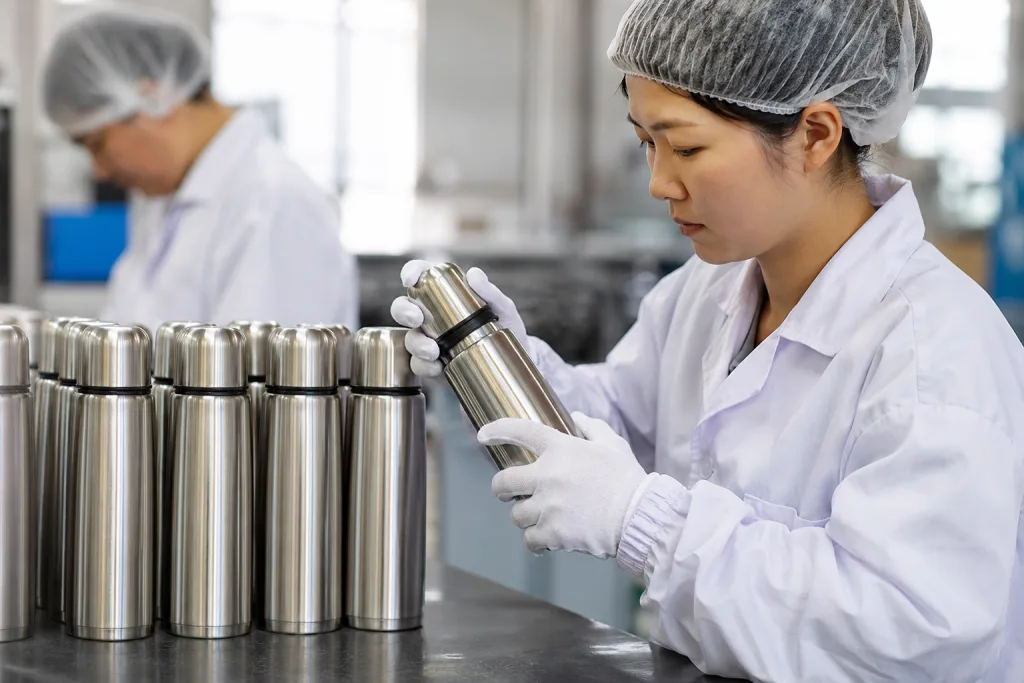
A sample is not a souvenir. It is the production contract you can hold in your hand. For a custom thermos order, we split samples into 3 stages: reference sample, logo sample, and pre-production sample. The reference sample locks the body shape and lid feel; the logo sample checks laser, screen print, or heat-transfer position; the pre-production sample locks 304 stainless, color, logo, inner tray, carton marks, and barcode before the line opens. QC pulled one PPS last month because the buyer’s PO said “matte sand,” but the artwork file said “satin beige.” That small typo would have turned into 3,000 wrong bottles.
Typical sample timing from Zhejiang is 3–5 days for an existing blank bottle, 7–12 days for logo samples, and 10–15 days when a new coating color or printed box is involved. Air courier to Europe or North America usually adds 3–6 days. If the launch date is tight, the wrong question is “can we decide the color later?” The math doesn't work. Send Pantone references early, then approve the target under a D65 light box, not beside a sunny office window at 4 p.m. We ship samples from Hangzhou with DHL most weeks; a 500 ml bottle sample is usually around 0.45–0.65 kg packed.
For performance, test the sample in a boring but measurable way. Fill with 95°C water, close the lid, record the temperature after 6 hours and 12 hours, and compare against the agreed requirement. A common retail-grade 500 ml vacuum bottle should hold roughly 60°C or higher after 6 hours, depending on body shape, lid design, and ambient temperature. Check leakage by filling, closing, inverting, and shaking for 30 seconds. Then leave it horizontal on tissue for 2 hours. Simple test. Real answer. We run the same check with a probe thermometer and a 2-hour tissue laydown; if the silicone ring sits 0.5 mm proud, the buyer will flag it after the first leak photo.
Your sample approval sheet should include SKU, sample date, photo set, measured capacity, weight, logo result, color result, lid fit, leakage result, insulation result, packing result, and named approver. Add the caliper reading for lid thread fit in mm and the carton gross weight if packing is already fixed. When the PO says “bulk must match approved PPS dated March 18,” your thermos factory has a clear target and your inspector has a comparison standard. We've seen this go sideways when approval sits in a WhatsApp thread with 14 photos and no named approver.
Build the PO line by line
The purchase order is where good intentions become enforceable. For vacuum bottle vendors, a clean PO prevents more mistakes than 6 friendly WeChat calls. Give each SKU its own line, even if the only difference is color. No shortcuts. Do not write “assorted colors” unless the ratio is exact: black 40%, olive 30%, navy 30%, for example. We once had QC pull 12 cartons because the PO said “blue series” while the artwork file showed navy and the carton mark said royal blue. Factories in China can follow precise instructions; they cannot guess your warehouse allocation plan.
Write the commercial terms on the PO: FOB Ningbo or FOB Shanghai, unit price in USD, MOQ, quantity tolerance, payment terms, production lead time, and shipment week. For our Hangzhou facility, standard capacity is about 450,000 stainless bottles per month across thermos, travel tumbler, and sports bottle lines. For a normal manufacturer thermos order using existing tooling, we usually quote 30–45 days after deposit and sample approval. If the buyer waits until September for Q4 goods, the math gets tight; a 38-day plan can become 52 days once coating line space and vessel booking are gone.
Then add technical terms. List the 304 stainless steel body, coating type, lid material, gasket material, insulation target, surface finish, logo method, logo size, packing structure, carton quantity, gross weight limit, barcode or FNSKU placement, and master carton marks. For marketplace warehouses, carton size and barcode scannability matter as much as the bottle itself. We run a Zebra scanner check at 300 mm because one blurred FNSKU can hold a full pallet at inbound. For distributor thermos programs, specify inner cartons, hang tags, spare parts, and multilingual instructions, with language versions named on the PO instead of buried in an email thread.
Quality terms should be written, not assumed. Use AQL 2.5 for major defects and 4.0 for minor defects unless your channel requires stricter limits. Define critical defects as leakage, unsafe sharp edges, wrong material, missing barcode, severe logo error, or failed insulation. We test random samples with hot water and a torque check on the lid; last month QC flagged 3 lids from one cavity because the silicone gasket sat 0.8 mm high. A supplier thermos partner that refuses written AQL is asking you to accept whatever comes off the line. We have seen this go sideways.
Inspect before cartons leave
Bulk production should never run as a black box. Ask your thermos manufacturer for 3 checkpoints: material confirmation, inline production photos with dates, and final random inspection before booking the truck. Material confirmation should show the steel grade declaration, silicone and PP data, and coating or ink compliance where the buyer’s market asks for it. On our line, we usually send photos from the body-forming area, the powder-coating rack, the pad-printing jig, and the packing table; last month QC pulled the sample because the PO said matte black, but the artwork file named it “BK glossy.” Photos do not replace inspection. They catch the stupid mistakes early.
Final inspection usually happens when 100% of goods are finished and at least 80% are packed. For a 3,000 pc thermos bulk order, an inspector may pull a sample size based on ANSI/ASQ Z1.4, then check appearance, dimensions with a digital caliper, capacity, coating adhesion, logo position within 1.5 mm, leakage, insulation spot test, carton marks, and barcode scans. For coated bottles, we run a cross-hatch tape test. For lids, check gasket seating and thread engagement; a loose silicone ring looks small until 300 pcs leak in transit. For retail boxes, drop-test a packed master carton if the shipment will face parcel handling.
Common defects are not dramatic, but they cost money after arrival: pinholes in coating, dust under paint, uneven laser depth, tilted logos, loose silicone rings, small dents near the base, wrong carton count, and unreadable FNSKU labels. QC pulled 18 pcs from one 500 pc lot last spring because the laser logo was 2 mm too low after the fixture screw backed out. A distributors thermos shipment with mixed barcodes can create chargebacks even when the bottle itself is fine. We’ve seen this go sideways.
Put inspection rights into the PO: inspection standard, defect classification, rework responsibility, re-inspection cost, and shipment hold condition. Better yet, write the hold rule in plain words, such as “no shipment release before passed final inspection,” because one buyer once sent us a PO with “AQL 2.5” typed as “AQL 25.” Serious thermos suppliers in China understand this. It protects both sides because the decision is based on agreed limits, not emotion at the loading dock.
Plan freight and repeat orders
Stainless thermos orders look small on the desk. Then we run the cbm. A 500 ml bottle packed 24 pcs per carton usually lands around 0.06–0.08 cbm per carton, depending on the color box, egg-crate divider, and master carton board. A 3,000 pc order can hit 8–10 cbm before the forwarder adds any pallet space. Sea freight makes sense for regular retail replenishment. Air freight is the wrong question to ask for most 500 ml vacuum bottles; the math usually breaks because the bottle takes space but does not carry enough unit value, unless we are shipping 300–500 pcs for a launch event or a hard promo date.
For FOB shipments, confirm port, forwarder contact, cargo ready date, carton dimensions, total cbm, gross weight, HS code, and loading photos. We ship most Zhejiang cargo through Ningbo or Shanghai, and the difference can be 1–2 days on trucking cut-off depending on the vessel schedule. If your warehouse requires palletization, put it in the RFQ before we quote. A 1.2 m pallet changes container use, carton stacking, and compression testing on the line. If you need Amazon-style prep, FNSKU labels, suffocation warnings for polybags, and carton weight limits should be in the PO from the start; we have seen a buyer flag a 16.8 kg carton because their warehouse limit was 15 kg.
Repeat orders are where a good thermos vendor earns the next PO. Keep one controlled spec file with approved sample photos, Pantone references, carton layout, barcode files, inspection reports, and past defect notes. We usually attach caliper checks for lid height in mm and gasket fit photos after QC pulls the sample. When you reorder, reference the previous PO and list only controlled changes. This keeps the thermos factory from making quiet swaps, such as a black gasket becoming grey or 350 gsm box board becoming 300 gsm because purchasing found a cheaper lot.
If you plan a seasonal range, build it around shared components. One 750 ml body with three colors and two logo versions is easier to run than six unrelated shapes, especially when the MOQ is 1,000 pcs per color. The line can keep the same body tooling, same lid torque setting, and same leak-test fixture. Outdoor retailers get consistent shelf language, promotional buyers get faster reorders, and your suppliers thermos pipeline stays stable. We have seen this go sideways when every SKU used a different lid. That is how stainless vacuum bottle sourcing becomes repeatable instead of a fresh negotiation every month.
Send your thermos RFQ for a factory review
Share capacity, logo, quantity, packing, and target market. We will reply with practical MOQ, FOB pricing, sample timing, and production notes.
Frequently asked questions
What MOQ should I expect from vacuum bottle vendors?
For an existing stainless thermos body with laser logo, a realistic MOQ is usually 1,000 pcs per SKU. If you need a new powder coated color, expect 2,000-3,000 pcs per color because coating setup, powder purchase, and line cleaning take time. For a fully customized thermos with new lid tooling, MOQ can reach 5,000-10,000 pcs, plus tooling charges. Promotional thermos orders sometimes ask for 500 pcs, but the unit price and setup cost become unattractive. If your annual demand is 10,000 pcs, tell the factory thermos vendor; they may accept a lower first run if the repeat plan is credible.
How long does a custom thermos order take from RFQ to shipment?
A normal timeline is 2-3 days for RFQ clarification, 7-12 days for logo samples, 2-4 days for buyer approval, and 30-45 days for bulk production after deposit and PPS approval. Sea freight to North America or Europe then adds roughly 25-40 days depending on port and season. If you need printed retail boxes, new coating color, or compliance testing, add 7-15 days. From Zhejiang, China, we advise buyers to plan 60-75 days from serious RFQ to arrival for a first custom thermos program.
What should be written on the PO for thermos bulk orders?
Each PO line should show SKU, quantity, capacity, body material, lid material, coating finish, logo method, logo size, logo location, packing, carton quantity, barcode file, unit price, Incoterm, lead time, and inspection standard. Add AQL 2.5 for major defects and 4.0 for minor defects unless your retailer requires another level. For marketplace or distributor thermos shipments, include FNSKU or GS1 barcode placement and carton marks. A vague PO like “black bottle with logo” leaves too much room for interpretation and makes claims harder after shipment.
Is laser engraving better than printing for promotional thermos orders?
Laser engraving is usually better for durability, especially on powder coated stainless steel used outdoors. It will not peel, and it handles single-color branding cleanly. Silk screen printing can be cheaper for simple logos on larger promotional thermos runs, but adhesion and curve distortion must be checked. UV print or heat transfer is useful for multi-color artwork, but setup cost and testing are higher. For 1,000-3,000 pcs, we often recommend laser unless your brand color must be printed exactly. Always approve a physical logo sample before bulk.
How do I compare thermos suppliers without choosing only the lowest FOB price?
Compare the full landed risk, not only FOB USD. Ask each thermos supplier for steel grade, wall thickness range, lid materials, insulation test result, coating type, carton size, cbm, MOQ, lead time, compliance support, and AQL acceptance. A bottle that is USD 0.18 cheaper but ships in larger cartons can lose the saving in freight. A supplier that refuses inspection can cost more through claims. For outdoor retail, coating durability and leakage control usually matter more than shaving 3% from FOB price.