Key Takeaways
- For custom stainless thermos orders, set AQL at 2.5 major / 4.0 minor and test 8-12 pieces per SKU for heat retention
- A practical MOQ for one color and one logo is usually 1,000-3,000 units per model
- Most vacuum failure comes from welding, evacuation, stopper fit, or inner wall contamination
- Plan 35-45 days for production after artwork approval, plus 7-10 days for pre-production sampling
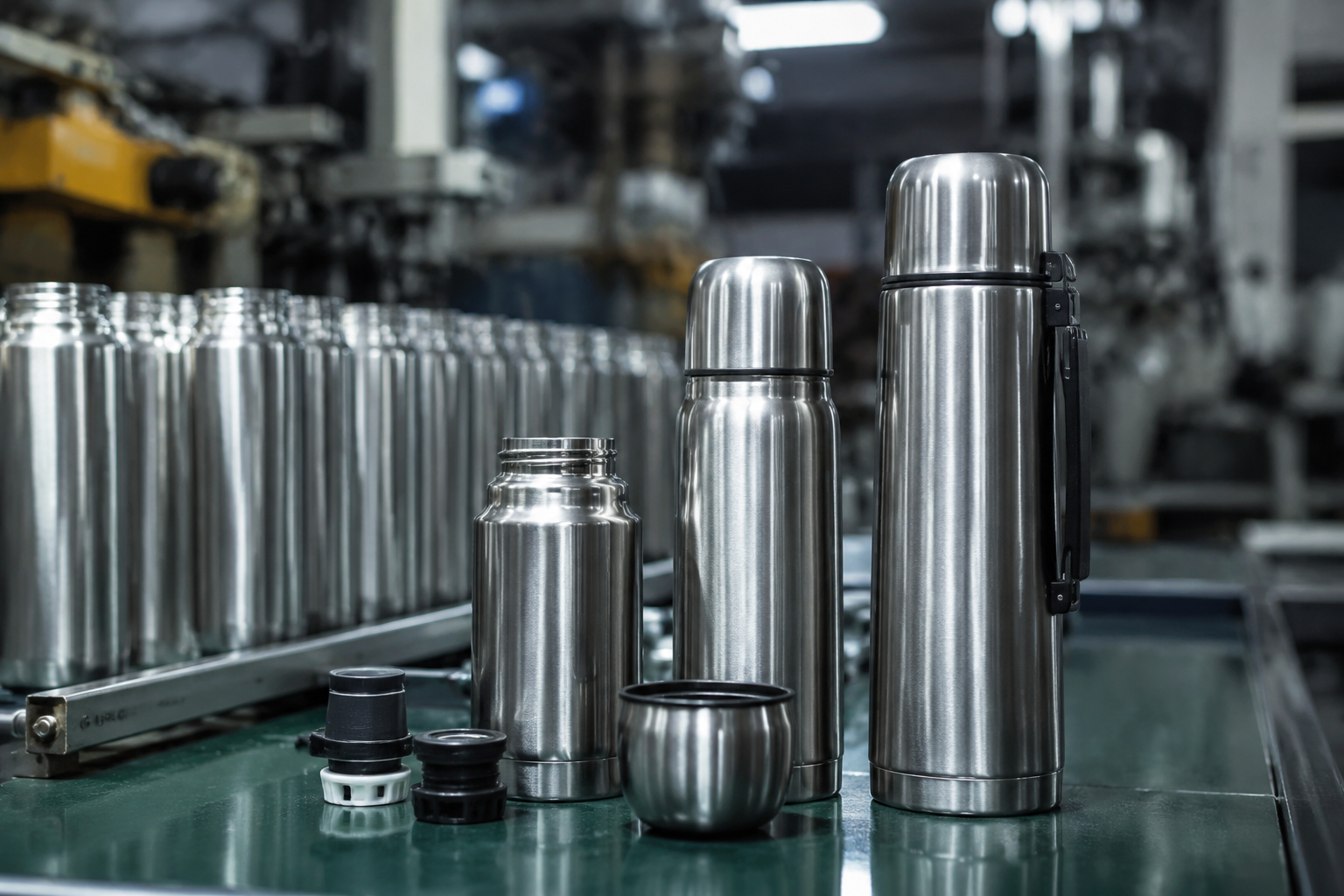
A stainless vacuum bottle looks simple until the first container lands with 52°C heat retention after 6 hours, a logo sitting 3 mm off center, 7 dented export cartons, and lids that start leaking after 14 days on the store shelf. Outdoor retailers and promo buyers usually catch it too late: the catalog is printed, FNSKU labels are already on, or the event date is locked.
Good vacuum bottle suppliers should not sell optimism. They should pin down the failure points before the line starts. From our factory in Hangzhou, Zhejiang, China, we see the same trouble repeat on bulk thermos, custom thermos, and promotional thermos orders: loose lid torque, thin inner walls, poor powder coating adhesion. QC pulled the sample, the buyer flagged it, and the math doesn't work if you only argue after packing. The fix is tighter specs, realistic tolerances, and boring QC discipline.
Vacuum failure is not random
The first mistake buyers make is treating insulation as copywriting instead of a factory process result. Wrong question. A double-wall stainless bottle works only when the inner and outer shells are TIG welded cleanly, the vacuum furnace pulls the cavity down to spec, and the tail is sealed without pinhole leaks. We have seen QC pull a sample that looked perfect under the light box, then it dropped 95°C water to 48°C after 6 hours. Nice finish. Bad bottle.
For a 500 ml or 750 ml stainless thermos, we run the usual check with hot water at 95°C, cap closed for 6 hours, then record the temperature with a calibrated probe. Most outdoor retail programs we see ask for 65°C or higher after 6 hours; premium specs push closer to 70°C depending on bottle diameter, cap design, and wall construction. Do not accept “keeps hot all day” on a purchase order. We had one PO with that exact line and no test temperature, and the buyer flagged it only after the first 3,000 pcs landed. The math does not work in a claim dispute.
Ask vacuum bottle suppliers for the actual test method: starting water temperature, room temperature, fill level, test duration, and sample size. For thermos bulk orders, we suggest pulling 8-12 pieces per SKU from mass production, not only golden samples from the sample room. On the line, QC should pick from sealed cartons after assembly, not from the supervisor’s desk. A vacuum defect rate of even 1% means 200 problem units when you ship 20,000 units to winter retail stores.
At BottleForge Industrial in Zhejiang, our stainless thermos lines can produce about 450,000 units per month across standard models, but we still slow down for vacuum testing and leak checks. Capacity is not control. We ship more smoothly when the vacuum tester, water bath, and cap torque gauge catch issues before cartons are taped. A supplier thermos program should prove the seal before it talks about carton quantity.
Steel grades get quietly substituted
Too many buyer briefs still say “stainless steel” and stop there. That is the wrong line to put on a PO. For the inner wall, write food-contact 304 stainless steel, usually 0.35-0.45 mm wall thickness depending on bottle shape and capacity; on our line, QC checks this with a digital thickness gauge before deep drawing. For the outer wall, 201 or 304 can work, but the choice should match the price target and where the bottle will be sold. If your bottle goes to outdoor retailers within 20 km of the coast, we push for 304 outer steel.
The problem does not always show up as orange rust. We see smaller warning signs first: tea staining around the mouth after 48 hours, a metallic smell after the 95°C hot water test, or uneven polishing that still ghosts through powder coating. Last April, QC pulled 12 samples from a mixed-coil batch and 3 failed visual inspection at the rim. A thermos manufacturer chasing a tight FOB price might reduce gauge or swap steel grade unless your purchase order blocks it in plain words.
Put the material line directly into the spec sheet, then ask for mill certificates for every stainless coil batch. No shortcut here. For EU buyers, confirm LFGB or EU 1935/2004 food-contact testing where it applies; for North America, ask about FDA food-contact compliance and California Prop 65 screening if your channel asks for it. REACH also comes up for coatings, inks, silicone, and plastic accessories. We have seen one PO typo, “304 outside” instead of “304 inside,” hold a 5,000-piece order for 2 days while the buyer corrected it.
Promotional brands often chase the lowest factory thermos price because the item is “just a giveaway.” The math does not work. A promotional thermos still holds hot liquid, still sits on a client’s desk, and still carries your logo under the clear tape test and drop test. Saving USD 0.18 by accepting unclear steel is poor buying if you are responsible for a 10,000-piece campaign; we have seen this go sideways when the buyer flagged smell complaints before the goods even left Hangzhou.
Lids fail before bottles do
Most complaints start at the lid. We see it on the line: threads bind on the go/no-go neck gauge, silicone gaskets take a set, flip hinges get loose after 500 cycles, push buttons seep, and painted caps pick up rub marks inside the master carton. The bottle body can pass the vacuum oven and hot-water hold test, then the finished SKU still gets rejected on a retailer shelf because QC pulled the sample and found 2 drops around the cap.
For a custom thermos, write the lid spec like a part drawing: PP or Tritan grade, stainless cap shell thickness, silicone gasket hardness in Shore A, spare gasket quantity per carton. If the bottle is for hikers or drivers, we run one-hand opening and leakage after 1,000 open-close cycles; for school bottles, we check drop dents and whether small fingers can pinch the latch. Simple screw lids are boring. Good. They have fewer parts. Push-button lids sell well in photos, but the math doesn't work unless the mold, spring, and gasket seat are controlled tighter, usually within 0.10 mm.
A practical lid test is simple: fill the bottle with 60°C water, tighten the cap to normal hand force, invert for 30 minutes, then shake horizontally for 30 seconds. Do this on at least 20 pieces during pre-shipment inspection for each lid type, not just the golden sample from the showroom. For sports or outdoor retail, add a 1.0 m drop test on filled samples, usually onto plywood or concrete depending on the agreed standard; last month the buyer flagged a latch crack after the second corner drop, and that saved a full container from going sideways.
About 6 out of 10 vacuum bottle suppliers will offer a thermos customizable with several cap options. Useful, yes, but this is the wrong question to ask if nobody checks the neck. Thread pitch, gasket compression, and cap height decide whether the lid seals after mass production, especially when the neck ID drifts 0.2 mm after polishing. A thermos vendor should provide assembly drawings or measured neck and cap tolerances before you approve a new combination; we ship faster when the PO says "lid B for 500 ml wide mouth" instead of a vague cap photo pasted into Excel.
Logo work hides expensive defects
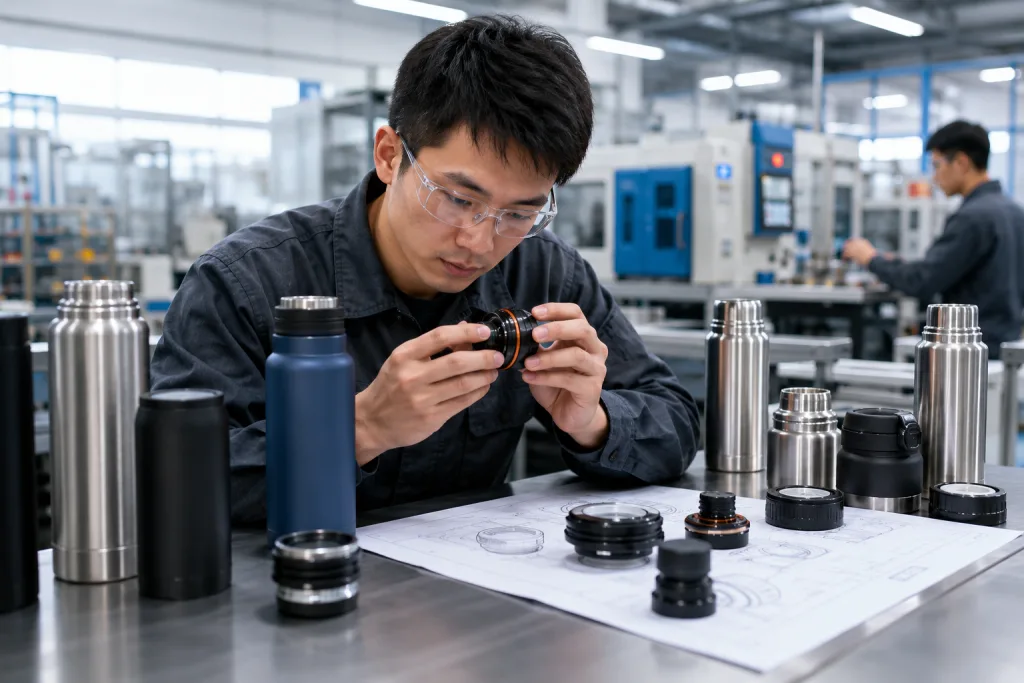
Logo work is where brand owners fall in love with a render and the factory starts checking risk. Laser engraving, silk screen printing, heat transfer, water transfer, UV print, and powder-coated color matching each fail in a different way, so this is the wrong place to approve by phone photo. We’ve had QC pull 12 bottles from a 15,000-unit run under 6500K warehouse lamps, and the logo looked clean on the desk but grey-green beside the approved sample.
Laser engraving holds up well on powder coating, but the visible mark depends on coating chemistry and engraving depth; on our line we usually check depth with a 0.01 mm vernier gauge after the first fixture setup. Silk screen works for 1-2 color logos, usually from about USD 0.05-0.12 per position, but it scratches when the tunnel oven is set for speed instead of curing. Cheap rush jobs go sideways here. Full-wrap heat transfer gives strong shelf impact for a customized thermos, but tapered bodies stretch artwork near the bottom radius, so the buyer needs to sign a physical pre-production sample, not just a flat AI file.
For Pantone colors, set a tolerance before production starts. Powder coating is not offset printing. A Delta E target or approved color chip beats arguing from a PDF, especially when the buyer’s PO says “navy blue” but the artwork file says Pantone 2965C. If you are buying distributor thermos inventory for multiple outdoor stores, lock repeat colors by recording powder supplier, coating code, baking temperature, and approved sample date; we run this on the color card taped to the spray booth control panel.
The defect to avoid is decoration that matches the approval sample on paper but not in mass production. Require a pre-production sample using the real bottle, real coating, real logo process, and final packaging, then let QC check it against the golden sample with a 3M tape test and AQL 2.5 visual criteria if that is in your inspection plan. For a thermos custom project, approval from a digital mockup alone does not protect either side. In China, most logo disputes we see come from skipped physical approvals, not from factories being unable to print.
Cartons can ruin good product
Drinkware is heavy, round, and easy to dent. We see it on the line: a 750 ml stainless bottle passes coating QC, then 312 cartons later the buyer flags chipped paint because the inner box rubbed the shoulder during truck loading. Sometimes the master carton caves in. Sometimes the pallet is stacked at 2.1 m when the carton was only built for 1.6 m. Packaging is not decoration. It is part of the bottle spec.
For e-commerce and promotional fulfillment, match the packing to the sales channel: individual polybag with a 0.03 mm suffocation warning print, tissue wrap inside a kraft box, color box with barcode space, egg-crate divider, or molded pulp insert. We run different packing for Amazon-style orders because FNSKU labels, carton labels, bag warnings, and drop-test packing all get checked before pickup. Retail distributors push back on different details, usually barcode position, multilingual warning text, and carton marks that match the inbound warehouse rule sheet. One PO typo on “carton mark” can hold 86 cartons at the forwarder.
A reasonable export carton for stainless bottles is usually 5-ply corrugated, with gross weight kept under 15-18 kg when possible. Ask for carton dimensions before production. This is the wrong question to ask too late, because a 3 cm change in carton height can move the CBM enough to hurt the landed price more than a small bottle-cost saving. For FOB Ningbo or Shanghai shipments from Zhejiang, China, carton cube affects ocean freight, warehouse handling, and retailer compliance fees. Our packing bench checks length, width, and height with a steel ruler before the carton artwork is released.
For thermos distributors and promotional agencies, we recommend one packaged drop test before mass production: one corner, three edges, six faces from 76 cm for standard export packing, or stricter if your channel demands it. QC pulled the sample, taped it with the same 48 mm BOPP tape used on the line, then checked dents, cap cracks, and coating chips after each drop. The math does not work if you skip this step. Replacing dented product in Canada, Germany, or the UK costs more than testing 1 carton before mass packing.
Inspection must match the risk
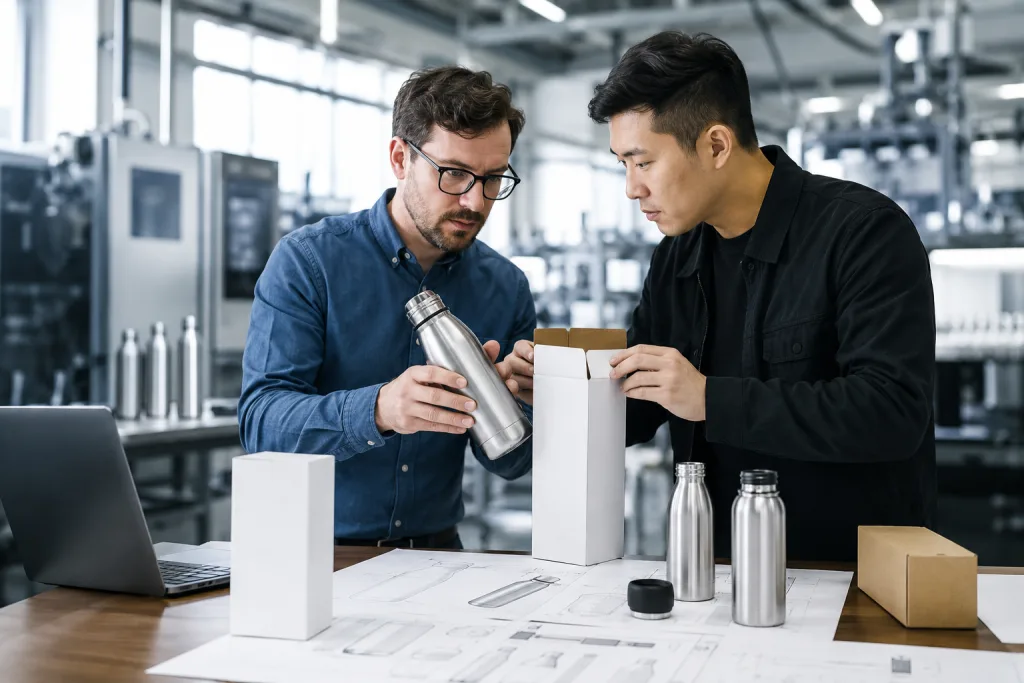
A pre-shipment inspection that only checks carton count is paperwork, not inspection. Stainless vacuum bottles need leak and heat-retention checks, surface review under a light box, carton and barcode checks, plus document matching against the PO. The plan changes with order size, logo process, and whether the buyer imports under their own brand; last month QC pulled 32 samples from a 3,000 pcs logo order because the PO said matte black but the approved sample was PMS 426C.
For a normal thermos manufacturer order, use ANSI/ASQ Z1.4 sampling with AQL 2.5 for major defects and 4.0 for minor defects. Critical defects should be zero. Major defects include leakage, failed vacuum retention, sharp edges, wrong material declaration, missing required warning label, or wrong logo. Minor defects include small coating specks under 0.5 mm, light scratches inside the signed limit board, or carton printing that is 2 mm off center but still scannable. We run this with a digital scale, caliper, 3M tape, and a 95°C water fill test on the line.
Do not let the inspector pick tests casually on site. Give a checklist: capacity measured to the agreed ml mark, net weight checked against the golden sample, coating adhesion cross-hatch, logo rub test with 3M tape, lid leak test upside down for 10 minutes, odor check after hot-water rinse, heat retention sample test, barcode scan, carton drop, and quantity reconciliation against the packing list. For thermos suppliers making custom packaging, also check insert fit and color box scuffing; we have seen this go sideways when a 500 ml bottle passed, but the EVA insert held the lid too tight and scratched 18% of color boxes.
Our standard lead time in Hangzhou is 35-45 days after deposit and artwork approval for most customizable thermos orders, with 7-10 days for pre-production samples. If a supplier promises 20 days during peak season for a new mold, new color, and custom box, the math doesn't work. Speed only helps when the inspection plan still has time to catch failure; for a new powder-coating color, we usually need 2 days just for line trial, color approval, and QC's first heat-retention pull.
Price gaps usually explain something
Compare three vacuum bottle suppliers and a USD 0.40-0.80 gap per unit usually has a reason. It can sit in 201 vs 304 stainless, powder coat thickness, PP lid parts, 5-layer carton strength, AQL 2.5 inspection, payment terms, or whether the factory counted 2-3% polishing scrap. We see buyers push all three quotes to the lowest number; this is the wrong question to ask. Ask for a line-by-line quote breakdown, then let QC pull one sample and check wall thickness with a digital caliper.
As a rough range, a 500 ml double-wall stainless bottle with powder coating and one-position logo may land around USD 3.20-5.80 FOB China depending on lid, steel, finish, testing, and packaging. A heavier outdoor-style bottle with 304 inner and outer walls, handle lid, and retail box can move higher. MOQ is usually 1,000-3,000 units per model for one color, while 300 or 500 pcs carry screen setup, color-change loss, and carton print costs that make the unit price ugly. We run this on the line every month: a 500 ml body that looks cheap on paper can lose the math after 6 logo rejects in a 50-piece first inspection.
If you are buying manufacturers thermos stock with only a logo, use existing molds and proven lids. That saves time. If you need a fully customized thermos shape, expect tooling, 3D drawings, sampling at 12 days vs 18 days after one lid revision, and more failure points at welding and vacuum testing. A new mold may take 25-35 days before reliable samples are ready. We once had a PO typo saying “matte black lid” while the artwork showed silver; the buyer flagged it after the PP injection mold was already booked.
The best thermos supplier conversation is direct: target FOB price, required tests, market, logo method, packaging, annual volume, and acceptable lead time. Give us 8 facts, not 20 screenshots. Whether you call it bulk thermos, thermos bulk, thermos promotional, thermos distributor, or manufacturer thermos sourcing, the factory still checks the same items with a torque tester, vacuum machine, and drop test carton. Cheap specifications produce expensive surprises, and we’ve seen this go sideways when the carton was cut from 12 kg paper to 9 kg paper just to save USD 0.06.
Send your thermos spec before booking production
Share capacity, lid, logo, packaging, target market, and annual volume. We will review the risk points before quoting.
Frequently asked questions
What MOQ should I expect from vacuum bottle suppliers for custom stainless thermos orders?
For an existing stainless thermos model with one powder-coated color and one logo position, a realistic MOQ is usually 1,000-3,000 units per SKU. Some China factories accept 500 pieces, but the unit price rises because coating setup, logo screen, carton printing, and line changeover costs do not shrink much. For custom color boxes, 1,000 pieces is often the practical floor. For a new bottle shape, expect tooling charges and higher trial quantities. If you are a promotional brand testing demand, start with a proven factory thermos model and customize the logo, color, and packaging instead of opening a new mold immediately.
How do I compare quotes from thermos manufacturers without choosing the cheapest bad option?
Put every thermos manufacturer quote into the same format: capacity, 304 or 201 outer steel, 304 inner steel, wall thickness, lid material, coating type, logo method, packaging, AQL level, Incoterm, and lead time. A USD 3.45 FOB quote and a USD 4.10 FOB quote may not be comparable if one uses a thinner outer wall, weaker carton, or no heat retention testing. Ask whether the price includes pre-production samples, logo setup, barcode labels, and export cartons. For outdoor retailers, also confirm REACH, LFGB, FDA, or Prop 65 requirements before price negotiation, not after production.
What heat retention spec is fair for a 500 ml custom thermos?
A fair commercial spec for a 500 ml stainless custom thermos is often 95°C water filled to rated capacity, tested at 20°C room temperature, with the temperature still above 65°C after 6 hours. Premium constructions may do better, but lid design and bottle diameter matter. Wide-mouth bottles usually lose heat faster than narrow-mouth models. Put the full method in the purchase order: starting temperature, ambient temperature, fill level, test duration, and sample size. For mass production, test at least 8-12 random pieces per SKU. One approved sample is not enough proof for a 10,000-piece thermos bulk shipment.
Which logo method is best for promotional thermos orders?
For most promotional thermos orders, silk screen printing is cost-effective for simple 1-2 color logos, while laser engraving is more durable and looks better on powder-coated bottles. UV printing is useful for multicolor marks but needs abrasion testing. Full-wrap heat transfer works for retail graphics but requires careful distortion checks on tapered bodies. If the bottle will be used outdoors, test logo adhesion after 24 hours, then do a rub test with alcohol or a standard eraser method. For 5,000 pieces or more, approve a physical pre-production sample using the real coating and logo process before mass production starts.
What documents should a thermos vendor provide before shipment?
A serious thermos vendor should provide a proforma invoice, packing list, material declaration, inspection report, and any required food-contact or chemical compliance documents. For Europe, buyers often request LFGB, EU 1935/2004, and REACH-related reports. For North America, FDA food-contact compliance and Prop 65 screening may be needed depending on the channel. If you sell through e-commerce warehouses, confirm carton labels, FNSKU labels, country-of-origin marking, and barcode scannability before shipment. For FOB China orders, ask for final carton dimensions and gross weight at least 7 days before booking, so freight estimates do not change at the last minute.