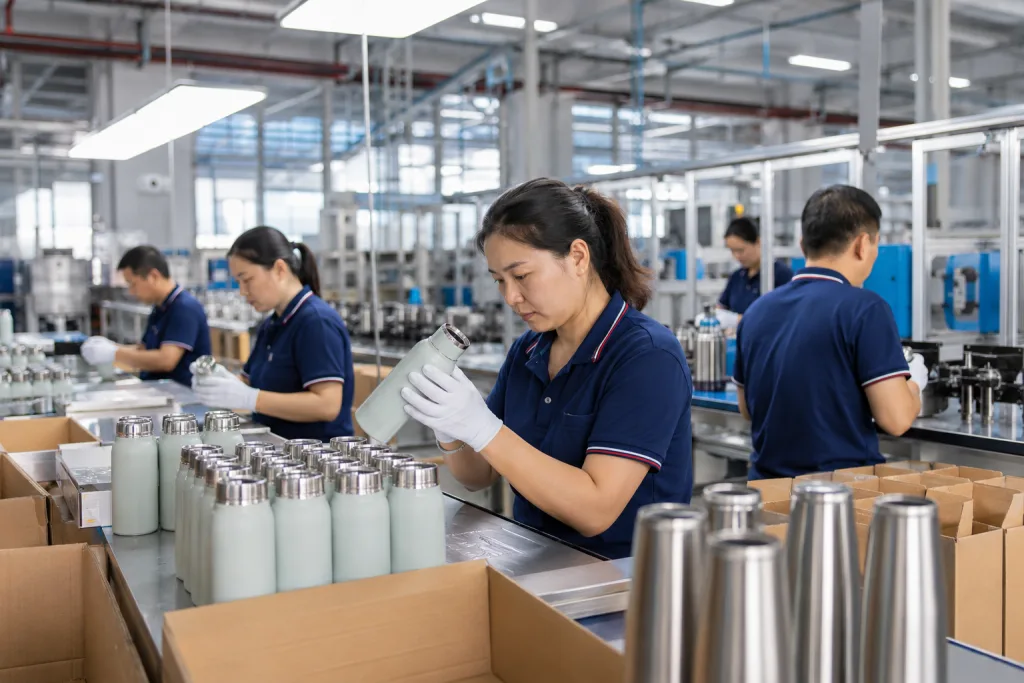
Key Takeaways
- A realistic stainless thermos MOQ starts at 1,000 units per color for powder coating
- 304 stainless steel at 0.4-0.5 mm wall thickness covers most outdoor retail use
- Laser engraving lasts longer than screen print but costs USD 0.18-0.45 more per unit
- Standard production lead time from Zhejiang, China is 35-45 days after sample approval
Outdoor retailers and promotional brands rarely lose money because a stainless thermos looks rough in a PDF quote. They lose money when a 0.4 mm body sweats on shelf, the cap leaks in a backpack, the logo rubs off after 21 days of hand use, or a 62×46×38 cm export carton pushes the landed cost past the buyer’s target.
Ask a vacuum bottle supplier for a custom thermos and you are comparing steel grade, vacuum hold time, cap tooling, coating wear, carton loading, and compliance risk. That long checklist is the right one. BottleForge Industrial is based in Hangzhou, Zhejiang, and we manufacture stainless vacuum bottles for B2B buyers who need a practical spec; last month QC pulled 32 samples from the line for a 24-hour temperature test before we approved the carton mark and PO artwork.
Start With The Use Case
A good vacuum bottle supplier should ask who carries the bottle before they quote it. A hiker stuffs it into a 38 mm side pocket; a ski resort gift shop cares if the powder coat survives a display rack; a corporate event buyer asks whether 2,000 pcs can land before Friday setup; a fishing distributor checks glove-friendly lids. If a supplier thermos quote gives one price without asking capacity range, coating test, lid style, or retail channel, treat it as a placeholder. We had one PO come in with “750 ml” in the subject line and “500 ml” in the artwork file name. QC pulled the sample before the line opened.
For outdoor retailers, we usually start with a 500 ml, 750 ml, or 1,000 ml double-wall stainless bottle. The 500 ml size fits day packs and commuter bags, with a carton weight around 10-12 kg depending on lid. The 750 ml size moves well in trail, camping, and workwear channels because the shelf price still works. The 1,000 ml size is heavier, but hunting, fishing, ski, and long-shift industrial buyers accept that if the handle feels solid. For promotional thermos projects, 350 ml and 500 ml are more common because freight and gifting budgets beat all-day capacity. The math doesn't work when a buyer asks for 1,000 ml, full-color box, and air freight on a 1,000 pcs rush order.
Here is the practical split we use in Zhejiang factory discussions after we check the caliper reading, logo method, and carton count:
- Retail outdoor bottle: 304 inner, 304 outer, 0.45 mm body wall, powder coat, leakproof screw cap, with a 24-hour leak test on the pre-production sample.
- Corporate promotional thermos: 304 inner, 201 or 304 outer, 0.4 mm wall, screen print or laser logo, usually built around lower freight weight and faster logo setup.
- Distributor thermos program: 3-4 capacities, shared lid system, master cartons optimized for pallet loading, so spare lids and carton labels do not turn into a warehouse headache.
- Premium custom thermos: 316 inner stainless, ceramic lining option, copper plating, custom lid tooling, with tooling drawings signed off before we cut steel.
The mistake is starting with the cheapest factory thermos and trying to upgrade it later. We've seen this go sideways. Wall thickness, lid fit, and vacuum process are built into the production route, not patched at final inspection with a torque tester on the packing table. You can change color late; you cannot cheaply fix a weak thread design after molds and PP lid tools are confirmed.
Spec Table: Retail Versus Promotion
First calls move faster when the buyer sees the spec head-to-head. We can quote a lot of versions, but each change hits MOQ, reject rate, lead time, and carton cube. Last month a German outdoor buyer pushed back on a 0.35 mm shell after QC checked it with a Mitutoyo caliper and said, “promo feel.” This table is how we run the first sourcing call with outdoor brands and promotion teams.
| Spec Point | Outdoor Retail Thermos | Promotional Thermos | Distributor Stock Program |
|---|---|---|---|
| Typical capacity | 500 ml for daily carry; 750 ml for hiking packs; 1,000 ml for family sets | 350 ml giveaway size; 500 ml office size | 500 ml core SKU plus 750 ml upsell |
| Steel choice | 304/304 or 316 inner | 304 inner, 201 or 304 outer | 304/304 for fewer claims |
| Body thickness | 0.45-0.5 mm | 0.35-0.4 mm | 0.4-0.45 mm |
| Finish | Powder coat for grip; matte for retail colors; hammertone for outdoor shelves | Spray paint for price jobs; powder coat for better scratch results | 2-3 standard powder colors |
| Logo method | Laser for permanent marks; debossed patch for premium sets; screen print for color logos | Screen print for simple logos; UV print for full-color artwork | Laser or 1-color print |
| MOQ | 1,000 pcs/color | 1,000-3,000 pcs/design | 3,000-5,000 pcs mixed sizes |
| FOB China range | USD 4.20-7.80 | USD 2.60-5.20 | USD 3.80-6.40 |
Those FOB China ranges assume standard mold bodies, not full new tooling. A customized thermos with a new cap, a 2 mm silicone bumper, a retail gift box, or a color-matched handle usually adds USD 0.40-1.20 per unit. On our cap line, a new PP cap tool often lands between USD 1,500 and USD 4,000, mainly because cavity count and slider action change the mold cost.
For a thermos bulk order, bottle price is the wrong question to ask first. Compare the claim risk. A USD 0.22 saving from a thinner outer shell can disappear if 2% of units dent during retail handling. We have seen this go sideways: QC pulled the sample after a drop on the packing table, and the shoulder dent showed through the powder coat. AQL inspection usually catches critical leaks, but it will not protect your margin from a bottle that feels cheap on the shelf.
Steel, Vacuum, And Heat Claims
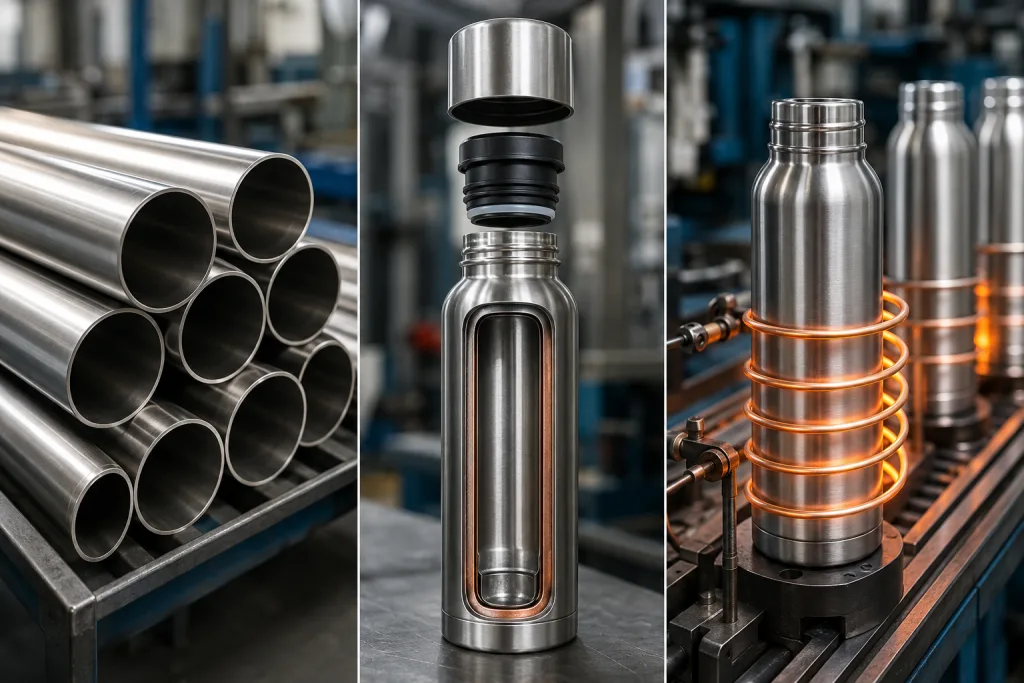
“Stainless steel” on a quote sheet is too thin. We ask for inner steel grade, outer steel grade, wall gauge in mm, and the inner finish, because QC pulled one sample last year that was sold as 304 stainless but tested as 201 on the outer shell with our XRF gun. For drink contact, 304 stainless is the normal choice. 316 stainless costs more and earns its place when the bottle will see lemon tea, sports drinks, or coastal use with salt in the air. For most outdoor retailers, 304 inner and 304 outer is the better buy; the math usually does not work on 316 unless the selling point is corrosion resistance.
Vacuum performance is not a steel-grade question. Neck diameter, bottle shape, copper plating thickness, vacuum furnace temperature curve, and stopper fit all change the result, and we run these checks on the line before packing. A tall narrow 750 ml bottle can beat a wide-mouth 750 ml bottle because the smaller opening leaks less heat. Simple physics. If you want a wide-mouth bottle for ice cubes and easier brush cleaning, accept a heat-retention drop of 1-2 hours under the same test method; we have seen buyers flag this after the first lab report, not before the PO.
Our normal test uses boiling water filled at 95°C, then readings at 6, 12, and 24 hours in a 20°C room. QC uses a calibrated probe thermometer with the sensor held 30 mm below the water surface, not touching the steel wall. A well-built 500 ml bottle should still read around 65-72°C after 6 hours. A 750 ml unit can often hold 68-75°C after 6 hours. Cold retention is easier to sell on a carton, but ask for the setup. “24 hours cold” means almost nothing without starting temperature, ambient temperature, and a clear note on whether ice was used.
For North America and Europe, ask your thermos suppliers about LFGB, FDA food contact, REACH for coating and rubber parts, and California Proposition 65 if you sell into that market. For children’s or family outdoor channels, CPSIA and ASTM considerations may apply depending on the final product design. We have had a buyer send a PO with “FDA passed” typed in the remarks, then reject the quote when the silicone gasket report was not included. A manufacturer thermos quote that skips compliance can look cheaper because the supplier has not priced the tests, sample courier fees, or 7-10 working days for the lab report.
Logo Choices Under Real Wear
Customizable thermos decoration is where buyers lose money fast: they either pay for a logo process the channel does not need, or choose the cheap mark and get complaints after 30 days. The right choice depends on the sales channel: retail shelf, one-day event giveaway, or distributor thermos with repeat orders over 12 months. We ask this before quoting because the math changes. Last month one PO even had “matte balck” typed in the color column, and QC caught the mismatch before the silk-screen film was opened.
Laser engraving removes the coating and shows the stainless steel underneath. Clean mark. Hard to kill. On powder-coated bottles, laser is what we run for outdoor retail because it survives backpack rub, car cup holders, and dish-rack scraping better than most inks. Our line checks the logo with a 10x loupe after the first 20 pieces, mainly to catch weak edges on small letters. The tradeoff is simple: laser is usually single-color by nature and adds roughly USD 0.18-0.45 per unit depending on logo size and production speed.
Screen printing works for simple promotional thermos jobs where the logo has 1 or 2 solid colors. A one-color logo may add USD 0.08-0.18 per unit after screen setup. It prints well on straight cylindrical areas, but curved shoulders and textured coatings cause skip marks; we see this most often within 12 mm of the shoulder radius. If your artwork has tiny text below 5 pt, do not expect miracles. The buyer usually flags this only after pre-production samples, which is late and annoying for both sides.
UV printing is the better choice for multi-color logos, gradients, and small picture-style artwork, but adhesion lives or dies on coating and surface pretreatment. We normally run cross-hatch adhesion testing and alcohol rub testing before mass production; QC pulled one sample last quarter after 50 alcohol rubs because the red layer softened first. For retail, use UV print with care. For promotional campaigns where the bottle sits on a desk instead of bouncing around a gym bag, it fits.
Embossed or molded logos need tooling, but they give the bottle a built-in custom look instead of a mark sitting on top. They make sense when you commit to 10,000 units or more across multiple POs. For smaller projects, this is the wrong place to spend money: put the budget into stronger coating, better cartons, and AQL 2.5 inspection. We have seen this go sideways when a buyer paid for mold changes on a 1,200 pcs trial order, then changed the logo before the second PO.
MOQ, Lead Time, And Cost
MOQ is not a factory punishment. It comes from coating line setup, 304 stainless coil purchasing, logo jig changes, carton plate charges, and QC efficiency. At BottleForge Industrial in Hangzhou, Zhejiang, we run 1,000 units per color as the normal MOQ for a stainless vacuum bottle using existing molds. For a new powder-coated color, 1,000 units usually works if the buyer accepts our standard lid and bottom shape. For a fully customized thermos with new lid tooling or silicone parts, 3,000 units is the safer number; below that, the tooling math does not work. Last month one buyer pushed for 500 pcs with a Pantone 5635C matte finish, but the coating line still needed the same 18 kg powder setup and color-change washdown.
Our monthly capacity is about 450,000 stainless drinkware units across vacuum bottles and travel tumblers, with sports bottles on the same welding and vacuum line. A standard custom thermos order usually needs 7-10 days for pre-production samples after artwork approval, then 35-45 days for mass production after sample sign-off and deposit. Peak season before Q4 can add 10-15 days because coating booths, carton printing, and AQL 2.5 inspection slots get booked across China. Tight weeks happen. On the line, QC pulled the sample after a 0.3 mm rim dent near the mouth opening, and that small finding pushed sample approval from 7 days to 9 days.
For price structure, ask for FOB Ningbo or FOB Shanghai if you are buying from Zhejiang. EXW looks lower on paper, but new buyers often miss domestic trucking, export handling, and documentation charges. We have seen this go sideways when a PO listed “FOB Ningbo” in the email but “EXW Hangzhou” in the attachment, and the buyer flagged it only after the forwarder asked for local charges. For Amazon or retail distribution, ask for master carton dimensions, gross weight, FNSKU labeling options, and drop-test packing. A thermos vendor that gives carton data early helps you calculate landed cost before the shipment reaches the warehouse.
Typical cost drivers are simple: 316 stainless adds cost over 304 stainless, powder coating costs more than spray paint because it needs baking time and film-thickness control, and copper plating improves heat retention but adds another processing step. Custom gift boxes can add USD 0.25-0.80 each, depending on paper weight, insert style, and whether the logo needs foil stamping. For thermos manufacturers, the painful costs hide in rework. A cheap coating that fails the 3M tape adhesion test delays shipment faster than a high unit price does; we have had QC reject 26 cartons after cross-cut testing showed peeling near the bottom curve.
Quality Checks Before Shipment
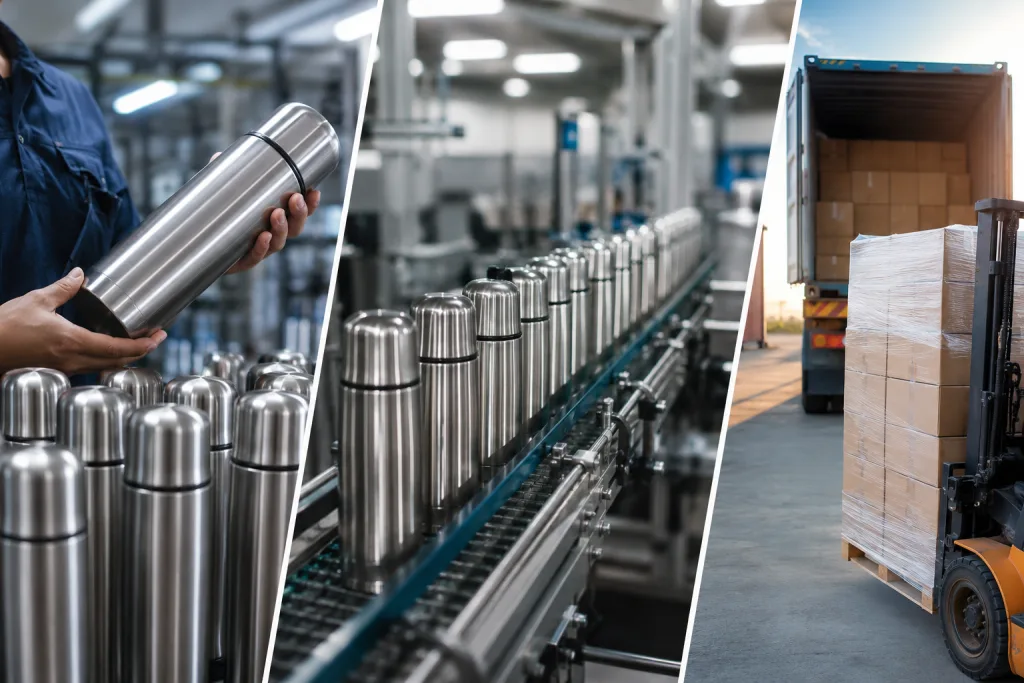
Do the bulk inspection before the balance payment leaves your account. We normally start with AQL Level II for general inspection, with Critical 0, Major 2.5, and Minor 4.0. For premium retail, the math doesn't work if you check cosmetics only at final packing; we add an inline check after powder coating and before logo printing, using a 0.2 mm scratch limit under a 600 lux light box.
The checklist should cover leak testing under inverted storage, vacuum performance sampling, coating adhesion with 3M tape, logo position measured from the bottom ring, cap torque, odor check, inner wall cleanliness, carton drop condition, and barcode scan. For vacuum testing, not every unit is cut open or heat-tested for 24 hours. We run vacuum detection equipment on the line, then QC pulls samples for heat retention, usually 8 pcs per size per batch unless the buyer's spec says more. Ask what percentage is tested at each stage. A responsible thermos factory gives the number, not a soft answer.
For outdoor retail, watch the lid first. We have seen returns go sideways over silicone gaskets, cross-threaded caps, weak carry loops, and odor trapped in PP plastic, while the 304 stainless body was fine. On one 5,000 pcs sports bottle order, the buyer flagged a 1.5 mm gasket gap during pre-shipment inspection, and QC pulled the sample before packing continued. Food-grade silicone should seat evenly, and distributors need spare gasket planning. If you sell through dealers, a small spare-parts box saves more money than arguing over returns.
Packaging is quality, too. A 750 ml bottle in a thin white box may look fine in a showroom and still fail parcel handling after 12 drops from 60-80 cm. For e-commerce or outdoor specialty distribution, we ship 5-layer export cartons with dividers where the bottle shape needs it; a 15 kg carton that bulges on the corner is already a warning sign. If you want retail gift boxes, confirm paper weight, surface coating, hangtag hole strength, and barcode placement before mass printing, because one wrong EAN digit on a PO can hold the whole shipment.
Choosing Your Supplier Fit
The right thermos supplier depends on your order pattern. For 500 units split across 12 colors, a trading company holding stock in Yiwu or Guangzhou may beat a factory; the math doesn't work when the line must change powder color every 40 cartons. For 5,000-30,000 units in repeat colors, a direct manufacturer thermos partner gives tighter control on coating thickness, laser logo position within 0.5 mm, AQL 2.5 inspection, and export carton specs. For a seasonal retail line, choose a supplier that can hold cap color, silicone ring hardness, and straw length across repeat POs.
Ask blunt questions. How many vacuum furnaces are running, 2 or 8? What is the monthly output in finished bottles, not blank bodies? Which tests are done in-house with a 24-hour heat-retention rack, and which ones go to SGS or Intertek? Can the supplier send BSCI audit documents if your retailer asks? What claim rate did they see on similar bottles last quarter? A confident suppliers thermos team answers with numbers. Not slogans.
For outdoor retailers and promotional brands, we push one route: start with an existing mold, customize the finish and logo, prove sell-through, then pay for custom lid or body tooling. We have seen this go sideways when a buyer spends USD 6,000 on a lid tool before dealers even touch the sample. QC pulled the sample once because the flip lid leaked at 45 degrees after 30 minutes; better to find that on a stock mold than after tooling approval. This path keeps the first PO under control and gives your sales team a real bottle to test before money is locked.
China has plenty of thermos suppliers, but only some run with export discipline. Zhejiang stays strong for stainless drinkware because steel forming, vacuum processing, powder coating, caps, cartons, and Ningbo port trucking sit within a 2-4 hour drive for most serious factories. That closeness does not guarantee quality; a 304 stainless body can still fail vacuum if the weld bead is dirty. It does give a serious vacuum bottle supplier room to move fast, fix a PO typo like “mat black” before mass production, and ship without guessing.
Send Your Thermos Brief For A Factory Quote
Share capacity, logo, color, target price, and market. We will return a practical MOQ, FOB quote, and sampling timeline.
Frequently asked questions
What MOQ should I expect from a vacuum bottle supplier?
For existing stainless thermos molds, a practical MOQ is usually 1,000 units per color. If you need a special powder color, custom retail box, or new silicone accessory, expect 1,000-3,000 units. New lid tooling often pushes the project to 3,000 units or more because PP injection setup and gasket fitting need stable volume. For mixed cartons or distributor thermos programs, 3,000-5,000 units across 2-3 capacities is more efficient. Very small orders are possible only from stock, but then your color, logo area, packaging, and compliance options are limited.
How much does a custom stainless thermos cost FOB China?
A standard 500 ml custom thermos normally falls around USD 3.20-6.20 FOB China, depending on steel grade, coating, lid, logo, and packaging. A 750 ml outdoor-grade bottle may run USD 4.20-7.80. Laser engraving can add USD 0.18-0.45 per unit, while a one-color screen print may add USD 0.08-0.18. Gift boxes often add USD 0.25-0.80. If a quote is far below the market, check wall thickness, 201 versus 304 outer steel, coating adhesion, and whether compliance testing is included.
Is 304 stainless steel enough for outdoor retail bottles?
Yes, 304 stainless steel is the normal choice for outdoor retail vacuum bottles. A 304 inner wall with 304 outer wall and 0.45-0.5 mm body thickness is a solid spec for most hiking, camping, and workwear channels. 316 inner stainless is useful for premium positioning, acidic drinks, marine environments, or brands that want a stronger corrosion-resistance story. It costs more, so use it where the buyer will understand the value. For low-cost promotional thermos projects, some buyers use 304 inner with 201 outer, but retail claim risk can increase.
Which logo method is best for a promotional thermos?
For a simple promotional thermos, one-color screen printing is usually the most cost-effective choice at about USD 0.08-0.18 per unit. It works best on smooth cylindrical surfaces and bold artwork. For outdoor use or long-term brand merchandise, laser engraving is better because it does not rub off like ink. UV printing is useful for multi-color logos, but you should request cross-hatch adhesion and alcohol rub testing before approving mass production. If the bottle has textured powder coating, test the logo method on an actual sample, not a flat color chip.
How long does production take after sample approval?
For an existing mold customized thermos, plan on 35-45 days after pre-production sample approval and deposit. Sampling normally takes 7-10 days once artwork, Pantone color, logo size, and packaging files are confirmed. Add 10-15 days during peak season or if you need third-party testing such as LFGB, FDA, REACH, or Prop 65 screening. New cap tooling can add 20-35 days before mass production starts. If your launch date is fixed, approve carton marks, barcodes, FNSKU labels, and shipping documents early, not at the end.