Key Takeaways
- Shortlist 5-8 suppliers, then sample 2-3 before any 5,000+ unit bulk thermos order
- A realistic custom stainless thermos MOQ is 1,000-3,000 units per color for factory pricing
- Ask for AQL 2.5/4.0 inspection, vacuum retention data, and steel certificates before deposit
- FOB China lead time usually runs 35-50 days after artwork approval and sample sign-off
A vacuum bottle supplier list is easy to build badly. We see buyers pull 30 China names from Alibaba, sort by the lowest FOB price, then miss the thermos details that decide whether a 12-SKU outdoor retail launch or a 5,000-piece promotional thermos order ships cleanly. Wrong question. The cheapest quote does not tell you if the lid thread gauge passes or if QC pulled the sample for weak vacuum after the 95°C hot-water test.
If you buy bulk thermos products for a retailer, distributor, or brand program, your job is risk filtering. Is the thermos factory using 304 stainless steel? Can the thermos manufacturer hold color tolerance across 10,000 units when the buyer flagged a 1.5 mm logo shift on the pre-production sample? Does the Zhejiang factory understand REACH, LFGB, FDA, and carton drop testing? BottleForge Industrial in Hangzhou, Zhejiang makes up to 600,000 stainless drinkware units/month, with custom thermos MOQ starting from 1,000 units per color on selected models.
Start With Supplier Type
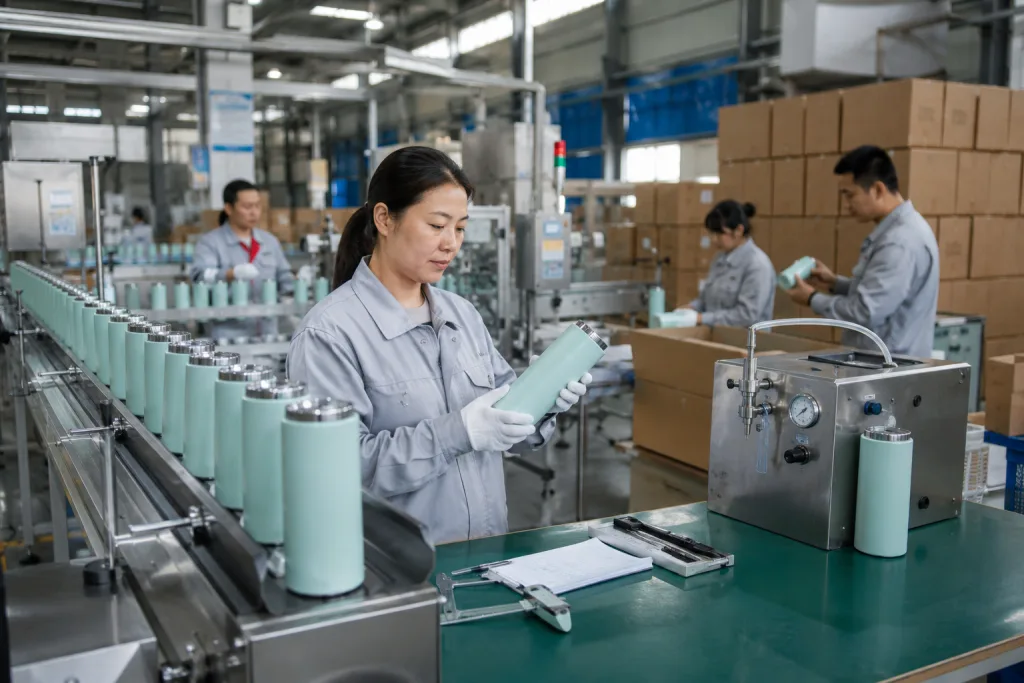
Start the vacuum bottle supplier list by separating factories from trading companies, online vendors, and promotional agencies. One price table hides too much. A thermos factory controls the tooling, polishing wheels, powder coating booth, laser jig, air-pressure leak test, and final packing line. A thermos vendor might only chase those workshops by phone. That can work for small repeat orders, but you need to know who owns the fix when QC pulls 32 leaking samples or the logo shifts 3 mm after the first laser setup.
For outdoor retailers and promotional brands, we usually build the shortlist in two layers. Put 3 to 5 direct manufacturers thermos with stainless vacuum production at the top. Then keep 1 or 2 service-heavy suppliers thermos for artwork checks, mixed SKUs, kitting, retailer compliance, and rush carton relabeling. The lowest-price supplier thermos often looks good on day one, then the math breaks when the buyer asks for hang tags, barcode labels, FNSKU, master carton marks, and 80 inspection photos before shipment. We have seen this go sideways on a PO where “matte black” was typed as “mate black” and nobody checked the artwork proof.
Quick filter questions
- Are you the factory thermos producer or an export office? Ask for the business license name, Chinese factory address, and one production-line video showing the gate plate or workshop sign.
- What production is in-house? Vacuum welding, electro-polishing, powder coating, and leak testing matter more than a thick catalog. Ask which steps they run on the line and which go outside.
- What is the monthly capacity? For example, BottleForge runs about 600,000 units/month across stainless thermos, travel tumbler, and sports bottle lines in Zhejiang. Also ask the MOQ per color, because 3,000 pcs split into 6 colors can slow coating changeover.
- Which audits are current? BSCI, ISO 9001, Sedex, or retailer-specific audits matter if you sell into Europe and North America. Ask for the expiry date, not just the certificate cover page.
If a supplier cannot explain where the bottle body is formed, where the lid is molded, and who performs vacuum testing, cut them from the list. A good manufacturer thermos supplier may write rough English, but they should answer with numbers: wall thickness in mm, leak-test pressure, defect rate from the last AQL 2.5 inspection, and packing weight per master carton. Pretty words do not stop returns.
What Should The Quote Include
A custom thermos quote that only says “500 ml vacuum bottle, USD 3.20 FOB Ningbo” is not a quote. It is a loose number. We need line items because stainless steel drinkware hides cost in small places: 0.4 mm versus 0.5 mm body sheet, push-button lid tooling, powder coating pass rate, logo size in cm², carton spec, FDA or LFGB testing, and trucking from Yongkang to Ningbo. Last month QC pulled a sample from the line with the right shape but a 0.32 mm outer wall. The buyer would never see that from a one-line quote.
For a 500 ml customized thermos, a workable FOB China price range can run from USD 3.10 to USD 6.50 depending on body shape, 304 versus 316 stainless steel, lid material, coating, and order volume. A simple powder-coated bottle with one-color silkscreen logo might sit near the lower end at 3,000 units. A retail-grade bottle with copper lining, carry handle lid, custom color box, and laser marking can sit 30-60% higher. If your vacuum bottle supplier list shows one factory at USD 2.20 while 6 other factories are near USD 4.00, this is the wrong question to ask: do not ask why it is cheap, ask what was removed. We have seen this go sideways when a PO said “304 stainless” but the factory quoted 201 for the outer shell and buried it in a Chinese spec sheet.
Quote checklist
- Capacity in ml and usable fill volume, not just catalog name.
- Inner and outer steel grade, usually SUS304 for food contact surfaces.
- Body wall thickness, commonly 0.4-0.5 mm for many retail vacuum bottles.
- Lid material, gasket material, and whether parts are BPA-free.
- Decoration method: laser engraving, silkscreen, heat transfer, 3D UV, or embossing.
- Packaging: egg-crate bulk pack, white box, kraft box, custom retail box, or gift tube.
- Incoterm: FOB Ningbo, FOB Shanghai, EXW Zhejiang, or DDP destination.
For thermos bulk programs, ask suppliers to quote at 1,000, 3,000, 5,000, and 10,000 units. The price curve tells you whether the thermos manufacturer is running the item on its own line or buying semi-finished bottles from another factory. We run this check with a simple Excel sheet: if 1,000 pcs and 10,000 pcs differ by only USD 0.08, the math doesn't work unless the mold, coating, and carton setup were already absorbed somewhere else.
Can They Handle Customization
Custom thermos work looks easy until the PO says 12 PMS colors, two logo positions, a printed sleeve, and a launch date tied to a trade show. We run these jobs by process control, not by how many nice decoration photos a supplier puts in a catalog. Powder coating needs proper degreasing in the pretreatment tank, curing at the set oven temperature, and film thickness checked with a coating gauge, usually around 60-80 μm on our line. Laser engraving needs a tight fixture, or the logo walks 1.5 mm around the bottle body. Silkscreen needs ink adhesion testing, especially on matte coatings; QC pulled a sample last month where the 3M tape test lifted a corner of white ink.
For a promotional thermos order, a one-color logo on one side is low risk if the artwork is clean and the MOQ is not split into too many colors. For outdoor retail, buyers push harder. They ask for a durable matte finish, low odor inside the bottle, a lid that opens with gloves, and packaging that survives pallet movement from Ningbo to Hamburg. A thermos custom project with 4 SKUs should have an approved pre-production sample for each color and decoration combination. Do not approve only a digital mockup if the finish matters. We have seen this go sideways when a buyer signed off on a PDF, then flagged the real beige as too yellow under warehouse LED lights.
Practical rule: if the logo or coating is part of your brand promise, treat the sample as a contract document.
Normal customization lead times in China are not instant. A logo sample by laser engraving may take 5-7 days. Powder-coated color sampling can take 7-12 days if a new PMS match is needed, and 12 days vs 18 days often depends on whether the coating supplier already has a close base powder. New mold development for a lid or body shape can take 25-45 days, plus test time. At BottleForge in Hangzhou, Zhejiang, standard custom thermos production usually runs 35-50 days after deposit, artwork approval, and pre-production sample approval. The wrong question is “how fast can you ship?” Ask what approval is blocking the line.
Ask for a decoration tolerance sheet. Reasonable tolerance for logo placement might be ±2 mm on 500 ml and 750 ml cylindrical bottles, measured from the centerline with a height gauge or a simple printed wrap ruler. Color tolerance should reference a physical PMS chip or approved sample, not a phone photo. A suppliers thermos partner who pushes you to approve from screen images is asking you to accept avoidable color disputes later. The math does not work once 3,000 bottles are coated, packed, and sitting in export cartons with the wrong logo angle.

How To Check Vacuum Performance
“Vacuum” is cheap ink on a spec sheet. The bottle either holds heat, or it doesn’t. A stainless vacuum bottle depends on the laser weld, vacuum tail sealing, lid gasket compression, and line QC. We’ve seen distributor programs accept 1-2 mm logo position drift, but nobody accepts a bottle that drops from 95°C to lukewarm after 2 hours or leaks inside a buyer’s backpack sample.
Ask every thermos supplier for the exact test setup. Heat retention claims should show starting water temperature, ambient temperature, fill level, and test duration. We run a common 500 ml internal check with boiling water at about 95°C, ambient at 20°C, full fill to the neck thread, then measure at 6, 12, and 24 hours with a probe thermometer. Capacity and mouth diameter change the result. Wide-mouth bottles lose heat faster than narrow-mouth bottles because the opening gives away more surface area. Don’t compare a 1,000 ml outdoor bottle with a 350 ml promotional bottle like they are the same SKU; the math doesn’t work.
Inspection checklist
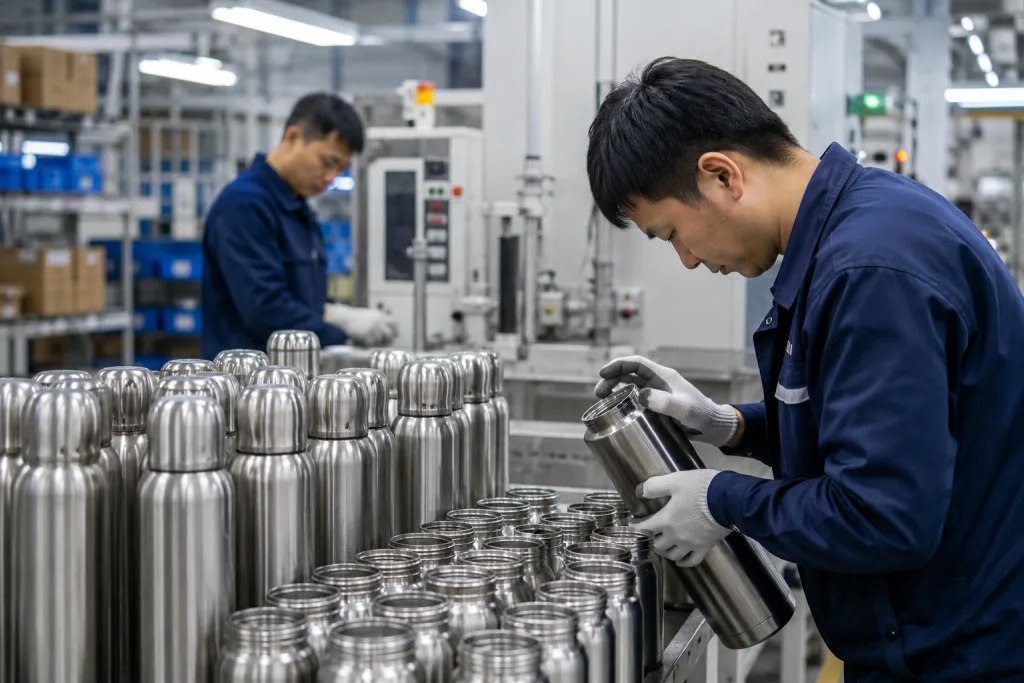
- 100% leak test before packing, especially for screw lids and flip lids; we usually invert filled samples for 10 minutes and check the inner carton for wet marks.
- Vacuum insulation sampling by batch, with failed units pulled and traced back to the sealing station and production date.
- Salt spray or coating adhesion tests when bottles are used outdoors; QC pulled the sample if powder coating lifts after a cross-cut tape test.
- Dishwasher claim validation if marketing wants to print it; one buyer flagged this after 20 wash cycles dulled a matte black finish.
- Carton drop test, commonly from 60-80 cm depending on carton weight, with corner, edge, and face drops checked before we ship.
Use AQL inspection terms in your purchase order. A common setup is AQL 2.5 for major defects and 4.0 for minor defects, with critical defects not accepted. Critical defects include leakage, sharp edges, wrong material in food-contact parts, or unsafe lid failure. For thermos distributors shipping to 3 or more retailers, add barcode scan checks and carton mark checks to the inspection scope. We once had a PO typo on an EAN code; the buyer caught it at warehouse receiving, not on the line. Painful lesson.
If you are comparing thermos manufacturers in China, ask for batch traceability. The factory should connect production date, coating batch, lid batch, and final QC record. We record this against the work order and carton lot, so a gasket issue can be narrowed to 2,400 lids instead of a full 40HQ argument. Without traceability, a small defect turns into a full-container fight, and we’ve seen this go sideways.
Compliance For Retail Markets
Europe and North America do not accept “food safe” as a sales promise. They want files: test reports, declarations, audit copies, and matching model photos. If your vacuum bottle supplier list is for outdoor retailers, corporate gifting buyers, or promo brands, check the compliance pack before the 30% deposit leaves your account. Fixing missing papers after production is where we have seen orders go sideways; one buyer flagged a lid report that named PP-05 while the PO said PP-08, and the shipment sat 12 days longer than planned.
For the EU, buyers usually ask for LFGB food-contact testing, REACH restricted-substance review, and migration tests tied to the actual lid and coating. For the US, FDA food-contact compliance and California Proposition 65 review often come up. If the bottle is for children, ASTM and CPSIA points enter fast, mainly around coatings, small parts, and lead content. A kids’ bottle is not just a 350 ml version of a 500 ml bottle. QC pulled one sample last year where the straw stopper measured 6.8 mm smaller than the approved drawing, and that kind of detail gets attention in a retailer review.
Ask whether each report is model-specific, material-specific, or just an old catalog report copied from another SKU. This is the wrong question to ask: “Do you have LFGB?” The better question is, “Does this LFGB report cover my lid, gasket, coating, and item number?” A 2021 report for a stainless mug with another lid material does not prove your 2026 customized thermos is compliant. The same check applies to silicone gaskets, PP lids, Tritan inserts, and painted coatings. On the line, we run separate incoming checks for gasket hardness with a Shore A tester because food-contact risk often sits in the lid, not the 304 stainless body.
Document checklist
- Material declaration for SUS304 or SUS316 stainless steel, with coil batch or supplier name if the retailer asks.
- BPA-free declaration for plastic and silicone components, matched to the lid code on your PO.
- Recent LFGB, FDA, or relevant migration test reports, ideally issued within 24 months.
- REACH or Prop 65 statement if required by your market, checked before artwork approval.
- BSCI, ISO 9001, or social audit documents for retailer onboarding, not screenshots from a sales deck.
A strong thermos manufacturer will not be annoyed by these requests. In Zhejiang, serious exporters send this paperwork every week; we ship it with the quotation folder before sample invoicing if the buyer asks cleanly. The math does not work if compliance starts after cartons are printed. One typo on a PO, such as “SUS316” ordered but “SUS304” declared, can trigger a full document reset and cost 3 working days before booking inspection.
MOQ, Lead Time, And Payment
MOQ is where 8 out of 10 buyer-supplier calls start to drift away from factory reality. A thermos line is planned around 304 stainless coil buying, powder coating changeover, logo fixture setup, carton printing plates, and QC headcount on the line. For a plain stock bottle with laser logo, 500 units may be possible; we run those with an existing jig and a 0.2 mm logo position tolerance. For a custom color, custom box, or private label bulk thermos project, 1,000-3,000 units per color is a cleaner MOQ. New tooling can push the practical starting point to 5,000 units or more. The wrong question is “Can you accept 300 pcs?” The better question is whether the math still works after coating loss, carton MOQ, and setup time.
Payment terms also show how seasoned the supplier is. A normal China export structure is 30% deposit and 70% balance before shipment after inspection. For repeat buyers, terms may improve after 3-5 clean orders with no chargebacks or last-minute PO changes. QC pulled one sample last month where the buyer’s PO had the wrong Pantone code, and nobody wants to finance that kind of mistake on open terms. Be careful with any thermos vendor asking for 100% upfront on a large order. Be realistic too: a factory will not buy steel, lids, cartons, and coating materials with no deposit from a new customer.
Lead time depends on approval speed as much as factory capacity. If you take 12 days to confirm artwork, the factory has not delayed you. A normal schedule for a customized thermos order can look like this: 3-5 days for quotation and technical confirmation, 5-12 days for sample, 2-3 days for sample review if courier time is excluded, 35-50 days for mass production, and 7-14 days for booking and loading depending on the season. Ocean transit is separate. We’ve seen this go sideways when a buyer approves the sample photo but forgets to confirm the silicone ring color; the line stops, and the loading date moves from May 12 to May 18.
For distributors thermos programs, ask about split shipments and reorder timing. A supplier who can ship 3,000 units in April and repeat 6,000 units in June is more useful than a supplier who wins the first order by cutting USD 0.08 but cannot keep production steady. We ship mixed-container programs from Ningbo when the carton marks, barcode labels, and master carton weight stay consistent under 18 kg. If you sell through outdoor retailers, late replenishment costs more than small FOB savings. The buyer may remember the USD 0.08 saving; the retailer remembers the empty shelf.
Build A Shortlist That Works
Your final vacuum bottle supplier list should stay short. Long lists just create 17 unread follow-up emails and 6 half-finished quote sheets. We run best with 5-8 candidates, then cut to 2-3 after FOB review, sample checks, and document matching. Put at least one direct thermos factory on it, one manufacturer thermos partner with export staff who can read a retailer manual, and one backup thermos suppliers option in case the line is full before Golden Week. We once saw a PO with “mate black” instead of “matte black”; the factory that caught that typo before silk screen approval stayed on the list.
Score each supplier on facts, not charm. Do they give complete FOB pricing with steel grade, lid material, coating, carton size, and MOQ? Do they understand retailer packing without asking what an inner master carton means? Can they produce custom thermos samples without three rounds fixing logo height, silicone color, or cap fit? QC pulled one sample last month with a 0.6 mm logo drift from the fixture mark, and the better supplier corrected the jig before the next run. Ask for real QC records. Check if answers match across sales, engineering, and production. If the sales contact promises 20-day lead time while the production contact says 45 days, believe production. The math doesn't work.
Shortlist scorecard
- Price realism: within 10-15% of the market range, with wall thickness, lid structure, coating type, and packing method written into the quote.
- Customization control: physical samples, PMS matching under a D65 light box, fixture-based logo placement with mm tolerance.
- Compliance: recent reports for the actual material set, not a 2021 report for another lid.
- QC system: AQL inspection, leak testing, vacuum testing, traceability from coil batch to finished carton.
- Export execution: FOB documents, carton marks, pallet plans, retailer labels, FNSKU if needed, checked against the buyer's routing guide.
Outdoor brands should test usability with dirty hands, not just clean conference-room hands. Fill the bottle to 95%, shake it 30 times, open it with wet hands, drop the empty bottle from 760 mm desk height, and leave coffee inside overnight. Procurement spreadsheets miss the details customers complain about: cap squeak, sharp lip edge, loose powder coat near the base. Promotional brands should test logo durability and packaging appearance because the unboxing moment often does most of the selling. We've seen this go sideways when a buyer approved the bottle but ignored the thin 250 g white box.
A good thermos manufacturer in China will help you kill weak ideas before production. They may tell you a glossy coating will scratch on the packing table, a lid handle is too thin at 2.0 mm, or a 0.35 mm wall saves USD 0.18 but dents too easily for outdoor use. That pushback matters. On our floor, the line leader checks risky designs with a caliper and a drop-test board before we quote bulk lead time, and the buyer who listens usually ships cleaner cartons.
Build your stainless thermos shortlist with factory input
Send your target capacity, quantity, market, and logo method. We will return practical MOQ, FOB pricing, lead time, and compliance notes.
Frequently asked questions
How many companies should be on my vacuum bottle supplier list?
Start with 10-15 names, but do not sample all of them. After checking business license, factory role, MOQ, compliance documents, and quote completeness, reduce the list to 5-8. Then request samples from 2-3 serious suppliers. Sampling every thermos vendor wastes time and courier fees. For a 5,000 unit order, two strong samples are more useful than ten weak quotes. Keep one backup thermos supplier in China for capacity or price pressure, but do not split the first order unless both suppliers can match color, logo position, packaging, and QC standard.
What MOQ should I expect for custom stainless thermos orders?
For a stock shape with laser engraving, some factories can accept 500-1,000 units. For a custom powder-coated color, custom box, or retail-ready customized thermos, expect 1,000-3,000 units per color. If you need a new lid mold, new body mold, or exclusive design, 5,000 units is a more realistic starting point. MOQ is not just factory preference; coating setup, carton printing, steel purchasing, and inspection labor all create fixed costs. BottleForge’s selected stainless thermos MOQ starts from 1,000 units per color, depending on model and decoration.
Is laser engraving better than silkscreen for a promotional thermos?
Laser engraving is usually more durable because it removes or marks the coating instead of adding ink on top. It works well for outdoor, corporate, and distributor thermos programs where the logo must survive handling. Silkscreen is better when you need solid colors, larger artwork, or lower cost on simple logos. For 1,000-3,000 units, laser setup cost is usually manageable, while multi-color silkscreen needs more screens and more QC checks. If the bottle has a curved or tapered body, ask for a real pre-production sample because artwork distortion can appear near the edges.
What certificates should a stainless thermos manufacturer provide?
At minimum, ask for food-contact documentation for the stainless steel, plastic lid, silicone gasket, and coating. For Europe, LFGB and REACH are common requests. For the US, FDA food-contact compliance and Proposition 65 review may be needed. If the product is for children, ask about CPSIA and ASTM-related requirements. Also request ISO 9001, BSCI, or social audit documents if your retailer requires them. Make sure reports match the actual materials in your order. A test report for another lid or an old catalog model is not enough for a serious retail program.
How long does a custom thermos order take from China?
A normal timeline is 5-12 days for sample preparation, then 35-50 days for mass production after deposit, artwork approval, and sample sign-off. Add 7-14 days for booking, export paperwork, and loading during busy periods. Ocean freight to North America or Europe is separate and can add several weeks. If you require new tooling, add 25-45 days before production. The fastest way to lose time is slow artwork approval or changing the logo after the sample. Lock the technical file before the factory orders coating, cartons, and components.