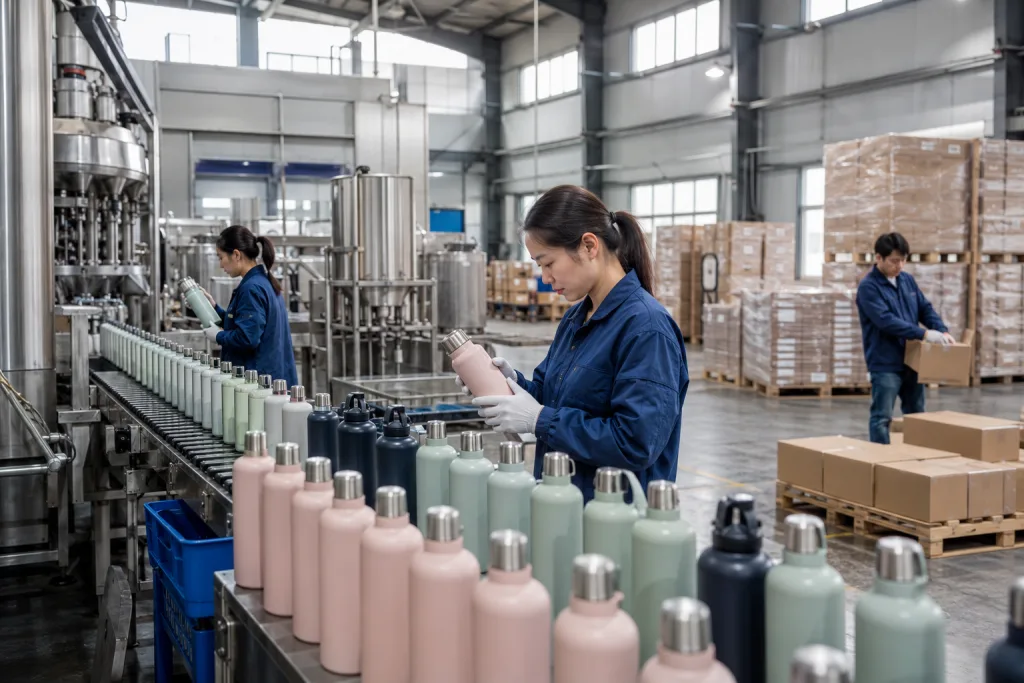
Key Takeaways
- Standard stainless vacuum bottle MOQ is usually 1,000 pieces per color, while new molds often start at 3,000-5,000 pieces
- 304 stainless steel is normal for inner walls; 316 steel adds cost and is only worth it for specific saltwater or premium use cases
- Laser engraving is cleaner for outdoor retail, while silkscreen and powder-coated logos usually work better for promotional thermos campaigns
- A realistic custom thermos lead time is 30-45 days after sample approval, plus 25-35 days ocean transit to North America or Europe
A vacuum bottle supplier directory looks helpful until 30 listings all say the same thing: OEM service, fast delivery, food-grade steel, low MOQ, perfect logos. If you buy for an outdoor retail chain or a promo program, finding a thermos supplier is not the hard part. Picking the supplier thermos setup that matches your channel, defect risk, and landed margin is where buyers get burned. We have seen this go sideways when a buyer approved a 500 ml sample with a 0.18 mm thinner outer wall than the mass-production spec.
For a custom thermos order, lock four items before quotation: bottle construction, decoration method, compliance scope, shipping plan. BottleForge Industrial manufactures stainless vacuum bottles in Hangzhou, Zhejiang, China, with monthly output around 420,000 units and typical MOQ from 1,000 pieces per color for standard models. Scale helps. Bad specs still lose money. On the line, QC pulled the sample last month because the PO said matte black, but the artwork file called out Pantone 426C gloss, and that small mismatch added 6 days to approval.
Start With The Buying Decision
Before you compare any vacuum bottle supplier directory, decide what kind of buyer you are. Outdoor retail and promotional merchandise can look alike in a catalog photo, but the sourcing math is different. Outdoor retailers usually ask us for repeatable SKU quality, 12-hour heat retention data, coating adhesion after a 3M tape pull test, carton drop strength, and shelf-ready packaging. Promo buyers push harder on campaign timing, logo position within 1 mm, thermos bulk pricing, event deadlines, and whether the line can run 6 decoration versions without mixed cartons. We have seen this go sideways when a PO says “matte black” but the buyer’s artwork file calls out Pantone Black 6C.
The first decision is whether you need an existing factory thermos model or a newly tooled customized thermos. Existing molds keep cost and lead time under control. For example, a 500 ml or 750 ml stainless bottle from our Zhejiang line can usually be sampled in 7-10 days and produced in 30-40 days after approval. A new shape with custom cap tooling can add USD 2,000-8,000 in mold cost and 25-35 days before mass production even starts. That is before we cut the first T1 sample on the CNC lathe. If your launch date is fixed, asking “can you make my own shape?” is the wrong first question; ask whether the delivery date survives tooling, testing, and one round of cap leakage correction.
The second decision is decoration. A promotional thermos may need four-color silkscreen, full-wrap heat transfer, or individual names. A retail manufacturer thermos project may sell better with laser engraving, debossed packaging, and one clean brand mark. Do not choose decoration only by appearance; choose it by expected abrasion, logo area, setup cost, and rejection rate. QC pulled the sample last month because the silkscreen logo shifted 1.8 mm after the jig loosened, and the buyer flagged it right away. For a 3,000 pcs MOQ, that kind of miss is not a small cosmetic issue.
The third decision is compliance. If you sell into the EU, ask about LFGB, REACH, and food-contact migration reports. For the US and Canada, FDA food-contact expectations and CPSIA may matter if the item is marketed to children. A serious thermos manufacturer will not treat testing as a last-minute PDF request. Testing belongs in the quotation and inspection plan, with sample quantities, lab name, and timing written down before deposit. We run this into the schedule early because one missing silicone gasket report can turn a 35-day shipment into 47 days at the worst possible time.
Choose Construction Before Price
Most buyer mistakes we see start with chasing the lowest FOB price for a bulk thermos. Wrong question. Price only means something after the construction is locked. A 500 ml bottle can be USD 2.40 or USD 5.20 FOB China depending on steel grade, wall thickness, cap design, coating, packaging spec, and whether QC runs AQL 2.5 or only a quick carton check. Last month a buyer sent us a PO with “500ml vacuum flask” and no wall thickness; our caliper reading was 0.42 mm on the approved sample, while another quote was built around 0.35 mm. Those are not the same bottle.
For outdoor and promotional programs, 304 stainless steel for the inner wall is the normal baseline. Outer walls can be 304 too, although lower-cost supplier thermos offers often switch the outside to 201 stainless. That is workable for a desk gift, not for outdoor retail where dents and rust complaints eat the saving fast. We run common double-wall vacuum bottles at about 0.4-0.5 mm wall thickness; below that, the line saves grams, but QC pulled samples with shoulder dents after a 1.2 m carton drop test. The math does not work if the buyer wants repeat retail orders.
Vacuum performance comes from the weld, pumping time, copper lining or reflective layer, and cap seal. A common target for a 500 ml stainless thermos is 6-8 hours above 60°C when filled with 95°C water and tested at 20°C room temperature. Premium builds may reach 18 hours instead of 12 hours under a different test setup, so ask for the exact method before trusting the sales photo. On our floor, the vacuum station gauge and water-bath leak test tell more truth than a glossy “keeps hot all day” claim.
Caps need more attention. A cheap flip lid can save USD 0.25-0.40 per unit, then create leakage complaints when cartons sit upside down in a distributor warehouse. Screw caps seal better and fit hiking, camping, and distributor thermos programs where goods pass through 3 warehouses before shelf delivery. Straw lids sell well, but they add silicone parts, cleaning questions, and extra testing on small components. If your directory shortlist includes several thermos manufacturers, ask each one to quote the same cap structure, gasket material, and packaging; we have seen this go sideways when one supplier quoted a PE bag and another quoted a color box with egg-crate dividers.
Match Decoration To Sales Channel
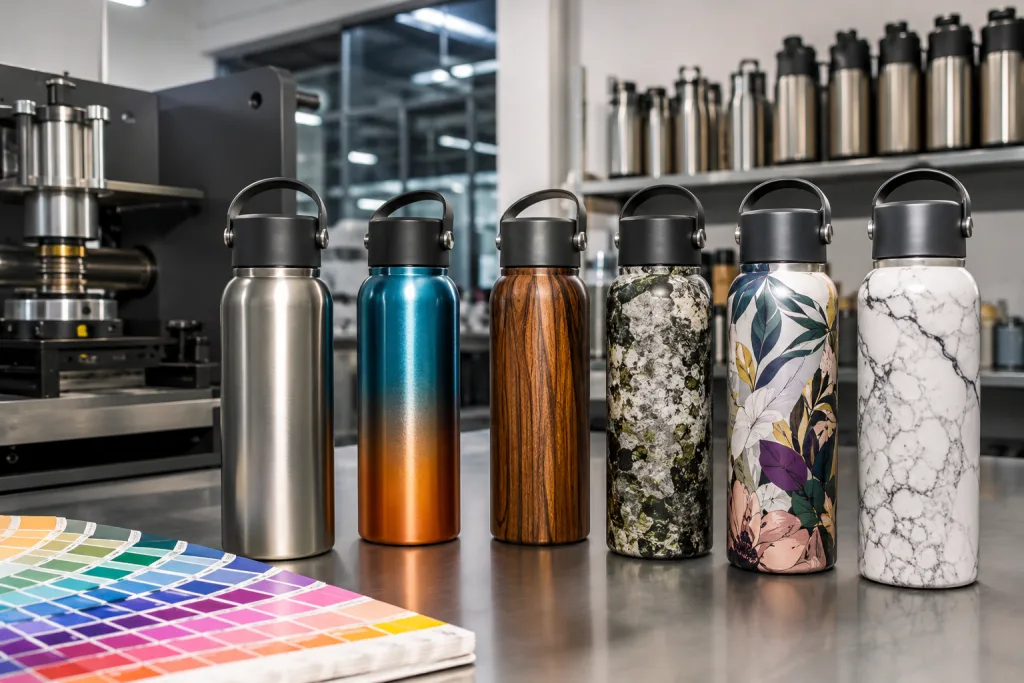
A custom thermos is often won or lost at the logo stage. The bottle body can pass vacuum testing, but if the logo chips, sits 3 mm off-center, or turns gray on matte black powder coat, the order becomes a margin problem. We’ve had QC pull 12 samples from the line because a buyer’s “gold” Pantone file printed closer to mustard. A capable thermos factory should push back when your artwork does not fit the process. That is not being difficult. It protects the order.
Laser engraving works well for stainless steel, powder-coated bottles, and premium outdoor retail where buyers care about a permanent mark. We run the sample under a 20W fiber laser first, then check whether the exposed 304 stainless or coating contrast is strong enough under warehouse light. It is durable and clean, with no ink adhesion issue. The limit is color. If your retail brand wants a rugged logo that survives daily handling, laser is usually the safest thermos custom route.
Silkscreen printing is better for one- to three-color logos on promotional thermos orders, especially when the artwork is simple and volume is above 1,000 pieces. Setup cost is modest, usually USD 40-80 per color per artwork, and unit cost stays low once the screen is made. The weak point is abrasion resistance. On powder coating, ink adhesion must be tested with cross-hatch tape testing before mass production; we use a 3M tape pull and reject the sample if edges lift after the first pull.
Heat transfer and water transfer allow larger coverage with complex graphics, so they fit campaign bottles and colorful customizable thermos projects. The math does not work for every order. Setup cost climbs, rejects rise, and approval can move from 12 days to 18 days once the buyer asks for a second color match. Full-wrap artwork also needs seam control within about 1.5 mm. For Amazon or retail shelves, a visible seam can trigger complaints even when the bottle keeps temperature perfectly.
For individual names or short-run variants, UV print or laser personalization can work, but it changes the workflow. A thermos vendor must control artwork files, carton marking, SKU separation, and sometimes FNSKU labeling. If you need 20 names across 2,000 units, say that before quotation; we once saw a PO typo turn “Mia” into “M1a” on 96 gift bottles. Decoration complexity is not free. It eats production management time.
Read Supplier Claims Carefully
A vacuum bottle supplier directory usually mixes trading companies, export agents, and real thermos factories. That alone is not a red flag. We still ship small mixed orders through trading partners when the MOQ is 300 pcs per color and the buyer needs 6 lid styles in one PO. But if you are building recurring outdoor retail SKUs or a distributor thermos line with stable specs, this is the wrong question to ask: “Are you a factory?” Ask who controls the welding, polishing, coating, and assembly. The answer matters when QC pulls 12 bottles from the line and finds one weld seam sitting 0.3 mm proud.
Ask direct questions. Does the supplier run vacuum pumping in-house? How many automatic welding lines are on the floor, 3 or 12? What is the monthly capacity by model type, not one blended number? Can they share BSCI, ISO 9001, or Sedex audit status? Are coating and printing in the same site or sent to another workshop? In Zhejiang and other China drinkware clusters, plenty of suppliers are strong at stainless forming but send powder coating out. That can work, but your schedule then depends on another plant’s oven, color-change queue, and masking jig availability.
At BottleForge Industrial in Hangzhou, Zhejiang, China, our common stainless thermos capacity is about 420,000 units per month across standard and custom lines. Normal sample lead time is 7-12 days for existing models, and mass production is usually 30-45 days after approved pre-production sample and deposit. These are not magic numbers. A matte black 750 ml bottle with a stock cap moves faster than a custom Pantone coating with silicone boot, gift box, and laser logo. We have seen 12 days turn into 18 days because the buyer changed the PO carton mark after the pre-production sample was already packed.
A serious thermos supplier should be comfortable discussing defects. Vacuum failure, coating dust, pinholes, lid leakage, logo misregistration, and carton compression are normal control points. If a supplier only says “no problem,” keep asking. Use AQL inspection terms: for example, general inspection level II, AQL 2.5 for major defects and 4.0 for minor defects. For leakage and vacuum failure, many buyers set stricter special checks because one leaking bottle causes more trouble than a small print blemish. We run hot-water leak tests with bottles inverted for 30 minutes; if the cap gasket is off by 0.2 mm, the buyer will flag it.
Check communication behavior before you trust the listing. If the supplier answers with exact tolerances, photos, test videos, and carton dimensions, that is a good sign. If every reply is “yes dear friend,” the directory page is not evidence. The math doesn’t work when a supplier claims 1,000,000 pcs monthly capacity but cannot tell you the carton size for a 500 ml bottle. Ask for one packing photo with a tape measure on the master carton.
Set MOQ And Pricing Rules
MOQ is not just a sales barrier. It comes from coating batch size, logo setup, cap inventory, carton printing, and how many times the line has to stop. For a standard manufacturer thermos model, we usually quote 1,000 pieces per color because one powder booth changeover can eat 45-60 minutes, including gun cleaning and test spraying. For custom powder coating, factories may ask 1,500-3,000 pieces per color because the math gets ugly below that. For new molds, 3,000-5,000 pieces is more realistic because tooling cost and process tuning must be absorbed, and QC may pull 20-30 trial samples before the vacuum test stabilizes.
When comparing thermos suppliers, ask for pricing at stepped quantities: 1,000, 3,000, 5,000, and 10,000 pieces. A fair FOB price curve shows where the factory starts to run clean. If the price barely drops from 1,000 to 10,000 pieces, the supplier may be buying from another factory, or the cap is coming from a small outside workshop with no volume discount. If the 1,000-piece price is unusually low, check whether packaging, testing, logo setup, and spare parts are excluded. We have seen buyers flag a USD 0.18 “surprise” charge after the PO because the carton mark was treated as extra printing.
For reference, a standard 500 ml stainless vacuum bottle with 304 inner wall, powder coating, one-color logo, and white box packaging may land around USD 3.20-4.80 FOB Ningbo or Shanghai depending on cap and coating. A premium 750 ml outdoor bottle with thicker shell, laser logo, retail color box, and stronger carton can be USD 5.20-7.80 FOB. These are working ranges, not promises. Still, they help you challenge directory quotes that look too clean. If a listing shows USD 2.10 for a 500 ml powder-coated bottle with retail box, ask for the wall thickness in mm, carton gross weight, and whether the sample passed 6-hour heat retention.
Payment terms also affect risk. A common China export term is 30% deposit and 70% balance before shipment after inspection. For repeat buyers, partial credit may be discussed, but new buyers should not expect open account terms. That is the wrong question to ask on a first order. If you are a thermos distributor buying mixed SKUs, consider fewer colors and stronger carton marking; one buyer’s PO once had “matte black” typed as “mate black,” and the line stopped until we confirmed the artwork sheet. Operational simplicity often saves more than negotiating USD 0.05 off the unit price.

Control Samples And Inspections
The sample process has one job: prove the final order. Not win a desk beauty contest. We run the first sample to lock the shape, welding, inner wall fit, and cap thread feel on the torque gauge. The pre-production sample must match the order sheet for material, coating, logo placement, cap color, gasket, packaging, barcode, FNSKU if required, and carton marks. Do not let mass production start until the buyer signs that pre-production sample in writing; we have seen a line lose 2 days because a PO said “matte balck” and nobody confirmed whether it meant black or dark charcoal.
For a customized thermos project, keep a control file. Ours usually has Pantone color, logo vector file, print position in millimeters, bottle capacity tolerance, carton quantity, gross weight, drop-test requirement, and compliance report list. About 6 out of 10 sample arguments we see start with the buyer approving a photo instead of a measurable specification. Photos help sales, but they do not say whether the logo is 42 mm wide or 48 mm wide. QC pulled the sample, caliper in hand.
Plan inspection before the deposit is paid. This is the wrong question to ask after cartons are sealed. For thermos bulk orders, pre-shipment inspection should cover workmanship, quantity, packaging, barcode scanning, carton drop condition, leakage, smell, coating, print adhesion, and insulation performance sampling. AQL level II with AQL 2.5/4.0 is common for visual defects. For leakage, sharp edges, wrong material, or severe vacuum failure, use a tighter rule; one leaking lid in a 20-piece pull is not “minor” when the buyer flagged wet retail shelves last season.
Ask your supplier thermos partner to keep golden samples at the factory and at your office. Same standard, both sides. If a dispute happens, compare against the sealed sample with the date sticker, not a phone photo from WeChat. For outdoor retailers, add carton compression and drop-test requirements because bottles are heavy. A 24-piece carton of 750 ml bottles can exceed 12 kg. Weak cartons may arrive crushed even when the bottles pass function testing; we ship double-wall cartons for some club-store orders because the math does not work with thin K=K board.
Testing cost is not wasted money. A REACH or LFGB food-contact test may cost a few hundred USD per material combination, but one failed marketplace listing or retailer compliance hold costs more. Build it into the calendar. If SGS needs 7 working days and the vessel cutoff is Friday, do not pretend the report will appear in 3 days because production is finished.
Plan Logistics Before Production
Talk freight before we run mass production. Carton size, shipping marks, and pallet pattern change the bill faster than most buyers expect. We can quote FOB Ningbo, FOB Shanghai, EXW Hangzhou factory, and sometimes DDP for small trial orders under 300 cartons. For importers with their own forwarder, FOB is cleaner; you control ocean freight, destination fees, and the surprise charges nobody likes. Air freight can save a launch date, but this is the wrong product to fly unless the math still works. A 5,000-piece order can easily become 6-8 cubic meters and over 2,500 kg depending on bottle size and packaging; last month QC pulled a 1L bottle set where the color box added 4.5 mm per side and pushed the carton count up by 11%.
For North America and Europe, ocean freight from China commonly needs 25-35 days on the water, before booking, customs, inland trucking, and warehouse receiving. Do not count production days only. We've seen this go sideways when a buyer planned 45 days door-to-door and forgot the 6 days waiting for a vessel slot after Golden Week. A safer calendar for a custom thermos program is 7-12 days for sample, 3-5 days for approval communication, 30-45 days for production, 3-7 days for inspection and vessel booking, then freight time. Build the calendar from the event date backward.
If you sell through Amazon or retailer distribution centers, lock labeling early. FNSKU labels, suffocation warnings for polybags, carton content labels, master carton dimensions, and pallet height limits can all change packing, so send the routing guide before the PP sample. The buyer flagged one PO last year because “matte black” was typed as “mate black” on the carton label file; small typo, 620 cartons re-labeled by hand. A thermos distributors program with mixed colors may need inner carton separation, such as 24 pcs silver in one inner and 24 pcs blue in another, so warehouse staff can receive inventory without opening every carton.
Ask for exact carton dimensions and gross weight before you approve final packaging. A beautiful retail box that increases carton volume by 18% may erase your margin, especially when the forwarder charges by CBM instead of actual kg. For outdoor retail, packaging must protect the product and sell the SKU; for promotional brands, plain white box or egg-crate packing may be enough. Channel decides. Ego does not. A good thermos vendor will help calculate landed cost, not just FOB price, and we usually run the carton through a 1.2 m drop-test corner before locking the packing spec.
Send Your Thermos Spec Before You Shortlist Suppliers
Share capacity, color, logo, MOQ, market, and deadline. We will return a practical FOB quote, sample plan, and risk notes.
Frequently asked questions
How do I compare suppliers in a vacuum bottle supplier directory?
Start by separating actual factories from trading companies, then compare on measurable points: MOQ, monthly capacity, sample lead time, production lead time, steel grade, inspection standard, and compliance reports. Ask whether vacuum pumping, welding, polishing, coating, and assembly are in-house. A useful thermos supplier should provide carton dimensions, AQL terms, logo process limits, and FOB port details without vague answers. For a standard stainless custom thermos, expect MOQ around 1,000 pieces per color and production around 30-45 days after sample approval. If a listing gives a very low price but cannot confirm 304 inner wall, leakage testing, or coating adhesion testing, treat the quote as incomplete.
What is a realistic MOQ for custom stainless thermos orders?
For existing bottle shapes, 1,000 pieces per color is a realistic MOQ for many China factories, including our Zhejiang production lines. If you need custom powder coating, special cap colors, or retail color boxes, MOQ can move to 1,500-3,000 pieces because coating, printing, and packaging suppliers have their own batch limits. For a new mold or exclusive cap design, plan for 3,000-5,000 pieces and tooling cost from roughly USD 2,000 to USD 8,000 depending on complexity. Small 300-500 piece orders may be possible from stock, but the unit price, logo choice, and color options will be limited.
Which logo method is best for a promotional thermos?
For promotional thermos programs, one-color silkscreen is usually the most cost-efficient if the order is above 1,000 pieces and the artwork is simple. Setup often runs USD 40-80 per color, with low unit cost. Laser engraving is more durable and looks better on retail-grade bottles, but it cannot reproduce full-color artwork. Heat transfer or UV print works for larger graphics and campaign designs, but expect more sampling time and higher rejection risk. For any method, request a pre-production sample and run tape adhesion checks on coated bottles. A logo that looks fine on day one but chips after handling is not acceptable.
What compliance documents should outdoor retailers request?
For EU sales, request LFGB food-contact migration testing and REACH information for coatings, inks, silicone, and plastic parts. For the US, ask about FDA food-contact material suitability, and CPSIA if the bottle is marketed for children. Retail buyers may also ask for BSCI, Sedex, or ISO 9001 factory documentation. Do not accept one old report for a different lid or coating as proof for your current customized thermos. Testing should match the actual materials in the shipped product. Budget a few hundred USD per test set and allow 7-10 working days for lab reporting, longer if multiple materials are involved.
How long does a thermos bulk order take from China?
A normal thermos bulk project from China takes about 65-95 days door-to-warehouse if you include sampling, production, inspection, and ocean freight. Existing model samples usually need 7-12 days. Mass production is commonly 30-45 days after approved sample and deposit, depending on coating color, cap availability, and factory schedule. Pre-shipment inspection and booking can add 3-7 days. Ocean freight to North America or Europe often takes 25-35 days on the water, plus customs and inland delivery. If you need air freight for an event, calculate by chargeable weight early because stainless vacuum bottles are heavy and not friendly to last-minute shipping budgets.