Key Takeaways
- Specify 304 stainless steel, 0.45-0.55 mm inner wall, and 0.50-0.60 mm outer wall before quotation
- Use AQL 2.5/4.0 inspection with heat retention, leak, coating adhesion, and logo position checks
- Plan 35-45 days production after approved sample, plus 7-10 days for pre-production sampling
- For promotional thermos programs, keep MOQ realistic: usually 1,000 pieces per color for stable pricing
A vacuum bottle promotional order usually fails in boring places: a lid torque test that slips at 0.6 N·m, powder coating that chips around the base, a logo sitting 2 mm off-center, cartons crushed on the corner, or heat retention that passes on the approval sample but drops after the line speeds up. Outdoor retailers and promo brands do not need romance here. You need bottles that survive warehouse stacking, trail use, and a buyer opening 3 random cartons with a box cutter.
From our thermos line in Hangzhou, Zhejiang, we see the same preventable problems across China sourcing projects. BottleForge Industrial produces up to 480,000 stainless drinkware units/month, with typical MOQ from 1,000 pieces per color and 35-45 days lead time after artwork approval. The cheapest quote is the wrong question to ask. We run into trouble when lid fit, coating thickness, logo position, carton burst strength, and vacuum test standards are not locked before the deposit; QC pulled one 750 ml sample last month because the PO said matte black, but the artwork file named it “sand black.”
The bottle does not stay hot
This complaint lands first. A buyer fills coffee at 7 a.m., opens the bottle at 12:30, and says the promotional thermos feels cheap. Usually the failure comes from the build, not the logo: a weak vacuum seal, thin stainless, light copper plating, insulation damaged on the polishing wheel, or a thermos line pushed at 1,200 pcs/day with only spot temperature checks. QC pulled one 500 ml sample last month that looked fine outside, but the base plug had a small weld shadow under the flashlight.
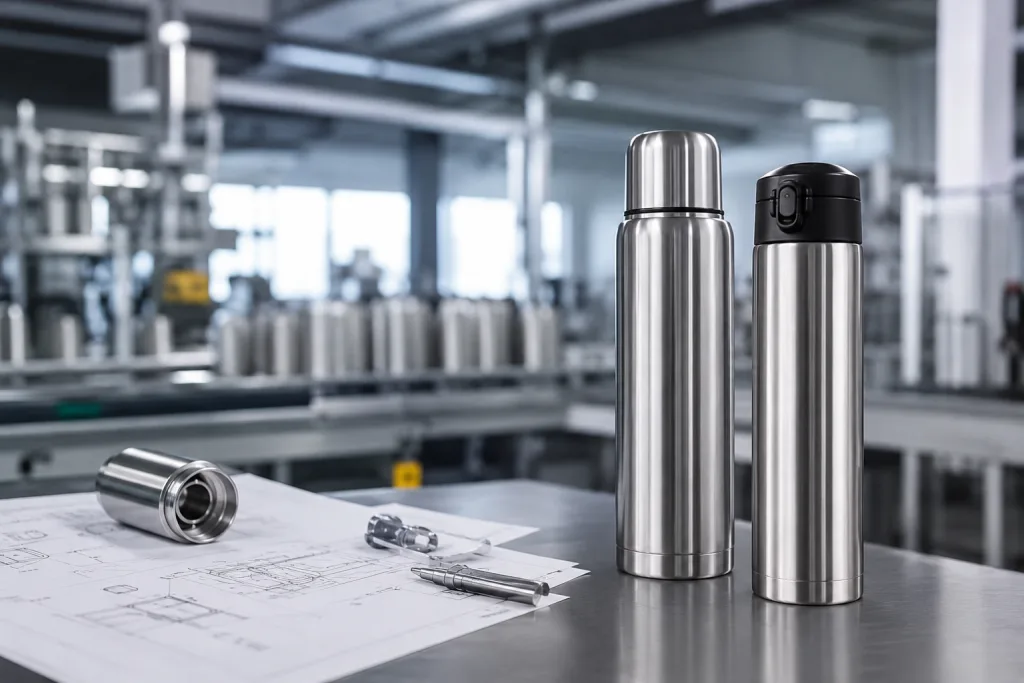
For a stainless vacuum bottle promotional project, lock the baseline spec before price talk: food-contact 304 stainless steel for the inner wall, 201 or 304 for the outer wall depending on price target, inner wall thickness around 0.45-0.55 mm, outer wall around 0.50-0.60 mm, and a vacuum base plug checked after welding. “Good quality” is the wrong question to ask. If that phrase sits on the RFQ, 6 thermos suppliers will nod and quote 6 different builds, and the cheapest one often hides the gap in wall thickness or vacuum time.
We normally test a 500 ml bottle with water at 95°C, room temperature at 20°C, and a 6-hour retention target above 65°C for standard promotional use. Premium outdoor retail specs may push 12 hours above 50°C, but the math does not work unless the vacuum is stable and the body construction is paid for. We run the test with a K-type thermometer and a taped cap position, because one loose cap thread can steal 3-5°C and start a useless argument with the buyer.
Your purchase order should include the heat test method, sample size, and reject level. Example: test 20 pieces from bulk thermos production, reject if more than 1 piece falls below the agreed temperature. Simple is better. We have seen this go sideways when the PO said “keep hot long time” and the buyer flagged it after shipment; now we write the temperature line into the QC checklist and mark the tested carton numbers with a red sticker.
The lid leaks in cartons
Leakage gets blamed on the cap first. Fair, but this is the wrong question to ask. On the line we check thread tolerance with a Go/No-Go gauge, gasket compression with a 0.02 mm feeler gauge, lid assembly pressure, mouth diameter, and carton vibration after packing. A new lid on a customized thermos needs tighter checking than a stock lid we have shipped for 3 years.
For outdoor retailers, do not sign off on the pretty tabletop sample alone. Fill the bottle to 90% capacity, tighten the lid to normal hand torque, invert for 30 minutes, then shake for 30 seconds. For travel and backpack use, we run 3 drops from 1 meter onto a rubber mat, then repeat the leak test. If the cap has a carry loop or push button, QC pulls that sample after the drop, because that is where we have seen buttons jam and loops crack.
Gasket material should be food-grade silicone, commonly 50-60 Shore A hardness. Too soft, it pancakes. Too hard, it misses the seal when the mouth size drifts by 0.10 mm across production. Ask your thermos vendor to confirm gasket material, spare gasket supply, and whether the gasket is removable for cleaning. Removable gaskets are better for users but easier to lose, so 6 out of 10 promotional buyers we ship for ask for one extra gasket per carton or per retail display pack.
Thread fit matters on thermos custom orders. If you are mixing a stock bottle body with a custom lid, request 10 assembled samples, not one. We have seen distributor thermos projects where the first sample looked fine, but the 800th piece in production leaked because the lid mold and body mouth tolerance were barely compatible; QC flagged a wet inner carton after the 2-hour vibration test. That is not bad luck. That is an incomplete specification.
The logo looks cheap
Logo problems are where marketing loses patience with operations. Fair. The bottle can pass leak testing and still look cheap if the imprint is 2 mm off-center, scratched by the carton divider, fuzzy at the edge, or printed in a “white” that looks gray next to the approved sample. We had one buyer flag 3 cartons because the logo leaned left under the light box. The fix starts with the decoration process and fixture setup, not with telling the line to “be careful.”
Laser engraving is clean and durable on powder coating or bare stainless steel, but you get the exposed metal tone, not a Pantone match. Silk screen printing works for simple 1-2 color logos and keeps cost low, usually adding USD 0.08-0.18 per position depending on size; we run it with a curved jig and check the first 20 pcs before mass print. Heat transfer and water decal handle gradients, but adhesion must be tested harder. UV printing gives sharp color, though the math does not work for heavy abrasion outdoor gifts unless the logo sits in a protected design area with a coating that can take rubbing.
For a customizable thermos order, define the logo size in millimeters, the position from the bottle bottom or centerline, the color standard, and the tolerance. Better: write “logo center 82 mm from bottom, facing opposite the seam line” on the artwork approval. A practical tolerance is ±1.5 mm for logo position and ±5 degrees for rotation on cylindrical bottles. If you need tighter control for retail shelves, say it before quotation because slower fixture alignment means fewer bottles per hour on the line.
Run adhesion checks before final packing. No shortcut here. For printed logos, use a 3M tape test after full curing; QC pulled the sample too early once and the tape lifted half the blue ink. For powder-coated bottles with engraving, run a rub test and check whether the laser burns unevenly through the coating. Promotional thermos suppliers sometimes rush curing because packing space is tight. That saves 1 day and creates a complaint 6 weeks later. In Zhejiang, China, we build curing and inspection time into the schedule because reworking 10,000 printed bottles is worse than being honest about one extra production day.
The coating chips too early
Powder coating helps a stainless bottle sell on the shelf. It also gives us one of the fastest complaint routes. We’ve seen cheap coating pass a desk-side visual check, then chip on the base ring after 7 days in a buyer’s hiking bag with keys and a stove canister. For outdoor retailers, matte powder coating is the right call most of the time because it gives better hand grip and a higher-value look, but the math doesn’t work if adhesion and film thickness are left to the coating shop’s mood.
A useful powder coat target is 60-90 microns film thickness. Under 60 microns, the edge coverage gets thin, especially around the bottom cup radius where the spray angle is poor. Over 90 microns, QC starts seeing orange peel, and we’ve had lids feel tight when powder crept into the thread area by 0.2-0.3 mm. Ask whether the bottle mouth and thread are masked before coating. We run silicone plugs on the mouth during the line, because paint dust where the user drinks is a bad argument to have with a brand manager.
QC should include a cross-hatch adhesion test with a 1 mm cutter, 3M tape pull, and a 1.2 m drop test on finished goods. For bulk thermos and thermos bulk orders, we suggest checking at least 32 pieces per color under AQL sampling, with extra attention on the bottom rim and shoulder seam. That is where QC pulled the sample last month and found 4 pieces with small chips after the carton drop. Salt spray testing fits metal accessories better than bottle bodies, but if your custom thermos includes a painted steel handle or carabiner, check it.
Color consistency is the quiet one. A promotional brand approves a Pantone-like blue sample, then the buyer flags cartons with 3 visible shades because the coating powder came from two lots. Your purchase order should state the maximum color variation, for example Delta E under 1.5 if your brand team measures it, and require the same powder batch for one SKU where practical. A good thermos factory records powder lot numbers on the coating report. If a supplier thermos quote is 8-12% lower than the others, ask whether coating is in-house or outsourced. Outsourcing is not the problem; the handoff is where we’ve seen this go sideways.
The carton arrives crushed
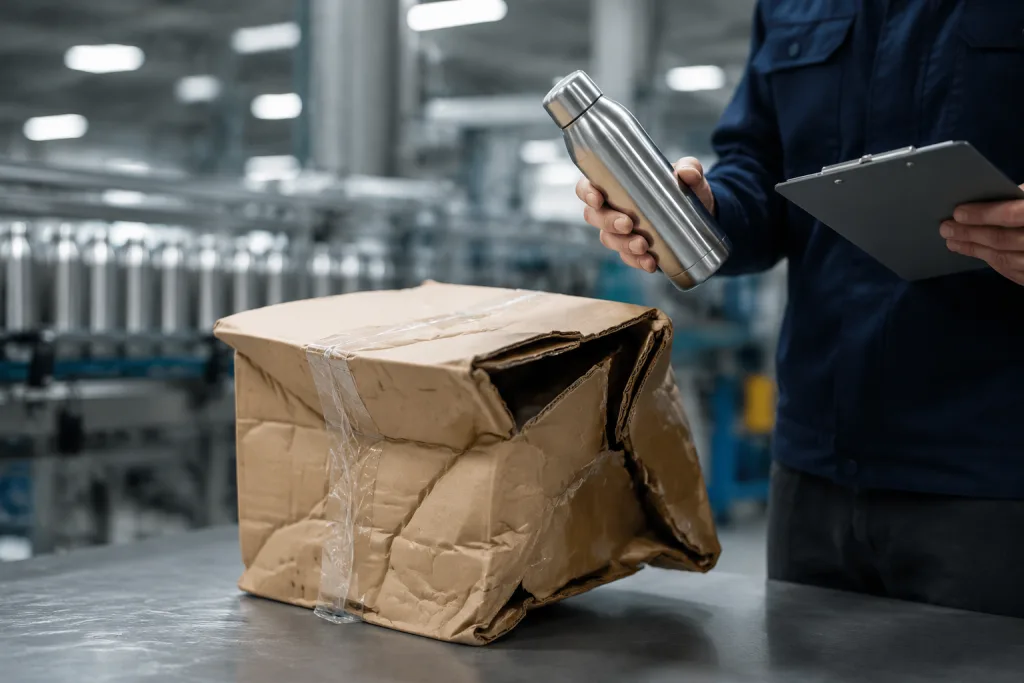
About 7 out of 10 distributor thermos complaints we see are not about vacuum performance or leaking. They start with packaging. Export cartons get dragged across the line, stacked in trucks, loaded at Ningbo port, squeezed in containers, re-stacked in warehouses, then sometimes handed to parcel networks. We had QC pull one crushed corner carton last month; the bottle was fine, but the retail color box looked like it had been stepped on. A gift box that looks clean on a buyer’s desk can fold fast in a mixed container if the carton spec is too soft.
For most 500-750 ml stainless bottles, we run an individual white box or color box in 300-350 gsm paperboard, then pack into a 5-layer corrugated outer carton. Standard packing is 24 pieces for 500 ml bottles, or 12-18 pieces for larger 1,000 ml outdoor bottles. Keep gross weight below 15 kg when the order allows it. Simple rule. Warehouse teams throw 18 kg cartons harder, and we see more crushed corners during AQL 2.5 final inspection when the carton is overloaded or the B flute is weak.
If you sell through e-commerce or FBA-style fulfillment, the carton needs another spec sheet, not just a prettier logo. We run drop testing from 60-80 cm, check barcode scannability with a handheld scanner, confirm FNSKU or SKU label placement, and put master carton labels on at least two sides. The buyer often pushes back on the extra insert cost, usually USD 0.06-0.12 per piece. The math does not work if one dented bottle creates a refund, a bad review, and a replacement shipment.
Do not approve packaging from a PDF dieline alone. Ask for a packed sample with the actual bottle, lid, manual, straw, brush, or spare gasket inside. Shake it. Open it. Check for coating rubs and pressure marks from accessories; QC pulled a matte black sample where the straw brush printed a 28 mm line into the powder coating. We have seen thermos manufacturers save USD 0.04 by using a thinner inner bag, then create visible scuffs on a matte black bottle. That is false economy.
Compliance is checked too late
Compliance failure hurts because it shows up near shipment, right when the line is sealing cartons and the forwarder has already booked space. We have seen QC pull a sample 6 days before ETD, then the buyer ask for a missing coating report. For Europe and North America, stainless drinkware is not complicated, but the food-contact and chemical papers need to match the actual bottle. Ask for them before sample approval, not after 3,000 cartons are taped shut.
For EU sales, buyers usually ask for LFGB or EU food-contact testing, REACH screening on the powder coating and soft-touch parts, plus BSCI audit status if their retailer requires it. For the United States, FDA food-contact expectations apply, and children’s products may require CPSIA and ASTM-related checks depending on design, paint, and age grading. If the bottle has a straw, painted surface, silicone gasket, plastic lid, or carry handle, check each material separately. The stainless body alone is not the whole product. We run a magnet check and material trace on the 304 stainless body, but the buyer often flags the lid resin first.
For a manufacturer thermos order, keep one compliance file per SKU: material declaration; test reports less than 12-24 months old where accepted; coating details tied to the coating supplier’s batch code; silicone grade and plastic resin type; factory audit documents. If you change the lid material from PP to Tritan, or change coating supplier, update the file. One PO we received still said “PP lid” after the buyer approved Tritan in the sample comments, and that typo would have broken the report trail. Buyers sometimes treat a customized thermos as “same as last year” after changing half the components. That is the wrong question to ask.
At BottleForge Industrial in Hangzhou, Zhejiang, we treat compliance as part of the quotation, not a cleanup job after production. China factories can move fast, but speed only counts if the paperwork follows the actual product on the bench. If your promotional thermos program needs BSCI, REACH, LFGB, or California Proposition 65 review, tell your thermos supplier at RFQ stage. The quote may change by USD 0.05-0.25 per unit depending on materials and testing burden, but late testing costs more: 12 days planned testing is manageable, 18 days after packing can miss the vessel.
The quote hides the real risk
The lowest thermos quote often looks good because the RFQ has holes. We see this on the line every month. One supplier prices 201 outer wall, 0.18 mm coating, single-wall carton, no third-party inspection, and a heat retention claim with no test method. Another prices 304/304 steel, powder coating, 5-layer carton, AQL inspection, and a sealed pre-production sample. On paper, both say “500 ml stainless vacuum bottle with logo.” Same wording. Different bottle.
For a fair comparison, make every thermos manufacturer quote from the same spec sheet: brimful capacity and usable volume in ml, steel grade for inner and outer wall, wall thickness in mm, lid material with gasket grade, coating type with color code, logo method with print size, carton structure with drop-test requirement, MOQ by color, sample cost, lead time, FOB port, payment terms, and inspection standard. Our merchandiser once caught a PO typo that changed “silicone gasket” to “silicon gasket”; small word, big argument after QC pulled the sample. If you need DDP delivery, list it as a separate line because freight, duty, and local VAT can bury the real unit price.
Typical FOB Ningbo or Shanghai pricing for a 500 ml customized thermos runs USD 3.20-5.80 depending on steel grade, lid complexity, finish, and packaging. A 750 ml outdoor bottle may run USD 4.60-7.50. These are sanity checks, not promises for your mold or logo file. The math doesn't work when one thermos vendor sits 25% below the other 6 quotes; we usually find a thinner outer wall, lighter carton, or missing inspection fee after asking for a cut sample and carton weight in kg.
Use a written golden sample. Approve one physical sample for construction, color, logo, packaging, and accessories, then require bulk production to match it within agreed tolerances. For outdoor retailers and promotional brands, this step beats a 28-email thread. We mark the sample with a red seal sticker, keep one in the sample room, and send one to the buyer; if 8,000 pieces are on the line, a good supplier thermos partner will want that control as much as you do.
Send your thermos spec before quoting
Share capacity, logo method, color, packaging, compliance market, and target delivery date. We will flag production risks before you place the order.
Frequently asked questions
What MOQ should I expect for a vacuum bottle promotional order?
For most stainless vacuum bottle promotional programs, a realistic MOQ is 1,000 pieces per color when using a stock mold and custom logo. If you need a custom color powder coating, some thermos manufacturers require 2,000-3,000 pieces because coating powder has minimum batch quantities. Fully custom molds are different: expect 5,000-10,000 pieces and tooling from USD 2,000-8,000 depending on lid and body design. If you are testing a new outdoor retail SKU, start with a stock customizable thermos body, apply your logo, and spend the budget on coating, packaging, and QC instead of tooling too early.
How long does custom thermos production take in China?
For a standard custom thermos using an existing bottle body, plan 7-10 days for artwork layout and pre-production sample, then 35-45 days for mass production after sample approval and deposit. Peak season before summer and Q4 gift campaigns can add 7-15 days. Ocean freight to Europe or North America often adds 25-40 days port to port, plus customs and inland trucking. If you need delivery for a fixed promotional launch, work backward from the event date and add a 10-day buffer. Rushing coating, logo curing, or final inspection is how small defects become large claims.
Which logo method is best for a promotional thermos?
For long-term outdoor use, laser engraving on powder coating is usually the safest because it will not peel. The limitation is color: the mark shows the exposed stainless tone, not a Pantone color. Silk screen printing is cheaper and good for simple logos, often USD 0.08-0.18 per position, but it needs proper curing and tape testing. UV printing works for colorful branding but should be tested for abrasion. For thermos promotional orders, do not choose by catalog photo. Ask for a decorated sample, run a tape pull test, and rub the logo 50-100 cycles with a dry cloth before approving bulk production.
Should I choose 304 or 316 stainless steel?
For most bulk thermos orders, 304 stainless steel is the right inner wall material. It is food-contact safe, widely available, and cost-effective. 316 stainless steel has better corrosion resistance, especially against salt or acidic environments, but it increases cost and is rarely needed for normal coffee, tea, and water use. If your outdoor retail product targets marine use, coastal fishing, or premium positioning, 316 can make sense. For promotional brands, spend first on stable vacuum performance, lid sealing, and coating adhesion. A 316 label will not save a bottle that leaks or loses heat after 4 hours.
What inspection standard should I use before shipment?
Use AQL inspection with clear defect categories. A common setup is AQL 2.5 for major defects and 4.0 for minor defects, with critical defects not allowed. Major checks should include leakage, heat retention, sharp edges, wrong logo, severe coating chips, lid failure, and carton label errors. Minor checks include small cosmetic marks within agreed limits. For a 5,000-piece thermos customized order, an inspector may check around 200 pieces under a general inspection level II plan, depending on the standard used. Add function tests for at least 20 pieces: leak test, lid assembly, logo adhesion, and temperature retention.