Key Takeaways
- 304 stainless steel inner walls at 0.4-0.5 mm are standard for most promotional thermos orders
- A realistic MOQ for custom thermos colors is 1,000-3,000 units per SKU
- Laser engraving adds about USD 0.18-0.45 per unit depending on logo size
- Normal production lead time from Zhejiang, China is 30-45 days after sample approval
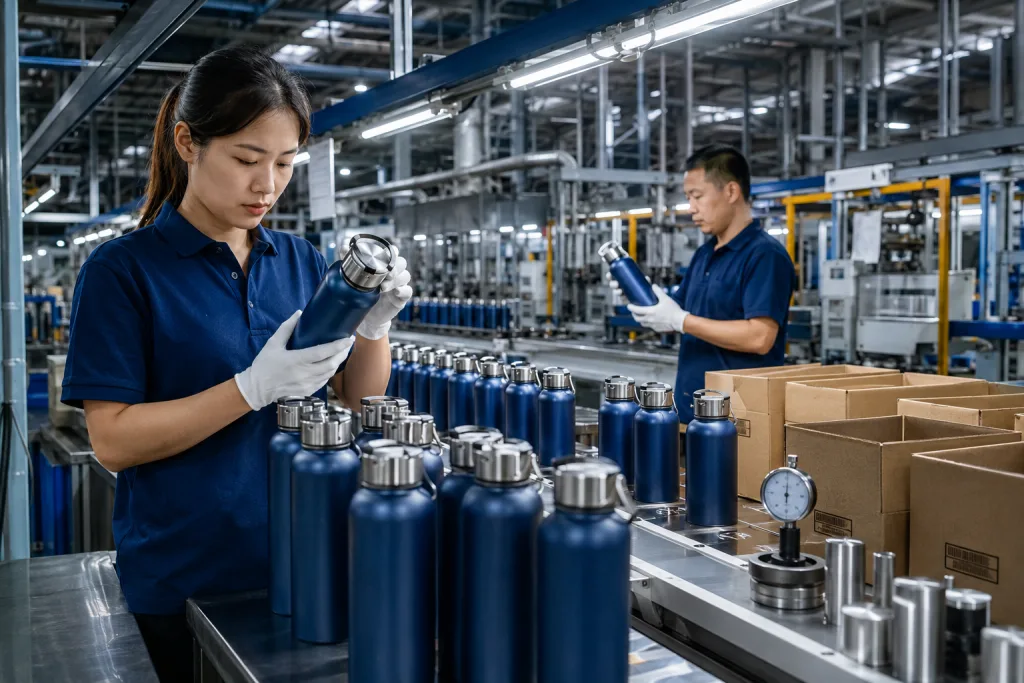
A stainless thermos looks simple until you are buying 5,000 units for an outdoor retail program or a promo launch that cannot slip. Then the spec sheet gets expensive fast: 304 stainless thickness, copper coating coverage, PP lid grade, logo position, 1.2 m carton drop test, and ΔE color control on repeat orders. We run this check with a caliper and color meter before the line releases bulk paint, because a 0.3 mm wall change or a bad Pantone callout on the PO can turn into 5,000 customer complaints.
At BottleForge Industrial in Hangzhou, Zhejiang, we see buyers lose margin when they treat vacuum bottle promotional products like cheap giveaways. Wrong question. A bulk thermos is a pressure-tested, vacuum-insulated product that has to pass food-contact rules, sit cleanly on shelf, and ship without dented shoulders or leaking lids. Last month QC pulled 32 samples from a 3,000 pcs run after the buyer flagged lid seepage at the silicone gasket; the math does not work if you find that problem after cartons reach the retailer’s DC.
Start with the steel line
The first line to check on any manufacturer thermos spec sheet is the steel grade. For most vacuum bottle promotional products, the inner liner should be SUS304 stainless steel. It is food-contact safe, handles acidic drinks better, and passes buyer review in Europe and North America when the file includes LFGB, FDA, or REACH documentation. We run 304 inner shells as the default on export orders; the outer shell can also be 304, while some budget promotional thermos models use 201 stainless outside to cut USD 0.20-0.45 per unit. QC pulled one sample last month with “304/201” missing from the laser-mark approval sheet. The buyer flagged it.
That saving is not always a mistake. For a 3,000 pcs short-term event giveaway, 201 outer steel can make sense. For outdoor retail, use 304 inside and outside. Retail customers scratch bottles, leave them in wet car boots, and expect the powder coat to survive two winters on a shelf claim. We have seen this go sideways: one buyer pushed for 201 outside on a camping bottle, then rejected 6 cartons after salt-spray marks showed near the base seam. A thermos supplier that only writes “stainless steel” is not giving you a specification.
Wall thickness is the second number. A common factory thermos build is 0.4 mm inner wall and 0.5 mm outer wall. Lighter 0.3 mm walls reduce weight and cost, but they dent faster when cartons get dropped from 80 cm during handling. Heavier 0.6 mm outer walls feel better in hand, but the math changes on both material cost and shipping weight. For a 500 ml customized thermos, a finished weight around 280-340 g is normal depending on lid design. Simple check: press the shoulder. Thin walls talk back.
Ask your thermos manufacturer to write the steel grade and wall thickness on the quotation, not just the sample tag. Samples are sometimes built better than mass production unless the purchase order locks the specification. We once saw a PO typo that changed “0.5 mm outer” to “0.35 mm outer”; the line stopped it before cutting, but only because the quotation had the right number. At our Zhejiang plant, incoming coil inspection checks thickness with digital gauges before cutting. That is basic factory discipline, not a luxury upgrade.
Vacuum performance is not magic
The insulation claim is where a lot of thermos promotional projects go messy. We see this on about 3 RFQs out of 10: the buyer writes “keeps hot 12 hours” but leaves out the test setup. That spec is not enough. Our lab fill is simple: water at about 95°C, lid closed by torque gauge, then temperature checked after 6, 12, or 24 hours in a 20°C room. A 500 ml stainless vacuum bottle with copper coating can typically stay above 60°C after 12 hours. Without copper coating, we normally see 3–5°C less on the same body.
Copper coating is a thin reflective layer applied to the outside of the inner liner before the two walls are sealed. It cuts radiant heat transfer. On retail-grade customizable thermos programs, we run copper coating on 500 ml, 750 ml, and 1 L models unless the buyer pushes hard on target price. The math does not work if you remove copper coating and still print a bold 12-hour claim on the color box. For distributor thermos campaigns with a modest 6-hour heat-retention promise, skipping it can make sense; QC still pulls samples from the line and checks the test sheet before packing.
The vacuum is made after the inner and outer bodies are welded, evacuated, and sealed. The weak points are ugly welds, oil or dust at the vacuum port, and overheating during powder coating or paint baking. We have seen this go sideways when a PO says matte black but the coating supplier bakes the body 18 minutes instead of 12 minutes. A reliable thermos factory should run vacuum detection on 100% of units before packing. At BottleForge Industrial in Hangzhou, China, our stainless bottle line can produce about 450,000 units per month, and vacuum failure sorting is part of normal inline QC.
Be careful with small bottles under 350 ml. Less water means less thermal mass, so the same insulation build gives lower temperature readings. If your outdoor retailer wants a 350 ml trail flask, do not copy claims from a 1 L camping bottle; this is the wrong question to ask at artwork approval stage. Put the real test result on the product page and the hangtag, even if the buyer flags it as “less sexy.” Overclaiming creates returns faster than a slightly higher FOB price ever will.
Capacity affects more than volume
Capacity looks like a marketing choice, but on the line it changes the body mold, carton loading, freight cost, and how the bottle sits in a real hand. We run 350 ml, 500 ml, 750 ml, and 1,000 ml most often for vacuum bottle promotional products. A 500 ml custom thermos fits office desks and travel programs without making the retail shelf look crowded. A 750 ml bottle suits outdoor clubs and hiking packs because buyers can justify the bigger logo area and higher gift value. A 1 L bottle looks generous, but the math can go sideways: one recent 24 pcs carton hit 17.8 kg after inner boxes, and the buyer flagged manual handling at their warehouse.
Check whether the quoted capacity is brimful or usable. Brimful means filled to the absolute top. Usable capacity is usually 10-20 ml less because the lid needs headspace. QC pulled the sample with a 500 ml graduated cylinder last month; the PO said “500 ml,” but the usable fill stopped at 472 ml under the stopper line. If your label says 500 ml and the bottle only holds 470 ml usable, some markets treat that as a compliance problem. Serious thermos manufacturers specify measured capacity with tolerance, commonly ±3%.
Mouth diameter is another line buyers feel after delivery. A 45-50 mm mouth is better for direct drinking and cuts heat loss because the opening is smaller. A 55-65 mm mouth takes ice cubes and is easier to clean with a bottle brush, but insulation can drop because the neck becomes a thermal bridge. For outdoor retailers, a wide-mouth thermos custom model often sells better because users want ice or soup, not just coffee. For corporate gifting, narrow mouth wins more often; it looks slimmer, and our caliper checks usually keep the body under common cup-holder limits.
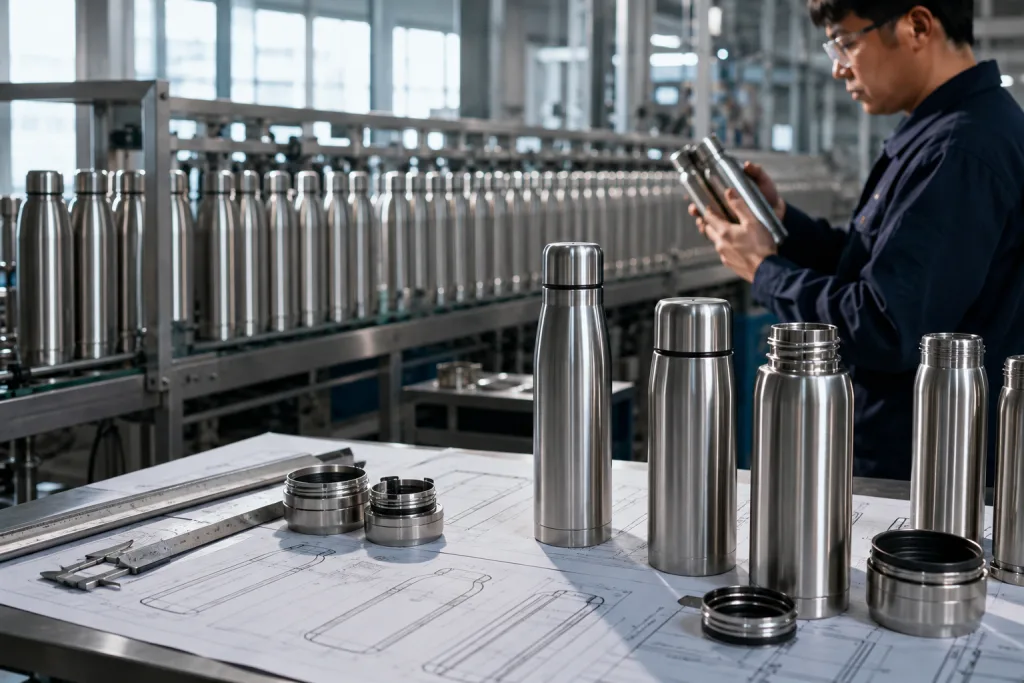
Do not ignore base diameter. Many North American buyers ask for cup-holder fit, usually below 74 mm for 500 ml travel formats. Taller bottles look clean in renderings, but we have seen them tip on a 600 mm acrylic store display during a mock shelf test. This is the wrong question to ask if the buyer only says, “Can you make it taller?” Ask for the cup-holder target first. A good thermos vendor should provide a 2D drawing with height, body diameter, mouth diameter, lid height, and carton layout before you approve tooling or a private-label body shape.
Lid construction sets complaint rates
Lids drive about 7 out of 10 after-sales complaints on the thermos programs we ship. The stainless body may come back with a dent from a drop test, but the lid is where leaks, trapped odor, cracked tabs, and child-safety failures show up. For a customized thermos program, choose the lid type early: screw lid for low-risk retail sets, flip lid for gym and commuter channels, push-button lid when one-hand drinking matters, straw lid for kids or cold drinks, cup lid for travel-flask positioning. QC pulled 12 lid samples last month because the buyer flagged “coffee smell after washing” during the first sample review. Small part. Big headache.
A simple screw lid is the safest starting point. We run PP or Tritan inner parts, a silicone gasket, and a stainless or plastic outer cap, then check the thread with a go/no-go gauge before leak testing. It passes leak checks more easily and tooling cost is usually lower than a spring lid. Flip lids sell well for sports and commuting, but the hinge pin, spring, and locking tab need their own test record; we normally test flip lids for at least 3,000 open-close cycles before approving a new thermos customizable project. We have seen this go sideways when a 0.2 mm hinge-pin change looked fine on the desk sample and failed on the line after 800 cycles.
Material declarations matter because the lid touches the drink first. PP should be food-contact grade, and silicone gaskets need odor control plus a removable design so the user can clean under the seal. If you sell in Europe, ask your thermos supplier for EU food-contact test reports on the full assembly, not only the metal body. For the U.S., FDA food-contact compliance and, where relevant, ASTM testing should be discussed before bulk thermos production. One PO came in with “LFGB body only” typed in the remarks; we pushed back because the math does not work if the lid is the complaint point.
Leak testing needs plain wording on the spec sheet. A common factory standard is room-temperature water, lid tightened to a defined torque with a torque wrench, bottle placed upside down or horizontal for 30 minutes, then checked for visible leakage. For retail-grade distributor thermos orders, we also run random hot-water leak checks at 90°C because heat can soften seals and expose poor gasket fit. On a 5,000 pcs order, our QC team usually pulls 125 pcs under AQL 2.5, and even 3 wet cartons at final inspection will stop shipment.
If you plan to sell replacement lids, confirm interchangeability across batches before you print the carton. A small thread change can make old and new lids incompatible; we have measured this at only 0.15 mm on the thread start and still had buyers complain that “the lid feels wrong.” This is the wrong question to ask after mass production. Outdoor retailers should not create 6 decorative lid versions unless the MOQ and spare-part inventory can support it, because separate gaskets, color caps, and hinge parts turn into slow-moving stock fast.
Finish and logo tolerances
The finish line on the spec sheet decides whether your thermos bulk order looks retail-ready or like cheap event stock. We run powder coating for most outdoor and promotional jobs because it gives grip, deeper color, and better scratch resistance than basic spray paint. A typical coating thickness is 60-90 microns; our QC checks it with a magnetic thickness gauge at the shoulder, body, and base. Too thin, the bottle chips after a drop test. Too thick, and we have seen lid threads bind by 0.3 mm.
Color matching should use Pantone or RAL references, but give the factory a tolerance in writing. On matte powder coating, Delta E under 2.0 is tight and usually means extra sampling cost. Delta E under 3.0 works for most promotional thermos colors; last month a buyer flagged a matte cream bottle at 3.4 because it looked warmer under office LED light. Metallic and translucent colors shift more between batches. If your brand color matters, approve a sprayed production color chip before mass coating, not a digital render from the sales deck.
Logo method changes both cost and durability. Laser engraving is clean, permanent, and common for stainless thermos custom orders, especially black, navy, or dark green bottles where the stainless mark contrasts well. Expect roughly USD 0.18-0.45 per unit for a normal logo size; on our line, that usually means one front logo within about 45 x 60 mm. Silk screen printing costs less for one-color graphics, often USD 0.08-0.20 per unit, but weak ink or short curing will scratch. QC pulled the sample after 50 rubs with 3M tape once, and the math did not work for that rush order. Heat transfer handles full-color artwork, but it adds setup time and needs abrasion testing.
For a promotional brand, the trap is overdesign. A full-wrap print on a tapered bottle looks good on screen, then goes sideways during application when the seam walks 1.5 mm near the base. A simpler front logo plus small rear compliance mark often gives a cleaner result. Ask your thermos factory to provide artwork templates in AI or PDF with safe areas, seam positions, and curve distortion notes. If the factory cannot explain print registration tolerance in millimeters, be cautious.
Compliance and inspection numbers
Compliance is not a PDF you collect after the container ships. Build it into supplier selection. For vacuum bottle promotional products going to Europe, ask for LFGB food-contact testing, REACH checks on coatings and plastic parts, and packaging rules if the order uses printed gift boxes. For North America, FDA food-contact statements are normal, and California Proposition 65 review comes up when the buyer adds powder coating, UV ink, silicone straps, or ABS lids. Last April, QC pulled a black 500 ml sample from the line and the buyer flagged the lid insert because the material sheet said “PP” while the PO said “Tritan.” Small mismatch. Big delay.
Factory audits matter if the bottles go through retailers. BSCI, Sedex, ISO 9001, and customer-specific social audits are different checks, not interchangeable badges. They still tell you whether a thermos manufacturer has a working system beyond one sales rep saying yes to everything. Around Zhejiang, I would say 7 out of 10 drinkware factories can make stainless bottles, but fewer are ready when an auditor asks for worker attendance records, chemical storage labels, and calibration logs for the vacuum tester. Ask for current certificates with the factory name and address matching the exporter or production site.
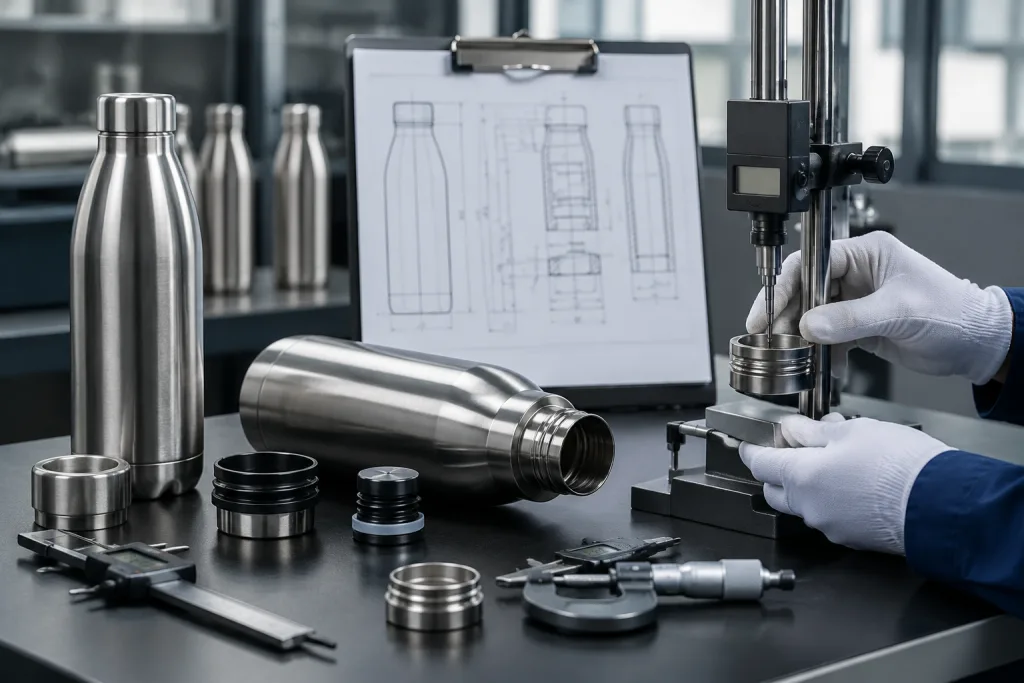
Write inspection terms into the purchase order. AQL is the usual sampling method. For promotional and retail drinkware, buyers often use AQL 2.5 for major defects and 4.0 for minor defects, with critical defects set at zero acceptance. Major defects include leakage, wrong logo, severe dents, failed vacuum, or coating peel. Minor defects include small specks, slight color shade variation, or carton scuffs within agreed limits. We once had a PO typo showing “matte blue” while the approved Pantone chip was 2965C, so the line stopped before the second oven pass. That saved 3,200 bottles.
Final inspection alone is the wrong question to ask. Run sample approval before production, incoming material checks, first-article review after coating and logo, inline inspection at 20-30% completion, and final random inspection before shipment. It sounds heavy. The math still works. Sorting 8,000 leaky bottles in a U.S. warehouse costs more than catching a bad weld seam with a water pressure test and a 0.01 g scale check during production. A serious thermos suppliers quote should state which tests are standard and which tests cost extra.
MOQ, pricing, and shipment terms
MOQ is where buyer expectations hit the line schedule. For an existing stainless vacuum bottle body with a stock color, MOQ can be 500-1,000 units. For custom powder coating, expect 1,000-3,000 units per color, because one color change means cleaning the gun, checking the powder booth, and wasting the first 20-30 bottles while the coating stabilizes. For a new mold or private body shape, the practical MOQ is often 5,000-10,000 units because tooling, line setup, and defect tuning take time. If a thermos vendor offers 100 units with full custom color, ask whether it is using hand-spray, stock overrun, or a trading-company workaround. We have seen this go sideways when the buyer approved “matte black” on a screen, then QC pulled the sample and found three shades under the D65 light box.
FOB pricing depends on steel, capacity, lid complexity, coating, logo, packaging, and inspection requirements. As a working range from China, a 500 ml stainless customized thermos may sit around USD 3.20-5.80 FOB Ningbo or Shanghai for normal B2B specifications. A 750 ml outdoor bottle may be USD 4.50-7.50. Premium lids, copper coating, retail boxes, and full-color transfer prints push the price up fast. The math doesn't work if you compare a plain white box quote with a retail gift box quote; one recent 500 ml order added USD 0.42 per set after the buyer changed the box from 300 gsm white card to 350 gsm printed kraft with an insert tray.
Lead time should be tied to sample approval. A normal timeline is 7-12 days for logo sample, 30-45 days for mass production, and 3-7 days for final inspection and shipment release. Peak season before Q4 can add 10-20 days if coating lines are full. At BottleForge Industrial in Hangzhou, Zhejiang, we prefer to confirm production slots only after artwork, Pantone, carton marks, and packaging dielines are approved. It avoids the fake comfort of a “fast” lead time that later slips. We run the schedule off the approved sample, not the first email inquiry; last September one PO had the carton mark typed as “THERMO BOTTEL,” and fixing that small typo cost 2 days before mass carton printing.
For outdoor retailers and distributors thermos programs, decide early whether you ship FOB, CIF, DDP, or direct to FBA/3PL. Amazon-style FNSKU labeling, carton weight limits, master carton drop tests, and pallet height all affect packing. A supplier thermos quote without packing details is not a landed-cost quote. Ask for units per carton, gross weight, carton dimensions, CBM, and spare-parts policy before you compare prices. Small detail, big cost. We ship plenty of 24 pcs/carton orders, but one buyer flagged cartons over 18 kg for warehouse handling, so we changed to 12 pcs/carton and the CBM jumped from 2.8 to 3.4 for the same 1,000 pcs.
Send your thermos spec sheet for factory review
We will check steel, lid, logo, MOQ, packaging, and FOB assumptions before you commit to mass production.
Frequently asked questions
What MOQ should I expect for custom vacuum bottle promotional products?
For an existing stainless thermos body, a realistic MOQ is 500-1,000 units if you accept stock colors and a simple laser or silk screen logo. If you need a custom Pantone powder coating, plan for 1,000-3,000 units per color because the coating line must be cleaned and tuned. A private mold or unique lid normally starts around 5,000-10,000 units. Very low MOQ offers can work for samples or local events, but they often use stock bottles, limited colors, or manual decoration. For retail or outdoor programs, it is better to consolidate colors and order enough volume to stabilize finish, carton packing, and inspection.
How much does a bulk thermos order cost FOB China?
As a practical FOB China range, a 500 ml bulk thermos with 304 inner steel, powder coating, and one-position logo usually lands around USD 3.20-5.80 per unit. A 750 ml outdoor bottle is often USD 4.50-7.50 depending on copper coating, lid type, and packaging. Gift boxes, full-color transfer printing, carry handles, and replacement lids add cost. Do not compare only the first unit price. Ask for carton dimensions, units per carton, gross weight, CBM, logo setup, sample fee, and inspection support. Those numbers decide your landed cost more accurately than a USD 0.15 difference in the headline quote.
Which logo method is best for a promotional thermos?
Laser engraving is the safest choice when you want durability and a premium look. It normally costs about USD 0.18-0.45 per unit and works especially well on powder-coated bottles because the mark exposes the metal below. Silk screen printing is cheaper, often USD 0.08-0.20 per unit for one color, and is fine for simple promotional thermos logos if ink adhesion is tested. Heat transfer is better for full-color artwork but needs abrasion and dishwasher-warning review. For outdoor retailers, I usually recommend laser for core SKUs and silk screen only when the campaign is price-driven or short-term.
What testing should a thermos manufacturer provide before shipment?
At minimum, your thermos manufacturer should provide leak testing, vacuum performance testing, coating adhesion checks, logo abrasion checks, capacity measurement, and carton drop testing. For Europe, request LFGB and REACH documentation where relevant. For North America, request FDA food-contact statements and review any coating or ink concerns. A normal final inspection can use AQL 2.5 for major defects and 4.0 for minor defects, with critical defects at zero. Ask for the inspection checklist before production starts. If the checklist is created after defects appear, it is already too late to control the order properly.
Can one thermos supplier handle retail packaging and distributor cartons?
Yes, but you need to specify both from the start. Retail packaging may include a printed box, hangtag, barcode, warning label, user leaflet, and sometimes recycled paper claims. Distributor cartons focus more on carton strength, pallet efficiency, and easy warehouse handling. A typical 500 ml stainless bottle may pack 24 units per master carton, but this changes with gift boxes and lid shape. If you need FNSKU labels, mixed SKU cartons, or 3PL routing labels, tell the thermos supplier before quotation. Packaging labor, label control, and carton sorting can add several days to the shipment schedule.