Key Takeaways
- A realistic MOQ for vacuum bottle private labeling is 1,000-3,000 pcs per color for stable pricing
- Standard 500 ml stainless vacuum bottles usually land at USD 3.20-6.80 FOB Ningbo or Shanghai
- Private label sampling normally takes 7-14 days; mass production is typically 25-45 days after approval
- Custom molds or exclusive lids can add USD 1,500-8,000 tooling and 25-40 extra days
You do not lose money on a custom thermos because stainless steel is complicated. You lose money when the quote hides small decisions: lid structure with 2 silicone rings, coating thickness, 5-layer vs 7-layer carton, logo method, sample rounds, inspection timing. We hear buyers ask for the clean FOB price first. Fair question, but this is the wrong question to ask if the price fails after QC pulls the sample and the lid torque gauge shows a weak seal.
From our factory in Hangzhou, Zhejiang, we see this pattern with first-time vacuum bottle private labeling buyers about 6 times a month. A buyer asks for a promotional thermos at 1,000 pieces, then adds a gift box, color coating, laser logo, spare lid, and FNSKU label. Each line looks small on the PO. Together, they add USD 0.80-2.20 per unit and turn a 10-day add-on into 18 days once the coating line, logo jig, barcode check, and carton packing slot are booked.
Start With The Real Unit Cost
A private label vacuum bottle quote should not be a single line item. Ask for the base bottle, finish, logo process, inner box, carton spec, test requirements, and export term as separate rows. If a thermos supplier writes only “USD 3.50 FOB,” the number is half-blind: steel could be 201 or 304, the lid could be PP instead of Tritan, and the master carton might be 5-ply when your distributor needs 7-ply for mixed pallets. We have seen this go sideways. QC pulled one 500 ml sample last year where the PO said “304 body,” but the shell test with an XRF gun showed 201 on the outside.
For a common 500 ml double-wall stainless steel manufacturer thermos, a workable FOB China range is USD 3.20-4.20 for a basic powder-coated model with a simple silkscreen logo at 3,000 pcs. A heavier 750 ml outdoor bottle with 0.45-0.50 mm inner wall, 0.50 mm outer wall, stainless cup lid, and stronger insulation performance usually lands around USD 5.20-6.80. Gift packaging adds USD 0.35-1.10. Laser engraving adds USD 0.12-0.35 depending on logo size. Full-wrap heat transfer adds USD 0.45-1.20. The math doesn't work if the buyer wants retail-grade coating, color box, laser logo, and 1,000 pcs MOQ at the same price as a plain promotional bottle; the line still needs coating jig changeover and 2 rounds of color matching under the D65 light box.
Steel choice matters. For drink contact parts, 304 stainless steel is the normal export option for Europe and North America. Some thermos manufacturers still quote 201 stainless for the outer shell to cut cost by about USD 0.08-0.18 per 500 ml bottle, depending on sheet price that week. That can pass for low-risk promotional thermos programs, but we do not recommend it for outdoor retail positioning. If you need REACH, LFGB, FDA food contact, or California Prop 65 documentation, tell the thermos factory before pricing, not after production. Once the body is welded and vacuumed, nobody wants to hear “the buyer flagged it” because the test plan was missing from the PO.
At BottleForge Industrial in Zhejiang, our stainless thermos lines can produce about 420,000 units/month across standard bottle families. Capacity helps. It does not delete cost drivers. A clean quote from a China thermos manufacturer should separate optional costs so your team can choose what the brand needs and cut what only looks nice on a spec sheet. On our floor, we run insulation checks with 95°C water and record the temperature drop after 6 hours; that one test alone can expose whether the cheaper lid or thinner wall is worth the saving.
MOQ Tiers Change The Math
MOQ is not a punishment. It is the point where setup time, coating loss, logo screens, packaging print plates, and QC labor stop bending the unit price. On our powder coating line, one color change can eat 2.5 hours and about 18 kg of powder before the first sellable bottle comes off the hanger. For vacuum bottle private labeling, the usual workable MOQ is 1,000 pcs per color for stock-shape bottles, 2,000-3,000 pcs for better price stability, and 5,000 pcs or more when you need room to push on coating cost, lid options, and outer cartons.
At 500 pcs, a thermos quote can look workable on paper. The math doesn't work unless you accept the trade-offs. We usually have to keep it to existing colors, standard white box, and a one-position logo because the silk-screen jig and oven time cost the same whether we run 500 pcs or 3,000 pcs. The unit price can be 15-35% higher than a 3,000 pcs order because the powder coating line and logo setup do not shrink with the PO quantity. For promotional brands running event merchandise, 500-800 pcs can still make sense when the buyer needs goods in 12 days instead of chasing margin over an 18-day production slot.
At 1,000-1,500 pcs, we can usually run a custom thermos with one Pantone-like color, laser or silkscreen branding, and a printed carton sticker. QC still checks color drift with a D65 light box, and the buyer flagged it last season when one batch was 1.8 Delta E off the approved sample. At 3,000 pcs, printed color box, better lid selection, and more stable AQL inspection economics become realistic. At 10,000 pcs, you can start negotiating dedicated production windows, mixed SKUs by carton, and customized thermos packaging without turning every small change into a surcharge.
One warning: “thermos bulk” pricing is not always the best choice for brand owners. We have seen this go sideways. A thermos vendor may offer a cheap existing model from bulk thermos inventory, but QC pulled the sample and found coating pinholes near the shoulder, older lid tooling, or carton markings left from a previous market. For distributors thermos programs, that risk can cost more than the savings once returns start at store level.
Logo And Packaging Cost Traps
Most buyers stare at the bottle body and forget the front-end decision happens on the line. Retail shoppers see the logo and the box first. For thermos custom projects, the decoration method has to match the channel. A corporate giveaway bottle can live with a one-color silkscreen logo. Outdoor retail is a different job. Bottles get rubbed by clips, rack hooks, car cup holders, and carton corners before the end user opens the pack. We had a buyer flag a matte black sample because the logo scuffed in the sleeve test.
Silkscreen is the cheap path for simple art, usually USD 0.08-0.18 per unit with a setup charge of USD 30-80 per color. Laser engraving looks cleaner and holds up better, usually USD 0.12-0.35 per unit. It works on powder coating, but fine lines vanish fast if the AI file is sloppy. Heat transfer and full-wrap graphics suit a thermos promotional run, yet the artwork control has to be tight and the oven adds time. Expect USD 0.45-1.20 per unit and 3-7 extra days. This is where weak files cost money.
Packaging has its own traps. A plain white box may cost USD 0.12-0.25. A printed kraft box is often USD 0.30-0.55. A full-color retail box with insert, barcode, warning text, and hangtag can reach USD 0.60-1.30. If you sell through Amazon FBA or a North American distributor thermos channel, carton drop strength matters. We usually run a compression check on 5-ply export cartons for heavier 750 ml and 1,000 ml bottles, especially when the gross weight goes above 14 kg per carton. Cheap cartons look fine until the stack test crushes them.
Do not approve packaging from a flat PDF only. Ask your supplier thermos team for a physical packaging sample or at least a white dummy with correct dimensions. QC pulled one sample last month and found the inner tray was 6 mm off, which changed the bottle fit and pushed the lid against the side wall. A box that is 6 mm too wide can cut pallet loading by 8-12%, and that math hurts on ocean freight from China. The buyer who ignores this usually pays twice.
Lead Time Is Built In Layers
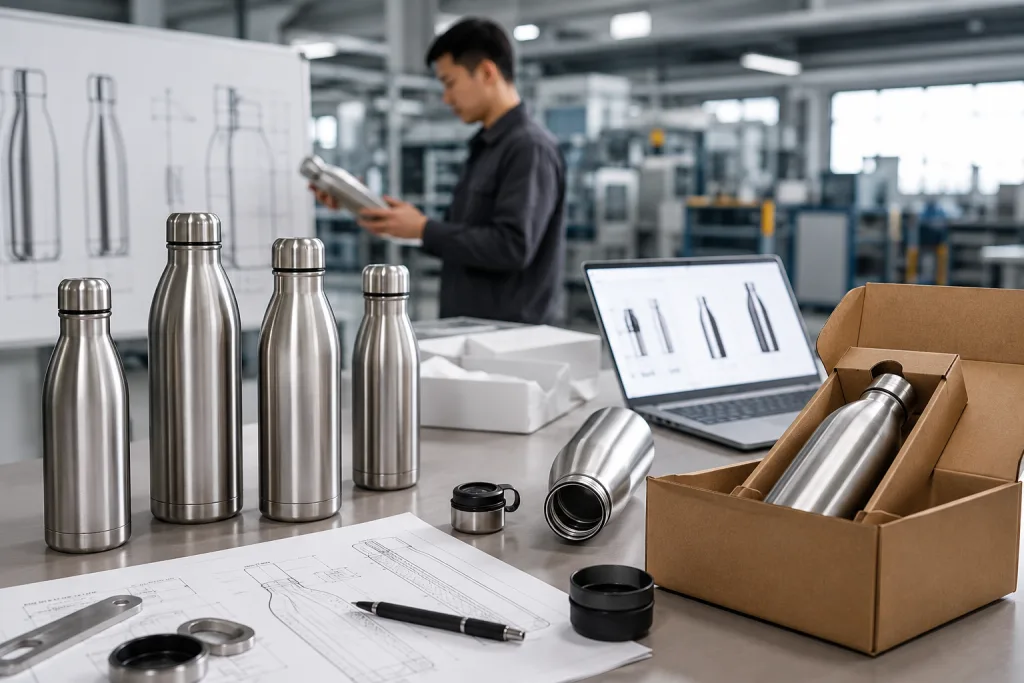
A realistic private label schedule starts before the purchase order lands. If you send a locked-in thermos model, editable logo files, Pantone code, packaging dieline, and test list, sampling moves fast. If the buyer is still choosing lid shape or carton copy, we lose 5-10 days on back-and-forth, and that delay is usually avoidable.
For stock-shape customizable thermos bottles, pre-production samples normally take 7-14 days. New powder coating colors sit at the long end of that window. A custom lid color, silicone boot, or carry handle can push sample time to 15-25 days, because the line has to match the color chip, run a small molding batch, and check fit again; QC pulled one sample last month because the cap color missed the Pantone card by a shade.
After sample approval and deposit, mass production is commonly 25-45 days. A 1,000 pcs promotional order can finish in 25-30 days if raw material is on hand and the box art is signed off. A 5,000-10,000 pcs outdoor retail order with printed cartons and multiple colors usually needs 35-45 days. Custom mold projects are another story: add 25-40 days for tooling, trial injection, fit testing, and leak testing before normal production starts. The math does not work any other way.
Shipping runs on a separate clock. FOB Ningbo or Shanghai means the China manufacturer thermos supplier delivers to the port under the agreed term; it does not cover ocean transit, customs, or inland delivery. Europe and North America buyers should plan 28-45 days by sea plus customs buffer, or 7-12 days by air for urgent thermos customized launches. Air freight can wreck margin on stainless bottles, so we use it for samples, replacement lids, or a small top-up lot only.
Quality Checks That Affect Price
Quality is not “looks good.” A vacuum bottle has to hold heat, stop leaks, pass food-contact checks, and land in the carton without dents. We’ve seen cheap thermos quotes remove the in-line pressure test and the carton drop check, then the buyer finds wet master cartons at arrival. Bad math. If you buy for outdoor retail or distributor resale, write the QC plan into the purchase order, including sample size, test method, and who signs off before balance payment.
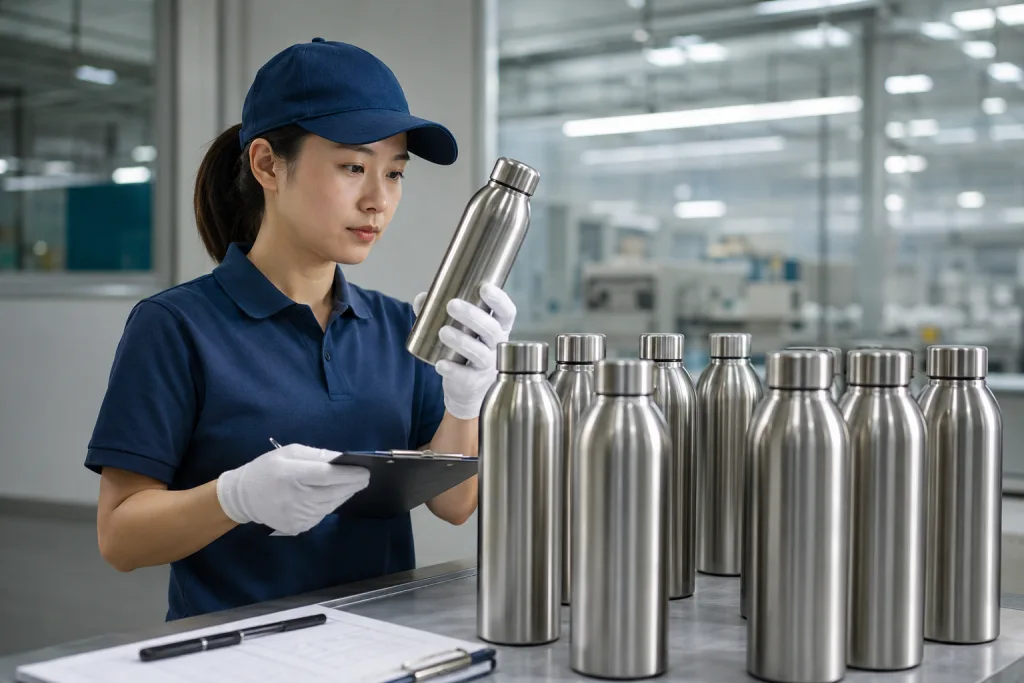
For stainless vacuum bottles, we run 100% leak testing during production, usually with an air pressure tester or inverted water test at the line. Vacuum performance should be checked by hot water temperature drop testing on sampled pieces, with readings after 6 hours and 12 hours depending on the model claim. Salt spray testing makes sense for painted metal accessories, especially handles, buckles, or coated lids. Coating adhesion can be checked by cross-hatch tape test; QC pulled one matte black sample last month where the tape lifted paint from 3 squares out of 100. For food-contact compliance, common requests include FDA, LFGB, REACH, BPA-free statement for plastic parts, and sometimes ASTM-related packaging or warning requirements for the U.S. market.
Final inspection should use AQL, not a casual photo review. Many buyers use AQL 2.5 for major defects and 4.0 for minor defects. Critical defects such as leaking, sharp edges, wrong material, or unsafe odor should be zero tolerance. At a standard inspection level II, a 3,000 pcs lot may require checking 125 pcs, depending on the inspection table and lot structure. The buyer flagged this once because the PO said “AQL 2.5,” but did not say major or minor; that typo cost 1 extra inspection day.
Inspection costs money. Third-party QC in Zhejiang or nearby China industrial areas may cost USD 180-320 per man-day. Factory internal QC is included in normal production, but an external report gives you leverage before balance payment. For a thermos distributor or promotional brand, that fee is small compared with a recall, chargeback, or rejected retail delivery. We ship a lot of private-label bottles out of Ningbo, and one failed leak batch can wipe out the saving from shaving USD 0.08 off the unit price.
When Custom Tooling Makes Sense
Not every customized thermos needs tooling. In our Hangzhou line, 7 out of 10 private label launches use an existing bottle body, then put the money into Pantone-matched powder coating, laser logo position, and printed gift boxes with the right barcode label. Tooling starts to make sense when the bottle shape is the brand asset, competitors can copy the current body too easily, or the project needs a proprietary lid across 350 ml, 500 ml, and 750 ml sizes. We have also tooled functional parts like a magnetic cap or carry loop, but only after QC pulled the sample and confirmed the off-the-shelf lid could not pass the buyer’s drop test.
Tooling cost varies by part. A simple silicone boot mold may be USD 300-800. A plastic lid mold can be USD 1,500-4,000 depending on sliders, thread detail, and sealing structure. A stainless body mold or major forming tool can reach USD 5,000-8,000 or more. Tooling lead time is normally 25-40 days before production sampling, and the first trial is rarely perfect. Expect at least one correction round for lid fit, thread feel, gasket compression, or molding marks. On one 500 ml lid, the CMM showed a 0.35 mm mismatch on the thread start, and the buyer flagged the lid as “cheap feeling” before we adjusted the cavity.
For a thermos manufacturer in China, tooling ownership must be written clearly on the PI and tooling agreement. If you pay for exclusive tooling, define whether exclusivity is global, regional, or limited to one channel such as Amazon or supermarket retail. Also define storage time, maintenance responsibility, and what happens if you do not reorder for 18-24 months. Vague tooling agreements create arguments later. We have seen this go sideways when a PO typo listed “exclusive mold” but the paid line item only covered sample development, not the steel mold sitting in our tool room.
Our practical rule: do not tool a new bottle body under 10,000 pcs annual demand unless the shape is central to your brand. For 1,000-5,000 pcs launches, use a proven thermos customizable platform and customize the visible elements. The math does not work for most small launches. We run stock-body samples in about 7-10 days, while a new body tool usually pushes the first usable sample to 25-40 days before mass production can even be scheduled.
A Sensible Buying Sequence
The cleanest buying sequence is boring. That is why it works. Start with capacity and use case: 350 ml for commuter gifts, 500 ml for daily retail shelves, 750 ml for outdoor sets, or 1,000 ml for camping and jobsite orders. Then set the target landed cost, not only FOB Ningbo or Shanghai. Ask 3 thermos suppliers to quote the same wall thickness, lid structure, coating, and carton pack, or the comparison is fake; last month QC pulled a 500 ml sample that looked identical but used a 0.38 mm outer shell instead of the 0.45 mm we run on our standard line.
A useful RFQ should include capacity, 304 stainless requirement, lid type, coating color, logo size and method, packaging style, compliance market, order quantity by color, delivery term, and target ship date. Add the boring details buyers often leave out: Pantone code, carton drop-test requirement, barcode position in mm, and whether the MOQ is 1,000 pcs total or 1,000 pcs per color. If you want a bulk thermos order for a distributor thermos catalog, say whether cartons need neutral marks or your brand marks. If you need Amazon-ready goods, list FNSKU labeling, suffocation warning if polybags are used, master carton limits, and pallet requirements; we once had a PO typo showing 54 pcs/carton when the approved carton was 24 pcs, and the buyer flagged it only after the packing list was drafted.
For a first private label order, we usually suggest this timeline: 2-4 days for model selection and quotation, 7-14 days for samples, 2-5 days for approval and PO cleanup, 25-45 days for production, 2-4 days for final inspection and export booking, then shipping. Real production is not a stopwatch trick. A new powder-coated color needs a spray plate, baking test, tape test, and color signoff before we run the line; that alone can be 12 days vs 18 days if the first sample misses the Pantone target. If a supplier promises 15-day production for a new color, printed box, and 3,000 pcs order during peak season, ask which step is being skipped. We have seen this go sideways.
As a stainless thermos factory in Hangzhou, Zhejiang, we prefer buyers who are direct about budget and timing. Give us the retail launch date, target landed cost, and inspection standard such as AQL 2.5 before artwork starts; then we can adjust decoration, packaging, or shipment split without burning 6 days on redraws. If the budget is fixed, we can suggest where to simplify. The wrong question is “what is your cheapest thermos?” The math does not work when cost, MOQ, and lead time are treated as separate decisions; they are the same decision seen from different sides of the production floor.
Price your private label thermos before production slots fill
Send your capacity, logo, MOQ, packaging, and delivery market. We will return a practical FOB quote and lead-time plan.
Frequently asked questions
What is the normal MOQ for vacuum bottle private labeling?
For standard stainless vacuum bottles, a practical MOQ is 1,000 pcs per color if you use an existing mold and simple logo. At 3,000 pcs, pricing becomes more stable and printed retail packaging is easier to justify. Below 1,000 pcs, many factories will limit you to stock colors, white box packaging, and laser or one-color silkscreen only. For custom lid colors, silicone boots, or full-wrap graphics, expect 2,000-3,000 pcs per SKU. For new tooling, plan around 10,000 pcs annual demand before the economics make sense.
How much does a custom stainless thermos cost FOB China?
A standard 500 ml 304 stainless double-wall vacuum bottle usually costs USD 3.20-4.80 FOB Ningbo or Shanghai at 3,000 pcs, depending on lid, coating, and logo. A heavier 750 ml outdoor bottle often runs USD 5.20-6.80. Printed retail packaging can add USD 0.35-1.10, laser engraving USD 0.12-0.35, and full-wrap artwork USD 0.45-1.20. If a quote is far below this range, check steel grade, wall thickness, lid material, vacuum testing, carton strength, and compliance documents before you celebrate.
How long does private label thermos production take?
For an existing bottle shape, expect 7-14 days for pre-production samples after artwork confirmation. Mass production normally takes 25-45 days after sample approval and deposit. A simple 1,000 pcs promotional thermos order may finish in about 30 days if coating and packaging are standard. A 5,000-10,000 pcs retail program with multiple colors, printed boxes, and AQL inspection usually needs 35-45 days. New tooling adds another 25-40 days before the production clock starts. Ocean shipping to Europe or North America usually adds 28-45 days.
Which logo method is best for outdoor retail bottles?
For outdoor retail, laser engraving is usually the safest balance of durability and cost, especially on powder-coated stainless bottles. It normally costs USD 0.12-0.35 per unit and resists scratching better than basic silkscreen. Silkscreen is cheaper at roughly USD 0.08-0.18 per unit, but it suits simple promotional thermos orders more than hard-use retail. Full-wrap heat transfer looks stronger on shelf but can add USD 0.45-1.20 and needs tighter artwork control. Always approve a physical logo sample, not just a digital mockup.
What quality documents should I ask a thermos manufacturer for?
For Europe and North America, ask for food-contact documentation relevant to your market: FDA for the U.S., LFGB for Germany or stricter EU buyers, REACH for chemical restrictions, and BPA-free statements for plastic parts. Also request material confirmation for 304 stainless steel on drink-contact surfaces. For production control, define AQL 2.5 for major defects and 4.0 for minor defects, with zero tolerance for leaks, sharp edges, wrong materials, or unsafe odor. If your retailer requires BSCI, ISO 9001, or factory audit records, confirm before placing the order.