Key Takeaways
- A practical stainless vacuum bottle MOQ starts at 1,000-3,000 units per color for private label work
- Standard FOB China pricing usually ranges from USD 3.20-8.50 depending on capacity, finish, cap, and packaging
- A realistic lead time is 35-55 days after artwork approval and deposit for repeatable factory thermos orders
- Logo method can change unit cost by USD 0.08-0.65 and add 2-7 days to the schedule
A vacuum bottle private label quote looks simple until the spec sheet hits the desk. We run two 500 ml stainless steel bottles through costing and one comes out at USD 3.20 FOB Ningbo while the other sits at USD 7.80, because 0.4 mm versus 0.5 mm steel, cap thread design, powder coating thickness, laser logo time, 5-layer carton, and AQL 2.5 inspection all change the number.
If you sell outdoor gear or promotional thermos programs, finding a thermos supplier in China is the wrong question to ask. The hard part is holding cost without blowing the delivery date. Our Hangzhou, Zhejiang team sees this 6 or 7 times a month: the buyer approves a nice shape first, then QC pulled the sample and the PO shows a 3,000 pcs MOQ, a mold charge, or a 45-day production slot that misses the campaign launch by 12 days.
Start With The Real Cost Base
For a vacuum bottle private label quote, the base bottle cost is just line 1 on the sheet. A standard 18/8 stainless steel double-wall vacuum bottle uses 304 stainless steel inside; outside we run 304 or 201 based on the buyer’s target shelf price. Wall thickness is usually 0.4-0.5 mm per layer, checked with a Mitutoyo thickness gauge after drawing. If you ask for a tougher outdoor bottle with better dent resistance, moving the outer wall toward 0.5 mm usually adds 6-10% to the body cost. The math doesn't work if the buyer wants “camping grade” but prices it like a supermarket giveaway.
For 2025 production in Zhejiang, a plain 500 ml manufacturer thermos with screw cap, powder coating, and one-color logo is usually quoted around USD 3.20-4.60 FOB Ningbo at 3,000 units. A 750 ml or 1,000 ml customized thermos with carry handle, silicone bumper, leak-proof lid, and retail box often lands around USD 5.20-8.50. We had one buyer flag a USD 0.18 box difference on the PO because the spec said 350 gsm, while the sample box was 400 gsm. Fair catch. These are working ranges, not bait prices.
The cost stack normally includes stainless steel, vacuum forming, copper plating if specified, coating, cap assembly, gasket material, decoration, packaging, inner carton, master carton, labor, AQL inspection allowance, and export handling. A thermos factory that quotes only the bottle body is leaving you to find the missing charges after artwork is approved. Ask for a line-by-line FOB offer with carton dimensions and gross weight before you compare suppliers thermos quotes; QC once pulled a sample where the master carton was 2.1 kg heavier than the quotation, which changed the container count.
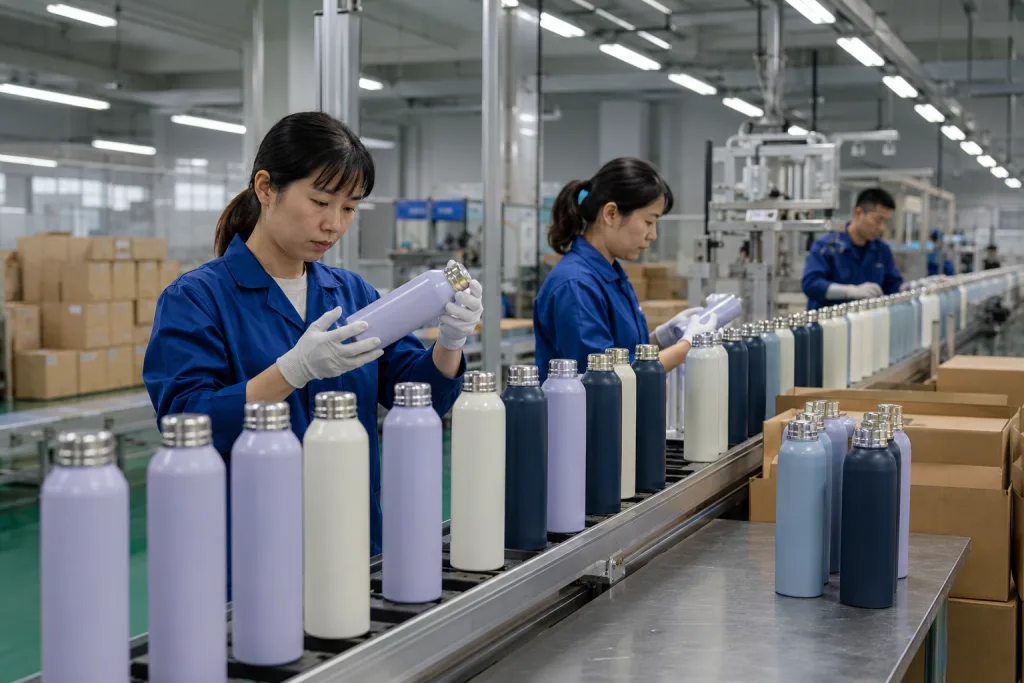
At BottleForge Industrial in Hangzhou, China, our stainless thermos line can produce about 180,000 units per month across standard shapes. That number matters during Q3 promotional peaks. We ship by retailer delivery windows, not factory excuses. A cheap factory thermos price is useless if the line is already full and your 3,000-unit order ships 18 days late instead of the promised 12 days.
MOQ Tiers Change The Math
MOQ is not a punishment. It is how we spread real setup cost across coating, logo fixtures, material buying, cap color matching, and packing line changeover. For a custom stainless thermos on an existing mold, we usually run 1,000 units for a simple laser logo, 2,000-3,000 units per color for powder coating, and 5,000 units for a custom cap color, silicone part, or gift-box print. On the line, one laser jig takes about 35 minutes to tune before QC pulls the first sample.
Below 1,000 units, the factory still has to set the line, mix coating, make films, tune laser jigs, and inspect cartons. The math gets ugly. A small custom thermos order often costs USD 0.40-1.20 more per unit than a 3,000-unit order because the same spray booth cleaning and carton drop-test work gets divided by fewer bottles. For outdoor retailers testing a new SKU, 1,000-1,500 pieces works if the bottle body and lid stay standard. For promotional brands selling to a national account, 3,000-10,000 units gives better pricing and fewer arguments over Pantone drift; we have seen buyers flag a 1.5 mm logo shift on the pre-production sample.
A common MOQ structure looks like this: 1,000 units for stock color with laser engraving, 3,000 units for custom powder color with one logo, 5,000 units for printed retail box, and 10,000 units for modified lid tooling. Mixed colors can pass if each color reaches 1,000 units and the total shipment keeps the coating line full for at least one shift. We ship these as distributor thermos orders, but the buyer needs clean color codes on the PO; one typo between “navy matte” and “matte navy” has stopped carton label approval for 2 days.
Be careful with “no MOQ” offers. In China, that usually means stock goods from a trading warehouse, not controlled vacuum bottle private label production. Fine for a fast promotional thermos job. Weak for repeat retail quality, REACH documentation, and stable color matching. QC pulled one warehouse sample last year with a 0.3 mm lip burr and no matching batch record, which is exactly how repeat orders go sideways.
Decoration Costs Are Not Equal
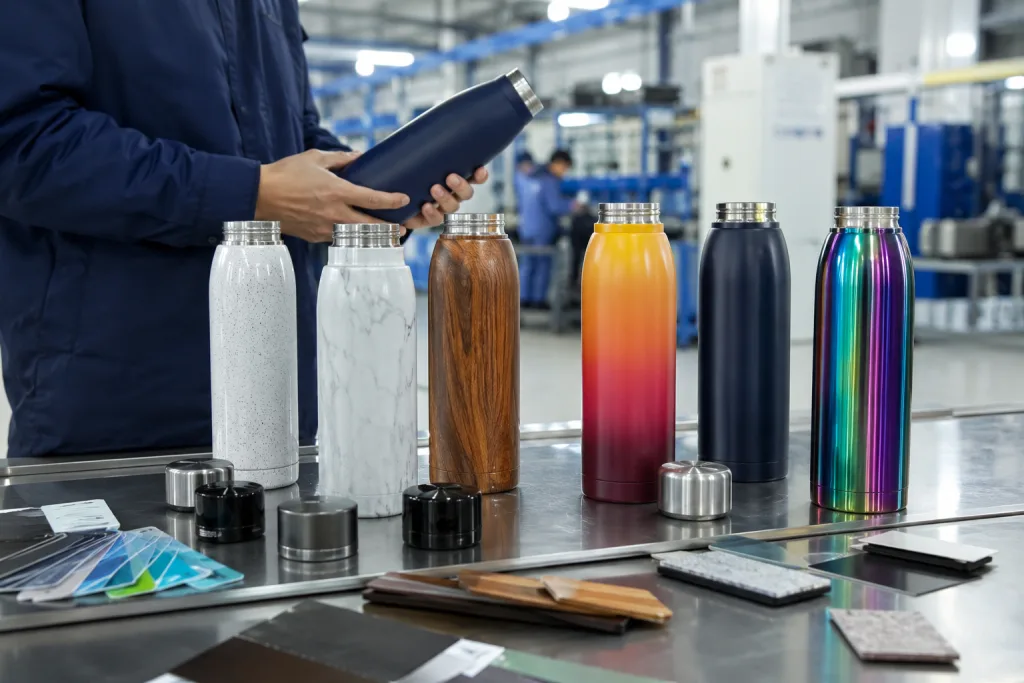
Your logo choice changes the unit price, wear life, sampling time, and reject rate. Laser engraving is the safest pick we run for stainless thermos custom orders. It costs about USD 0.08-0.20 per position on standard shapes, does not peel, and suits outdoor retailers asking for a clean premium finish. QC pulled 30 engraved samples last month after the buyer asked for a 42 mm logo on a tapered 500 ml body; the bottom edge looked 1.5 mm off because the bottle wall curved faster than the artwork file showed. Color is the catch. Laser shows the metal or the underlayer, so bright multi-color campaign artwork is the wrong job for it.
Silkscreen printing costs less for simple marks, often USD 0.06-0.15 per color per position, but the line needs clean surface prep and proper curing time. On powder-coated bottles, we run 3M tape pull and rub testing before packing; if the coating supplier changed powder batch, QC checks again. Heat-transfer printing and water-transfer printing cover larger wrap graphics, but expect USD 0.35-0.90 per unit and a higher reject pile on curved bodies. We have seen this go sideways when a buyer approved a straight wrap on paper, then flagged the seam gap after 600 pcs were printed. UV printing works for colorful promotional thermos orders, but test it on the selected coating, not a random sample from the showroom shelf.
Private label packaging is where buyers often miss the math. A plain white box may add USD 0.10-0.20. A printed retail box with 350 gsm paperboard can add USD 0.28-0.65 depending on size and finish. If you need barcode labels, FNSKU labels, hang tags, instruction sheets, or warning stickers for North America, put them in the first RFQ, not after the PI is signed. Last quarter we had a PO with “FNSU” typed instead of FNSKU; the carton team stopped 18 cartons at packing because the scanner could not read the label spec.
Do not approve decoration from a PDF only. Ask your thermos supplier for a pre-production sample with the exact coating, logo size, logo position, and packaging. A 2 mm logo shift looks small on screen and ugly on a 500 ml bottle. We check it with a caliper and a paper positioning jig on the line, because once the pad-print fixture is locked, changing it costs time and a new sample round.
Tooling And Custom Parts
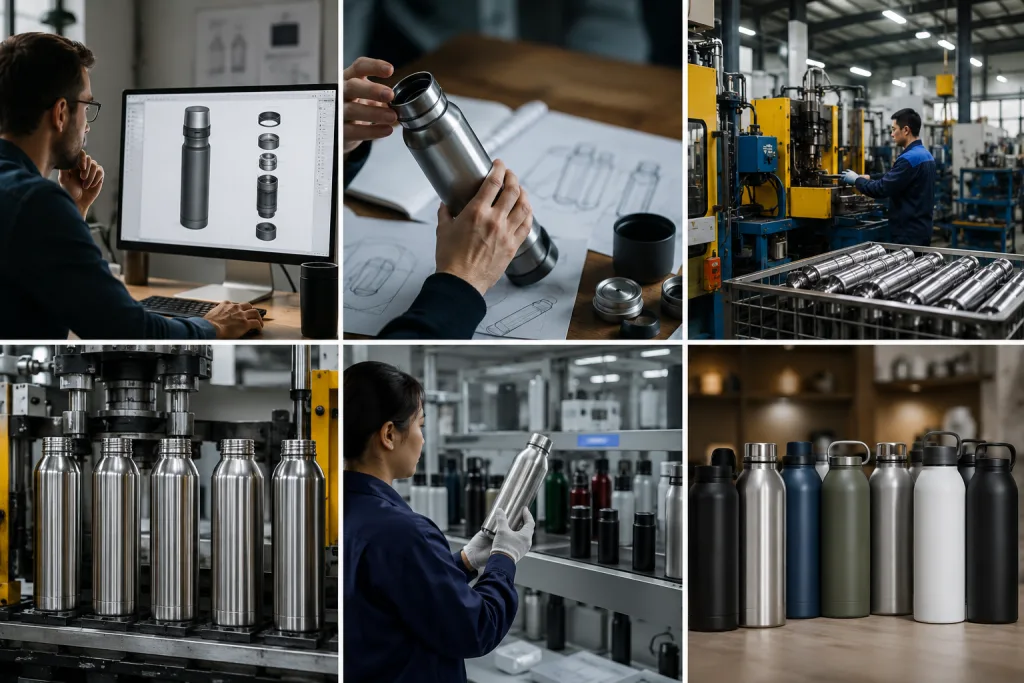
Most vacuum bottle private label projects should start with an existing mold. This is the right starting point. We can still make the bottle look owned through PMS color spraying, powder coat texture, lid choice, logo position, gift box structure, and add-ons like a silicone boot or tea strainer. Full new bottle-body tooling burns time and cash. For a stainless vacuum bottle, body mold and forming fixtures can run from USD 2,000-8,000 depending on geometry; our line also needs new neck gauges and a trial draw on the hydraulic press before we trust the shape. A new plastic lid mold can range from USD 3,000-12,000, especially if it includes a push-button mechanism, handle insert, or multiple sealing parts.
If you are building a retail outdoor line, custom tooling can make sense after the first production run proves sell-through, say 5,000 pieces shipped and reordered within 60 days. If you are buying thermos bulk for a promotion, use standard molds. The buyer who spends USD 7,000 on a lid mold for a one-time 2,000-unit event usually regrets it; we had one PO with the event date typed as 06/18 while the artwork said 06/08, and the math already did not work before that typo landed.
Small modifications are more practical. A custom silicone boot may require a mold around USD 600-1,500 and an MOQ near 3,000-5,000 pieces, with the boot ID checked by caliper so it grips the bottle body within about 0.3 mm. A custom color lid using an existing mold may need 2,000-3,000 pieces per color if the resin is not standard. A modified straw or gasket material can add 7-15 days because the cap assembly must pass leak testing again. QC pulled the sample last month for a slow drip at the vent hole after 30 minutes upside down.
For compliance, specify food-contact requirements before tooling starts. EU buyers should ask for LFGB or EU 1935/2004 food-contact testing where applicable, plus REACH for coating and plastic parts. US buyers may need FDA food-contact documentation and ASTM-related checks for children’s products if the bottle is marketed to kids. A good thermos manufacturers quote should list these items before mold deposit, not after T1 samples; we have seen this go sideways when a buyer approved a soft-touch coating first and asked for REACH only after the cartons were printed.
Lead Time By Project Stage
The cleanest schedule for a manufacturer thermos order is not the earliest date someone types in a quotation sheet. It is the date that still holds after logo file cleanup, sample sign-off, powder coating slots, QC, and the Ningbo vessel cutoff. For an existing stainless thermos model, we run 3-7 days for initial quote and artwork check, 7-12 days for a decorated sample, 2-4 days for buyer approval if your team answers fast, and 30-40 days for mass production after deposit and signed sample. The line needs confirmed AI artwork, Pantone code, and logo position in mm before the laser jig or screen plate gets booked.
Add 3-5 days for AQL inspection, rework buffer, and export carton handling. QC pulled one sample last month with a 1.8 mm logo shift, and that alone burned 2 days because the buyer wanted photos under daylight and lightbox. Sea freight from Ningbo or Shanghai to major North American or European ports can take roughly 25-40 days port-to-port, depending on route and season. Air freight works for urgent promotional brands, but the math doesn't work on most 750 ml stainless items because freight can exceed the bottle cost.
A realistic end-to-end China schedule is 45-60 days from confirmed artwork to FOB shipment for standard private label. If tooling is involved, add 20-45 days before production, including CNC mold work and a first-shot lid fit check. If the order includes four bottle colors, printed boxes, FNSKU labels, and mixed cartons for distributors thermos programs, add another 5-10 days for packing control. We ship these programs often, and mixed cartons go sideways when the PO says “blue lid” but the barcode file says “navy cap.”
The biggest delay is usually not factory production. It is unclear approvals. Buyers send 72 dpi logos, change Pantone codes after sampling, or ask for carton revisions after mass production starts. Lock the product spec sheet early: capacity, steel grade, lid type, coating, logo method, packaging, carton quantity, barcode, inspection standard, and incoterm. One signed spec sheet saves more time than 12 aggressive emails, and the buyer flagged fewer disputes when every carton mark and MOQ note sat in the same file.
How To Compare Supplier Quotes
Don’t sort thermos quotes by unit price first. That is the wrong question to ask. We put each offer into one sheet with capacity, actual fill volume, inner and outer steel grade, wall thickness in mm, vacuum performance, coating type, logo method, cap material, gasket material, packaging, carton count, FOB port, MOQ, sample charge, sample time, production lead time, and payment terms. Last month a buyer flagged a USD 4.10 quote against our USD 4.55 offer; the cheaper bottle used 201 outer steel, 0.38 mm body sheet, a thin white box, and paint that failed our 3M tape pull after 24 hours.
Vacuum performance needs a test condition, not sales talk. We run hot water at 95°C, then measure after 6 hours and 12 hours at room temperature with a probe thermometer. For a decent 500 ml bottle, water should stay above 60°C after 6 hours, but the number shifts with mouth diameter, lid design, and bottle size. Ask for the factory’s test method. “Keeps hot 24 hours” means little unless QC pulled the sample, recorded the starting temperature, and wrote down the room temperature on the test sheet.
Quality terms matter. For most bulk thermos shipments, AQL 2.5 for major defects and 4.0 for minor defects is a practical baseline. Critical defects such as leakage, rust, sharp edges, strong odor, and unsafe packaging should be zero tolerance. We’ve seen this go sideways when a PO says “standard inspection” and the buyer later expects retail-grade limits; write BSCI audit status, ISO 9001 process control, or retailer-specific restricted substance documents into the quote stage, before tooling, cartons, and barcode labels are booked.
A proper supplier thermos relationship should feel boring: stable samples, documented specs, honest lead times, and repeatable cartons. We ship from Zhejiang, China, and our line team checks carton drop marks, lid torque, and gasket fit before mass packing starts. BottleForge works with export buyers who prefer the real constraint on day one, like 12 days for a PP lid mold change versus 18 days after plating approval, instead of a nicer number that fails in week five.
Get a costed thermos quote before sampling
Send capacity, logo, packaging, MOQ, and delivery date. We will return a practical FOB China quote with lead-time risks clearly marked.
Frequently asked questions
What is the best MOQ for a first vacuum bottle private label order?
For most outdoor retailers, 1,000-3,000 units is the practical first MOQ if you use an existing mold. At 1,000 units, keep the finish simple: stock color, laser logo, and plain or stickered packaging. At 3,000 units, you can usually request a custom powder color, one-position logo, and printed carton or retail box with better unit economics. If you need custom caps, silicone boots, or multiple Pantone colors, plan for 5,000 units or more. A first order below 1,000 units is possible only with stock goods, but the cost per unit rises and private label control is weaker.
How much should a custom stainless thermos cost FOB China?
A normal 500 ml custom thermos using 304 inner stainless steel, powder coating, laser logo, and individual box usually falls around USD 3.20-4.60 FOB Ningbo at 3,000 units. A 750 ml or 1,000 ml outdoor bottle with handle lid, silicone base, printed box, and heavier wall can reach USD 5.20-8.50. Very cheap quotes below USD 3.00 often remove something: thinner steel, lower-grade outer wall, weaker coating, basic packaging, or loose inspection. Always compare the full specification, not just the price line.
Can I mix colors in one thermos bulk order?
Yes, but each color still creates setup work. A reasonable structure is 1,000 units per color for standard stock colors or laser engraving, and 2,000-3,000 units per color for custom powder coating. If your total order is 3,000 units split into three colors, many factories can handle it. If you want six colors at 500 units each, expect a surcharge or rejection because coating changeovers increase waste and line downtime. For distributor thermos programs, choose two or three core colors first, then expand after sell-through data.
How long does a private label thermos project take?
For an existing bottle mold, allow 45-60 days from confirmed artwork to FOB shipment. The usual breakdown is 7-12 days for a decorated sample, 2-4 days for approval, 30-40 days for mass production, and 3-5 days for inspection and export handling. New tooling adds 20-45 days before production starts. Sea freight is separate and may add 25-40 days to Europe or North America. If your campaign has a fixed event date, work backward from delivery, not from factory shipment.
What quality checks should I require from a thermos factory?
Use a written checklist. At minimum, require leak testing, vacuum heat-retention testing, coating adhesion testing, logo position check, cap torque or fit check, odor check, carton drop check, and visual inspection under AQL 2.5 major and 4.0 minor. For EU sales, ask about REACH and food-contact requirements such as LFGB or EU 1935/2004 where relevant. For US sales, request FDA food-contact documentation for materials. If the bottle is for children, add stricter safety checks for small parts, sharp edges, and applicable ASTM requirements.