Key Takeaways
- For custom thermos orders, 3,000 units is usually the practical MOQ for a new color with logo
- 304 stainless steel at 0.45-0.55 mm wall thickness suits most outdoor retail bottles
- Laser engraving is slower but cleaner than 1-color silkscreen on textured powder coating
- AQL 2.5/4.0 inspection and 24-hour leak testing reduce distributor thermos returns
If you are buying vacuum bottle online wholesale, the hard part is not finding a stainless thermos. The hard part is locking a spec that fits the retail shelf, promotion brief, freight budget, and the number of complaints your team can absorb. This is the wrong question to ask if the first line on your RFQ is only “best price.” A 500 ml commuter flask, a 750 ml outdoor bottle, and a 1 L expedition thermos can look close in a catalog, but the line sees the difference after we add 0.35 mm powder coating, laser logos, 300 gsm gift boxes, and a 1.2 m carton drop test.
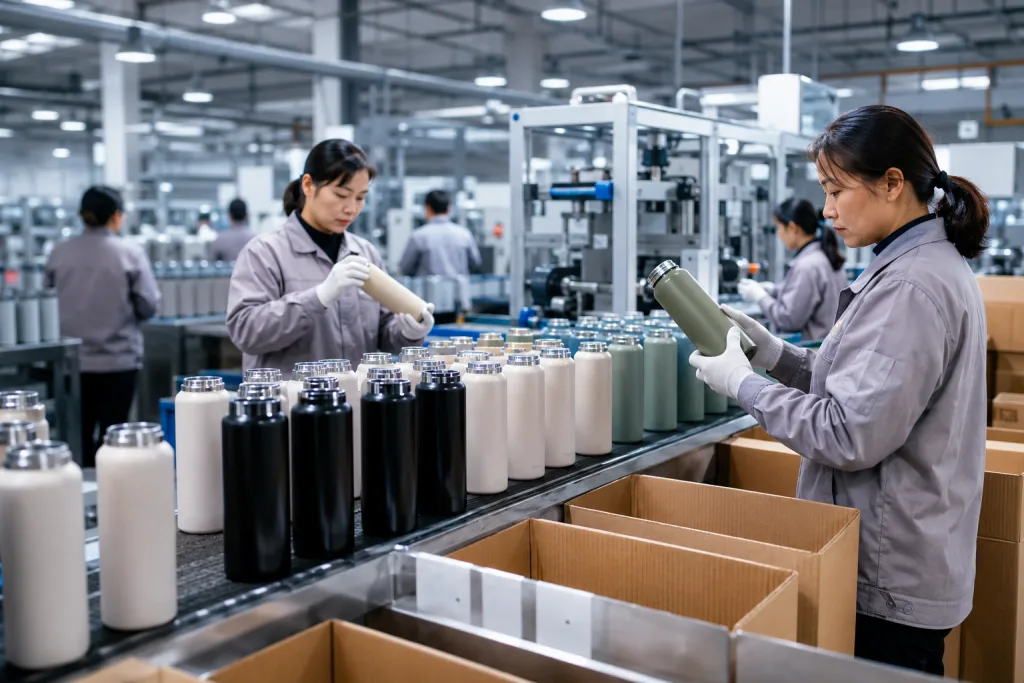
We manufacture stainless vacuum bottles in Hangzhou, Zhejiang, and we see the same mistake on about 6 RFQs out of 10: buyers compare only FOB price. For outdoor retailers and promotional brands, we run a cleaner comparison by checking wall thickness with a digital caliper, lid thread fit, coating cross-hatch result, MOQ, lead time, and the way the bottle will be used. Cheap drinkware is easy to quote. Stable programs are harder. Zhejiang factories can ship both, but the math does not work if the PO says “304 stainless” and the buyer flags lid leakage only after carton artwork is approved.
The spec table buyers actually need
Do not judge a vacuum bottle online wholesale quote by one studio photo and one unit price. Wrong question. Ask for a side-by-side spec table with capacity, lid type, coating, carton size, and test items, because the 500 ml bottle we run for a conference kit is not built like the 750 ml bottle QC drops on the 1.2 m rubber mat for outdoor retail. Below is the comparison we show new buyers before tooling or sampling starts.
| Spec option | Best use case | Typical MOQ | FOB China range | Risk to watch |
|---|---|---|---|---|
| 500 ml slim bottle | Commuter bag, corporate gift desk, light outdoor giveaway | 3,000 pcs | USD 3.20-4.60 | Logo area under 45 mm wide on some bodies; value can feel light in hand |
| 750 ml outdoor bottle | Hiking pack, camping shop, retail shelf with hangtag | 3,000 pcs | USD 4.40-6.30 | Paint chips show up fast if powder coating thickness is cut below spec |
| 1,000 ml thermos | Fishing, worksite, expedition team, club merchandise with larger print | 2,000-3,000 pcs | USD 5.80-8.50 | Cartons get heavy; freight math changes by carton CBM and gross kg |
| Wide-mouth food thermos | Outdoor meals, kids lunch, winter promotion packs | 3,000 pcs | USD 4.80-7.20 | Lid sealing, silicone ring fit, and odor after hot soup testing |
These are working wholesale ranges, not magic numbers. A thermos factory in China can quote lower with thinner steel, shared color stock, a basic PP lid, and no individual drop test. That can pass for a short promo run. The math does not work if your outdoor retailer expects repeat seasonal orders and a return rate under 1.5%; we have seen this go sideways when the buyer flagged 37 chipped bottles during incoming inspection.
At BottleForge Industrial in Zhejiang, our normal stainless thermos capacity is about 600,000 units per month across bottle, tumbler, and food jar lines. We run standard lead time at 30-40 days after approved pre-production sample and deposit, assuming the PO artwork file name matches the dieline and the barcode is scannable on our Zebra reader. For a custom thermos with private color, molded lid, retail box, and barcode labeling, plan closer to 45-55 days.
500 ml versus 750 ml retail fit
The 500 ml and 750 ml sizes fight for the same shelf space, but they do not sell the same job. A 500 ml customized thermos ships cleaner: on our line, a standard 500 ml bottle with color box usually runs 24 pcs per master carton at about 13.5-15 kg gross weight. It is easier to quote for office desks and school campaigns, and most car cup holders accept the base without buyer complaints. For a thermos promotional campaign where the bottle sits inside a gift set with a notebook or tea pack, 500 ml usually wins. The math is simple.
The 750 ml bottle fits outdoor retailers better. It has more hand weight, a wider logo panel, and a stronger look in lifestyle photos beside a backpack or bike frame. If your brand sells camping kits, cycling accessories, fishing gear, or trail products, a 750 ml stainless bottle has enough capacity to support a higher retail price. We usually recommend 304 stainless steel inner and outer walls, 0.45-0.55 mm body thickness, and powder coating checked by cross-hatch adhesion plus a 3M tape pull; QC pulled 32 samples last month and flagged 2 lids for loose silicone rings before packing.
Here is the trade-off we see on real quotes: a 500 ml factory thermos may save USD 0.70-1.20 per unit versus a 750 ml version, while the retail value gap can be USD 5-8. For distributors thermos programs, that spread matters. Freight changes too. A 500 ml bottle often packs 24 pcs per master carton; a 750 ml bottle often packs 12 or 24 depending on gift box thickness. If Amazon FBA or retailer DC compliance is involved, carton gross weight should stay under 15-18 kg where possible; one buyer pushed for 28 pcs per carton, and the carton failed our drop test at the bottom corner.
If you are unsure, ask your thermos supplier for both samples in the same coating and logo method. We have seen 6 buyers approve size from a PDF, then change after holding the sample. A 750 ml bottle that looks premium online can feel too large for a corporate giveaway, especially with a 68 mm base and full gift box. A 500 ml bottle that looks efficient on a quote sheet can look small beside outdoor gear. Size charts do not close this decision; hands do.
Lid design changes the product
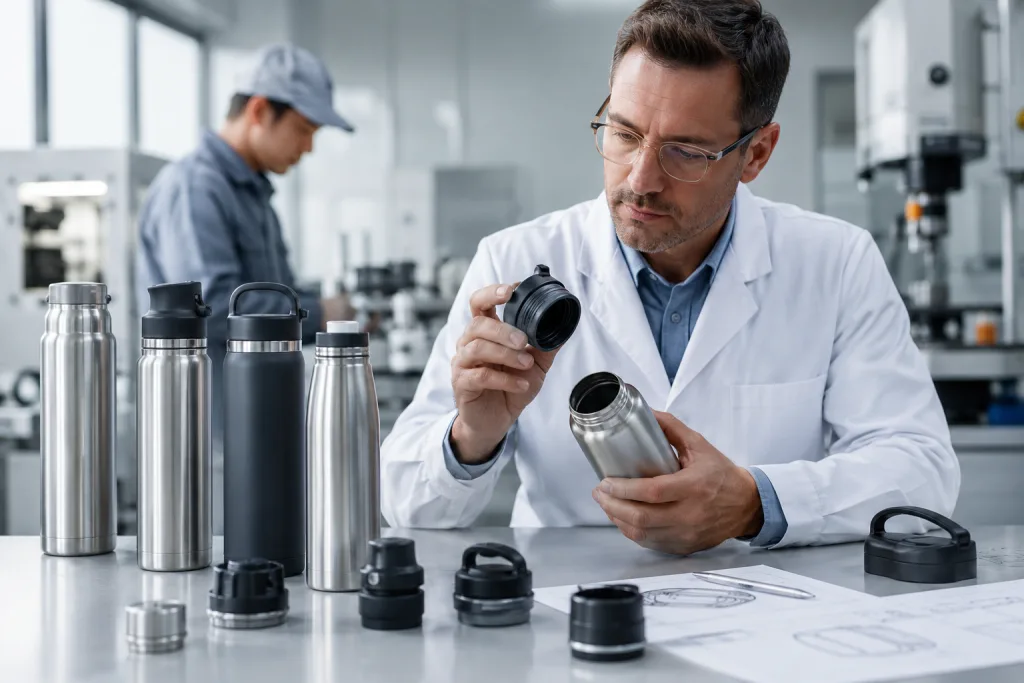
The lid is where 6 out of 10 wholesale thermos problems start: leaks, stuck buttons, loose handles, or a gasket that goes missing after the first wash. The stainless body is the easy part; our 0.4 mm body wall and vacuum station readings are predictable once the tooling is stable. A lid has silicone gaskets, threads, hinge pins, sip slots, carry handles, and sometimes a spring-loaded button. Treat it as its own engineering item, not a trim piece.
- Screw cap: lowest failure rate and strongest leak resistance; we run these for hiking sets, jobsite bottles, and 500 ml corporate gift orders where returns hurt the margin.
- Push-button lid: good for commuters, but QC needs to pull the spring action and silicone seal after assembly, not just check the outside.
- Straw lid: fits sports bottle positioning; do not use it for hot liquid unless the carton, manual, and product page say so clearly.
- Handle lid: gives a tougher outdoor look, but the mold parting line, pin fit, and 8 kg hanging test matter.
For hot-liquid vacuum bottles, we push buyers toward screw caps or simple pour-through stoppers. Less sexy in the render. Better in the field. A push-button distributor thermos can work, but only when the supplier thermos program includes leak testing after assembly, not a quick visual pass on the packing table. Our standard QC includes 100% vacuum check for insulated bodies, 100% lid fit check, and AQL final inspection. For most export orders we use AQL 2.5 for major defects and 4.0 for minor defects; last month QC pulled 32 samples from a 3,000 pcs lot and found 2 lids with slow seepage after the inverted 30-minute test.
Ask your thermos manufacturer for gasket material details before artwork approval. Food-grade silicone is standard, but buyers should still request LFGB or FDA food-contact documentation depending on market. For Europe, REACH compliance on coatings and packaging inks may also be requested. For the United States, some promotional brands ask for California Proposition 65 screening. These papers are not decoration; they protect your account when a retailer or corporate client asks for compliance files two weeks before shipment. We have seen this go sideways when a PO typed “FDA lid” but the approved sample used a no-name gasket from a backup supplier.
Logo methods head to head
A custom thermos order lives or dies on decoration. The bottle body can pass vacuum testing and still look cheap if the logo is fuzzy, off-center, or sitting on the wrong coating. We match the logo process to coating type, order quantity, brand position, and where the bottle will be used. On our line, QC checks logo position with a 0.5 mm ruler from the bottle base; if the buyer’s PO only says “logo on front,” that is already a risk.
| Method | Best surface | Typical cost | MOQ impact | Durability |
|---|---|---|---|---|
| Laser engraving | Powder coating, stainless steel | USD 0.12-0.35 | Low | Excellent, permanent mark |
| 1-color silkscreen | Smooth paint, glossy coating | USD 0.08-0.18 | Low | Good if cured properly |
| Heat transfer | Full-color retail graphics | USD 0.35-0.80 | Medium | Good, edge quality varies |
| Water transfer | Patterned outdoor designs | USD 0.70-1.50 | Higher | Good with clear coat |
Laser engraving is usually the safest choice for outdoor brands. It cuts through the powder coat and shows the stainless base or underlayer, so the mark will not peel after 300 dishwasher-style rubs in our alcohol cloth test. Clean and permanent. It is the wrong choice for a 6-color badge or gradient logo because the result is normally single tone. Silkscreen costs less and runs faster for simple logos, but it fights rough powder texture and tight curves; last month QC pulled the sample because the left edge of a 42 mm logo broke on a tapered 500 ml bottle.
For a promotional thermos order, speed can beat perfection. If you need 5,000 pcs for a trade show in 35 days, a stock color bottle with laser logo is realistic; we can usually sample in 3 days and hold bulk packing to 12 days if cartons are standard. If you want full-wrap mountain artwork, molded retail packaging, and individual FNSKU labels, the math does not work on the same clock. Plan 18 days or more before vessel booking. We ask for vector artwork, Pantone references, logo size in millimeters, and placement measured from the bottle base. “Make it like the mockup” is not a production instruction; we have seen this go sideways when the PO said 60 mm wide but the JPG showed 75 mm.
Insulation claims need proof
Online wholesale listings often say 12 hours hot and 24 hours cold. We see that claim on at least 7 different grades of bottles, which already tells you something. Some pass. Some are copied from a stronger SKU with a narrower mouth and a better stopper. If you are buying a manufacturer thermos for retail, ask for the test sheet, not just the sales line. The result changes with starting water temperature, room temperature, lid type, fill volume, and whether the cap is opened during the test; last month QC pulled the sample after 6 hours and found the buyer’s “12H hot” artwork did not match the 58.4°C reading on our digital probe.
A practical benchmark for a 750 ml double-wall stainless vacuum bottle is hot water above 60°C after 6 hours when filled with 95°C water and kept at 20°C ambient temperature. That is the number we run on the line before we talk about fancy claims. Better bottles hold useful heat past that point, especially with narrow mouths and thicker stopper structures measured around 18–22 mm at the plug. Wide-mouth food jars lose heat faster because the opening is larger. Not a defect. The claim has to match the geometry, or the math doesn’t work.
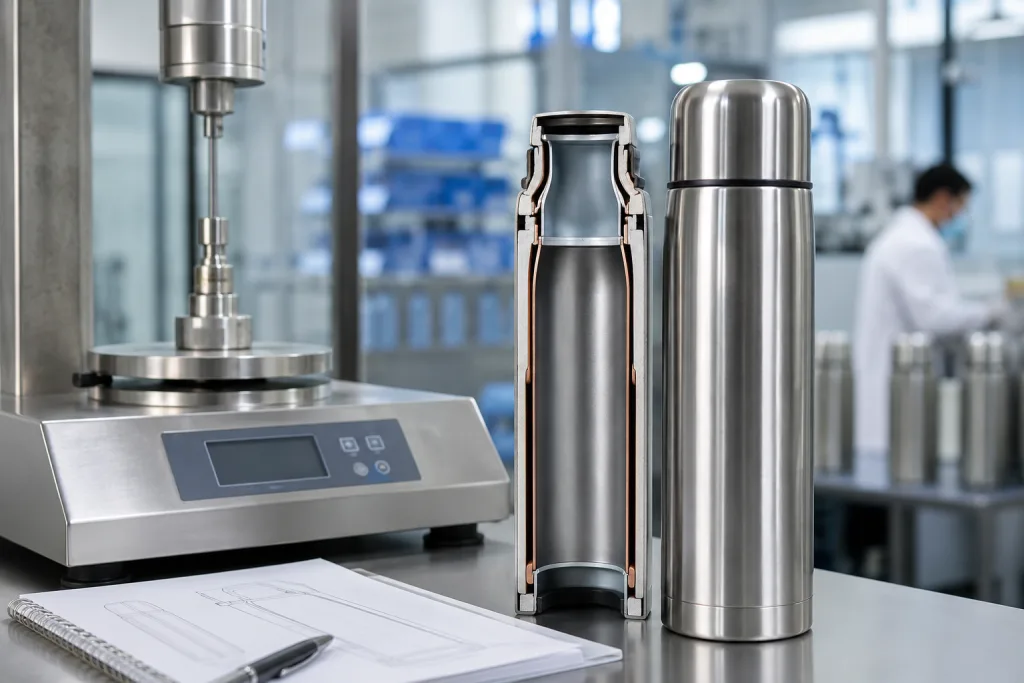
The vacuum process matters too. A strong thermos factory uses copper plating or another reflective treatment on the inner wall, vacuum pumping, high-temperature sealing, and then vacuum performance sorting. Cheap bottles often fail after rough transport or repeated lid stress, not on day one. We’ve seen this go sideways: a carton looked clean at loading, then 3 bottles out of 48 showed weak insulation after a bumpy truck leg from Yiwu to Ningbo. That is why carton testing matters. We recommend 5-layer export cartons, individual polybag or tissue protection, egg-crate or box packing where needed, and a 76 cm drop test on full cartons for retail shipments.
For outdoor retailers, do not oversell. “Keeps drinks hot up to 12 hours under standard lab conditions” is a claim your customer has a fair chance to repeat. A loud 36-hour promise usually turns into email trouble, especially when the buyer tests it in a cold warehouse with the lid opened twice. For promotional brands, the insulation claim often sits behind leak resistance, logo clarity, and delivery date; on one PO the buyer even flagged a 1 mm logo shift before asking about temperature. Match the claim to the channel.
Wholesale pricing without blind spots
FOB unit price is only one line on a vacuum bottle online wholesale cost sheet. You still pay for sampling, molds if needed, logo setup, cartons, packaging, inspection, freight, duty, and retailer compliance labels. We had one buyer flag a quote that was USD 0.40 lower, then the packing list showed no inner box, no FNSKU label, and a 5-ply carton upgrade charged later. The math did not work.
For a standard 750 ml customized thermos, a proper landed-cost review should show the bottle, decoration, color coating, retail box, master carton, barcode or FNSKU label, spare parts if required, and third-party inspection. Sampling is usually USD 80-200 per style for existing molds with custom logo. New lid or body tooling can range from USD 1,500 to USD 8,000 depending on complexity. If a supplier thermos quote says “mold fee TBD,” do not approve artwork yet; we have seen this go sideways when the PO says matte black but the approved sample was measured at 0.18 mm coating thickness and the tooling cost came 12 days later.
MOQ is where buyers get pulled off track. Some thermos suppliers advertise 100 pcs custom orders. That can work for laser marking stock inventory, using a fiber laser on plain 304 stainless bottles, but it is not the same as a production run with your own Pantone color and carton drop-test requirement. For stable pricing, our usual MOQ is 3,000 pcs per color for stainless vacuum bottles. Mixed-color orders may work if the colors are already on the line, but private colors need coating line setup and material control; QC pulled 32 samples from one small mixed-color order last quarter because the beige shade drifted between batches.
Payment terms also affect risk. Common terms from China are 30% deposit and 70% balance before shipment, with FOB Ningbo or Shanghai for Zhejiang factories. Larger distributors thermos accounts may negotiate different terms after 3 or 4 clean shipments. For a new relationship, chasing softer terms is the wrong question to ask. Lock the specification sheet, approved sample, inspection criteria, and shipment schedule first, because one typo on a PO, such as “750 ml” in the title and “700 ml” in the packing notes, can stop the line for half a day.
Which thermos fits your channel
The best thermos manufacturer is not the one with 80 shapes in the catalog. It is the one that stops you from buying the wrong bottle. Outdoor retailers need a thicker shell, coating that passes a 3M tape pull, retail packaging that does not crush at the corners, and performance claims we can back with test data. Promotional brands care more about lead time, logo position within 1 mm, workable MOQ flexibility, and sample approval that does not drag from 5 days to 12 days. We see this go sideways when the buyer asks for “the premium model” before checking the selling channel.
If you sell through outdoor retail, start with a 750 ml or 1,000 ml thermos bulk program in two colors, maybe three if your forecast is solid. We run powder coating for this channel, then QC pulls the sample for cross-cut testing before packing. Laser engraving or a small woven hangtag keeps the look clean, and the retail box should handle a 12 kg master carton stacked in a warehouse. Ask for BSCI or Sedex audit status if your retailer requires social compliance. Ask for REACH and food-contact documentation before the deposit, not when the goods are already on the line.
If you sell promotional drinkware, start with a stock 500 ml or 750 ml bottle and keep the decoration simple. A laser logo on black, white, navy, or army green coating is safer than custom full-wrap artwork, because registration drift of 2 mm looks ugly on a cylinder. Fixed event date? Don’t gamble. We had one PO where the buyer typed the delivery week wrong, and the whole thermos promotional order became a freight argument instead of a product order. A bottle delivered five days late has almost no value, even if the finish looks perfect.
For distributors, the best program is often modular: one body, two lid options, three colors, with decoration choices tied to real MOQ breaks. That gives you range without creating ten SKUs that all need separate forecasting. The math does not work if every customer gets a special lid, special PMS color, and special carton mark. A good thermos supplier in Zhejiang, China should show production photos from the line, carton specs in mm, inspection reports under AQL 2.5, and lead times that match the current workshop load before you issue the purchase order.
Send your thermos spec and target price
We will compare bottle size, lid, logo method, MOQ, and FOB cost before you approve samples.
Frequently asked questions
What MOQ should I expect for a custom stainless thermos order?
For real production, expect 3,000 pcs per color for a custom thermos with Pantone coating, logo, and retail packaging. Smaller quantities such as 300-500 pcs are usually stock bottles with laser engraving, not a fully customized thermos program. If you need mixed colors, ask whether those colors are already running in the factory. New powder coating colors require line setup, paint matching, and QC checks, so the cost per unit rises sharply below 3,000 pcs.
How long does vacuum bottle online wholesale production take?
For existing stainless thermos molds, normal production is 30-40 days after deposit and approved pre-production sample. Add 5-10 days for sample making and approval if your artwork is ready. A new lid mold, full-wrap artwork, or custom gift box can push the schedule to 45-55 days. Sea freight to North America or Europe can add 25-40 days depending on port and season, so plan backward from your retail launch or event date.
Is laser engraving better than silkscreen for outdoor thermos bottles?
For powder-coated outdoor bottles, laser engraving is usually better because it is permanent and does not peel. Typical cost is USD 0.12-0.35 per unit depending on logo size and speed. Silkscreen can be cheaper at USD 0.08-0.18 per unit and works well on smooth coatings, but it is weaker on rough textures and large curved artwork. For a distributor thermos program, laser is often the safer default unless your brand requires exact Pantone logo colors.
What stainless steel grade should a thermos supplier use?
Most export vacuum bottles use 304 stainless steel for the inner wall because it has good corrosion resistance for coffee, tea, and sports drinks. Some suppliers use 201 stainless steel on the outer wall to reduce cost, but 304 outer is better for premium retail and humid outdoor use. Ask for material declaration and food-contact testing. For Europe, request LFGB or relevant EU food-contact documents; for the US, FDA food-contact compliance is commonly requested.
How do I compare FOB quotes from different thermos manufacturers?
Compare the same specification line by line: capacity, steel grade, wall thickness, lid type, coating, logo method, packaging, carton quantity, inspection level, and lead time. A USD 4.80 quote and a USD 5.30 quote may not be the same bottle. Ask whether the price includes retail box, barcode labels, logo setup, and AQL inspection support. Also confirm FOB port, usually Ningbo or Shanghai for Zhejiang suppliers, because inland freight can change the final cost.