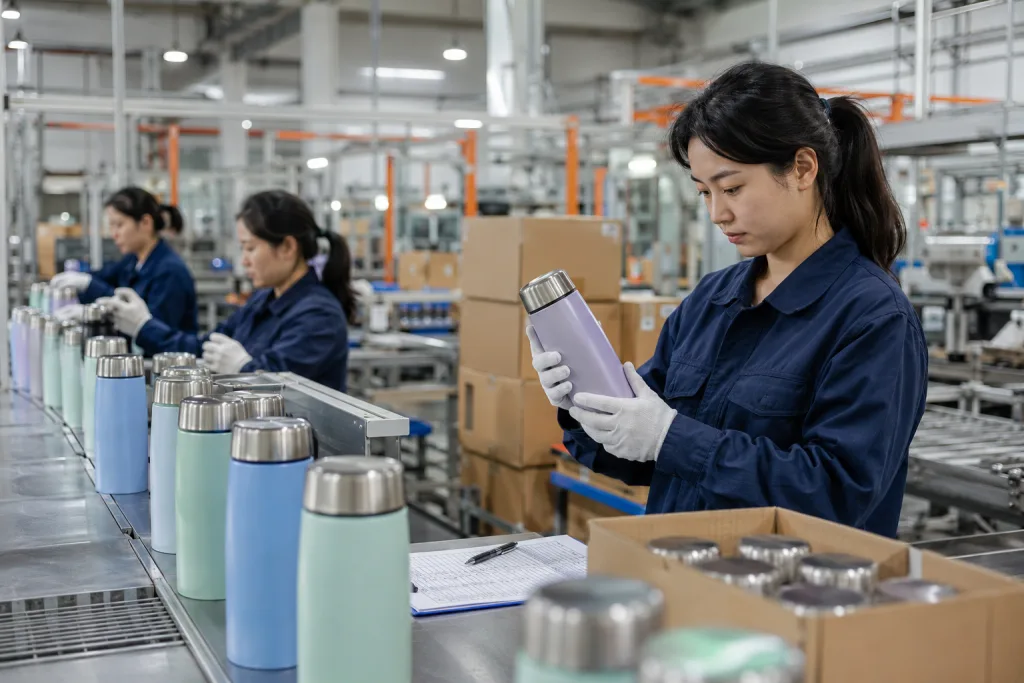
Key Takeaways
- Start with 304 or 316 stainless, 0.4-0.5 mm inner wall, and 0.5-0.6 mm outer wall before discussing price
- A realistic MOQ is 1,000 pcs per color for stocked shapes and 3,000-5,000 pcs for private mold changes
- Expect 25-35 days production after sample approval, plus 7-10 days for pre-production sampling
- Use AQL 2.5/4.0 inspection and request vacuum decay or temperature retention testing by batch
Buying a custom stainless thermos is easy. Buying 5,000 pieces that ship on the booked vessel, pass AQL 2.5, hold heat for the claimed hours, and still look clean under 4,000K retail lighting is where projects get messy. We have seen QC pull 32 samples from a run because the laser logo sat 1.5 mm off-center; the buyer flagged it before cartons left Hangzhou.
As a vacuum bottle oem manufacturer in Zhejiang, China, we see the same choices repeat on almost every RFQ. Pick the bottle structure, decoration method, packaging route, and inspection standard before asking for a final FOB price; otherwise, the math doesn't work. Last month one PO called for powder coating in the email and spray painting in the attachment, so three thermos suppliers quoted three different costs and lead times.
Decide The Bottle Architecture First
Start with the bottle architecture, not the logo position. On our line, a stainless vacuum thermos is built from the inner liner, outer shell, vacuum gap, base weld, lid seal, stopper flow, coating, and carton packing. One weak point is enough. QC pulled a 750 ml sample last month with a clean logo but a 0.3 mm wobble at the base weld, and that is the kind of thing that turns a bulk thermos order into after-sales emails.
For most outdoor retail programs, 304 stainless steel is still the practical baseline. It is food-safe, welds cleanly on the laser seam welder, and keeps the FOB number where buyers expect it. 316 stainless steel fits marine shops, salt-air markets, or premium outdoor ranges, but it can add USD 0.35-0.80 per unit depending on capacity and order quantity. We’ve seen this go sideways when a buyer pays for 316, then the sales team cannot explain the upgrade on the shelf tag.
Wall thickness gets ignored too often. A common 500 ml manufacturer thermos uses a 0.4 mm inner wall and 0.5 mm outer wall. For rugged outdoor lines, we often recommend 0.5 mm inner and 0.6 mm outer, especially for 750 ml and 1,000 ml bottles. The math is simple: fewer dents in drop checks, a bit more weight, and a higher FOB price. During one 1,000 ml trial run, the buyer flagged 18 g extra weight, but accepted it after the 80 cm carton-drop sample came back without a side dent.
The lid needs the same hard look. A push-button lid looks convenient, but it brings springs, pins, and more places for leakage. A screw cap with silicone gasket is less flashy, but our QC team can pressure-test it faster with a 30 kPa leak tester, replace the gasket easily, and ship spare parts with the order. For distributor thermos programs that may sit in a warehouse for 6 months, reliability beats novelty unless the lid has already survived field use.
Ask your vacuum bottle oem manufacturer for cutaway photos, liner grade, gasket material, and temperature test conditions. Do not accept “keeps hot 12 hours” as a standalone claim. The test should start with 95°C water, check at 6 and 12 hours, and use a room temperature of about 20°C. We run that with a calibrated probe thermometer; once, QC found a PO typo calling for 85°C start water, which made the lab result look better than the real retail-use condition.
Match MOQ To Your Sales Channel
The second decision is quantity structure. MOQ is not a factory rule on a price sheet. It drives color consistency, unit cost, carton fill, inspection hours, and cash tied up in stock. We can run small lots in Zhejiang, yes, but the math usually breaks below 1,000 pcs because the line still needs jigs, cartons, logo films, and QC time. Last month QC pulled 80 pcs from a 900 pcs trial order, and the buyer still paid nearly the same inspection charge as a 2,000 pcs run.
For existing BottleForge stainless thermos bodies in Zhejiang, a normal MOQ is 1,000 pcs per color with logo decoration. If you need a custom powder-coat color, 1,500-2,000 pcs is more realistic because the coating booth needs setup time and color purge. The operator will not clean a spray gun, swap powder, and recheck gloss at 60° for a 300 pcs color unless someone pays for the lost line time. For a new lid, changed diameter, or private mold body, plan for 3,000-5,000 pcs and tooling from USD 800 to USD 4,500 depending on complexity.
Promotional thermos buyers often ask for 500 pcs split across 5 logo versions. We can do it only when the body color is standard and the logo is simple laser engraving or pad printing. Small splits go sideways when every version needs a separate PO line, barcode sticker, and carton mark. One buyer once flagged a 0.5 mm logo shift on only 100 pcs, and the rework cost more than the logo charge. Outdoor retailers should plan cleaner SKUs: one capacity, two colors, one lid, retail packaging, and a reorder date.
Use this simple check before asking for a thermos bulk quotation:
- Market test: 1,000-2,000 pcs, standard body, standard color, laser or silkscreen logo. We run this fastest when artwork is AI or PDF, not a blurred JPG copied from a catalog.
- Retail launch: 3,000-6,000 pcs, two colors, custom packaging, AQL inspection. The buyer should lock the color box dieline before sampling, because a 2 mm barcode shift can delay packing.
- Owned product line: 10,000 pcs and above, private color, adjusted lid, spare gasket set, retail carton. At this volume, we check gasket fit with a go/no-go gauge before the lid goes to assembly.
Our Hangzhou-area production partners can support about 450,000 stainless drinkware units per month across thermos, tumbler, and sports bottle lines. That capacity helps when a thermos distributor needs a reorder in 30 days, but the first order still needs clean specifications. Big capacity does not fix unclear artwork, late packaging files, or Pantone changes after sampling. We ship faster when the PO says “Pantone Black 6C” instead of “same as last time.”
Choose Decoration Without Guesswork
The third decision is branding. We usually narrow it to 4 decoration routes after we see the channel: retail shelf, corporate gift, outdoor brand, or low-budget promo. Pick the wrong one and the bottle feels cheap, even when the 304 stainless body is solid. We’ve seen this go sideways: one buyer asked for full-color art on a rough powder coat, then flagged the fuzzy logo edge during AQL 2.5 inspection.
Laser engraving is the safe choice for outdoor brands. It holds up, looks clean, and runs well on powder-coated stainless steel. The catch is color. The logo normally cuts down to stainless steel or the base layer, so it will not match full-color artwork from an AI file. For a 1,000 pc order, laser setup cost is usually low, and per-unit cost can be around USD 0.08-0.18 depending on logo size. On our line, QC checks the first 20 pcs with a 10x loupe because a weak laser pass leaves smoky edges around small 1.5 mm letters.
Silkscreen printing fits one- or two-color logos on flat or gently curved print areas. It gives stronger brand color than laser, but it can scratch if the coating, ink, or curing is off. For a thermos promotional campaign, silkscreen is often the best balance. For hard outdoor use, run a 3M tape pull test and abrasion check before mass production. Small detail, big trouble: we had a PO typo call for Pantone 186C instead of 185C, and the buyer caught the red shift only after QC pulled the sample under the light box.
Heat transfer and full-wrap graphics look good for retail gift sets, but they bring more risk. Alignment, edge lifting, and color variation need tight control. If you need a customized thermos with all-over artwork, approve a physical pre-production sample, not only a digital mockup. A digital rendering hides seam problems. We measure the wrap seam in mm with a caliper; once it drifts past 1.0 mm, the shelf look drops fast.
Powder coating is now standard for better customizable thermos programs. A good coating should pass cross-hatch adhesion testing and survive normal dishwasher-like exposure, although many brands still label vacuum bottles as hand-wash only to cut complaints. Matte finishes sell well, but they show oil marks and scratches faster than semi-gloss finishes. If your customers are hikers, guides, or field crews, a slightly textured powder coat beats soft-touch. The math doesn’t work on soft-touch for rough use; after 300 pcs in carton rub testing, QC often finds shiny rub spots near the shoulder and bottom ring.
Price The Thermos Like A Factory
A factory-grade quote from a vacuum bottle oem manufacturer should never be one loose number. It should show capacity, steel grade, wall thickness, lid type, coating, decoration, packaging, MOQ, carton quantity, lead time, payment terms, and Incoterm. If those lines are missing, the comparison is already bent. Last month we saw a PO list “500ml tumbler” but no lid drawing number; QC pulled the sample and found the supplier priced a flip lid instead of the buyer’s push-button lid.
For reference, a 500 ml stainless vacuum bottle with 304 inner and outer steel, powder coating, laser logo, and simple white box may sit around USD 3.20-4.60 FOB Ningbo or Shanghai at 3,000 pcs, depending on lid and finish. A 750 ml outdoor-style factory thermos with thicker wall, carry handle lid, and retail color box may run USD 4.80-7.20 FOB. Use these as buying ranges, not promises. On our line, a 500 ml body often runs about 0.45 mm inner wall and 0.50 mm outer wall; changing that by 0.05 mm can move the quote by several cents before anyone talks about logo work.
The main cost drivers are not mysterious. Steel grade and finished weight set the material base. Lid complexity adds mold cost, silicone gasket checks, and assembly time at the torque tester. Powder coating changes defect rate and line speed; black matte hides less than buyers think, and we have seen 6% pulled for pinholes under a 6500K inspection lamp. Retail packaging raises unit cost and carton CBM. Decoration adds setup and rejection risk. A cheap thermos vendor may quote low by using thinner steel or soft gaskets. The math does not work forever; the problem usually shows up in a 1.2 m drop test or after 30 customer returns.
Ask for the net weight and gross weight. A 500 ml bottle that is 40 g lighter than comparable samples probably saves cost somewhere. Fine for a giveaway. Wrong for a premium outdoor shelf product. Also ask whether the price includes individual polybag, silica gel, instruction leaflet, barcode label, or FNSKU if you sell through fulfillment channels. We once had a buyer flag a USD 0.09 gap; the “cheaper” quote left out the 70 x 30 mm barcode sticker and inner carton, so the saving disappeared before shipment.
FOB terms are cleaner for most importers. EXW can look cheaper, but then you handle inland trucking, export clearance, and coordination. For new buyers sourcing from China, FOB Ningbo or FOB Shanghai keeps responsibility clearer. We ship from Hangzhou often, and the truck to Ningbo port is usually 2.5-3.5 hours; if export documents miss one HS code digit, that cheap EXW quote can cost you a lost sailing.
Lock Compliance Before Production
The fourth decision is compliance. For Europe and North America, stainless drinkware is not treated like a cheap giveaway. It touches food, sits in backpacks, and sometimes ends up in a child’s hand if the shape or artwork looks youth-focused. A thermos manufacturer should map the test route before asking for your deposit. We run this check from the BOM: 304 stainless body, PP lid, silicone gasket, powder coating, carton ink.
For the EU, ask about LFGB or EU food contact testing, REACH for restricted substances, and packaging rules where they apply. For the US, FDA food contact expectations apply, and 7 out of 10 retail buyers we quote also ask for California Proposition 65 screening. For kids or youth products, ASTM or CPSIA-related checks may be needed based on design and age grading. A normal adult stainless thermos does not automatically need every children’s standard. Be honest about the user. Last month QC pulled a lid sample with a cartoon bear print, and the buyer flagged it as “youth style” even though the PO said adult travel bottle.
Factory social compliance can carry the same weight as product testing. Outdoor retailers and promotional groups often ask for BSCI, Sedex, ISO 9001, or audit files before they release a 3,000 pcs trial order. Not every thermos supplier controls every process in one building. Stainless forming, laser welding, polishing, powder coating, silk-screen printing, and packaging can involve 4 or 5 workshops around Zhejiang or nearby provinces in China. That is normal. The exporter still has to control the chain, including the coating shop’s batch card and the packing line’s metal detector log.
Do not wait until final inspection to ask for certificates. Confirm test reports at the quotation stage, then decide whether existing reports match your SKU or your order needs batch-specific testing. Batch testing adds cost and time: we usually plan 7 working days for sample submission and 5 to 9 more days for the lab report, depending on the item. For retail launch orders above 5,000 pcs, the math works. We have seen this go sideways when a buyer saved USD 180 on testing, then lost 12 days because the gasket material on the report did not match the mass production gasket.
Compliance documents should match the material, coating, gasket, and lid actually used in your order. A report for a different bottle is only a conversation starter.
For packaging, check country of origin marking, recycling symbols, warning statements, and importer information. Small artwork mistakes can delay customs or trigger retailer chargebacks. One carton PO came to us with “Made in Chian” in the side-mark file; the line caught it during pre-production artwork check, not at the port. Catch it early.
Control Samples And Inspection
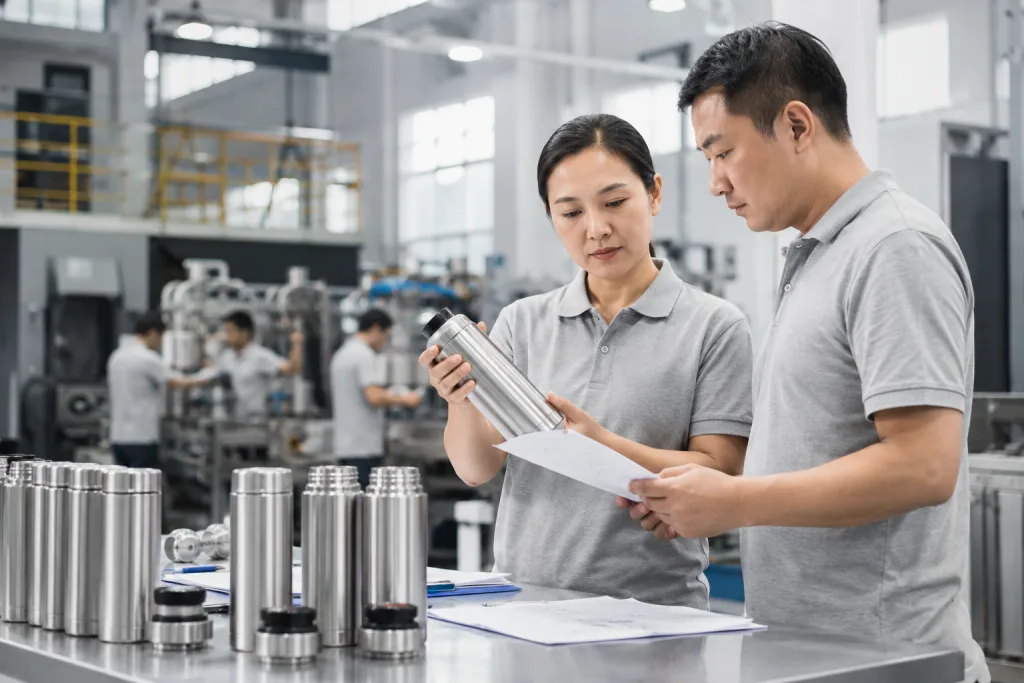
Sampling is where disciplined buyers save money. For a thermos custom project, we run 3 sample stages if the calendar allows: a reference sample to lock the bottle body and lid choice, a logo sample to check the artwork on the curved shell, and a pre-production sample pulled from the same line planned for the order. Skipping samples because the event date is 18 days away instead of 30 looks fast on paper. We have seen this go sideways when QC pulled the first carton and found the logo 4 mm lower than the approved PDF.
A reference sample confirms size, lid, drinking comfort, hand feel, and insulation performance. A logo sample checks decoration size, print position, and finish under normal light, not just in a showroom photo. A pre-production sample confirms the actual material, Pantone color, retail box, barcode, carton marks, instruction sheet, and spare gasket if included. For a customized thermos retail order, sign off the pre-production sample before coating all shells. Once 8,000 powder-coated bodies come off the line, the math does not work.
Use measurable inspection criteria. Common AQL levels are 2.5 for major defects and 4.0 for minor defects. Critical defects should be zero. Major defects include leaking, failed vacuum, sharp rim edges, wrong logo, cracked lid, coating peel larger than 3 mm, or a retail box packed into the wrong master carton. Minor defects include small specks, slight color variation inside the approved tolerance, or tiny cosmetic marks outside the main display area. On one PO, the buyer typed “mat black” instead of “matt black,” so we now check color wording against the signed sample before mass packing.
For vacuum performance, ask the supplier thermos team how they test. Typical checks cover hot water temperature retention and leak testing, then a separate vacuum failure check. Some factories use a saltwater or condensation method; others use equipment-based vacuum testing with a vacuum detector at the inspection bench. For a 500 ml bottle, a practical retention target might be water above 60°C after 6 hours when starting near 95°C at 20°C room temperature. Higher claims need verified test data, not marketing copy. This is the wrong place to accept “keeps hot all day” as a spec.
Carton drop testing also needs attention. Export cartons for thermos bulk shipments should usually be 5-ply corrugated, with dividers or tight retail boxes to reduce rubbing. If your goods go to distributors thermos warehouses, assume cartons will be stacked 6 layers high, moved by hand pallet truck, opened for picking, re-taped, and moved again. Weak cartons save a few cents. Then the buyer flags dented retail boxes after a 1.2 m drop test, and nobody wants that claim on a repeat order.
Pick The Manufacturer You Can Reorder
The best thermos manufacturers are not always the ones with the lowest first quote. For outdoor retailers and promo brands, the wrong question is “who is cheapest today?” Ask whether the supplier can repeat the same powder-coat shade, logo centerline, lid torque, and 5-ply export carton six months later. We have seen reorder projects go sideways over a 3 mm logo shift and a lid gasket changed without notice.
Ask how the factory records your specifications. A workable manufacturer thermos file should include 304 stainless steel grade, bottle drawing, lid drawing, Pantone or RAL color, coating type, logo vector file, print position in millimeters, packaging dieline, carton mark, inspection checklist, and approved sample photos. On our line, QC pulled one reorder sample last year because the PO said “matte black” while the approved swatch was Pantone Black 6 C with a 12±2 μm powder layer. Chat history is not a spec sheet.
Communication matters, but technical communication matters more. Your thermos supplier should push back on unclear requirements. If you ask for a “premium bottle at lowest cost,” a responsible supplier will ask about wall thickness, target retail price, compliance market, and whether the bottle is for gym bags or winter hiking. A weak supplier says yes, then the math doesn't work when the 0.45 mm body, LFGB request, and retail gift box all land on the same quotation sheet.
For distributors thermos programs, spare parts are a clean test. Can the factory ship extra lids, silicone gaskets, straws, or retail boxes under the same carton mark? A 1% spare gasket allowance costs little and reduces after-sales noise when one pallet gets repacked at the warehouse. For outdoor retail, we often suggest 0.5-1.0% spare lids on larger orders if the lid is proprietary, because a buyer flagged this once after 27 broken flip lids came back from a 3,000 pcs promotion.
At BottleForge Industrial in Hangzhou, Zhejiang, China, we prefer to quote after the decision framework is clear: product architecture, MOQ, decoration, compliance, and inspection. It is slower than throwing out a number in 10 minutes, but it gives you a quote you can use when purchasing asks why lead time is 18 days instead of 12 days. We run the cost sheet against the drawing, the decoration fixture, and AQL 2.5 inspection points before we ship a formal offer. A reliable vacuum bottle oem manufacturer should make your buying decision simpler, not bury the trade-offs until production starts.
Send Your Thermos Specs For A Practical Quote
Share capacity, quantity, logo, packaging, and target market. We will quote the realistic OEM route, not just the cheapest version.
Frequently asked questions
What MOQ should I expect for a custom stainless thermos order?
For a standard stainless thermos body with your logo, expect 1,000 pcs per color as a workable MOQ. If you need a custom powder-coated color, 1,500-2,000 pcs is more realistic. For a new lid, changed bottle shape, or private mold, plan for 3,000-5,000 pcs and tooling cost from about USD 800 to USD 4,500. Very small thermos customized orders, such as 300-500 pcs, can sometimes be done with stocked colors and laser engraving, but the unit price and freight ratio will be high. If you are an outdoor retailer, it is usually better to launch fewer SKUs at 1,000-2,000 pcs each than split the order into too many colors.
How long does production take after I approve the sample?
For a normal custom thermos order using existing molds, production usually takes 25-35 days after pre-production sample approval and deposit. Sampling often takes another 7-10 days if the body is in stock, or 12-18 days if custom coating and packaging are involved. Private mold work can add 20-35 days before production starts. Sea freight to North America or Europe may add 25-45 days depending on port and season. If you have a fixed event date for promotional thermos goods, build the timeline backward and leave at least 10 days for inspection, rework buffer, and export paperwork.
Which logo method is best for outdoor retail thermos products?
For outdoor retail, laser engraving is usually the safest because it is durable and clean on powder-coated stainless steel. It works especially well for one-color brand marks and avoids ink adhesion problems. Silkscreen printing is better when your logo needs a specific color, but you should request adhesion testing and abrasion checks before mass production. Heat transfer or full-wrap printing can look strong for gift sets, but it has more alignment and edge-lift risk. For a 1,000-3,000 pc thermos promotional order, laser or 1-color silkscreen keeps cost and defect rate under control.
What certifications should a vacuum bottle OEM manufacturer provide?
For Europe, ask for EU food contact or LFGB-related test reports, plus REACH where coatings, paints, or plastic parts are involved. For the US, confirm FDA food contact suitability and consider California Proposition 65 screening if your retailer requires it. If the product is marketed to children, ASTM or CPSIA-related requirements may apply. Factory documents such as BSCI, Sedex, or ISO 9001 can also be important for outdoor retail chains. The key is matching reports to the actual stainless steel, coating, silicone gasket, and plastic lid used in your production batch, not a similar bottle from three years ago.
How do I compare quotes from different thermos suppliers fairly?
Put every supplier thermos quote into the same format: capacity, 304 or 316 stainless steel, wall thickness, net weight, lid type, coating, decoration, packaging, MOQ, lead time, payment terms, and Incoterm. A 500 ml bottle at USD 3.30 FOB and another at USD 4.10 FOB may not be comparable if one has thinner steel, a basic lid, no retail box, and no inspection allowance. Ask for carton size, gross weight, and temperature test conditions. For large thermos bulk orders, also request AQL 2.5/4.0 inspection standards and clarify who pays for reinspection if major defects fail.