Key Takeaways
- A 500 ml stainless vacuum bottle usually ranges from USD 3.20-5.80 FOB China depending on steel, lid, coating, and packaging
- For custom logo thermos orders, 1,000 pcs is a practical MOQ; color coating or new mold work often starts at 3,000 pcs
- Insulation claims should be tested at 95°C fill temperature over 6, 12, and 24 hours, not described as “keeps hot all day”
- AQL 2.5/4.0 inspection, REACH/LFGB checks, and carton drop tests reduce most distributor thermos complaints before shipment
A stainless thermos looks simple on a retail shelf: body, lid, logo, box. On a PO, it is not simple. One loose line like “500 ml custom thermos, good quality” can turn into 3 different bottles from 3 vacuum bottle manufacturers, with 3 cost points and 3 ways to fail. We’ve seen this go sideways when QC pulled the sample and found a 0.38 mm outer wall where the buyer expected 0.50 mm.
If you buy for an outdoor retail range or a promotional thermos campaign, the spec sheet protects your margin. BottleForge Industrial is based in Hangzhou, Zhejiang, and we quote stainless vacuum bottles from the questions our export engineers ask before the line starts: 304 or 316 stainless steel, wall thickness in mm, heat retention target after 6 hours, lid leak test method, logo process, carton drop test, AQL 2.5, MOQ, lead time, and FOB price. The buyer often asks for “cheaper”; sometimes the math doesn’t work once we add a push-button lid, color powder coating, and individual kraft box packaging.
Start with the real bottle size
The first line on your spec sheet should not be the logo. Put capacity, usable capacity, and outer dimensions first. A “500 ml” stainless thermos from one thermos factory might take 520 ml when QC fills it to the brim with a graduated cylinder; another is 485 ml once we leave safe headspace under the stopper. That gap causes trouble. For outdoor retailers, it changes shelf labels, silicone gasket matching, and customer reviews. For promotional brands, freight cost jumps fast when the body diameter moves from 68 mm to 73 mm, because one carton can lose 12 bottles per layer.
Common retail sizes are 350 ml, 500 ml, 750 ml, and 1,000 ml. For a bulk thermos campaign, we run 500 ml and 750 ml most often because they fit standard backpacks and most 72–76 mm car cup holders. Gift box tooling is easier too. A 1,000 ml bottle sells for camping and jobsite use, but this is the wrong question to ask if the buyer says “daily commuter.” QC pulled one 1,000 ml sample last month at 92 mm body width; the buyer flagged it before artwork because it failed their office-cup-holder check.
Ask your thermos manufacturer to list three measurements: actual full capacity, recommended fill capacity, and outer size with lid fitted. We normally quote with tolerance of ±5 ml capacity and ±1 mm on body diameter. If your product must fit an existing retail display tray or FBA carton, send that limit before sampling, not after mass production. We have seen this go sideways when a PO said “500ML-BLK” but the attached drawing showed a 73 mm body for a 68 mm tray; the math does not work once 24 pcs need to sit inside a fixed master carton.
Buyer impact: capacity errors are not cosmetic. They create relabeling costs, compliance issues, and angry end users who test the bottle at home with a measuring jug.
Steel grade and wall thickness
Most customized thermos bottles we run use 304 stainless steel on the inner wall, with 201 or 304 on the outer shell. For Europe and North America, 304 inside should be the floor, not an upgrade. It handles tea tannin, black coffee residue, fruit-acid drinks, and 500-cycle wash testing better than 201. For premium outdoor lines, 316 inner steel is available, but we have seen 7 buyers pay for it and then remove the claim from the hangtag. The math did not work. QC usually checks incoming coil with a PMI gun before the line starts, because one wrong coil label can ruin a shipment.
Wall thickness is where thermos quotations get messy. A lower price often comes from thinner steel, not smarter production. Typical stainless vacuum bottle body material is 0.4-0.5 mm before forming, measured with a digital micrometer at coil inspection. For light promotional thermos projects, 0.38 mm can pass if the bottle is under 500 ml and the target price is tight. For outdoor retail, 0.5 mm is the safer call because dent resistance matters when the bottle sits in backpacks, bike cages, and campsite boxes. We have seen this go sideways when a buyer approved a cheap 0.38 mm sample, then flagged 18 dented pieces during a 200-piece drop test review.
Weight needs a calm discussion. Heavier does not automatically mean better insulation. Vacuum draw quality affects heat retention, copper plating changes radiant heat loss, neck diameter controls heat escape, and lid sealing decides whether hot air leaks at the gasket. Still, if two 750 ml samples look the same and one is 45 g lighter, ask what changed. QC pulled a sample last month where the lighter version used thinner outer steel and a shorter inner liner, while the lid weight stayed the same.
- Entry promotional: 304 inner, 201 outer, 0.38-0.4 mm body, usually for 3,000 pcs MOQ giveaway orders.
- Standard retail: 304 inner, 304 outer, 0.45-0.5 mm body, the setup we ship most for supermarket and Amazon-style programs.
- Premium outdoor: 304 or 316 inner, 304 outer, reinforced base, powder coating, with base impact checked before mass packing.
China has strong stainless forming capacity, but the quote still needs the numbers written down. “Food grade stainless steel” is not a complete specification. Ask for inner grade, outer grade, pre-forming thickness, and coating standard on the PI. One buyer once sent a PO with “304 outside” typed as “204 outside”; our merchandiser caught it before deposit, which saved 12 days of argument later.
Vacuum performance is measurable
Insulation performance belongs in a test condition, not a sales line. A serious manufacturer thermos quote should show starting water temperature, room temperature, test duration, and minimum remaining temperature. For a 500 ml stainless vacuum bottle, we run 95°C fill temperature, 20°C room temperature, and after 6 hours above 65°C. Better models hold above 50°C after 12 hours and above 35°C after 24 hours. QC logs it with a calibrated probe, usually a ±0.5°C digital thermometer, and the buyer flagged one PO last year because “hot 12H” had no test standard behind it.
Cold retention sells easily. Comparing it is where the math gets messy. Buyers use ice in 3 different ways: full cubes, crushed ice, or chilled water only. We suggest testing with 4°C water at 20°C room temperature, then recording temperature at 6, 12, and 24 hours. If ice is used, define the ice-to-water ratio, such as 50:50 by weight on a 0.1 kg bench scale. Without that, “keeps cold 24 hours” is the wrong line to put in a procurement spec.
The vacuum process decides the result. After welding and cleaning, the bottle is evacuated, sealed, and tested. On the line, we check the weld seam under a 10x lamp before vacuum pumping, because one pinhole can turn a good-looking bottle into a return claim. Copper plating on the inner liner can improve heat reflection, mainly on higher-end thermos customizable models. Mouth diameter matters too. A wide-mouth 750 ml bottle is easier to clean and fill with ice, but it loses heat faster than a narrow-mouth bottle when the lid design is basic.
At BottleForge Industrial in Zhejiang, our regular stainless thermos capacity is about 450,000 units/month across standard and custom thermos lines, with vacuum failure screening before packing. For mass production, ask for random retention testing from each production batch. We usually pull samples after leak testing and before carton sealing, not after the container is loaded. One golden sample is not enough; you need batch behavior, because we’ve seen this go sideways when 1 approved sample passed and 8 cartons later showed weak vacuum.
Lids decide complaints fastest
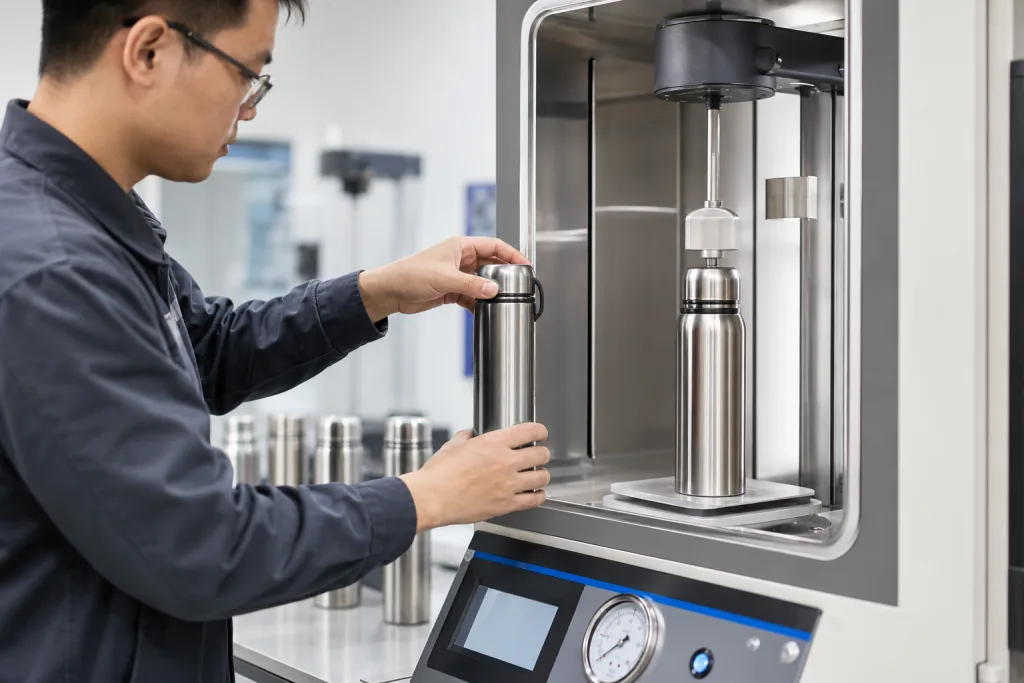
The fastest after-sales claims on stainless thermos orders usually start at the lid, not the bottle body. We can run the bottle through a vacuum tester at -0.08 MPa for 6 hours and still get a return because coffee leaked into a laptop bag, or the buyer flagged a plastic smell after a 95°C hot-water soak. When comparing vacuum bottle manufacturers, check lid material, gasket groove depth in mm, thread engagement turns, and whether spare lids can ship with the first PO.
For food-contact plastic, PP is common for hot water contact. Tritan is often used for transparent parts. Silicone gaskets should come out for cleaning, but if QC can shake the lid 10 times and the ring drops, the design is wrong. If your thermos custom project targets the EU, ask for LFGB or EU 10/2011 documentation for food-contact parts. For the US, FDA food-contact compliance is normally requested. For outdoor retail, we push for a simple gasket replacement plan. A USD 0.08 silicone ring can save a USD 8 retail complaint, and we have seen one missing spare-ring line on a PO turn into 600 customer-service emails.
Lid style changes the product positioning. A screw cap with cup is traditional and stable for camping; our line checks cup fit with a 0.2 mm feeler gauge before packing. A flip lid suits commuting, but it needs stronger leak testing because the hinge pin and lock button take abuse in backpacks. A straw lid works for cold drinks, not boiling water. A handle lid adds perceived value, but the math does not work if the taller carton cuts your 40HQ loading by 8%.
For a distributor thermos program, we usually recommend one bottle body and two lid options. Simple sells. That gives your sales team a good-better structure without creating 12 SKUs that warehouse staff mix up during relabeling. If you need a fully new lid mold, budget tooling at roughly USD 2,000-6,000 depending on structure, and allow 25-35 days for mold sampling in China. We have seen this go sideways when a buyer asks for a new push-button lid but still wants the same MOQ, same carton size, and the same 18-day delivery window.
Surface finish changes both price and risk
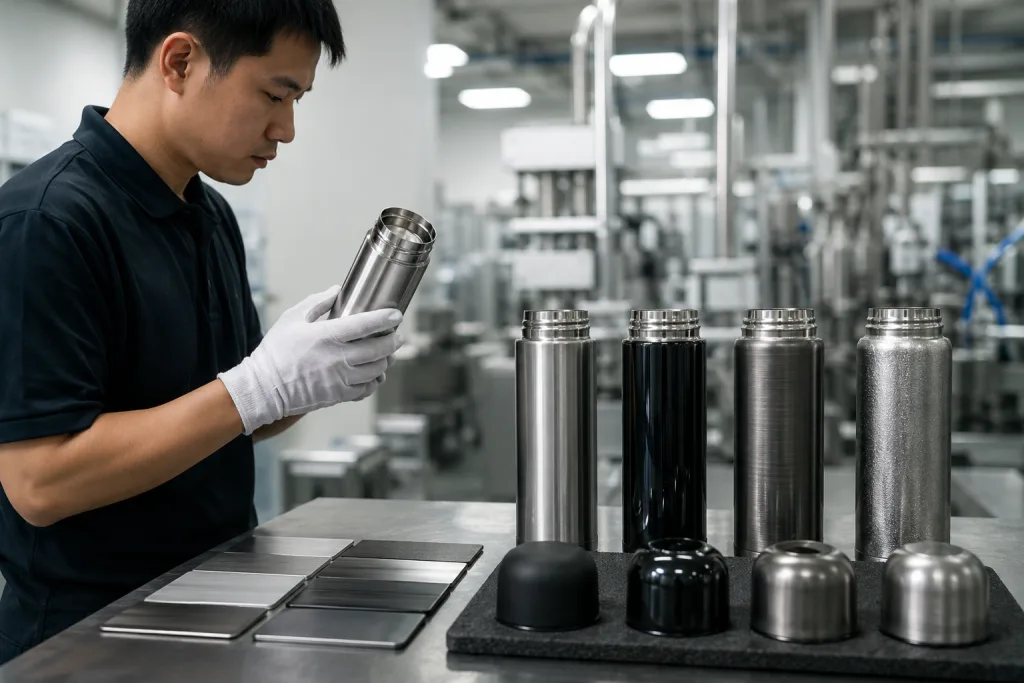
A stainless thermos can be polished, painted, powder coated, plated, wrapped, or rubberized. Each finish carries a different price and a different defect list. On our line, brushed stainless is the safest choice when a buyer wants low risk and quick replenishment. We usually see fewer complaints with a 180-grit brush pattern and a simple oil wipe check. Powder coating gives a tougher outdoor look and better grip, but it needs color control, adhesion testing, and scratch checks. Spray painting costs less than powder coating in many orders, but a hard knock in transit can chip it fast. This is the wrong place to chase the cheapest quote.
For promotional brands, logo method is usually the second big decision after color. Silk screen works well for one or two colors on a flat or gently curved body. Laser engraving is cleaner, lasts longer, and suits premium customized thermos bottles, but it shows the steel color underneath and may miss a strict brand spec. Heat transfer gives full-color artwork, though the setup is touchier and the reject rate is higher. A metal badge or embossed logo looks expensive, but it adds tooling and lead time. We had a buyer flag a curved shell because the screen print sat 2 mm off center, and that kind of miss shows up immediately.
Typical logo setup costs are USD 30-80 for silk screen film, USD 40-100 for laser positioning fixtures, and higher for heat transfer plates. Unit logo cost can range from USD 0.05 for a simple one-color print to USD 0.60 or more for complex full-wrap decoration. For thermos bulk orders above 5,000 pcs, the math starts to work better because the setup gets spread across more units. On a 3,000 pcs order, a 15-minute jig change already eats into margin. That is why we ask buyers to match the artwork to the run size, not the other way around.
Always approve a pre-production sample in the actual finish. A computer rendering cannot show powder texture, laser contrast, or how a dark logo sits on matte navy coating. QC pulled a sample last month with a gloss reading of 11 GU, and the artwork looked fine on screen but nearly disappeared in hand. We have seen this go sideways when the buyer approved from a PDF and then complained after the first carton. Test the real bottle, under real light, before the line starts.
MOQ, lead time, and price logic
MOQ is not a penalty from a thermos factory. It comes from steel purchase, coating setup, logo setup, carton printing, and QC hours on the line. At BottleForge, we usually see 1,000 pcs per model for logo work on an existing stainless thermos, 3,000 pcs per color for custom PMS powder coating, and 5,000-10,000 pcs when the buyer wants a new mold or a new lid structure. A buyer once pushed for 500 pcs on a new lid; the math did not work, and the PO stayed open for two weeks.
As an FOB China guide, a 500 ml double-wall stainless vacuum bottle usually lands around USD 3.20-4.20 for a plain promo build, USD 4.20-5.20 for a retail-grade powder coated bottle with 304/304 steel, and USD 5.20-7.50 for premium lids, special coating, gift box, and tighter testing. On our weighing scale, the same bottle can jump by 18-25 g once you change the cap and box, and that shows up in freight. Price moves with stainless cost, exchange rate, order quantity, and pack weight. If a supplier gives one flat number for 1,000 pcs and 10,000 pcs, we’ve seen that go sideways.
Lead time needs to be split by stage. Stock sample dispatch is usually 3-7 days. Custom logo samples take 7-12 days after artwork approval, once the laser engraver or pad print plate is set. Mass production is usually 30-45 days after deposit and sample sign-off. For a seasonal outdoor launch, add 10-15 extra days for inspection, booking, and port movement. QC pulled one sample at AQL 2.5 last month because the lid torque was off by 0.3 mm, and that sort of thing can cost a week if you miss it early. Ningbo and Shanghai are the usual ports for Zhejiang shipments.
For distributor thermos orders, ask your supplier to show breaks at 1,000, 3,000, 5,000, and 10,000 pcs. That is the real test of whether the bottle works for reorder business or only a one-time gift program. If the quote sheet skips one of those steps, the buyer should push back. We also catch simple PO typos here, like 10,000 pcs written as 10000pcs with no pack spec, and that can mess up carton counts and labeling.
Quality lines your PO should include
A clean PO prevents arguments. Put the QC lines in writing: material grade, capacity tolerance in ml, insulation test temperature and hours, leak test method, coating adhesion standard, logo position tolerance in mm, packaging spec, barcode file name, carton mark layout, and inspection level. We still see 6 out of 10 first-time POs miss the logo tolerance line, then the buyer flags a 3 mm shift after printing. If you are buying from vacuum bottle manufacturers in China, use terms every export QC team knows: AQL 2.5 for major defects, AQL 4.0 for minor defects, ISO 2859 sampling, REACH for EU chemical control, LFGB when required for Germany, and ASTM or CPSIA requirements if the item is positioned for children.
Leak testing should not mean “we checked some lids.” Write 100% leak testing for assembled bottles into the PO. We run inversion checks on the line, and pressure-related checks for push-button or straw lids when the structure needs it. QC pulled a sample last week where the silicone ring sat 0.8 mm proud; it passed a quick look but failed after 12 minutes upside down. Coating adhesion belongs there too: cross-hatch tape test, usually with 3M 600 tape. Carton strength needs a drop test, especially for e-commerce and distributor warehouses. For Amazon-style preparation, list FNSKU labeling, polybag warning text if used, carton weight limits such as 15 kg or 18 kg, and master carton dimensions.
Packaging is part of the product cost. A white box adds USD 0.15-0.30. A printed color box adds USD 0.25-0.60 depending on paper grade, size, and MOQ. Molded pulp inserts cost more than thin paper dividers, but they protect powder coated bottles better when the carton takes a corner drop from 76 cm. The math does not work if the bottle arrives scratched and the buyer asks for a 5% debit note. If you ship mixed colors, define inner carton assortment and barcode rules before production, for example 6 black, 6 white, 6 blue, 6 green in a 24 pcs master carton.
A reliable thermos vendor will not object to clear QC terms. They may negotiate the numbers, but they should not ask you to accept “standard inspection” with no sampling plan. We have seen this go sideways when a PO typo changed matte black to glossy black and nobody caught it until pre-shipment photos. For outdoor retailers and promotional brands, clear QC wording matters more than a USD 0.12 unit saving.
Send your stainless thermos spec sheet for review
We will check materials, MOQ, decoration, testing, packaging, and FOB China pricing before you commit to samples.
Frequently asked questions
What MOQ should I expect from vacuum bottle manufacturers?
For an existing stainless thermos body with one-color logo, 1,000 pcs is a practical MOQ in China. If you need custom PMS powder coating, plan for 3,000 pcs per color because coating lines need setup volume and color loss allowance. A new lid or bottle mold usually needs 5,000-10,000 pcs to make tooling worthwhile. Some thermos suppliers will accept 500 pcs, but the unit price, logo cost, and freight ratio usually become unattractive unless it is a market test.
How much does a 500 ml custom thermos cost FOB China?
A realistic FOB China price for a 500 ml custom thermos is about USD 3.20-7.50. The low end usually means simple lid, standard color, basic box, and 304 inner with 201 outer steel. A retail-grade 304/304 bottle with powder coating, laser logo, and color box often lands around USD 4.50-5.80. Premium lids, copper plating, special finishes, molded inserts, and tighter AQL requirements push the price higher. Always compare full specs, not just the headline quote.
Which logo method is best for promotional thermos orders?
For promotional thermos orders under tight budgets, silk screen is usually the best first option. It works well for simple one- or two-color artwork and can cost around USD 0.05-0.18 per unit after setup. Laser engraving is better when durability matters, especially for outdoor or corporate gift programs, and often costs USD 0.15-0.35 per unit. Heat transfer is useful for full-color designs, but reject rates and setup costs are higher. Send vector artwork early so the factory can check printable area.
What tests should a distributor thermos order include?
A distributor thermos order should include 100% leak checks, random insulation testing, coating adhesion testing, visual inspection under AQL 2.5/4.0, and carton drop testing. For Europe, request REACH and food-contact documentation such as LFGB or EU 10/2011 where applicable. For North America, ask for FDA food-contact declarations and any required state-specific warnings if relevant. If selling online, add barcode scan checks, carton dimension confirmation, and packaging drop tests because warehouse handling is often rougher than retail shelf handling.
Can I use one thermos factory for retail and promotional programs?
Yes, but separate the specifications. A retail outdoor bottle may need 304/304 steel, 0.5 mm body material, powder coating, stronger lid, color box, and tighter cosmetic standards. A promotional bottle may prioritize price, faster lead time, and simple logo placement. Using one thermos factory can reduce sampling time and keep colors consistent, but do not force both channels into the same spec. We often build one standard body with two lid choices and two packaging levels for this reason.