Key Takeaways
- Specify 304 inner steel, 201 or 304 outer steel, and 0.4-0.5 mm wall thickness before sampling
- Use AQL 2.5 for major defects and AQL 4.0 for minor defects on distributor thermos orders
- Realistic MOQ is 1,000-3,000 units per color for most custom thermos designs
- Plan 30-45 days for mass production after artwork, sample, and deposit approval
A stainless thermos looks simple until 8,000 units land with 38°C heat retention after 6 hours, logos tilted 2 mm off center, lids that rattle on the thread gauge, or cartons that crush on the first pallet move. We’ve had a buyer flag this after the PO typo showed “matte black” in one line and “gloss black” in the artwork approval. Too late is expensive.
As a vacuum bottle manufacturer in Hangzhou, Zhejiang, we see the same problems repeat on custom thermos projects: unclear steel grades, insulation claims no one tested, decoration rushed through the line, and packing specs left at “export carton.” China can ship strong bulk thermos orders, but the math doesn’t work if the factory gets slogans instead of numbers like 304 stainless, 500 ml capacity tolerance, 12-hour test data, carton burst strength, and AQL 2.5 inspection points before production starts.
Insulation Claims Fail First
The costliest mistake is accepting a heat-retention number without the test setup behind it. A thermos quote might say “keeps hot 12 hours,” but we have seen that based on 95°C full-fill water, 20°C room temperature, lid never opened, and no drop test before reading. Real use is messier. Your customer half-fills it, opens it 6 times, rides with it in a 2°C delivery truck, then leaves it outside a trailhead. Last month QC pulled a 500 ml sample from the line after a 1.2 m carton drop, and the same bottle lost 9°C more than the untouched sample.
For a stainless vacuum bottle, the failure is not always “bad vacuum.” We see heat loss from weak copper plating, 0.38 mm walls instead of the approved 0.42 mm, uneven weld seams, or a lid design with too much plastic touching the inner plug. The wrong question is “how many hours does it keep hot?” Ask how the supplier proves it. For a custom thermos program, lock the test method on the PI and PO, down to capacity, fill temperature, room temperature, and test time. One buyer once flagged a PO that said “12 house” instead of “12 hours”; funny typo, bad spec control.
- Basic test: fill with 95°C water, close for 6 hours at 20°C, target remaining temperature above 65°C for a 500 ml bottle.
- Cold test: fill with 4°C water, check after 12 hours, target below 10°C depending on capacity.
- Vacuum check: use thermal imaging or hot-water surface touch screening during inline QC.
At our Zhejiang facility, we run hot-fill screening before final packing and reject units with obvious outer-wall heat rise. Simple work. The operator uses an IR thermometer at the shoulder and base, because weak vacuum often shows there first. It is not a pretty sales point, but it catches bad bottles before they reach the carton sealer. If you compare thermos manufacturers in China, ask whether they test every unit or only random samples. For outdoor retail, random checks do not work on premium SKUs; 1 failed bottle can mean a return, a 1-star review, and a buyer who remembers your brand for the wrong reason.
Steel Grade Gets Quietly Downgraded
Steel grade is where low-price offers hide 3–8% margin. We see the same build on the line every week: 304 stainless steel for the inner liner, 201 stainless steel for the outer shell. That is fine for a 5,000 pcs promotional thermos order if the outer finish is powder coated and the film build reads 60–80 μm on the coating gauge. If the bottle will see marine air, dishwasher cycles, sweaty hands, or an uncoated brushed finish, spec 304 outer steel. The math doesn't work if you save USD 0.18 and then eat a corrosion claim.
The failure mode is not always rust on day one. QC pulled samples that looked clean at packing, then showed pin spots after a 24-hour salt-spray check, winter road salt on a car cup holder, or acidic drink residue sitting around the mouth thread. A thermos vendor that refuses to state material grades on the proforma invoice is asking you to trust a handshake across 9,000 km. Don't do that. We had one buyer flag a PO that only said “SS bottle,” and that tiny wording gap became a 12-day argument before production could start.
Your purchase spec should include steel grade, wall thickness, finish, and food-contact compliance. For a mid-market customized thermos, we run 304 inner liner, 201 outer body, 0.4 mm nominal wall thickness, LFGB or FDA food-contact documentation for silicone and plastic parts, with REACH compliance for coating if selling into Europe. For higher-end outdoor bottles, move to 304 inner and outer, 0.5 mm wall thickness, plus a cross-hatch coating adhesion test with 3M 600 tape after curing. Simple spec. Fewer surprises.
Low price is not a factory capability. It is often just an incomplete specification.
For China sourcing, ask for a material declaration and keep one approved golden sample sealed, with the weight written on the carton label to the nearest 1 g. If a future thermos bulk shipment feels lighter, scratches faster, or has a different ring when tapped with a 6 mm hex key, you have a reference point for dispute resolution. We've seen this go sideways when the approved sample sat open on a buyer's desk for 8 months and nobody knew which version it was.
Lids Leak Before Bodies Do
Stainless bodies are the easy part. Lids are where we see trouble: PP or Tritan caps, silicone rings, springs, sliders, threads, gaskets, and sometimes a push-button set that has 6 small parts inside. On our line, QC pulled 12 samples last month where the body passed vacuum and weld checks, but 3 lids showed seepage around the gasket seat after cycling. A factory thermos can pass a desk leak test at 10:00, then fail after 200 open-close cycles or one drop onto the lid corner.
If you sell to outdoor retailers, your customer will throw the bottle into a backpack next to a laptop, socks, and a down jacket. For promotional brands, one wet event gift bag is enough for the buyer to flag the whole PO. Spec the lid in numbers. For screw lids, require no leakage after 30 minutes inverted with room-temperature water, then repeat after a 1.0 m drop test on three axes. For flip lids, add 300 open-close cycle testing and check button return force after cycling; we run this with a simple cycle jig and record the force in N, not “feels okay.”
Gasket material matters. Food-grade silicone is standard, but gasket hardness needs a control range, usually around Shore A 50-60 for bottle lids. Too soft and it mushrooms after hot water. Too hard and it stops sealing after temperature changes, especially when the lid thread tolerance is off by 0.2 mm. Ask for spare gaskets. For distributor thermos programs, a small spare-parts pack with 1 lid seal and 1 straw seal per carton saves more claims than another glossy insert.
When you review a thermos manufacturer sample, don’t just admire the color and logo. Fill it, shake it, invert it, wash it, freeze cold water in it if the design allows, and open the lid with wet hands. We’ve seen this go sideways: the buyer loved the matte finish, then the sample leaked after a dishwasher run because the gasket was installed upside down. A customizable thermos that photographs well but annoys the user becomes dead stock after the first reorder cycle.
Decoration Breaks Under Real Handling
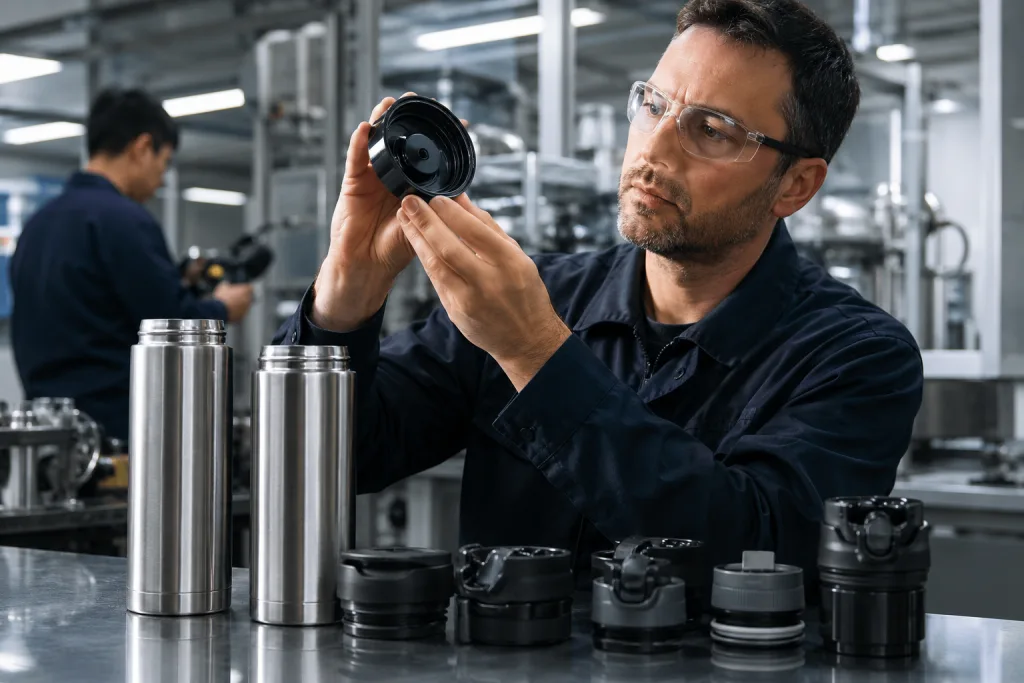
Logo decoration is where promotional thermos projects get political. The brand team asks for Pantone 186C to match the gift box, the buyer pushes back on USD 0.06 extra ink cost, and the factory is waiting for a signed artwork sheet before the line can run. Then QC pulls 12 bottles from the pilot run and finds the real problem: scratched logos, crooked placement, fuzzy screen edges, or laser engraving that looks too shallow on matte black coating.
Pick decoration by how the bottle will be handled. This is the wrong question to ask: “Which logo method is cheapest?” Silk screen printing works well for 1-2 color logos on smooth areas, usually with a setup charge around USD 40-80 per color depending on artwork; we run a curved screen jig and check first-piece position with a 0.5 mm ruler. Laser engraving is durable and clean, but contrast changes a lot between black powder coat, white spray paint, and bare 304 stainless. Heat transfer gives better color detail, but QC should cut the edge and run adhesion before approving bulk. Powder coating with logo printing suits outdoor retail orders, while a lower-cost thermos promotional order may use spray paint and one-color screen print.
The spec should state logo size in millimeters, placement tolerance, Pantone code, decoration method, and the exact durability test. A reasonable production tolerance is ±1.5 mm for logo position on cylindrical bottles, though tapered bodies or grip grooves need wider tolerance; we have seen a 72 mm logo drift at the shoulder because the fixture was copied from a straight tumbler. For adhesion, use a 3M tape test after curing. For abrasion, request a rub test: 500 cycles with a dry cloth under the same pressure each time. It is not a full laboratory standard, but it catches weak ink and poor curing before 48 cartons are sealed.
At BottleForge Industrial in Zhejiang, our normal MOQ for custom logo stainless thermos orders is 1,000 units per SKU, with mass production capacity around 450,000 drinkware units per month across stainless bottles, tumblers, and related lines. Fast is not always smart. We once had a PO with the logo file named “final-final.ai” but the carton mark still showed the old importer code, and the buyer flagged it after pre-shipment photos. If artwork, coating, and carton marks are not approved, speed only produces faster mistakes.
Cartons Fail in Distribution
We see buyers spec 304 stainless, copper lining, powder coat, laser logo, then leave the carton as “standard export packing” on the PO. Bad move. On 47 thermos projects we shipped last year, carton complaints caused more buyer noise than bottle vacuum failures. The load reaches a North American 3PL or a German distributor warehouse with 12 mm crushed corners, rubbed retail boxes, and Code 128 barcodes that the Zebra scanner will not read. For distributor thermos programs, packaging is part of the product. It drives chargebacks, returns, shelf presentation, and whether your warehouse team starts hating that SKU by week two.
Start with the sales channel. A 3,000 pcs bulk thermos order for corporate gifting may only need individual white boxes and 5-ply export cartons. Outdoor retail usually needs color boxes, hang tags, instruction sheets, retail barcodes, and FSC paper claims if the buyer asked for them on the artwork file. E-commerce is a different animal because parcel networks punish cartons harder than pallet freight; we have seen one Amazon-style set pass pallet stacking, then fail after 6 single-parcel drops. If selling through marketplace fulfillment, lock FNSKU labels, suffocation warnings for polybags, carton weight limits, and scannable outer labels before goods leave China. QC pulled the sample last month because the PO said “FNSKU,” but the artwork folder had a UPC only.
For export cartons, specify 5-ply corrugated for most stainless bottles and keep gross weight under 15 kg where possible. We run 42 x 36 x 28 cm cartons often for 500 ml bottles, but the right size depends on bottle height, box wall thickness, and divider layout. Request a carton drop test from 76 cm for lighter cartons or use ISTA-style handling checks for e-commerce sets. Bottle dividers matter for powder-coated products; coating rub inside the carton is a common preventable defect, and the math does not work if you save $0.04 on dividers and eat a 3% return rate. If you use individual color boxes, add a polybag or tissue wrap when the finish is matte and easy to scuff. The line can catch this early with a simple rub check on a white A4 sheet.
FOB Ningbo or FOB Shanghai is common for our Hangzhou-area production because Zhejiang has strong access to both ports. We ship from the factory gate to Ningbo in about 4 hours, Shanghai in about 3.5 hours when traffic behaves. For a thermos supplier, the job is not finished when the bottle passes vacuum testing. This is the wrong question to ask: “Did the bottle pass?” Ask whether the carton can survive China loading, ocean freight, warehouse handling, and the last 1–2 courier moves to the final customer. We have seen this go sideways from one typo on a shipping mark, not from the bottle itself.
QC Plans Are Too Late
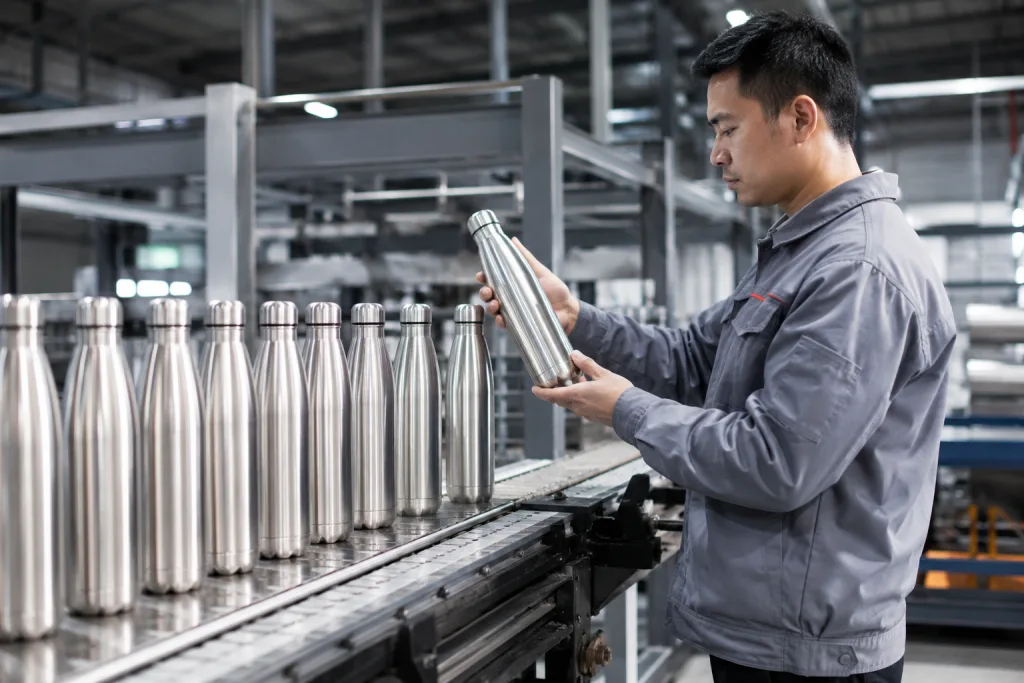
QC cannot rescue a loose specification. It can only check against the spec sheet on the clipboard. We have seen this go sideways: the buyer asks for inspection after 1,200 cartons are sealed, while the line has already cut 304 stainless, shot the PP lids, printed the logo, and booked the export cartons. Too late. At that point, rejecting goods means rework tables, repacking tape, and a freight delay, so everyone starts arguing over whether a scratch is “acceptable.”
Build the control plan before deposit. For a manufacturer thermos order, we run three checks with clear files attached: pre-production sample approval with signed photos and Pantone references, inline inspection at 20-30% completion while the ultrasonic leak tester is still beside the line, and final random inspection after at least 80% packed. Use AQL 2.5 for major defects such as leakage, poor vacuum, wrong logo, rust, unsafe burrs, or broken lids. Use AQL 4.0 for minor defects such as small dust points under 0.5 mm, slight color variation inside the approved tolerance, or carton scuffs that do not break the outer paper.
Your approved sample should include the full selling unit: bottle with measured capacity, lid with gasket fitted, finish panel, logo position, retail box, instruction sheet, barcode, and carton marks. Sign and date it. Keep one set at your office and one sealed in the factory sample room. QC pulled the sample more than once and found the buyer approved the bottle body but never signed the printed box; then final inspection became a debate over whether the blue box was 286C or 287C. This is the wrong question to ask at shipment time.
Lead time needs the same discipline. A realistic schedule is 7-10 days for an existing-shape sample with custom logo, 15-25 days if a new lid color or coating needs trial work, and 30-45 days for mass production after deposit and approvals. A new mold can add 25-40 days. A good thermos manufacturers quote should state what is included: logo artwork confirmed, coating trial passed, LFGB or FDA testing arranged, packaging dieline approved, and carton marks checked against the PO. The math doesn't work when a vague “25 days” promise ignores two artwork revisions, 6 days in the lab, and a buyer who typed the barcode wrong on the PO.
Pricing Looks Clean Until Landed Cost
Unit price is one line on the buying sheet. We’ve seen a USD 4.20 FOB bottle lose to a USD 4.55 quote after the buyer added 5-ply export cartons, 9 kg drop-test failures, extra CBM, and one round of compliance retesting. The cheaper line looked clean. The landed cost did not.
For a 500 ml stainless customized thermos, typical FOB China pricing runs about USD 3.20-6.80 depending on steel grade, lid parts, coating process, decoration method, packaging, and order quantity. A simple thermos bulk order at 5,000 units with one-color logo and white box sits near the low end. A retail-ready custom thermos with 304 inner and outer steel, powder coating, laser logo, color box, barcode labels, and tighter QC lands higher because the line needs slower handling after coating, usually 18-22 seconds per piece before the next rack move. If a quote is 18% below the market, something is missing. The math doesn’t work.
Ask suppliers thermos questions in writing: What Incoterm is used? Are inner cartons included? Is logo setup included? Are samples refundable? Who pays for failed inspection rework? Are compliance documents current for your market? If you sell in the EU, REACH and LFGB questions are not optional. If you sell in the US, FDA food-contact expectations and California Proposition 65 risk screening belong on the quote checklist, especially when the lid has silicone, PP, or painted contact-area claims. We once had a PO typo list “LFGB lid” but the artwork file called for a soft-touch coated mouth ring, and QC pulled the sample before packing.
The best thermos distributor relationships come from boring clarity: one spec sheet, one approved sample, one packing standard, one inspection plan, and one commercial term sheet. Make the factory quote the bottle you plan to sell, not the bottle that fits a target price in a spreadsheet. We run this through a signed golden sample, carton mark file, and AQL 2.5 inspection checklist before mass production; otherwise we’ve seen this go sideways at the 30% deposit stage.
Send your thermos spec before you quote
Share capacity, logo, market, packaging, and target FOB price. We will flag production risks before you commit to tooling or bulk orders.
Frequently asked questions
What MOQ should I expect from a vacuum bottle manufacturer?
For existing stainless thermos shapes, a practical MOQ is usually 1,000 units per color for laser logo or one-color silk screen. If you need a custom powder coating color, expect 2,000-3,000 units because coating lines lose material during color changeover. New lid colors can also push MOQ to 3,000 units if plastic injection parts are involved. Fully private-mold bottles are different; tooling may start around USD 3,000-12,000 depending on body, lid, and mold complexity, with order quantities often above 5,000 units. If a supplier offers 100 units with full custom color, low price, and retail packaging, check whether they are using stock inventory or cutting corners.
How do I compare two custom thermos quotes fairly?
Put both quotes into the same specification table. Compare capacity, steel grade, wall thickness, lid type, coating method, logo process, packaging, AQL level, Incoterm, sample cost, and lead time. A USD 0.35 difference may disappear if one quote excludes color box printing or uses 201 outer steel instead of 304 outer steel. For a promotional thermos, maybe that saving is acceptable. For outdoor retail, it may not be. Ask each thermos supplier to confirm gross carton weight, units per carton, carton dimensions, and FOB port. Freight can change landed cost by 5-12%, especially on bulky bottles packed in retail boxes.
What quality standards should I request for bulk thermos orders?
Use a written QC checklist with AQL 2.5 for major defects and AQL 4.0 for minor defects. Major defects should include leakage, failed vacuum performance, sharp edges, wrong material, incorrect logo, broken lid function, serious coating damage, and barcode failure. Minor defects can include small dust points, slight print specks, or acceptable carton scuffs. For compliance, request food-contact documentation for stainless steel, silicone, and plastic parts. EU buyers should ask about LFGB and REACH. US buyers should ask about FDA food-contact suitability and Proposition 65 risk if applicable. For children’s bottles, add age-grade requirements and relevant ASTM or CPSIA checks.
How long does a customized thermos project take from China?
For an existing bottle shape with a simple logo, plan 7-10 days for sampling and 30-45 days for mass production after deposit and final approval. Add 5-7 days if Pantone coating approval is needed. Add 10-15 days if retail packaging requires several artwork revisions. If you need a new mold, add 25-40 days before production starts. Sea freight from Ningbo or Shanghai to Europe or North America can add roughly 25-40 days port-to-port, depending on route and season. Air freight is faster but usually only makes sense for urgent samples or small replacement quantities, not full thermos bulk programs.
Can one thermos manufacturer handle both retail and promotional orders?
Yes, but the factory must understand the different failure points. Promotional orders usually prioritize logo accuracy, deadline control, and safe basic packaging. Retail orders add shelf packaging, barcode quality, color consistency, stricter cosmetic standards, and longer after-sales exposure. A good factory should quote these as different builds, not pretend one product fits both channels. For example, a conference giveaway may use 201 outer steel, one-color logo, and white box packaging at 3,000 units. An outdoor retail SKU may use 304 inner and outer steel, powder coating, laser engraving, color box, instruction sheet, and tighter AQL inspection at the same order size.