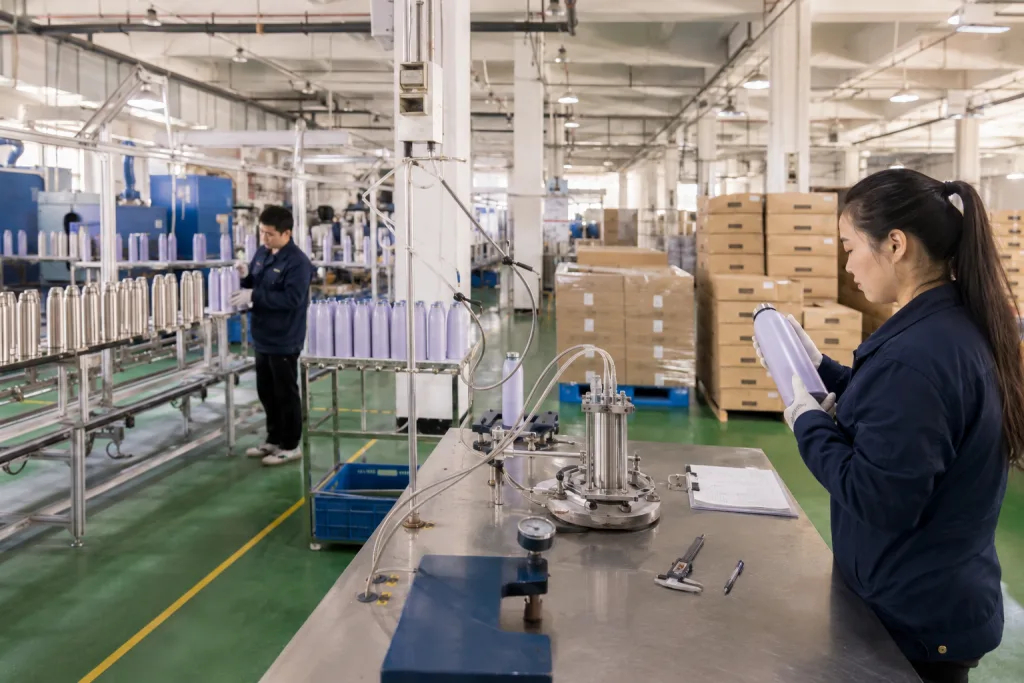
Key Takeaways
- A 750 ml custom thermos order usually needs 3,000 pcs MOQ for color coating and logo work
- A realistic sample cycle is 7-10 days for stock mold bottles and 20-35 days for new tooling
- AQL 2.5/4.0 inspection should include vacuum retention, leak testing, coating adhesion, and carton checks
- FOB Ningbo pricing for mid-range stainless thermos projects often lands around USD 4.20-7.80 per pc
You are launching a 750 ml stainless thermos for an outdoor retail chain or a promotional thermos campaign, and the brief sounds simple: matte black bottle, front logo, 8-hour heat claim, retail color box. Then the factory asks about 304 stainless or 316, lid tooling, powder coating thickness in μm, 1.2 m carton drop test, EAN-13 barcode size, and AQL 2.5. This is where cost slips. We saw one PO last month with “mat black” typed on page 1 and “gloss black” on the artwork file; QC pulled the pre-production sample before the line opened.
As a vacuum bottle factory in Zhejiang, China, we run into this on roughly 6 out of 10 custom thermos RFQs: the buyer compares unit prices before the specification is locked. That is the wrong question to ask first. A workable order starts with the selling scenario, target shelf price, logo method, MOQ, and packing rule, not a catalog screenshot. Below is how we would build and QC one customized thermos order from RFQ to container loading, including the caliper checks on mouth diameter and the carton marks the buyer flagged at final inspection.
Start with the actual retail use
Take a normal buyer case. You run an outdoor retail chain and need 5,000 pcs of a 750 ml stainless steel vacuum bottle for a winter campaign. It sits on European retail shelves, then 300-800 pcs also go to corporate customers as a promotional thermos. The bottle must not feel like a cheap giveaway. The math does not work if you pay for a new lid mold before the first sell-through report comes back. We see this on POs often: the buyer writes “custom lid” in one line, but the artwork file only shows a logo on the body.
This is where a serious vacuum bottle factory should slow the project down. A thermos factory can quote nearly any loose description, but that quote will not protect your margin. First define the use: hiking pack, car cup holder, retail gift set, staff uniform kit, or distributor thermos range for repeat wholesale sales. Better yet, pick two and rank them. QC pulled one 750 ml sample last month that passed capacity, but the buyer flagged it because the 78 mm body did not fit their car cup holder display test.
For this buyer case, I would not start with an unusual body shape. Use an existing factory thermos mold: 750 ml, double-wall vacuum insulated, 18/8 stainless inner wall, screw lid, powder coating, and wide-mouth opening around 50-55 mm. Safer choice. You cut tooling risk, get samples in 7-10 days instead of 25-35 days, and keep welding plus vacuum pumping more stable on the line. Our vacuum leak tester catches trouble fast when a new shoulder radius is too aggressive.
Our Hangzhou, Zhejiang production network can produce about 450,000 stainless vacuum bottles per month across standard bottle and travel tumbler lines. For a 5,000 pcs custom thermos order, MOQ is not the hard part. The hard part is locking the same specification across artwork, packaging, compliance, and inspection before the PO is issued. We ship cleaner when the PO states coating code, carton drop-test requirement, barcode position, and AQL 2.5 before deposit. Leave those details open, and your suppliers thermos quote looks cheap on day one, then turns expensive when the pre-shipment inspection finds mixed lid gaskets or a 2 mm logo shift.
Build the specification before pricing
For a stainless manufacturer thermos order, the RFQ needs to read like a job sheet the line can run, not a style reference. The base spec drives 304 stainless usage, weld scrap, polishing minutes, powder-coating rejects, and carton cube. Send 3 thermos suppliers only a photo and “750 ml,” and you will get 3 different bottles wearing the same name; we saw one buyer flag this after QC pulled the sample and found the outer wall at 0.38 mm instead of the quoted 0.50 mm.
For this scenario, write the specification like this:
- Capacity: 750 ml nominal, tolerance ±5%.
- Body: double-wall vacuum insulated stainless steel, 304 inner, 201 or 304 outer depending on target price.
- Wall thickness: inner 0.40 mm, outer 0.50 mm for a durable outdoor retail position.
- Finish: matte powder coating, black PMS matched within reasonable production tolerance.
- Lid: PP food-grade screw cap with silicone sealing ring, BPA-free declaration available.
- Performance: hot water 95°C start, 6 hours above 65°C under room temperature 20°C ±2°C.
- Logo: one-position laser engraving or one-color silk screen, 45 x 35 mm maximum.
- Packing: individual kraft box, 24 pcs export carton, carton under 15 kg gross weight.
This is enough detail for a thermos manufacturer to price without guessing. For FOB Ningbo, a 750 ml bulk thermos with powder coating and laser logo usually lands around USD 4.20-5.60 per pc at 5,000 pcs when we run an existing mold. Move to 304 outer wall, a heavier lid, retail color box, and tighter coating inspection, and the same customized thermos can reach USD 6.20-7.80 per pc. The mold question matters too: existing tooling can ship in about 18 days after artwork approval, while a new mold and first sample often pushes the schedule to 35-45 days.
There is no magic in a low quote. The math doesn’t work. A thermos vendor cuts price by thinning the steel, spraying less powder, switching to cheaper silicone, passing more weak-vacuum units, or using a carton that crushes after 2 container rows. Some choices are fine for a 30-day promotion with MOQ pressure from the buyer; they go sideways for outdoor retail when returns hit the brand and the distributor.
Choose customization that survives production
Customization is where buyers overload the first PO. We see it in Hangzhou every month: 5,000 pcs, 4 lid changes, 2 coating colors, gift box, sleeve, and a new stopper drawing with no sales data behind it. That is the wrong question to ask. A customizable thermos does not mean every part needs a new tool. For a 5,000 pcs launch, put the money where the end customer touches it: powder coating grip, logo edge sharpness, one-hand lid feel, and the first 3 seconds of box opening. Keep new mold work for repeat programs above 20,000-30,000 pcs per year; otherwise the tooling fee and 25-35 day validation cycle eat the margin before the line even runs.
For this order, I would quote 3 thermos custom branding routes, but not treat them as equal. Laser engraving is the safer choice on powder coating because it removes the coating cleanly and adds no ink adhesion risk; QC usually checks it with a 3M tape pull and a 0.2 mm logo-edge tolerance on our sample table. Silk screen is cheaper for large simple logos, usually around USD 0.05-0.12 per position depending on size and color, but curved bottle alignment needs a proper jig, not a worker eyeballing the center line. Heat transfer handles gradients and full-color artwork, yet the math does not work if the design wraps over a shoulder radius; we have seen rub testing fail after 300 cycles on that area.
If you need a promotional thermos for an event, silk screen on a stock color is often enough. Fast and clean. For a distributor thermos line with seasonal reorder, laser engraving plus debossed packaging looks more stable, and buyers complain less about color drift between batches. For retail shelves, the box matters more than buyers admit during price negotiation. A plain white box may save USD 0.18-0.35 per pc, but a kraft or color box with barcode, material icons, and care instructions reduces hesitation at the shelf; last quarter one buyer flagged a PO typo on the EAN code, and QC pulled the carton proof before 12,000 boxes went to print.
For a thermos customized to a brand campaign, define what stays standard. Use a standard silicone seal if it already passes migration requirements, and keep the proven cap if the leak test holds 30 minutes inverted at room temperature. Use existing carton dimensions if they fit pallet loading; a 55 x 40 x 38 cm master carton that stacks cleanly is better than a “custom” carton that bulges after 18 kg gross weight. We ship better orders when customization improves the sell-through story, not when it creates 10 new failure points on the line.
Practical rule: if the order is under 10,000 pcs, customize surface and packaging first. Touch the mold only when the sales forecast justifies tooling, test samples, and at least one full pre-production run.
Sample like you plan to inspect
A sample is not for catalog photos. It is your first inspection standard. For a stock mold customized thermos, we usually run a pre-production sample in 7-10 days after artwork confirmation. If the job needs a new lid insert, color-matched coating panels, or a special packaging structure, plan 14-20 days. Full new mold work can take 20-35 days before stable samples, and we have seen lid buttons with tiny springs push that to 42 days after the first CNC trial.
Ask your vacuum bottle factory for two sample steps. First, get a blank physical sample from the existing mold so you can check hand feel, weight on a digital scale, mouth size with calipers, and lid operation. Second, approve a decorated pre-production sample showing the actual coating, logo, and packaging. Too many buyers skip the blank sample. Then QC pulled the sample and the buyer flagged the bottle as 18 mm too wide for a gym cup holder, which is the wrong time to find out.
For this buyer scenario, I would request 3 decorated samples: one for the brand owner, one for the distributor, and one sealed as the factory reference. The sealed sample should have date, version number, PMS reference, logo method, and packaging code written on the approval label. Use a real label, not a loose email thread. We had one PO typo where “matte sand black” became “matte black,” and the sealed sample stopped the line from spraying 5,000 pcs in the wrong finish.
Do basic abuse tests before you approve. Fill with hot water and check temperature after 6 hours. Fill and invert for 30 minutes to check leakage. Rub the logo 50 cycles with dry cloth and 50 cycles with wet cloth. Apply 3M tape to the coating cross-cut area if you are worried about adhesion. Drop the packed unit from 80 cm on one corner, one edge, and one face. These are not full lab tests, but they catch obvious problems before the thermos bulk order goes live in China. We run this on the sample table with a timer, a 3M 600 tape roll, and a marked 80 cm drop board; the math does not work if the first failure appears after 12,000 pcs are already packed.
Control production with measurable QC
Mass production for stainless vacuum bottles is a chain of separate stations, not one smooth step. We run tube cutting on a CNC pipe cutter, then water expansion or stretching, welding, polishing, vacuum pumping, temperature testing, coating, logo work, assembly, packing, and final inspection. A dent found after polishing costs little; the same dent found after powder coating means stripping, repainting, and usually 1 lost day on the line.
For a 5,000 pcs order in Zhejiang, China, a realistic mass production lead time is 30-45 days after deposit and sample approval. Peak season before Q4 can push this to 50-60 days, especially for powder coating colors and retail packaging. Last October, one buyer flagged a 20-day supplier thermos quote for 5,000 pcs matte black bottles with color boxes; the math did not work because our coating line alone was booked 12 days out. If a quote promises 20 days during peak season, ask which queue you are skipping and which QC checks are being cut.
Set the QC plan before production starts. For final random inspection, about 7 in 10 export buyers we work with use ANSI/ASQ Z1.4 with AQL 2.5 for major defects and 4.0 for minor defects. Critical defects should be 0. For 5,000 pcs, general inspection level II usually means a sample size of 200 pcs. QC pulled the sample with a barcode scanner, digital caliper, torque meter, and 85°C hot water test setup; this is the wrong time to argue about what counts as a major defect. That inspection should count scratches, then check function against written limits:
- Leak test after filling selected samples, closing the cap, and inverting for 10 minutes.
- Vacuum performance check using hot water retention on a defined sample group, with starting water temperature recorded.
- Coating appearance under consistent light at 50-60 cm viewing distance, not beside a dusty packing table.
- Logo position tolerance, for example ±2 mm from approved sample, checked with a caliper or printed jig.
- Cap torque and thread smoothness checks, especially on flip lids with silicone seals.
- Carton assortment, barcode scan, and gross weight verification against the packing list.
For Europe, discuss LFGB, REACH, and food-contact declarations before the PO is released. For North America, ask about FDA food-contact expectations and ASTM packaging or labeling requirements if the product is for children. We have seen this go sideways when the PO says “304 stainless” but the artwork file names the lid material as “PP+Tritan” with no test request. A manufacturers thermos team can prepare documents, lab sample bottles, and sealed reference samples, but the importer owns the compliance decision in the destination market.
Ship for distributors, not just factories
A factory thermos order is not finished when the bottle is packed. Retail buyers send routing guides with pallet height, carton label position, barcode grade, and delivery window; we once had QC pull 18 sealed cartons because the SSCC label sat 25 mm too low. If those rules arrive after production, the warehouse team has to cut tape, relabel, and repack finished goods. That cost is avoidable.
For distributor thermos shipments, confirm the sales channel before carton artwork is printed. Retail distribution may need EAN or UPC barcode on the gift box and master carton, with the code placed away from the carton seam so the scanner reads it on the first pass. Promotional orders often need neutral cartons showing PO number and item code; last month one buyer flagged a PO typo where “750ML-BLK” became “750ML-BL,” and the line had already printed 600 cartons. If the goods go to Amazon FBA, each unit may need FNSKU labeling, carton labels, suffocation warnings for polybags, and carton weight under marketplace limits. Tell your thermos supplier the final channel early, or the math doesn't work.
For this 5,000 pcs 750 ml order, expect around 24 pcs per export carton. Depending on box size, a 20 ft container may hold roughly 9,000-12,000 pcs and a 40 HQ around 22,000-28,000 pcs. If you ship only 5,000 pcs, LCL from Ningbo or Shanghai may be cheaper than waiting to fill a container, but we run stronger cartons for LCL, often 5-ply instead of 3-ply, because those boxes get moved by forklift 6-8 more times. We've seen this go sideways when a buyer saved USD 0.18 per carton and then received crushed corner gift boxes.
FOB terms are common for experienced importers because you control the forwarder. DDP works for smaller promotional thermos projects, but it hides freight, duty, and tax assumptions inside one number, so comparing quotes gets messy fast. For repeat thermos distributors, I prefer FOB Ningbo with carton measurements in cm, gross weight checked on the floor scale, HS code discussion, packing list, and commercial invoice reviewed before booking. Clear paperwork beats cheap guessing.
Decide what makes a supplier worth keeping
The cheapest thermos supplier is not always the problem, and the highest quote does not make the order safer. The right question is whether the supplier can hold the same result after the sample room hands it to the line. We’ve seen this go sideways: one 1,200 pcs outdoor bottle order looked perfect at sample stage, then QC pulled the packed sample and found the lid torque drifting from 9 kgf·cm to 14 kgf·cm. Repeatability is where a vacuum bottle factory earns its margin.
After the first shipment, review the order like an engineer. How many pcs failed factory vacuum testing before packing? Was the coating rejection rate 2%, 5%, or 10%? Did the final inspection pass the first time? Were carton dimensions accurate within 1 cm? Did the supplier send production photos before you asked? Did the commercial documents match the booking details? Small clues matter. On one PO, the buyer flagged a single wrong digit in the HS code, and that tiny typo held the booking for 2 days. These points tell you more than a showroom wall of certificates.
For BottleForge Industrial in Hangzhou, we usually treat the first 3,000-5,000 pcs as the baseline order. If the buyer plans repeat thermos bulk programs, we document the approved sample, coating code, lid batch, silicone spec, carton layout, and AQL history with photos from the caliper check and drop-test corner. It sounds boring. It saves orders. The second run should not depend on whether a new purchasing assistant remembers that the black powder coat was code BK-118, not BK-181.
A good manufacturers thermos partner should push back when the math doesn't work. Glossy coating on a bottle that gets thrown into backpacks will show scratches sooner than powder coating after a 1 m rub test. A 95 mm logo on a tapered body can stretch at the edge. A new flip lid at low MOQ often brings more leakage complaints than a standard screw cap, especially when the silicone ring tolerance is only 0.2 mm. We tell buyers before deposit. Fixing it after shipment costs more for both sides.
Send your thermos brief for a factory quote
Share capacity, target price, logo method, market, and quantity. We will respond with practical options, MOQ, lead time, and FOB China pricing.
Frequently asked questions
What MOQ should I expect from a vacuum bottle factory for a custom stainless thermos?
For an existing 500-1000 ml stainless vacuum bottle mold, expect 1,000 pcs for simple laser logo on stock color and around 3,000 pcs for custom powder coating. Retail color box printing often also starts around 1,000-3,000 pcs, depending on box size and paper. If you want a new lid mold or body shape, practical MOQ is usually 10,000 pcs or more because tooling, trial runs, and defect loss need to be absorbed. For a first outdoor retail order, 3,000-5,000 pcs is a sensible starting range.
How long does a customized thermos order take from sample to shipment?
For a stock mold customized thermos, plan 7-10 days for decorated samples after artwork approval, then 30-45 days for mass production after deposit and sample sign-off. Add 7-14 days if you need special packaging, multiple logo positions, or a tight PMS coating match. During August to October peak season in China, lead time can stretch to 50-60 days. Ocean freight is separate: roughly 28-40 days to many European ports and 18-30 days to North America West Coast, depending on routing.
Is 304 stainless steel necessary for both inner and outer walls?
The inner wall should usually be 304 stainless steel for food-contact confidence and corrosion resistance. The outer wall can be 201 stainless steel for lower cost, especially when powder coated, but 304 outer is better for premium outdoor retail ranges and humid environments. The price difference depends on steel markets, but for a 750 ml bottle it may add roughly USD 0.25-0.60 per pc. If your brand position is premium or your distributor wants fewer complaints, 304 inner and 304 outer is easier to defend.
Which logo method is best for a promotional thermos?
For a promotional thermos with a one-color logo, silk screen is usually the cheapest option at scale, often around USD 0.05-0.12 per position. For outdoor brands, laser engraving is more durable and looks cleaner on powder coating, though the contrast depends on coating color and base metal. Heat transfer is useful for multi-color artwork but needs rub and adhesion testing. If the thermos will be used daily outdoors, I would choose laser engraving unless the campaign artwork requires full color.
What should I inspect before paying the final balance?
Use a final random inspection before balance payment and shipment release. For 5,000 pcs, AQL general level II normally checks 200 pcs. Inspect appearance, coating defects, logo position, lid fit, leakage, barcode scanning, carton markings, and packaging strength. For function, test a sample group with 95°C hot water and confirm the agreed 6-hour temperature result, such as above 65°C at 20°C room temperature. Critical defects like leakage, broken caps, unsafe burrs, or wrong material markings should be zero tolerance, not averaged into minor defects.