Key Takeaways
- 304 stainless steel at 0.4-0.5 mm outer wall is common for retail-grade bulk thermos orders
- A real vacuum bottle factory direct quote should state MOQ, lead time, AQL, carton size, and FOB port
- Powder coating usually adds USD 0.25-0.55 per unit versus plain stainless finish
- Custom packaging can add 7-12 days before mass production if artwork is not print-ready
A vacuum bottle looks simple until the spec sheet is soft. Then QC pulls a 500 ml sample from the line and it weighs 40 g less than the approved golden sample, the powder coat fails a 3M tape rub after carton scuffing, or the cap leaks after your outdoor retailer has printed 20,000 catalogs. Factory direct sourcing works only when the quotation locks the parts that control cost and returns: steel thickness, vacuum hold, coating, cap fit, and packing.
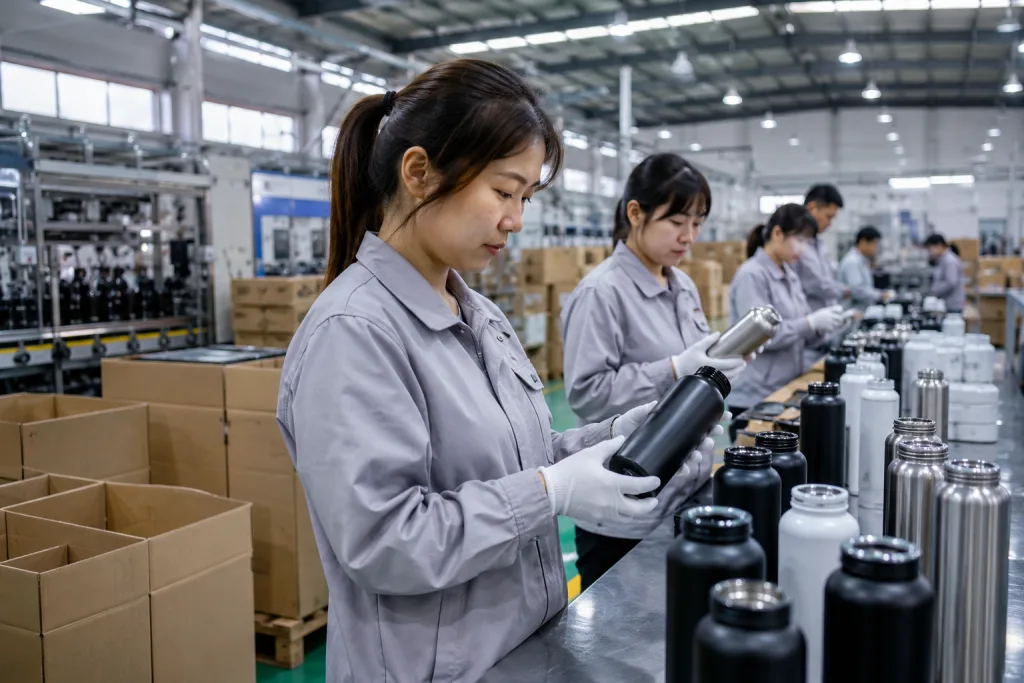
We manufacture stainless drinkware in Hangzhou, Zhejiang, and 8 out of 10 buyer problems we see start before mass production. Not on the line. A custom thermos order needs hard numbers on 304 stainless, inner and outer wall thickness in mm, vacuum performance after 6 hours and 12 hours, coating test method, logo process, 1.2 m carton drop standard, AQL 2.5, MOQ, and FOB Ningbo or Shanghai terms. If the supplier only says “good quality,” push back. We’ve seen this go sideways when a PO typo changed 0.5 mm to 0.4 mm and the math didn’t work after tooling was opened.
Capacity Is Not Just Milliliters
Buyers usually start with the capacity line: 350 ml, 500 ml, 750 ml, 1,000 ml. Fair enough. On a factory-direct thermos project, that number also drives tooling choice, carton cube, shipping cost, and whether the bottle fits a car cup holder or a backpack side pocket. We see outdoor retailers push for 750 ml and 1,000 ml because those sizes look right on a hiking wall. Promo buyers usually stay with 500 ml because the landed unit price still passes the spreadsheet test. The line checks this early with a 0.1 g scale and a graduated cylinder, not by reading the catalog.
Ask your thermos factory for three measurements, with photos if possible: full brim capacity, practical fill capacity under the stopper, and outside dimensions in mm. A 500 ml bottle might take 530 ml at full brim but only 500 ml safely before the lid gasket touches water. Small gap. Big trouble. If you sell through Amazon or a distributor thermos program, that gap shows up fast because buyers flag “does not hold the advertised volume” in reviews and return notes. QC pulled one 500 ml sample last year at 492 ml practical fill, and we had to adjust the inner liner drawing before mass production.
Diameter is the second hidden issue. A 74 mm body works with most car cup holders we test on the bench jig. An 85 mm body gives a tougher outdoor look, but the math does not work if your customer wants commuter use in sedans and office cup trays. Height matters for cartons too: a 270 mm bottle can force a taller master carton, raising volume weight even when actual weight stays modest. We have seen this go sideways when a buyer approved the sample by hand feel, then the forwarder charged on CBM because the carton height jumped 18 mm.
At BottleForge Industrial in Zhejiang, we run a normal MOQ of 1,000 units per SKU for a customized thermos color run, with monthly capacity around 600,000 stainless bottles across standard lines. For a new mold, expect a higher starting quantity, typically 3,000-5,000 units, because the first production has to cover tooling setup, trial assembly, and QC fixtures. This is the wrong place to squeeze the factory down to 500 pcs. The mold room still needs CNC time, a leak-test fixture, and at least 30 trial samples before the line can ship clean cartons.
Steel Grade And Wall Thickness
The material line should never stop at “stainless steel.” Too loose. On a factory PO, we want to see 304 stainless steel, or SUS304, for both inner and outer walls. For lower-cost promotional thermos projects, we do see quotes with 201 stainless steel outside and 304 inside; last month QC pulled a 500 ml sample and the XRF gun read 201 on the shell, even though the buyer’s artwork file said “304 body.” 201 outside can pass for dry office use if the buyer accepts the trade-off: it costs less, but it does not handle salty air, wet camping gear, or 90 days in a humid warehouse as well as 304.
For Europe and North America, we run 304 inner wall as non-negotiable. Don’t bargain with the liner. If the product touches coffee, tea, or sports drinks, the math doesn’t work when a complaint costs more than the steel saving. You may need LFGB, FDA food-contact documentation, or REACH compliance depending on your market and coating; our lab pack usually includes the steel test report, coating report, and a sample seal photo from the carton before shipment. If a thermos supplier cannot tell you what steel is used inside, you are not buying a spec; you are buying a hope.
Wall thickness is where the quote often hides cost. Common outer wall thickness is 0.4-0.5 mm for standard stainless vacuum bottles. A lighter 0.35 mm wall saves material, but it dents faster; we have seen a 1.2 m drop test leave a flat spot that the buyer flagged right away. A heavier 0.6 mm wall gives better hand feel and dent resistance, but carton weight climbs, and freight cost follows. Inner wall thickness is often around 0.3-0.4 mm. For outdoor retail, 0.5 mm outer wall is a sensible target. For a one-event promotional thermos, 0.4 mm may be enough.
Ask about welding method and polishing before you approve the pre-production sample. The seam should be clean, the inner surface should be electropolished or properly passivated, and the mouth rim should not have sharp edges; on the line we check the lip with a cotton wipe because a burr will snag it in one pass. Small test. Big warning. A custom thermos with a nice logo still fails if the lip feels unfinished.
Vacuum Performance And Heat Claims
“Keeps hot for 12 hours” is not a complete technical claim. Ask for the test sheet. A proper thermos factory should state starting water temperature, room temperature, fill level, cap torque, and measured temperature after 6, 12, and 24 hours. On our line, QC records cap closure with a 0.6 N·m torque driver because one loose stopper can make a good bottle look bad. Without those conditions, two quotes that both say “12 hours hot” can be different products.
For a 500 ml stainless vacuum bottle, we run a practical benchmark with 95°C hot water in a 20°C test room. After 6 hours, 8 out of 10 good narrow-mouth bottles should still read above 65°C; after 12 hours, above 45°C is normal depending on mouth diameter and cap structure. Cold retention is easier to sell on a carton claim, but the test method still decides the number. Wide-mouth bottles lose heat faster than narrow-mouth bottles because the cap area is larger. QC pulled one 500 ml sample last month with a 58 mm mouth, and the buyer flagged the 12-hour result even though the weld and vacuum were fine.
The vacuum process is the heart of a thermos manufacturer line. After forming and welding, the double-wall body is evacuated and sealed on the vacuum brazing station. Some factories add copper plating between walls to improve thermal reflection. That can improve insulation but adds cost, usually around USD 0.10-0.25 per unit depending on size. For a promotional order at 3,000 pcs MOQ, the math often does not work. For an outdoor retailer selling at a higher shelf price, specify it and ask the factory to mark it on the BOM, not just the sales quote.
Leak testing and vacuum testing should be written into the QC plan. We use 100% leak inspection on assembled bottles, then sample vacuum retention checks per batch before final AQL inspection. Typical final inspection uses AQL 2.5 for major defects and AQL 4.0 for minor defects, unless your brand manual requires stricter levels. On the packing table, we run an upside-down leak test for 30 minutes, and QC logs any wet inner carton as a major defect. If your thermos vendor says “we check everything” but cannot name the test, push back.
Lid Structure Drives Complaints
The cap costs less than the bottle body, but it creates 7 out of 10 complaint emails we see on custom thermos orders. Pick the drinking habit first, then pick the lid. A screw stopper with a cup cap works for camping sets and work trucks because the seal face is simple; we check it with a 0.20 mm feeler gauge during first-piece QC. A flip lid is quicker for commuters, but the hinge pin and spring add two failure points. A push-button lid looks premium, then the math doesn't work if the silicone gasket tolerance drifts by 0.3 mm. A straw lid is not for boiling water. Do not sell it that way.
Food-contact parts need to be written on the PO: PP, Tritan, silicone gasket, or stainless insert. Ask if the gasket comes out for washing, and ask for a photo of the gasket groove before sampling. Outdoor buyers push back on this because milk coffee, protein drinks, and sweet tea leave odor when liquid sits under the plug for 12 hours. Promotional brands care too; a USD 4.20 bottle still becomes a refund claim when QC pulled the sample, filled 350 ml, laid it sideways, and found tea inside the polybag after 18 minutes.
Regional compliance is not paperwork to leave until the carton marks are printed. For children’s bottles, ASTM and CPSIA may apply in the U.S., and small-part risk needs attention; we have had a buyer flag a pull tab because it failed a small-parts cylinder check. For adult stainless thermos products, LFGB or FDA food-contact testing is common. REACH may apply to coatings, plastics, and colorants entering the EU market. A China factory can prepare test samples, but choose the test standard before mass production, not after the forwarder has already booked ETD Ningbo for Friday.
For a distributor thermos line, keep spare lids available. A practical spare lid ratio is 1-2% of order quantity, packed separately in a marked inner carton, not mixed into the master carton where the warehouse team misses it. It costs little and lets your sales team close a leak claim in 3 days instead of waiting 28 days for the next container. If you are building a long-term customized thermos program, do not change lid molds every season unless there is a real product reason; we’ve seen this go sideways when the bottle body stayed 74 mm wide but the new lid skirt measured 74.6 mm.
Finish, Logo, And Print Limits
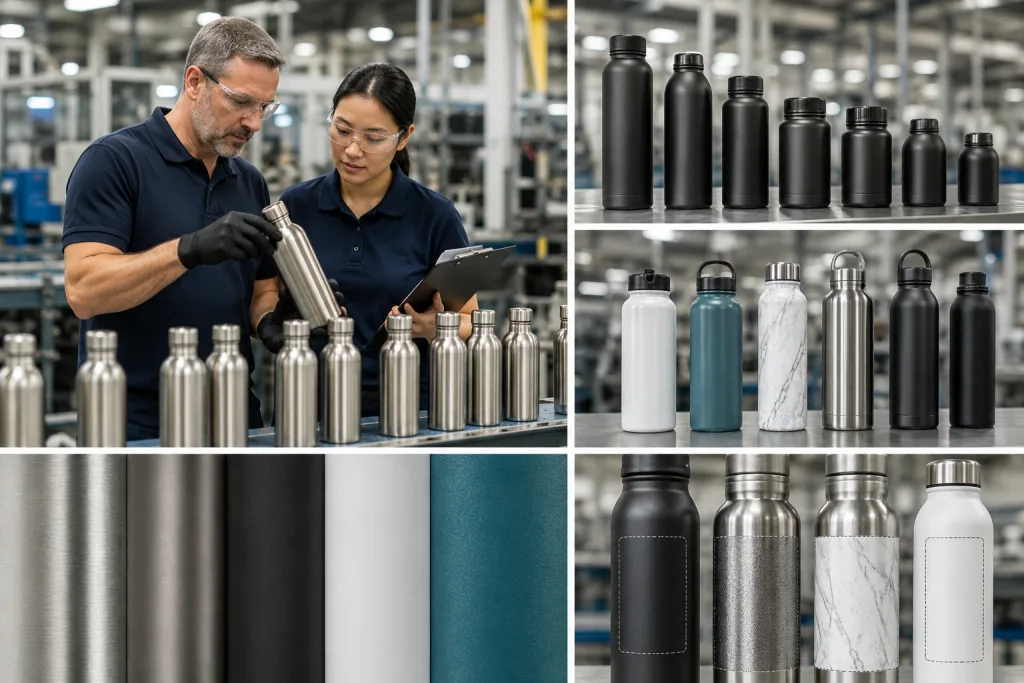
Surface finish changes shelf value more than buyers expect; I’d say 7 out of 10 retail buyers judge the bottle by the coating before they ask about vacuum performance. Plain stainless is durable and keeps the math clean. Powder coating gives the outdoor look retailers ask for, but the abrasion standard must be written down. We run cross-hatch adhesion with a 3M 600 tape pull and a simple rub test before mass packing. For hard use, ask for coating thickness, usually around 60-90 microns, and confirm matte, semi-matte, or glossy. QC pulled one matte black sample last month at 52 microns. It failed on the bottom edge.
Color matching is where projects drift. Pantone on powder coat is not paper printing, and this is the wrong question to ask if the buyer says, “Can you match it 100%?” A tolerance of Delta E 1.5-2.5 is realistic depending on pigment and finish. Dark colors are easier. Pale colors and metallic shades cost more, and neon orange shows dust specks fast under the line lamp. On one PO, the buyer wrote “Pantone 186C” in the email but “186U” on the artwork file; QC flagged it before we sprayed the first 12 trial bodies. If your promotional thermos campaign depends on an exact brand color, approve a physical color chip, not only a PDF.
Logo method should follow the finish. Laser engraving works well on coated bottles because it removes the coating and exposes 304 stainless underneath. Silk screen is cheaper for simple one-color artwork, but it scratches if the operator skips surface cleaning or the curing tunnel runs low. Heat transfer handles full-color artwork, though setup time jumps and the math doesn't work for rough outdoor use. For a thermos promotional order of 1,000 units, one-color silk screen might add USD 0.08-0.18 per unit; laser engraving often adds USD 0.15-0.35 depending on size and position. We ship samples with a 10 mm tape rub mark checked near the logo, because buyers always rub that spot first.
For a customizable thermos range sold by distributors, define the logo area in millimeters. Don’t write “front logo.” Write 45 mm wide by 60 mm high, centered 35 mm below the shoulder. That one line saves 2 days of artwork back-and-forth and prevents layout arguments between the buyer, sales rep, and factory artwork team. We’ve seen this go sideways when the PO says “logo on cup” and the AI file puts it 18 mm too low, right where the bottle curve starts.
Packaging, Cartons, And FBA Reality
Packaging is not just decoration. It decides damage claims, warehouse handling, shelf look, and whether the compliance label passes the first check. A factory direct quote should say clearly: white box, kraft box, color box, belly band, or retail gift box. For thermos bulk shipments to distributors, we often run a plain kraft box with a 0.8 mm E-flute insert, because the math works and the buyer only cares about clean cartons. For outdoor retailers, a printed color box with barcode, warning text, capacity, and material statement usually moves better on the shelf. Last month QC pulled the sample because the PO said “matte black box,” but the artwork file was named “mat black.” Small typo. Big delay.
Master carton strength matters. A typical 500 ml stainless bottle might pack 24 units per carton, with a carton weight around 10-13 kg depending on bottle weight and packaging. For heavier 1,000 ml bottles, 12 units per carton is more practical. Ask for a 5-ply export carton if the route includes LCL sea freight, 2 or more warehouse transfers, or courier delivery. We run a quick drop check on corners, edges, and faces using a 76 cm drop height for this type of bottle, even when the buyer does not pay for a formal ISTA test. Cheap cartons are the wrong place to save USD 0.18.
If you sell through Amazon, plan the carton and unit labels before packing starts. FNSKU labels, suffocation warnings for polybags, country of origin marking, and carton weight limits are not small details. A thermos suppliers team in China can apply labels, but wrong label placement can delay receiving by 12 days vs 2 days on a clean inbound. We have seen this go sideways when the buyer sent 6 FNSKUs for 5 colors, and the line had to stop while QC checked every SKU against the packing list. For a direct-to-FBA order, we normally ask for the shipment plan before final packing so carton labels match the warehouse assignment.
Custom packaging also affects schedule. Artwork confirmation often adds 3-5 days. Color box printing and proofing can add 7-12 days before mass packing. If you are launching before a spring outdoor season or a Q4 promotional campaign, approve packaging before bottle production finishes. Waiting until the goods are ready is how buyers lose a vessel booking. We ship from Ningbo often, and a missed cut-off can turn a planned 18-day sailing into a 26-day arrival once the next vessel and warehouse slot are counted.
Price Lines Worth Challenging
A vacuum bottle factory direct quotation should never land as one vague number. Ask for unit price, MOQ, sample cost, tooling cost if any, logo cost, packaging cost, inner carton or master carton specification, lead time, payment term, and trade term. FOB Ningbo or FOB Shanghai are normal for a Zhejiang factory. EXW can look lower on paper, but then you carry inland trucking, export handling, and customs work yourself. On our packing table, the master carton spec gets checked against the PO before we ship.
As a rough 2026 factory thermos reference, a 500 ml 304 stainless vacuum bottle with powder coating and one-position logo may sit around USD 3.20-5.20 FOB China depending on wall thickness, lid type, coating, packaging, and order quantity. A heavier 750 ml outdoor bottle may run USD 4.60-7.50. Treat those as sanity-check ranges, not a quote to build your budget on. At the sample bench, QC pulled the bottle and checked the 0.35 mm wall gauge before release. Steel prices, exchange rate, and accessory design all move the number.
MOQ should follow the real bottleneck. Body shape MOQ may be 1,000 units. Custom powder color may require 1,000-2,000 units. Printed color boxes may need 1,000 or 3,000 pieces depending on the printer. A thermos manufacturers quote with one MOQ for everything is hiding separate minimums that show up later. This is the wrong question to ask. Ask which line sets the floor: the mold shop, the powder booth, or the box printer. We have seen buyers get burned when the lid mold and bottle body were treated as one number.
Lead time should be broken down too. Standard sample with logo: 5-7 days. Pre-production sample with custom color: 10-15 days. Mass production after deposit and sample approval: usually 30-45 days for 1,000-5,000 units. Larger distributor thermos programs may need staggered shipment dates. The spray line needs cure time, and a new powder color can add 2 days before the first full run is clean. The best suppliers thermos quote is not the cheapest first email; it is the one that tells you which spec line will cause trouble before the buyer flags it.
Send Your Thermos Spec For Factory Review
Share capacity, finish, logo, packaging, and target market. We will check feasibility, MOQ, lead time, and FOB China pricing.
Frequently asked questions
What MOQ should I expect for vacuum bottle factory direct orders?
For standard stainless thermos shapes, expect 1,000 units per SKU for a normal custom logo order. If you need a custom powder coat color, many China factories set MOQ at 1,000-2,000 units because coating lines and powder suppliers have setup minimums. New mold projects usually start around 3,000-5,000 units, plus tooling cost. Printed color boxes may have a separate MOQ, often 1,000 or 3,000 pieces. If a supplier offers 100 units factory direct with full customization, check whether it is trading stock, digital print only, or a higher unit price that already absorbs setup waste.
How do I compare two bulk thermos quotes fairly?
Build a line-by-line comparison. Match capacity, steel grade, outer wall thickness, lid material, coating type, logo method, packaging, carton quantity, AQL level, and trade term. A USD 3.60 quote may be worse than a USD 4.10 quote if it uses 201 outer steel, 0.35 mm wall, thin coating, and EXW terms. For thermos bulk orders, also compare carton cube because freight can change landed cost by 5-12%. Ask both suppliers to quote FOB Ningbo or FOB Shanghai, then request gross weight, carton size, and units per carton.
Is laser engraving better than silk screen for a promotional thermos?
Laser engraving is usually more durable, especially on powder-coated bottles, because it removes the coating and exposes the stainless layer underneath. It works well for outdoor retailers, corporate gifts, and distributor thermos lines that need a premium, permanent mark. Silk screen is cheaper for simple one-color logos and can be good for short promotional campaigns, but it depends on ink adhesion and curing. For 1,000 units, silk screen may add USD 0.08-0.18 per unit, while laser may add USD 0.15-0.35. If the bottle will be washed often or used outdoors, laser is the safer choice.
What compliance documents should I ask a thermos supplier for?
For Europe, ask about LFGB food-contact testing, REACH for coating and plastic components, and migration test reports for the inner stainless surface and lid materials. For the U.S., FDA food-contact compliance is common, and children’s items may need CPSIA and ASTM review. Also ask whether the factory has BSCI, ISO 9001, or similar audit records if your retailer requires social or quality documentation. Test reports should match materials and colors close to your order. A three-year-old report for a different lid is useful background, not proof for your exact customized thermos.
How long does a custom thermos order take from China?
A realistic timeline is 5-7 days for a logo sample on an existing bottle, 10-15 days for a pre-production sample with custom color, and 30-45 days for mass production after deposit and approval. Add 7-12 days if you need printed packaging proofing before packing. Sea freight to Europe or North America can add 25-45 days depending on port and season. Air freight is faster but often makes sense only for samples or urgent partial shipments. In Zhejiang, we plan production slots after deposit, approved artwork, and confirmed packaging files, not after the first inquiry.