Key Takeaways
- A realistic custom stainless thermos MOQ starts around 1,000 units per color for stable factory pricing
- 304 stainless steel at 0.4-0.5 mm wall thickness is the normal baseline for distributor-grade bottles
- Laser engraving usually beats silk screen for outdoor retail use, while UV print suits promotional thermos campaigns
- AQL 2.5/4.0 inspection plus 24-hour leak and heat-retention checks catches most costly shipment failures
If you sell outdoor gear or promotional drinkware, a stainless thermos looks simple until the PO lands 9 days late, the logo fails a 3M tape test, or the lid leaks after a 1.2 m carton drop. The steel body is not where distributors usually bleed margin. The damage comes from loose specs, rushed samples, and lead times promised at 18 days when the line needs 26 days.
At our Hangzhou, Zhejiang export desk, buyers from Europe and North America usually ask 3 questions: what MOQ we run, which logo process survives daily use, and how much QC is enough before shipment from China. Fair questions. The wrong question is asking only for the lowest unit price. A solid distributor thermos program starts with 304 stainless checked by caliper, vacuum performance we can repeat, and packaging that does not collapse when QC pulls 5 cartons from the stack.
Start with the buyer question
Q: What should vacuum bottle distributors define before asking for a quote? Start with the product job, not the catalog photo. A bulk thermos for a ski shop, a bank campaign giveaway, and an outdoor retail shelf item do not belong in the same RFQ. The math changes fast: capacity, lid structure, coating thickness, logo process, packaging spec, and compliance route all move the unit cost. We had one buyer send a PO marked “matte balck” on 500 ml bottles, then ask why the pre-production sample did not match their Pantone black swatch. Small detail. Big delay.
For stainless thermos orders, the first clean RFQ should include capacity, target FOB price, estimated annual volume, logo colors, carton requirements, and destination market. If you only ask for “500 ml custom thermos, best price,” a thermos supplier in China will quote the lowest safe-looking version: thinner paint, basic PP lid, and plain white box. That works for a giveaway. It fails fast on outdoor retail shelves when the buyer opens 12 cartons and QC pulls samples with scuffed coating around the bottom radius. We run coating checks with a cross-cut tester and tape pull before mass packing, but the spec has to be clear first.
Use this simple pre-quote checklist:
- Capacity: 350 ml, 500 ml, 750 ml, 1,000 ml, or a mixed assortment with the quantity split shown for each size.
- Steel: food-contact 304 inner wall, 201 or 304 outer wall depending on price target and dent-risk tolerance.
- Finish: powder coating, spray paint, electro-polish, or raw brushed steel, with target color code and surface feel confirmed on a sample cup.
- Logo: laser engraving, silk screen, heat transfer, UV print, or full-wrap, plus artwork size in mm.
- Market: EU, UK, US, Canada, or mixed compliance route, so the factory knows whether to prepare FDA, LFGB, or other test planning.
- Channel: outdoor retail, corporate gifting, Amazon FBA, or distributor warehouse, since carton drop strength and barcode labeling are not the same job.
A serious thermos manufacturer can then give a quote that helps buying decisions, not just a cheap number. At BottleForge Industrial in Zhejiang, our standard custom stainless thermos MOQ is usually 1,000 units per color, with pilot orders discussed case by case when the mold and color are already on the line. Asking for the cheapest price first is the wrong question to ask. Tell us the channel, the target margin, and the failure you cannot accept; then we can quote the bottle you can ship twice, not once.
Material specs that actually matter
Q: Is “stainless steel” enough as a specification? No. Too loose. On a manufacturer thermos order, write the steel grade and the food-contact surface on the PO: inner wall 304 stainless steel, outer wall 201 or 304 stainless. Most retail vacuum bottles we run use 304 stainless steel inside because coffee, tea, salt water, and mild acidic drinks punish cheaper steel faster. For price-sensitive gift programs, 201 stainless steel on the outer wall can work, but outdoor buyers usually push for 304/304 construction; last April one EU buyer flagged “201 outside” during artwork approval because their sales team did not want to explain it to stores.
Wall thickness matters. A normal distributor-grade vacuum bottle starts with about 0.4-0.5 mm stainless steel before stretch forming. Too thin, and cartons come back with dent claims after courier drops from 80 cm. Too thick, and the math doesn't work: you pay extra steel and higher shipping weight, while heat retention barely moves. For a 500 ml customized thermos, a finished unit weight around 280-330 g is common depending on lid design and coating; QC pulled one 312 g sample last week because the powder coating added 18 g against the approved sample.
Vacuum performance is not only steel. The vacuum gap, copper plating, welding control, and base sealing process all change heat retention, and this is where cheap quotes go sideways. A practical test for a 500 ml thermos customized for retail is hot water at 95°C, measured after 6 hours and 12 hours in a 20°C room. We usually see good stainless bottles hold above 68°C after 6 hours, with the test rack checked by a digital probe thermometer. Claims like “keeps hot for 24 hours” need a written test method, not a nice line on the color box.
For Europe, ask your thermos suppliers for LFGB or EU food-contact documentation when required. For the US, FDA food-contact expectations and California Prop 65 review may matter. REACH can apply to coatings, inks, and external components, so ask which exact parts were tested: silicone ring, powder coating, ink logo, plastic lid. If your thermos vendor cannot answer that from a test report number, you are not buying a controlled product; you are buying hope in a carton.
Customization choices without guesswork
Q: Which logo method should a thermos distributor choose? Start with the sales channel and how rough the bottle will be treated. For outdoor retail, we run laser engraving first in 8 out of 10 sample requests because it cuts through or marks the coating and will not peel like ink after a few weeks in a truck cup holder. It suits one-color logos, club names, and hard-use branding. Full-color artwork is the limit. The laser head also needs a clean vector file; last month QC pulled a sample where a 0.35 mm line in the mountain logo filled in after engraving.
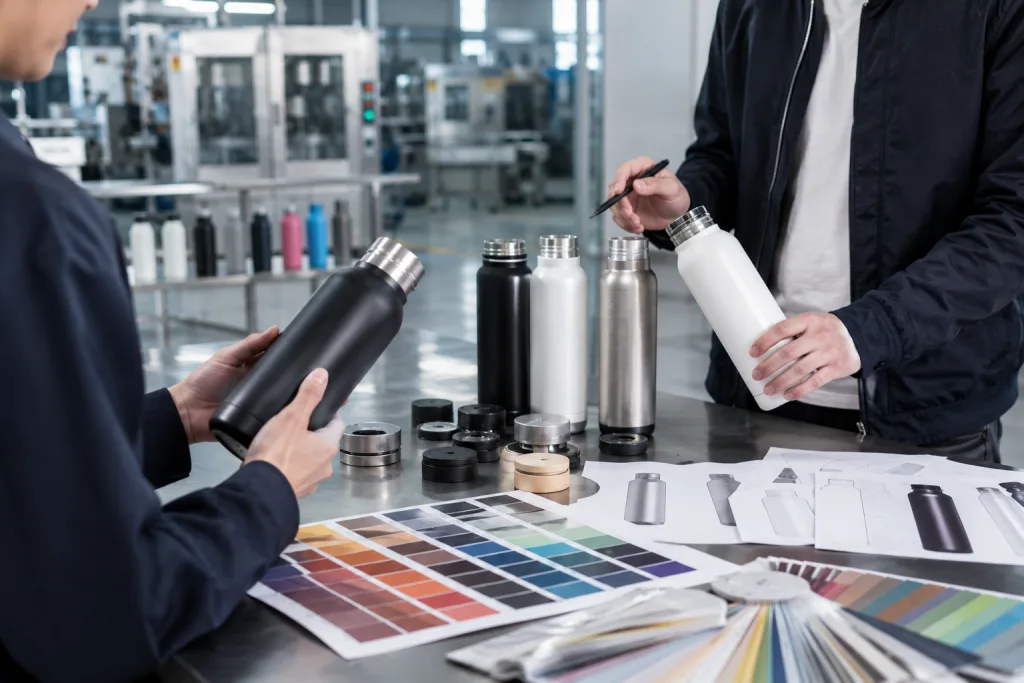
Silk screen keeps the unit cost down on larger runs, especially above 3,000 pcs with a simple front logo. It prints well on smooth powder coating, but the ink and oven curing decide whether it passes. Cheap ink fails fast. We test with 3M tape and a 50-rub alcohol wipe when the buyer asks for barware or gym use, and we have seen promo jobs go sideways when the sample looked fine but the mass batch scratched under a fingernail. UV print and heat transfer give better color, gradients, and event artwork. They sell well in a proposal deck, but they need signed approval samples and abrasion testing before the line starts.
For a customizable thermos program, the wrong question is “how many colors can we offer?” Ask what the warehouse can reorder without pain. A clean platform might use the same 500 ml and 750 ml body, 3 coating colors, 2 lid styles, and 2 logo positions. That gives distributors room to sell without turning production into a sorting job. Once buyers split 4 colorways under 1,000 units each, the math gets ugly: coating changeover takes about 45 minutes, carton labels multiply, and mixed-color mistakes show up during final packing.
Here is the practical logo checklist we use before sample approval:
- Logo file: AI, PDF, or SVG vector file, not a low-resolution JPG; our prepress desk rejects anything under 300 dpi for bitmap artwork.
- Print area: measured in mm, with position from bottle base or centerline; we mark it on a wrap template before making the sample.
- Color control: Pantone code for coating and printed logo; “same as last order” is not enough if the PO has a typo.
- Durability: 3M tape test, 50-rub alcohol test where relevant, and scratch review with the retained golden sample beside it.
- Retail view: logo visible when bottle sits in the box, sleeve, or display tray; the buyer flagged this once after the sleeve covered 18 mm of the mark.
The best thermos custom projects feel boring at approval stage. Good. By then the artwork, color, position, and test method are locked, and everyone knows what we ship.
MOQ, pricing, and lead time
Q: What is a normal price and MOQ for thermos bulk orders? For a standard 500 ml stainless vacuum bottle, FOB China pricing usually lands at USD 3.20-6.80 per unit, depending on steel grade, lid parts, coating, logo method, carton spec, and test requirements. We check this on the quote sheet, not by guesswork. A 1,000 ml outdoor bottle with a handle lid, powder coating, and 5-layer export carton will price higher, especially if the lid has a silicone carry loop or locking button. A basic corporate promotional thermos can price lower when the buyer accepts plain white box packaging and 1-color silk screen logo.
MOQ is not a punishment. It is how coating, printing, material purchasing, and line changeover stop wasting money. For our Hangzhou, Zhejiang production network, a typical MOQ is 1,000 units per color for existing molds, 3,000-5,000 units for custom color development, and higher if you need a new lid mold. The line needs enough bodies to run the powder booth cleanly; changing from matte black to cream white means cleaning guns, hooks, and the recovery filter. A new private mold can add USD 2,000-8,000 in tooling depending on complexity. We have seen buyers ask for 300 pcs in 6 colors, but the math does not work.
Lead time is also less flexible than buyers hope. A realistic schedule is 7-10 days for sampling after artwork confirmation, 30-45 days for mass production after deposit and sample approval, and extra time for third-party testing or BSCI documentation review. During peak China export periods before summer and Q4 campaigns, add 7-14 days of buffer. Our current stainless thermos capacity is about 450,000 units/month across regular bottle lines, but capacity does not help if your Pantone color is approved late. Last month QC pulled the sample because the approved lid logo was 2 mm off-center, and that small miss cost 3 days before the buyer signed the sample card.
Ask suppliers for thermos quotes in a format you can compare: FOB Ningbo or Shanghai, packaging included or excluded, logo method stated, inspection standard stated, and payment terms clear. Do not compare only the unit price. If one thermos factory is 18% cheaper, check whether it removed the inner 304 steel, reduced carton strength, skipped copper plating, or quoted a thinner coating. We have seen this go sideways after shipment, when a buyer flagged dented cartons under AQL 2.5 and the “cheap” quote had used 3-layer cartons instead of 5-layer. The lowest line item can become the most expensive claim.
Quality control before the carton
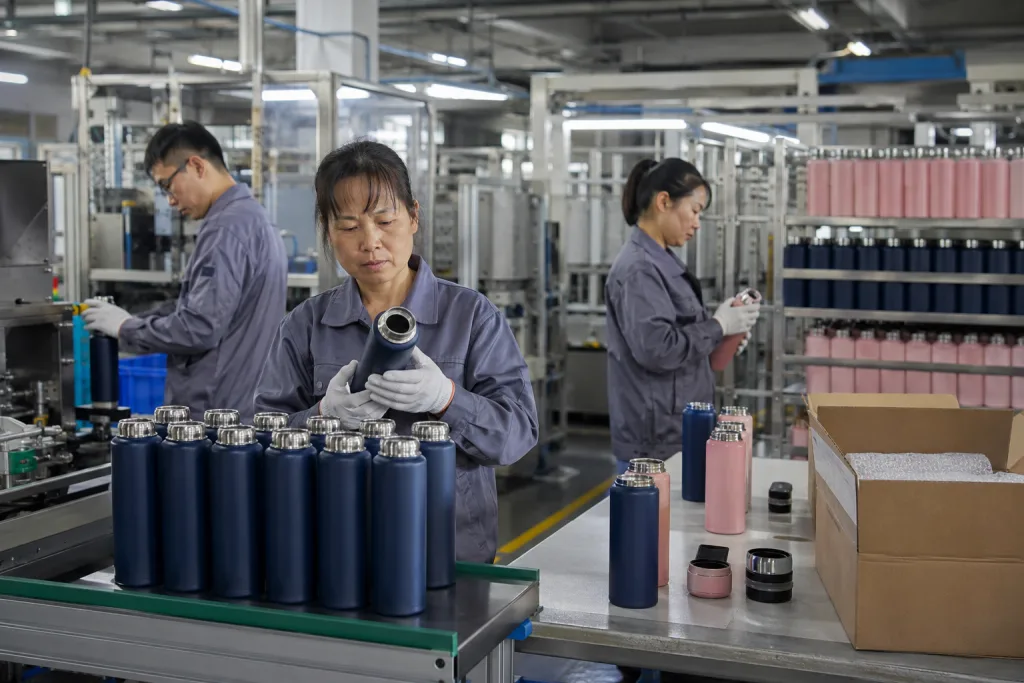
Q: What inspection should vacuum bottle distributors require? Treat inspection as a process control sheet, not a WeChat photo sent 2 hours before loading. On a 5,000 pcs thermos order, we run checks at 304 stainless coil receiving, laser welding, vacuum pumping, powder coating, logo printing, lid assembly, and final packing. Once the master cartons are taped with 48 mm BOPP tape, fixing a bad weld or weak vacuum is already expensive.
For final inspection, AQL is still the shared language buyers and factories understand. Most distributor thermos buyers we ship for use AQL 2.5 for major defects and 4.0 for minor defects. Critical defects get zero tolerance: leaking, 0.3 mm sharp metal burrs, oil contamination inside the liner, cracked lids, or unsafe odor after a 95°C rinse. The inspection lot should include function testing with water, appearance review under a D65 light box, barcode scans on 32 random cartons, and packaging checks against the approved carton mark.
For stainless thermos performance, we recommend these checks:
- Leak test: fill to 90%, invert for 10 minutes, then shake 20 times; QC pulled the sample and checks the silicone gasket seat.
- Vacuum check: run a 6-hour heat-retention test or temperature decay sampling from each batch, with readings recorded on the line sheet.
- Coating check: cross-hatch adhesion with 3M tape, scratch review at 30 cm, color matched against the signed sample or Pantone chip.
- Thread fit: open and close the lid 10 cycles on the torque jig; reject cross-threading or a loose first turn.
- Odor check: rinse with hot water, wait 3 minutes, then check the silicone gasket and inner wall before the bottle cools.
For outdoor retailers, dent resistance and lid reliability beat a flawless studio finish. This is where buyers sometimes ask the wrong question. A camping chain once flagged 18 lids in a 1,200 pcs pilot run because the flip button stuck after dust testing, while the powder coat still looked perfect. For a thermos promotional order, logo position and color drift create the complaints; a 2 mm logo shift on a curved body is enough for some brands to reject. Tell your thermos manufacturer what your customer will refuse, then we build the inspection around that risk.
Do not accept a “QC passed” stamp without numbers. Ask for inspection photos, defect counts, tested quantities, temperature readings, and carton dimensions, including gross weight in kg and carton size in cm. We have seen this go sideways when a PO typo changed “white box” to “window box” and nobody checked the packing sample before carton sealing. A thermos supplier who records data is easier to work with when a buyer flags a claim 12 days after delivery instead of 18 days later.
Packaging for retail and promo
Q: Should packaging be designed by the distributor or the factory? Both, but this is the wrong question to ask. Split the job by who owns the risk. We run the dieline in ArtiosCAD, set the carton structure, and offer insert choices with 1.5 mm bleed marked. You own brand order, legal copy, barcode rules, and retail channel notes. We once had a PO with “matte black box” typed as “matt back box”; QC pulled the sample before print, but that small typo would have burned 12 days.
For retail, most distributors choose a printed color box or kraft box; window boxes and molded pulp inserts cost more because the line slows during packing. A 500 ml bottle color box often uses 350 gsm paperboard, with E-flute master cartons for export loads over 14 kg. Promo jobs are different. A plain white box can work for a giveaway, but the math doesn't work when a USD 5.50 customized thermos sits in a weak USD 0.12 box. Buyers notice that.
If your channel includes Amazon or marketplace fulfillment, plan labels before artwork lock. FNSKU blocks, suffocation warnings for polybags, carton weight limits, and scannable barcodes all need clean space, not leftover space near a fold line. Our packing table uses a Zebra 300 dpi printer; if the barcode lands across a carton edge, the warehouse scanner misses it. If your warehouse uses GS1 carton labels, confirm placement and barcode grade before mass print.
Use this packaging checklist before the PP sample leaves Hangzhou:
- Retail box size: confirm after the final lid, handle, and bottle height are measured with calipers, not copied from a catalog photo.
- Carton strength: use a 5-ply export carton for heavier thermos bulk shipments when the packed carton passes 12 kg.
- Drop risk: check corner protection and insert fit with a packed sample; a 6 mm gap can dent the shoulder.
- Labeling: lock SKU, barcode, country of origin, capacity, 304 stainless materials, and care instructions before print plates are made.
- Pallet plan: calculate carton count, gross weight, and CBM before freight booking, then test one pallet with stretch film on the line.
Packaging is not decoration. It is product, freight, and warehouse handling in one line item. We have seen this go sideways: a carton saved USD 0.04 per unit, then failed at receiving because the hand pallet jack crushed the bottom layer.
How to compare suppliers
Q: How do you compare thermos suppliers without choosing the cheapest mistake? Put every thermos quote into one grid before you look at the unit price. We run columns for steel grade, capacity tolerance in ml, wall thickness in mm, coating type, logo method, lid material, gasket material, packaging, inspection standard, payment terms, FOB port, and production lead time. A 500 ml bottle with 0.45 mm outer wall is not the same offer as one at 0.38 mm. If a supplier will not write these details on the PI, the quote is not ready for comparison. The cheap line item usually hides somewhere else.
Factory audits matter for promotional brands selling to corporate clients. BSCI, Sedex, ISO 9001, and factory social compliance records may be required by your end customer, and the buyer will flag missing scope fast. Not every good China thermos factory holds every certificate, but a serious export partner should say exactly what is available, what expired, and what does not apply to that product. Watch phrases like “we can pass all tests.” Real compliance has report numbers, lab names, test dates, and product scope. Last month QC pulled a sample for a buyer who asked for LFGB on the lid gasket, not just the stainless body.
For a first order, do not overload the project. Pick 1 or 2 capacities, one lid, and 3 to 5 colors the powder-coating line can hold without constant changeover. Confirm samples in writing with photos, caliper measurements, carton marks, and signed approval. Keep one golden sample at your office and one at the factory. Simple works. That sample becomes the argument stopper when mass production starts, especially when someone says the black looks “a little warmer” under warehouse lighting.
At BottleForge Industrial, we prefer buyers who ask hard questions before deposit. It saves both sides time, and we have seen this go sideways when the PO says “same as sample” but the sample code is typed wrong. As a thermos vendor in Zhejiang, China, we can build a custom thermos program for outdoor retailers, promotional brands, and regional distributors, but the best results come when the buyer shares the target channel, acceptable defect level, and repeat-order plan. A thermos distributor does not need a miracle supplier. You need a manufacturer thermos process that repeats the approved sample 5,000 or 50,000 times without drama.
Build your next stainless thermos program with us
Send your target capacity, logo file, quantity, and market. We will return a practical FOB quote, MOQ, sample plan, and QC checklist.
Frequently asked questions
What MOQ should I expect for a custom stainless thermos order?
For existing stainless thermos molds, 1,000 units per color is a realistic MOQ for stable factory pricing. Some suppliers may accept 500 units, but the unit cost usually rises because coating, printing, packing, and line setup are spread over fewer bottles. For a custom Pantone powder coating, 3,000-5,000 units is more normal. If you need a new lid mold or unique body shape, tooling may cost USD 2,000-8,000 and MOQ can move higher. For first-time vacuum bottle distributors, we usually recommend starting with 1-2 proven capacities, such as 500 ml and 750 ml, instead of launching six SKUs at once.
Which stainless steel grade should outdoor retailers specify?
For outdoor retail, specify 304 stainless steel for the inner wall as the baseline. It gives better corrosion resistance for coffee, tea, sports drinks, and normal cleaning than lower-grade material. The outer wall can be 201 stainless steel for cost control, but 304/304 construction is easier to position as premium. Ask the thermos manufacturer to confirm wall thickness, normally around 0.4-0.5 mm before forming for many distributor-grade bottles. Also confirm lid plastic grade, gasket silicone, and food-contact test reports. The steel grade alone does not guarantee a good bottle, but vague “stainless steel” wording is not enough for a serious purchase order.
Is laser engraving better than printing for a promotional thermos?
Laser engraving is better when durability matters more than color. It is a strong choice for outdoor retailers, staff gifts, and long-use products because the mark will not peel off. Printing is better when you need full-color logos, campaign artwork, gradients, or large graphic areas. For a thermos promotional campaign, UV print or heat transfer can look more impressive, but you should approve a production sample and run tape, rub, and scratch checks. For orders above 1,000 units, the logo setup cost is usually not the main issue. The bigger risk is choosing a beautiful decoration method that cannot survive real handling.
How long does production take after sample approval?
For an existing mold with standard materials, plan 30-45 days for mass production after deposit and signed sample approval. Sampling usually takes 7-10 days once artwork, Pantone color, logo size, and packaging are confirmed. Add 5-10 days if third-party lab testing is required before shipment. During China peak export seasons, especially before summer outdoor programs and Q4 promotional campaigns, add 7-14 days of buffer. Freight is separate: sea freight to Europe or North America can take several weeks depending on port and routing. A good purchase plan works backward from your warehouse delivery date, not the factory finish date.
What defects should I reject during final inspection?
Reject any critical defect: leaking lids, sharp edges, rust, unsafe odor, broken caps, contaminated interiors, or missing food-contact markings where required. For normal final inspection, many buyers use AQL 2.5 for major defects and 4.0 for minor defects. Major defects include obvious dents, poor coating adhesion, unreadable logos, wrong color, lid fit failure, or wrong packaging. Minor defects include small cosmetic marks outside the agreed viewing area. For stainless thermos orders, include heat-retention sampling, leak testing, logo position checks, barcode scans, and carton drop review if the channel requires it. Do not rely only on finished-product photos.