Key Takeaways
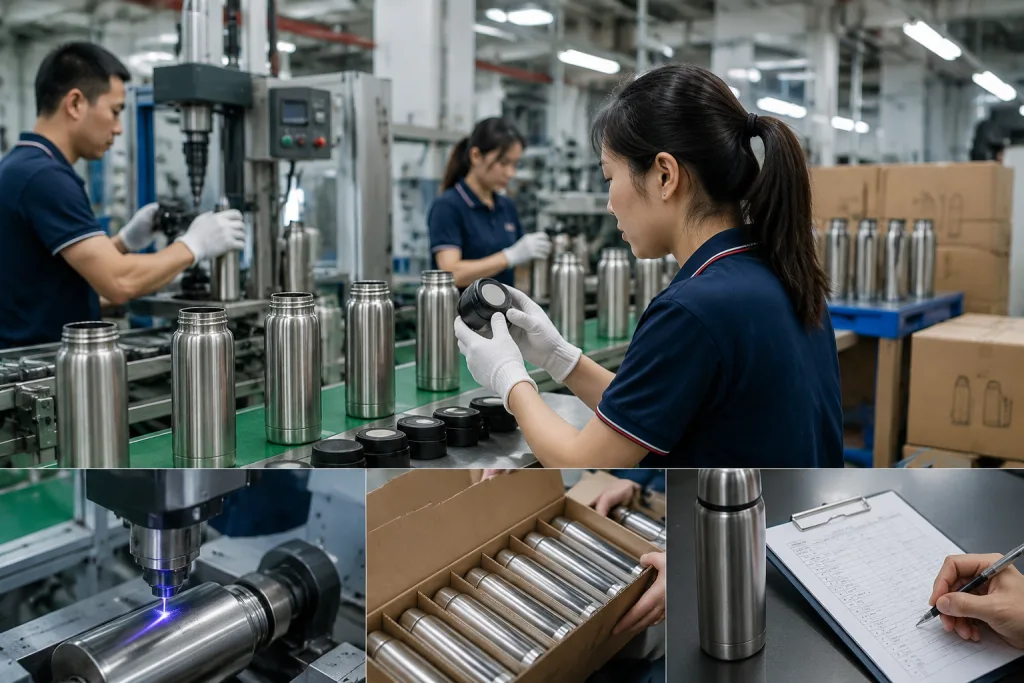
- For bulk thermos orders, set AQL 2.5 for major defects and 4.0 for minor defects before production starts
- 304 stainless steel at 0.45-0.55 mm wall thickness is a practical baseline for most outdoor retail bottles
- BottleForge Zhejiang capacity is 600,000 stainless units/month with typical MOQ from 1,000 pieces per color
- Logo, lid, carton, and vacuum retention failures should be checked separately, not as one general QC line item
A vacuum bottle distributor does not lose money because one sample looks bad. You lose money when 8,000 units land with heat retention at 49°C after 6 hours, logos sitting 2 mm off-center, lids leaking at the silicone ring, or 5-layer cartons going soft in a wet warehouse. QC pulled a 500 ml sample from one line last month and the buyer flagged the same issue too late, after the FOB balance was paid and the launch date was locked.
We run stainless thermos programs in Zhejiang, China, and we have seen this go sideways: weak specs, rushed tooling, and a buyer approving a clean pre-production sample without setting the AQL 2.5 limits. A PO typo like “304 stainless inside” without wall thickness, vacuum test time, or logo tolerance leaves too much room on the line. If you want a custom thermos that sells through cleanly, spec the failure points before the factory starts cutting steel.
Vacuum Loss Starts Earlier Than Buyers Think
The first serious failure in a stainless thermos usually does not show at carton opening: the vacuum layer has already started leaking. We have seen 500 pcs look clean under warehouse light, then lose heat after 7 days on a retailer shelf. The usual culprits are shallow laser weld penetration, oil dust near the mouth weld, pinholes in the inner shell, or a dent from polishing and packing. QC pulled one sample last month where the weld bead looked fine, but the helium leak tester still caught it at the neck. If your supplier thermos quote sits 8-12% below the other offers, ask where the saving comes from: 0.38 mm shell, shorter vacuum testing, or fewer rework rejects. The math often does not work.
For a 500 ml to 1,000 ml vacuum bottle, we normally suggest 304 stainless steel inside and outside, with 0.45-0.55 mm wall thickness for general outdoor use. Some promotional thermos programs can run 0.40 mm or close to it, but do not sell it as the same bottle. It is not. A customizable thermos for camping retail needs better dent resistance than a conference giveaway, especially when buyers press the body near the shoulder with their thumb during approval. On the line, we check body roundness with a simple go/no-go ring gauge before coating, because a 1.5 mm oval body can still pass visually and then fit badly in printed sleeves.
Spec the performance test in numbers. Example: fill with water at 95°C, close for 6 hours at 20°C ambient temperature, and require remaining water temperature above 68°C for a 500 ml bottle, depending on mouth diameter and lid type. Wide-mouth models usually lose heat faster than narrow-mouth models because the lid area is larger and the stopper has more plastic contact. Put that in the purchase order, not just in a WeChat message. We have seen this go sideways when a PO said “keep hot long time” and the buyer later expected 12 hours while the approved sample was tested for 6 hours.
At BottleForge in Zhejiang, China, production includes vacuum pumping and retention screening before packing. Ask any thermos manufacturer how they check it: 100% vacuum check on the line, random retention test by batch, or only sample-based verification before shipment. Those answers are not equal. For distributor orders, we run the vacuum detector before lid assembly, then QC pulls retained samples from packed cartons after 24 hours; one inspection finding we reject fast is a bottle that passes sound check but drops 6°C more than the control sample in the 6-hour test.
Leaks Usually Come From Lid Choices
Most leak claims get blamed on the bottle body. In our Hangzhou line, the lid causes about 7 out of 10 complaints we review after shipment. Flip lids leak at the hinge pin, push-button lids fail around the spring seat, and straw lids often lose seal after the silicone valve is pulled during washing. Cup lids have their own issue: the buyer likes the clean look, then flags drips after a backpack test. A thermos custom project for outdoor retail cannot use desk-mug lid logic. Backpacks squeeze bottles sideways, kids drop them on tile, and warehouse teams stack 18 kg master cartons higher than the carton supplier planned.
When you brief a thermos factory, define the lid material, gasket material, torque feel, and leak test in the PO. We run PP and Tritan lids most weeks; stainless outer cups need a separate check because the rolled edge can scratch if the fixture is set 0.3 mm too tight. Gaskets are usually food-grade silicone, but hardness matters. A soft gasket can flatten after 3 heat cycles; a hard one leaks when cap thread tolerance opens by even 0.2 mm. For hot-fill bottles, we test with 95°C water and invert the closed unit for 30 minutes. For travel use, add a horizontal shake test for 60 seconds. The buyer once wrote “silicon” on the PO, and QC still pulled the sample to confirm it meant silicone, not a decorative coating.
Thread tolerance is the quiet problem that shows up late. If the cap turns smoothly on the golden sample but feels gritty in mass production, the mold, shrinkage rate, or line sorting is probably wrong. We check this with a thread gauge and 10 random caps per color before packing. For a customized thermos with multiple lid colors, test every lid color on every bottle body color if the plastics come from separate batches. This is not overkill. We have seen this go sideways when black lids from Monday fit, but cream lids from Wednesday bind after the parts cooled 12 hours vs 18 hours.
A practical QC line item is simple: no visible leakage after inversion, no gasket displacement, no cracked lid parts, and cap opening torque inside the agreed range. We usually write the torque window in kgf·cm on the inspection sheet, then QC pulled the sample again after carton drop testing. If your thermos supplier cannot explain its lid test, the math does not work. You are not buying a finished product; you are buying hope in cartons.
Logos Fail When Decoration Is Underspecified
Custom logo failures cause the ugliest arguments because both sides point to the approved AI or PDF file and say, “we followed this.” For a promotional brand, the decoration is what the buyer sells. If QC pulls a carton sample and finds the logo leaning 3 degrees, the laser mark too shallow, powder coat flaking at the rim, or PMS 186C drifting toward orange, the bottle may be packed well and still be unsellable. More emails won’t fix it. The right question is simple: can the inspector measure the logo with a steel ruler, angle gauge, and tape test?
For stainless bottles, we run laser engraving, silk screen printing, pad printing, heat transfer, water transfer, UV printing, and powder coating with engraved logo. Each one fails in a different way. Laser engraving lasts, but on champagne gold or brushed silver it can look weak unless the buyer signs off on contrast under normal warehouse light. Silk screen works well for 1-2 color logos, but the line still needs adhesion testing after curing, not just a quick finger rub. UV printing handles gradients; we do not like it for rough outdoor retail programs unless the buyer accepts abrasion test results, because we’ve seen key-scratch complaints come back after shipment.
Put the control points on the PO: Pantone reference, logo height and width in millimeters, centerline distance from the bottle bottom, placement tolerance, and maximum skew. A realistic mass production tolerance is often ±1.5 mm for placement and 1-2 degrees for rotation, depending on bottle shape and fixture. On a tapered 500 ml bottle, our jig may hold the body tight at the bottom but still allow a small twist near the shoulder, so the math doesn’t work if the buyer asks for ±0.5 mm. For powder coating, request a cross-hatch adhesion test and tape pull. For printed logos, add alcohol rub testing and dishwasher guidance if you plan to make dishwasher-safe claims.
Do not approve only a polished showroom sample. Approve a pre-production sample made on the actual line using the actual coating, fixture, and logo method. We ship better when the sample comes from the same fixture rack and the same operator setup, not from a hand-tuned photo sample made for a trade show. For thermos promotional orders, especially seasonal campaigns, one extra 5-day sample cycle is cheaper than arguing over 20,000 pieces with the logo 4 mm too low.
Steel Claims Need Paper And Testing
Every thermos manufacturers quotation says food grade stainless steel. That line will not carry a shipment into Europe or North America. If you are a vacuum bottle distributor selling to outdoor retailers, ask for material declarations, migration test reports, and compliance files tied to the destination market. For an EU order, we usually prepare LFGB or EU food contact migration testing, plus REACH declarations for coatings and plastic parts. For the US, buyers often ask for FDA food contact compliance and, on children’s items, CPSIA and ASTM-related documents. Last month QC pulled a 650 ml sample from the line because the PO said “PP lid,” while the approved sample had a Tritan lid.
The common shortcut is 201 stainless steel on the outer wall instead of 304. It can work for a low-cost promotional thermos program if the buyer signs off, but it is the wrong question to ask if the bottle will sit in salty air, winter road salt, or premium outdoor retail. For the inner wall, 304 stainless steel is the practical default. Some premium programs ask for 316 stainless steel inside; the math does not work unless the brand can charge for it. On our incoming check, the handheld XRF gun will flag a 201 outer shell in about 10 seconds.
Ask the thermos vendor for a material test report that identifies the steel grade by batch. Ask whether the coating passed heavy metal and migration requirements, not just whether it “looks safe.” If a factory says testing is unnecessary because “all customers use this material,” treat that as a red flag. China ships strong drinkware, but compliance still follows the exact bill of materials. We have seen this go sideways when one 0.35 mm inner wall coil was swapped during rush production and the report no longer matched the batch.
For private label programs, keep documents organized by SKU, color, lid type, and production batch. A black powder-coated 750 ml bottle with a PP lid is not automatically covered by the same report as a white UV-printed 500 ml bottle with a Tritan lid. Retailers now check this line by line. One buyer flagged a typo where “matte black” became “mate black” on the PO, and the inspection team held 3,000 pcs until the SKU file matched the carton mark.
Cartons Break Before Bottles Do
About 7 out of 10 thermos complaints we see from distributors are not factory defects. They come from export packing that survives a short China domestic truck run, then fails during 35-45 days of ocean freight, port handling, inland trucking, and warehouse stacking. QC pulled one sample carton last month after the corner-crush tester marked a 14 mm collapse on the bottom edge. Bottles were fine. The cartons were not. Once cartons arrive crushed, good bottles turn into returns because lids scuff, coatings rub, and gift boxes lose retail value.
For thermos bulk shipments, write carton strength and packing method into the PO, not just “standard export packing.” We run a typical retail thermos with an individual polybag or tissue wrap, egg-crate divider, inner box, and 5-ply export carton. For heavier 1,000 ml stainless bottles, do not accept thin cartons just to save USD 0.08 per unit. The math doesn't work when 6% of cartons arrive damaged and your buyer sends photos of flattened master cartons beside a delivery dock scale.
Drop testing should match the selling channel. Promotional brands shipping straight to event venues may only need safe bulk packing in 12 kg master cartons. Outdoor retailers with shelf-ready packaging need clean gift boxes, correct barcode placement, and tighter scuff limits, usually checked under a 600 mm light box on the line. If the order goes to Amazon FBA or a 3PL, agree carton labels, FNSKU labels, suffocation warnings, and master carton dimensions before packing starts. We have seen this go sideways when a PO typo showed 48 x 36 x 32 cm, but the printed carton was 46 x 36 x 32 cm.
Moisture is a boring cost until the buyer flags wavy gift boxes. Zhejiang and coastal China get humid in parts of the year, and containers can sweat when temperature changes. Use dry cartons, avoid packing hot bottles off the coating line, and add desiccants for gift-box programs when cartons will sit 18 days at port instead of the planned 12 days. If your thermos distributor business depends on clean retail presentation, packaging is not an afterthought. It belongs in the product specification.
Production Timing Fails Without Control Points
A thermos schedule on a proforma invoice looks clean: sample, deposit, production, inspection, balance, shipment. The line is not that clean. Steel coil arrival, mold adjustment, powder coating slot, lid injection, logo jig setup, color box printing, and final assembly each run on a separate clock. We had one order where a lid mold insert came back 0.3 mm off on the CMM check, and that 4-day correction pushed the buyer from a 12-day vessel plan to an 18-day sailing option. That is how a retailer window gets missed.
At BottleForge, our typical MOQ starts at 1,000 pieces per color for most stainless thermos models, with higher MOQ for custom mold lids, special powder colors, or fully customized thermos shapes. Standard lead time is usually 25-35 days after sample approval and deposit for repeat models, and 45-60 days for more complex custom thermos projects. Our Zhejiang facility can produce about 600,000 stainless units per month, but capacity still needs to be booked, especially before Q4 promotional seasons. In September, the powder coating line gets packed; last year QC pulled 32 first-off samples in one morning just to lock Pantone matches before mass spraying.
For a thermos supplier relationship, finished goods photos are the wrong control point to ask for. Ask for material arrival confirmation, first-off coating samples with color readings, logo trial photos from the fixture, inline inspection results, and final random inspection booking. Use AQL standards in the purchase order: about 8 out of 10 overseas buyers we ship use AQL 2.5 for major defects and 4.0 for minor defects, with critical defects not accepted. Define critical clearly: leakage, rust inside, sharp edges, wrong capacity, wrong logo, and non-compliant materials. We have seen this go sideways when a PO only said “good quality”; the buyer flagged 500 ml bottles filling at 470 ml during an inline water-fill check.
FOB Ningbo or FOB Shanghai terms are common from Zhejiang, China. Confirm the named port, carton count, gross weight, and ready date before you sell inventory downstream. Small line, big risk. A 1,000-piece order can still miss a launch if the carton mark has one PO digit wrong or the gross weight changes after thicker inserts are approved. A good thermos manufacturers partner will welcome clear checkpoints because they stop last-minute blame.
Send your stainless thermos brief for factory review
Share capacity, lid, logo, quantity, and market. We will flag production risks and quote a practical FOB China specification.
Frequently asked questions
What MOQ should a vacuum bottle distributor expect for custom stainless thermos orders?
For existing molds, a realistic MOQ is usually 1,000 pieces per color, although some simple bulk thermos programs can start at 500 pieces if you accept standard colors and packaging. Custom powder coating, special lids, gift boxes, or Pantone-matched parts normally push MOQ to 2,000-3,000 pieces. A fully custom body or lid mold can require 5,000-10,000 pieces because tooling, testing, and production setup costs are higher. If a thermos vendor offers 100 pieces with full customization at a very low price, check whether it is trading stock, not factory production.
How much does a custom thermos cost from a China factory?
For FOB China pricing, a basic 500 ml stainless vacuum bottle may land around USD 3.20-5.50 depending on steel thickness, lid type, coating, logo, and packaging. A premium 750 ml outdoor bottle with powder coating, laser logo, and retail box may run USD 5.80-9.50. Tooling, compliance testing, and special packaging are usually separate. Prices move with stainless steel, exchange rate, and order quantity. Always compare itemized quotes: body, lid, decoration, carton, testing, and inland freight if not FOB Ningbo or Shanghai.
Which logo method is best for promotional thermos programs?
For durable outdoor use, laser engraving on powder coating is usually the safest choice because it resists abrasion and does not peel. Silk screen printing is cost-effective for 1-2 color logos and works well for corporate promotional thermos campaigns, but it needs adhesion and rub testing. UV printing is better for gradients or full-color artwork, though it is more sensitive to scratching. For mass production, ask for a pre-production sample and set placement tolerance, such as ±1.5 mm, before approving 5,000 or 20,000 units.
What inspections should I require before shipping thermos bulk orders?
Use a final random inspection based on ISO 2859-1 sampling, with AQL 2.5 for major defects and 4.0 for minor defects. Critical defects should be zero tolerance: leakage, rust inside, sharp edges, cracked lids, wrong material, and unsafe packaging. Add functional checks for vacuum retention, cap fit, coating adhesion, print alignment, barcode scanning, carton drop resistance, and capacity. For large thermos bulk orders above 10,000 pieces, add inline inspection after 10-20% production so problems are caught before all units are coated or printed.
Can one thermos supplier handle both outdoor retail and promotional brands?
Yes, but the specifications should not be identical. Outdoor retail usually needs stronger coating, better dent resistance, cleaner packaging, and more compliance paperwork. Promotional brands may prioritize unit cost, logo accuracy, event delivery date, and carton labeling. A capable thermos supplier can run both, but you should create separate QC standards. For example, a retail bottle may require 0.50 mm outer wall thickness and gift box scuff limits, while an event giveaway may accept simpler bulk packing and a lower-cost lid.