Key Takeaways
- Pantone powder coating usually needs 1,000 pieces per color and 7-10 days for lab dip approval
- Laser engraving is cleaner than silkscreen on textured coatings but limits color expression
- For outdoor retail, 304 stainless steel with 0.4-0.5 mm inner wall is the practical baseline
- Use AQL 2.5/4.0 inspection and approve golden samples before releasing thermos bulk production
A vacuum bottle custom pantone job looks easy on the PO until QC pulls the first lab dip under a D65 light box and it reads 15% too dark, the silk-screen logo has a soft 0.3 mm edge, or the buyer flags the cap because it sits one shade off the body. For outdoor retailers and promo brands, color is not decoration. It is shelf recognition and campaign consistency, and sometimes it is the reason the buyer signed off the range.
Set four items before we run the line: the stainless thermos structure, the Pantone coating method, the decoration process, and the inspection standard. BottleForge Industrial manufactures in Hangzhou, Zhejiang, China, with monthly capacity around 650,000 stainless drinkware units and practical MOQ from 1,000 pieces per color for standard custom thermos programs. We have seen this go sideways when a PO says “blue” instead of a Pantone code, then the buyer expects the cap, body, and silicone ring to match after 18 days of sampling.
Start With Four Buying Decisions
Most problems in a vacuum bottle custom pantone order start with the sequence. Buyers send us a Pantone number and an AI logo file first. Fair enough. But this is the wrong place to start. On the factory side, we run the project from four buying decisions: capacity and construction, coating type, decoration process, and inspection tolerance. Last month QC pulled a 750 ml sample where the PO said “mat black” instead of “matte black,” and that one typo delayed color approval by 3 days.
Capacity changes the price and the way the color looks. A 500 ml slim bottle does not show Pantone 186C the same way as a 1,000 ml outdoor flask with wide shoulders and a larger sprayed area. Powder coating builds a thicker surface than spray paint, usually around 60-90 microns, and gives a flatter matte look under a D65 light box. Spray paint can reach brighter shades, but the scratch result depends on the topcoat and oven curve. We’ve seen this go sideways when a buyer wanted a rugged outdoor customized thermos with glossy spray paint; the 3M tape test passed, then the line found rub marks after carton packing. For outdoor use, powder coating is usually the safer call.
Decoration is the next trade-off. Silkscreen gives colored artwork, but rough powder finishes can break fine lines, especially text below 1.5 mm stroke width. Laser engraving is cleaner and more durable, but it cuts back to the stainless base instead of adding color. For a promotional thermos with campaign artwork and 2,000 pcs MOQ, silkscreen or heat transfer can work if the logo has enough stroke width. For a distributor thermos going into outdoor stores, laser engraving usually cuts after-sales complaints. We ship fewer replacements that way.
The inspection decision should be fixed before the container is ready. Define your AQL level, color tolerance, drop test, leak test, and carton test before mass production starts. Put the details on paper. A good supplier thermos partner in China should be comfortable adding these points to the proforma invoice or quality agreement, not leaving them buried in email. On our line, QC checks vacuum performance with a hot-water hold test before packing, and the buyer should know the reject rule before the first carton is sealed.
Choose Steel Before Choosing Color
Pantone matching will not rescue a weak bottle. We tell buyers this early, because the line can spray any PMS color, but it cannot hide thin steel after a drop test. For outdoor retailers, the stainless body carries the sale: heat retention, lid seal, and dent resistance decide whether the customer buys the next season. Our usual factory baseline is 304 stainless steel on both the inner wall and outer shell. Some buyers move to 316 stainless steel for premium lines; the add-on normally lands at USD 0.25-0.60 per unit, depending on capacity and that week’s stainless sheet pricing from Ningbo.
Wall thickness matters. A common stainless vacuum bottle runs 0.4 mm inner wall and 0.5 mm outer wall, checked with a digital micrometer before deep drawing. Cheaper thermos suppliers sometimes quote 0.3 mm material to win the first round. The PO looks better by USD 0.15-0.25 per piece, then QC pulls samples with soft shoulders after the 1.2 m carton-drop check. On 750 ml and 1,000 ml bottles, the math doesn't work for outdoor retail. The dents show fast.
Vacuum performance needs test conditions written into the spec sheet. For a typical 500 ml double-wall bottle, we expect water to stay above 60°C after 6 hours when filled with 95°C water and tested at 20°C room temperature. Premium construction can beat that, but we've seen this go sideways when a supplier quotes results from a 350 ml sample and ships 750 ml production. Ask the thermos manufacturer for test photos, time logs, and sample results from the same capacity you plan to order. Our lab bench uses 6 probe thermometers and a handwritten time sheet, not a sales brochure.
Caps deserve the same attention as the bottle body. PP inner caps are common and cost-effective; Tritan parts give better clarity when the buyer wants a higher-shelf look. Silicone rings should be food-grade and removable, because one retail buyer flagged mold complaints after a fixed gasket trapped coffee residue in 14 returned samples. If you sell in Europe, ask for LFGB or EU food contact documentation. For North America, FDA food contact compliance and relevant ASTM performance checks may be needed depending on your sales channel.
Pantone Matching Has Real Tolerances
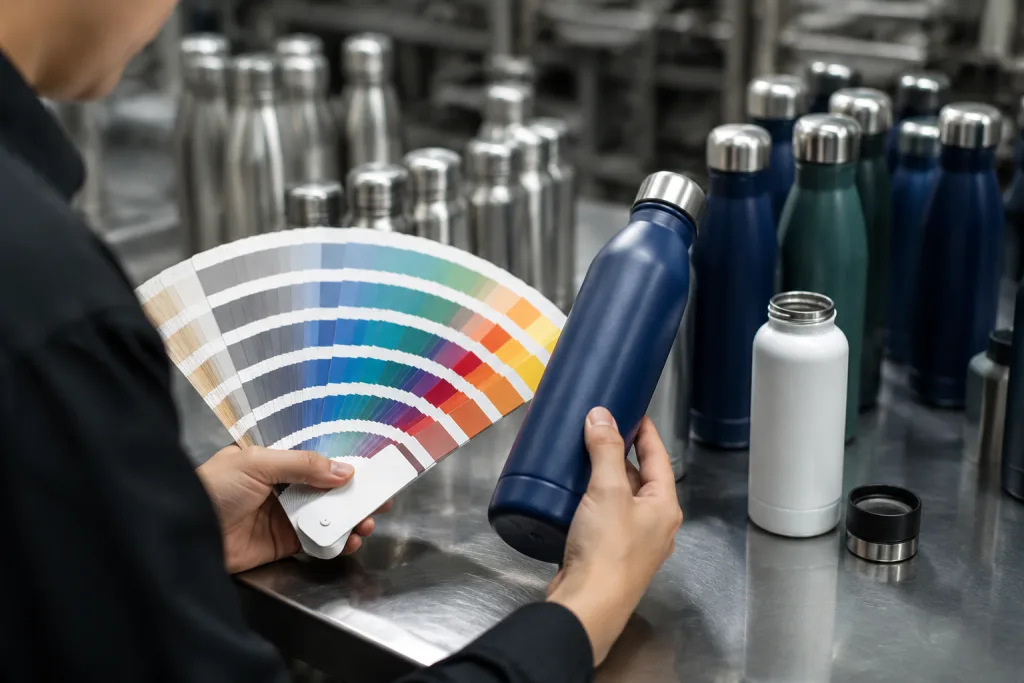
A vacuum bottle custom pantone request needs more than a single code on the PO. We ask buyers to confirm the Pantone book, surface finish, checking light, and allowed Delta E before we open the powder order. Pantone C on coated paper will not land 1:1 on matte powder over a curved 304 stainless body; our QC team usually checks it in a D65 light box, then again by eye at the spray booth door. A color that pops in a brand guide can drop after 180-200°C baking for 18 minutes. No magic here. Pigment load and orange-peel texture change the result.
For most custom thermos orders, we run it this way: you send the Pantone code with gloss or matte target, the coating supplier makes a lab dip, then the line sprays 2 flat panels and 3 bottle bodies for approval under D65 daylight or a light box. This usually takes 7-10 days if the powder supplier is not stacked up. Last month a buyer pushed for 4 days because their Amazon photo shoot was booked; the math didn’t work, and the first beige sample came back too yellow. If your launch calendar cannot absorb the sampling window, pick an existing factory color instead of forcing a new Pantone match.
Reasonable color tolerance should be locked before mass production. Some buyers use Delta E under 1.5 for strict retail packaging, but for powder-coated drinkware, Delta E under 2.0-2.5 is more realistic because film thickness can move by 10-15 μm across a curved bottle shoulder. Metallic and neon colors are harder to hold; deep colors show dust and pinholes faster under AQL 2.5 inspection. Matte black is easy. Warm beige is not. Dusty pink and fluorescent orange have both gone sideways for us when the approved panel looked fine but the bottle body looked warmer after baking.
MOQ is also tied to coating. BottleForge in Zhejiang usually recommends 1,000 pieces per Pantone color for stable powder coating, though some existing bottle models can run 500 pieces with a surcharge because we already have the jig and spray path set. If you split 3,000 pieces into six colors, you are not making one efficient bulk thermos order. You are making six small production lots with six powder changes, six gun cleanouts, and six chances for the buyer to flag shade drift. That is where 20-30% of thermos custom projects lose time and margin.
Decoration Must Match The Surface
The logo method has to fit the coating and the way the bottle will be sold. We run this check before opening the logo jig, because a 5,000 pcs outdoor retail order and a 20,000 pcs bank giveaway do not fail in the same place. Pick durability first. Appearance comes after. Last month a buyer flagged this exact issue when the PO said matte black powder coat, but the artwork file was built for glossy silkscreen.
Laser engraving is still our safest choice on powder-coated stainless bottles. The laser head cuts through the coating and shows the metal below, so there is no ink layer to scratch off or fade. It suits single-color logos, GPS coordinates, club badges, and clean type with enough stroke weight. The tradeoff is simple: you cannot call out a printed logo Pantone, because the mark is not ink. On black, navy, or forest green bodies, contrast is sharp. On beige or pale grey, QC pulled the sample under a D65 light box and the buyer called it too quiet.
Silkscreen printing works when the logo color must match a Pantone chip. It is cost-friendly for simple one- or two-color artwork, with typical setup cost around USD 40-80 per color. On textured powder coating, we test adhesion before bulk print. We use 3M tape for lift-off, alcohol rub for ink softening, and a dishwasher simulation only when the retail carton makes that claim. Fine lines below 0.15 mm fail too often, and small text under 6 pt usually fills in on the curved body.
Heat transfer and full-wrap printing give stronger shelf impact, but the math does not always work. Expect USD 0.35-0.90 extra per piece depending on coverage, plus more time on the line because every wrap needs alignment at the seam. For thermos distributors carrying 30 or 40 SKUs, this slows replenishment and creates more inspection points. For one hero seasonal item, it can be worth the trouble. A competent thermos vendor should push back when the artwork is wrong for the surface, not accept the file and let bulk production go sideways.
Price Depends On Fewer Variables
Buyers often ask for a quick FOB price before the bottle is locked. Fair enough. The first number only means something when the assumptions are written down on the quote sheet. For a 500 ml stainless vacuum bottle, we’d budget FOB Ningbo or Shanghai at USD 3.20-5.80, based on steel gauge, cap structure, coating, logo method, carton packing, and order volume. A 1,000 ml outdoor flask usually sits around USD 5.20-8.50. These are working ranges, not a sales promise; last month QC pulled a 500 ml sample with a 0.38 mm outer shell instead of the quoted 0.42 mm, and the math changed by USD 0.18 per piece.
The biggest price hits are often outside the bottle body. A custom cap mold may cost USD 1,500-4,000 and add 20-30 days. A special handle, silicone boot, retail color box, or FSC-certified packaging can move the unit cost faster than switching the body shape. Carton strength matters for thermos bulk orders. We run 5-ply corrugated board for most North America and Europe shipments, and Amazon or distributor warehouse routing may require a 76 cm drop test; we’ve seen this go sideways when a buyer approved a thin carton to save USD 0.06 and then got corner crush on 9 cartons during pre-shipment inspection.
MOQ should be discussed by model, color, and logo. One thermos manufacturer might accept 1,000 pieces total for one model, but four Pantone colors with four logos turns into sixteen combinations. That is the wrong question to ask if the buyer only wants “1,000 pcs MOQ.” The line needs separate color setup, logo positioning checks, and AQL 2.5 sampling for each SKU. For distributor thermos programs, we usually recommend two colors and one decoration method for the first PO, then expand after sell-through data; our screen-print jig takes about 35 minutes to reset between logo sizes.
Payment terms also carry risk. Standard China export terms are 30% deposit and 70% before shipment after inspection. For repeat suppliers thermos accounts with stable volume, partial balance against copy bill of lading can be discussed. If a thermos supplier offers pricing far below the range with loose specs, assume something was cut: steel thickness, coating quality, vacuum test time, packing strength, or inspection discipline. We ship enough bottles to know the pattern; on one PO the buyer flagged “304 stainless” in the artwork file, but the spec sheet said 201 inner wall, and that typo stopped production for 2 days.
Build Quality Into The PO
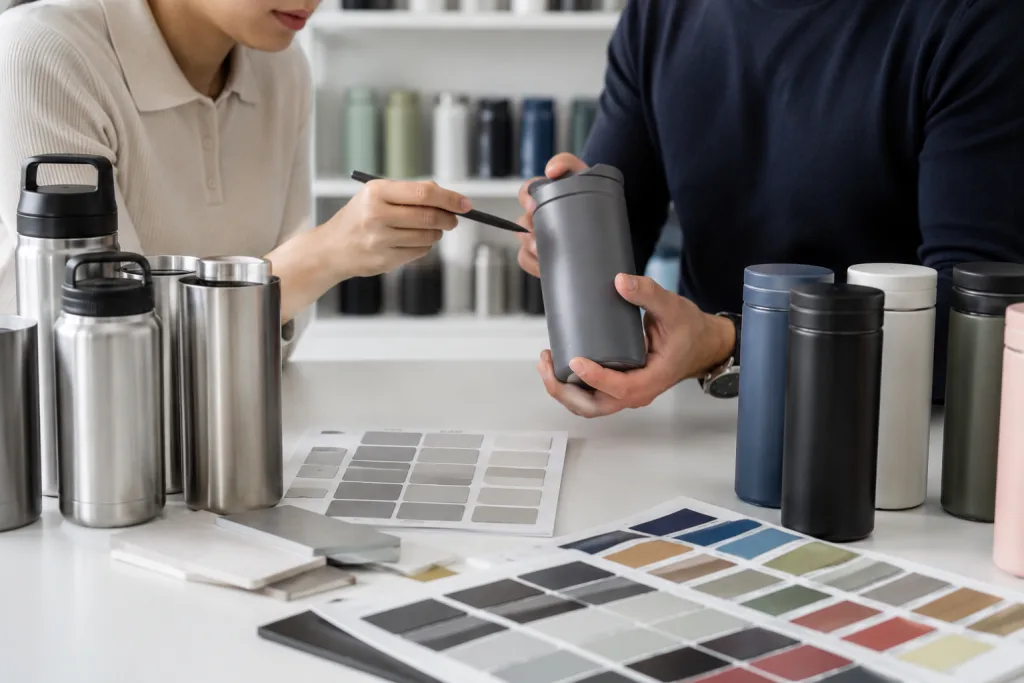
A purchase order should do more than state quantity and price. It should protect your brand when the line is full and the coating booth is running 2 colors in one shift. For vacuum bottles, write the PO with the exact material grade, capacity tolerance in ml, Pantone code and gloss target, logo drawing with mm position, insulation test time, leak test method, odor standard, inner box spec, master carton barcode rules, and inspection level. If you need FNSKU labels, mixed cartons, or retailer warning text, put them in before artwork approval. We once had a PO typo that said “matte black 419C” while the approved artwork showed 426C; QC pulled the sample, but the buyer still lost 3 days.
For AQL, about 8 buyers out of 10 we ship for use critical 0, major 2.5, minor 4.0. Critical defects mean sharp mouth edges, wrong material, leaking caps, oil or dust contamination inside the bottle, or packaging that creates a safety issue. Major defects cover visible dents, vacuum performance below the signed test result, Pantone shade outside the agreed tolerance, logo shift over 2 mm, or failed 3M tape adhesion after the coating cures. Minor defects are small paint specks under the agreed diameter, light scratches inside the limit sample, or carton scuffing that does not affect retail display. The math does not work if you call every tiny speck a major defect after goods are packed.
Golden samples matter. Approve one final sample for color and logo, then check cap fit with the real silicone ring, packaging layout, and barcode scan using a handheld scanner, not just a phone app. Keep one sample with you and one sealed at the Zhejiang factory with a signed label across the box tape. During production, we run random units against that sample under a D65 light box and normal warehouse light. This beats arguing about photos shot under yellow office lamps.
Lead time should be honest. For a new customized thermos with Pantone coating and logo, expect 7-10 days for color sample, 5-7 days for pre-production sample after artwork approval, and 30-40 days for mass production after deposit and sample sign-off. In peak China export months before summer and Q4, add 7-14 days. We have seen this go sideways when a buyer pushes a 30-day schedule down to 24 days; the coating line runs hot, dust points jump from 2 per 100 pcs to 9 per 100 pcs, and rework eats the days you thought you saved.
Pick A Supplier You Can Audit
A good thermos factory is not just a building with polishing machines. You need a supplier you can audit, question, and hold to written standards. Ask for factory photos, a production flow chart, BSCI or Sedex status if your retailer asks for social compliance, and ISO 9001 files if they have them. We usually send a 9-step flow from tube cutting to final AQL check, plus photos of the vacuum testing station and the 0.01 mm caliper used on mouth diameter checks. Paper does not prove the line is clean, but it shows whether the factory is used to export orders with written control.
Outdoor retailers and promotional brands need communication discipline. A solid thermos manufacturers team should confirm drawings, send coating panels, flag risky artwork before mass print, and report at set points: material arrival, coating start, assembly line start, packing trial, final inspection. Short updates are enough. Silence during production is a bad sign. We have seen this go sideways when a buyer approved PMS 186C, the PO typo said PMS 168C, and nobody checked the PDF against the signed color card before spraying 3,000 bottles.
Location helps. Hangzhou, Zhejiang sits close to the drinkware supply chain across Zhejiang and nearby provinces, with workable access to Ningbo and Shanghai ports. That matters when a lid gasket supplier misses 5,000 pcs, or carton printing needs one more day after the barcode size gets flagged by QC. We can pull coating, accessories, color box printing, and export booking into the same week more easily here. China still has deep stainless drinkware capacity, but chasing ten thermos suppliers for the cheapest screenshot quote is the wrong question to ask.
If you are testing a new manufacturers thermos relationship, start with a controlled PO: one model, one or two Pantone colors, one logo method, and standard packaging. Keep the first run at 1,000 to 3,000 pcs if your MOQ allows it. Measure sample accuracy, lead time, inspection pass rate, and response speed when something is not perfect. QC pulled the sample? Check the logo position in mm, the lid torque, the carton drop-test result, and whether the supplier reports a failed vacuum piece before you ask. After that, you can build a wider thermos customizable range with fewer expensive surprises.
Send Your Pantone Thermos Brief For Review
Share capacity, Pantone code, logo file, MOQ target, and market. We will flag cost, coating, and compliance risks before quoting.
Frequently asked questions
What MOQ should I expect for a vacuum bottle custom Pantone order?
For most stainless vacuum bottles, expect 1,000 pieces per Pantone color as a practical MOQ. Some existing models can run 500 pieces per color with a surcharge, but the coating line still has setup loss, powder waste, and cleaning time. If you need three colors, plan for 3,000 pieces rather than assuming 1,000 total can be split freely. For a new bottle shape or private mold cap, the MOQ may move to 3,000-5,000 pieces because material purchasing and assembly setup become less flexible. A supplier thermos quote should state MOQ by model, color, and logo version.
Can you match any Pantone color on a stainless thermos?
Most standard Pantone colors can be matched closely, but not every color behaves the same on powder-coated stainless steel. Matte powder coating has texture and absorbs light differently from a printed Pantone book. Fluorescent colors, metallic shades, very pale beige, and warm greys are harder to control. A realistic tolerance is often Delta E under 2.0-2.5 for powder-coated bottles. The correct process is to approve a lab dip or coated bottle sample before production. Do not approve mass production from a digital mockup, because screens do not show gloss, texture, or pigment shift after baking.
Is powder coating better than spray paint for outdoor bottles?
For outdoor retail bottles, powder coating is usually better because it gives stronger scratch resistance and a more durable hand feel. Typical coating thickness is around 60-90 microns, and the finish holds up better in backpacks, cup holders, and warehouse handling. Spray paint can produce brighter gloss colors and special effects, but it needs a strong topcoat and more careful adhesion control. If your product is a promotional thermos used for a short campaign, spray paint may be acceptable. If it is a retail custom thermos expected to survive daily use, powder coating is normally the safer specification.
How long does a custom stainless thermos order take?
A normal timeline is 7-10 days for Pantone color development, 5-7 days for pre-production sample approval, and 30-40 days for mass production after deposit and signed sample. Add ocean freight time separately: roughly 28-40 days to many North American ports and 30-45 days to major European destinations, depending on routing. Air freight is faster but expensive for stainless bottles because cartons are bulky. If your order needs a new cap mold, add 20-30 days before sampling. For Q4 promotions, approve colors at least 75-90 days before your warehouse deadline.
What quality checks should I require before shipment?
Use AQL inspection with critical 0, major 2.5, and minor 4.0 as a common starting point. The checklist should include vacuum performance, leak testing, coating adhesion, logo placement, color comparison against the golden sample, cap torque, odor check, barcode scan, carton drop test, and quantity verification. For insulation, test with 95°C water at 20°C room temperature and record temperature after 6 hours. For coating, use a cross-hatch or tape test where appropriate. If your thermos distributor channel has retailer routing rules, check labels, master carton marks, and pallet requirements before the balance payment.