Key Takeaways
- A realistic MOQ for custom Tritan bottle projects is 1,000-3,000 units per color
- Tritan body thickness should usually sit around 1.8-2.5 mm for retail-grade bottles
- FOB China pricing changes sharply when lid structure, logo method, and packaging are defined
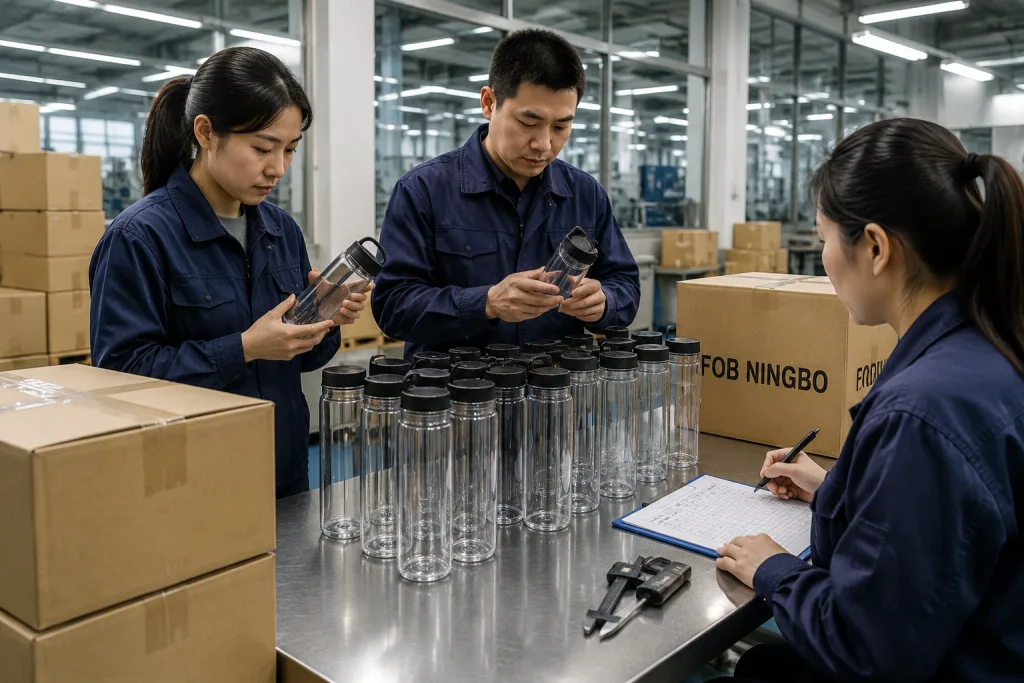
- AQL inspection should cover leak testing, cap torque, drop testing, and carton drop checks
A tritan thermal bottle wholesale quote looks clean at first, then you line up three suppliers and the spec sheet falls apart. One factory writes 650 ml, another writes 700 ml, one says “thermal,” and nobody says whether the body is double-wall Tritan, a stainless liner build, or just a sleeve. That is where purchase orders go wrong. We have seen a buyer catch a 2 mm wall-thickness gap only after QC pulled the sample off the line.
If you buy bulk drinkware for retail, promotions, school programs, outdoor channels, or private-label distribution, get the boring details down before you pay the sample fee. BottleForge Industrial in Hangzhou, Zhejiang works with China buyers every week, and the right project starts with a spec sheet, MOQ, logo method, and pack-out note that leaves no room for guessing. The math does not work any other way.
Start With The Body Material
The first spec line should not say “plastic bottle.” It should say Tritan copolyester, food-contact grade, BPA-free, and name the sales market on the PO. For EU orders, ask for food-contact papers aligned with EU 10/2011 where applicable, plus REACH screening for restricted substances. For North America, 7 out of 10 import buyers we quote ask for FDA food-contact suitability; children’s bottles often need CPSIA or ASTM-related checks based on lid design, straw length, and age grade. QC pulled one sample last month where the carton mark said “TRITAN,” but the resin bag tag at the injection line showed AS. We stopped it there.
Tritan sells because it gives glass-like clarity without glass breakage. It also takes drops better than cheap AS or PC alternatives. But it is not magic. If the wall is too thin, the bottle feels like free event stock, not retail shelf stock. For a 600-750 ml bottle, we normally run 1.8-2.5 mm wall thickness, checked with a digital caliper at the shoulder, waist, and base. Shape matters. A straight cylinder can sit at the low end, while a molded waist or handle cutout needs more material or the math doesn't work.
For tritan thermal bottle wholesale, define “thermal” before pricing. This is the wrong question to leave open. Many buyers expect stainless vacuum performance, but a Tritan bottle will not hold heat for 12 hours unless it has a separate insulated structure. A double-wall Tritan body can reduce condensation and slow temperature change, but it is not vacuum insulation. On gym, office, or school programs, we label it “double-wall Tritan” and give test data, such as water at 5°C rising to 11°C after 2 hours at 25°C room temperature. The buyer flagged this wording twice on artwork proofs, so now we lock it before mold sampling.
Our Zhejiang factory team rejects vague material descriptions at quotation stage because they turn into claims after shipment. China has plenty of suppliers who can mold Tritan bottles, but fewer will document resin grade, wall thickness, molding shrinkage, and pre-production testing. We ask for the resin code, target wall range, sample weight in grams, and shrinkage note before we open the price sheet. We have seen this go sideways: one PO typo changed “Tritan” to “transparent plastic,” and the buyer’s inspector later wrote a nonconformity against the approved sample.
Capacity Is Not Just Milliliters
Capacity looks like one clean line on the spec sheet: 500 ml, 650 ml, 750 ml, 1 L. On the line, it changes the blow mold, carton weight, freight cube, shelf height, and lid torque setting. A 750 ml bottle works for sports retail, but we had one buyer flag it because the 268 mm height missed a school backpack side pocket by 12 mm. A 1 L bottle can move online, but if the master carton jumps from 56 cm to 63 cm, the math on landed cost starts to look bad.
Separate nominal capacity from brimful capacity. Every time. If you advertise 700 ml, the bottle should hold 700 ml below the thread or drinking line, not only when QC fills it to the lip with a graduated cylinder. For wholesale drinkware programs, we normally allow 3-5% tolerance on capacity, but that tolerance has to be written into the pre-production sample approval. We have seen this go sideways when the PO says “700 ml” and the approved sample sheet says “brimful 700 ml.”
If you also source canteen wholesale or wholesale canteen items, do not copy the same sizing logic. A bulk canteen for camping may need a wider shoulder, integrated strap, or military-style body, and cap retention matters more because buyers expect outdoor use. On one 3,000 pcs canteen bulk order, QC pulled the sample after the strap pin loosened during a 1.2 m drop test. A Tritan bottle for office hydration can run slimmer, with a lighter carry loop and less aggressive grip texture.
Large-format items bring a different problem. Some buyers use “bulk growler” or “wholesale growler” when they mean a 1.5 L or 2 L water container, and this is the wrong question to ask if the liquid is not defined. If the product is for beer, say beer. A beer growler bulk project needs sealing review, pressure discussion, and local alcohol container labeling checks; our QC team will usually ask for the gasket spec and thread drawing before quoting tooling. Tritan is not always the right material for carbonated beer storage, so be careful when a supplier says yes in 5 minutes.
Lid Engineering Drives Complaints
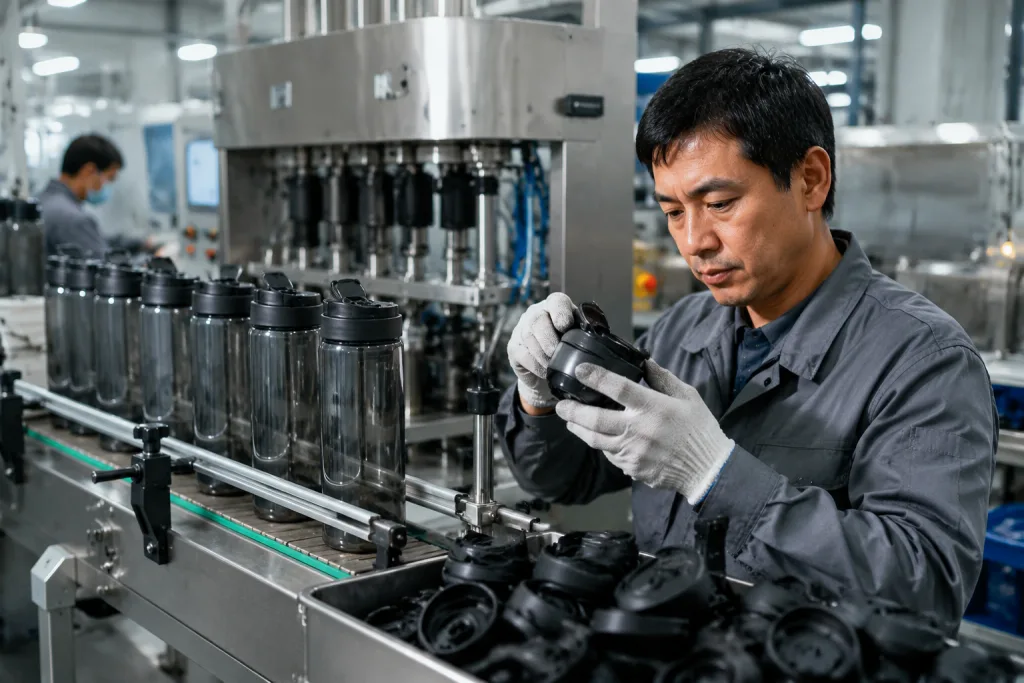
On bulk drinkware orders, lid issues create around 70% of the after-sales noise we see, while the bottle body gets blamed first. Wrong target. The lid carries the sealing gasket, hinge pin, push button, straw, carry handle, and sometimes the logo pad; QC pulled one 10,000-unit sample run last May because the button spring sat 0.4 mm off-center and the buyer flagged sticky opening.
Your spec sheet should name the lid type: screw cap, flip-top, straw lid, chug lid, sports spout, or dual-use lid. Then lock the gasket material. Food-grade silicone is the normal choice, but ask the supplier to state gasket hardness if the seal matters; 50-60 Shore A is common for flexible sealing parts, measured with a Shore A durometer on the line. Too soft and it deforms. Too hard and it leaks when the bottle rides sideways in a carton or backpack.
For tritan thermal bottle wholesale, buyers often ask for a premium lid with one-hand opening. Fine, but do not skip cycle testing. We run at least 3,000 open-close cycles for hinge and button structures on retail-grade bottles; for promotional orders, 1,000 cycles can pass if the target price is tight, but the math does not work if the buyer expects retail return rates at giveaway pricing. Last quarter, one PO even had “300 cycles” typed by mistake, and our merchandiser caught it before tooling confirmation.
Write the leak test like an inspector will read it: fill with room-temperature water, close cap, invert for 30 minutes, then shake or rotate based on the real use case. For straw bottles, test upright and inverted because air vents leak first; we have seen 6 samples out of 80 fail only after a 180° rotation. For kids or school products, add a drop test from 1.0 m onto plywood or a concrete-simulating surface, depending on your quality level and carton weight.
If you sell alcohol flask wholesale or alcohol flask wholesale bulk, lid compliance gets stricter because alcohol attacks some plastics and seals. For alcohol flask in bulk orders, we usually push buyers toward stainless steel rather than Tritan unless the use is short-term promotional sampling, like a 50 ml event giveaway packed for 7 days. We have seen this go sideways when a buyer stored samples with spirits for 30 days and the gasket picked up odor.
Thermal Claims Need Test Numbers
Treat the word “thermal” with discipline. A double-wall Tritan bottle feels more solid in the hand and slows heat transfer from fingers, but it is not a stainless vacuum flask. If your sales page says “keeps cold 24 hours,” show the test report, room temperature, fill temperature, and bottle size. No report, no claim. We had a distributor in Germany reject 3,000 hangtags because the copy said “24H cold” while QC pulled the sample at 6 hours and found only a small temperature gap.
A workable test for double-wall Tritan is simple: fill the bottle with 4°C water, place it in a 20-25°C room, then record liquid temperature after 2, 4, and 6 hours with a probe thermometer. Write down the cap status too, because an open spout changes the result. For hot water, do not assume boiling water is safe. On our line, 6 of 8 Tritan bottle designs are rated around 80°C, depending on resin grade, lid material, wall thickness in mm, and neck structure. If the cap uses PP, silicone, or TPE, the weakest part sets the fill limit.
For buyers sourcing beer tumbler wholesale or beer tumbler wholesale bulk at the same time, keep the spec sheets separate. Mixing them is where we’ve seen this go sideways. A beer tumbler bulk order often uses stainless steel because the buyer wants stronger cold retention and a lip that works with foam. A beer tumbler in bulk program for a 2-hour event may accept single-wall plastic. Tritan bottles fit water programs, gym bottles, and school hydration better than beer service; last spring one PO even had “Tritan beer vacuum cup” typed in the item name, and the buyer flagged it before mold deposit.
Thermal performance controls packaging copy. If you sell through retail chains in Europe or North America, claims need to be conservative and repeatable across production lots, not just one nice lab sample. At BottleForge Industrial, our Hangzhou, Zhejiang team quotes the structure first and the claim second: double-wall Tritan, 650 ml, 80°C max fill, 4°C cold test at 20-25°C. The math doesn’t work when a buyer asks for vacuum-flask wording on plastic construction. China export projects move faster when the buyer approves measurable targets, not adjectives.
Decoration And Packaging Lines
Logo and packaging lines move the unit price faster than 6 out of 10 new buyers expect. For drinkware wholesale, a plain bottle and a retail-ready branded unit should be quoted as two SKUs. A one-color silk screen logo on one side may add USD 0.06-0.12 per unit at 3,000 pieces. Laser marking is not usually used directly on clear Tritan body surfaces, but it works on stainless trims or metal lid plates; last month QC pulled the sample because the laser mark on a 28 mm lid plate looked gray, not black. Heat transfer and UV print add cost and usually need 3-5 extra sampling days. Full-wrap inserts are another job, not a quick logo add-on.
Define logo size in millimeters, not “small logo.” Say 45 x 30 mm, one color, front center, Pantone 286C, tolerance ±1.5 mm. Better yet, mark the logo position from the bottle bottom and center line; our screen jig uses those two points, not a buyer’s screenshot with a red circle. If you need multiple SKUs, specify whether the MOQ is per logo, per color, or per total order. We’ve seen this go sideways: a factory quotes 3,000 units total, then later says it means 3,000 per color. With four bottle colors, the math changes from 3,000 to 12,000 units.
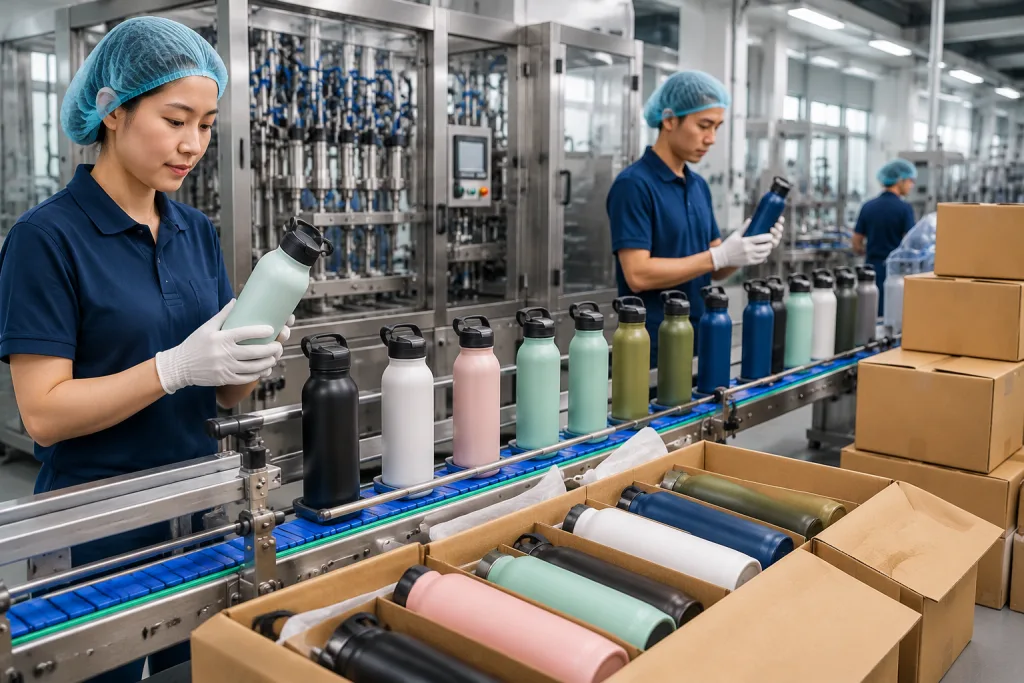
Packaging should list white box, kraft box, color box, belly band, hang tag, barcode sticker, FNSKU label, master carton, and pallet requirements. Don’t leave it to “standard export packing.” That is the wrong question to ask. For Amazon FBA, carton weight should often stay under 22 kg unless your forwarding plan allows otherwise; we run cartons on a floor scale before final sealing because a 22.8 kg carton gets flagged fast. For retail distribution, you may need ISTA-style carton drop testing or at least a 5-face carton drop check before shipment.
For mixed programs that include wholesale drinkware, canteen wholesale, and growler wholesale, packaging standardization saves money. Use the same carton grade, similar barcode placement, and shared instruction sheet where possible. The buyer flagged one PO typo last season: “matte black” on the bottle line, “matt black” on the color box file. Small typo, real delay. Standard packing specs cut artwork mistakes and make pre-shipment inspection faster because the line inspector checks one carton layout instead of six.
MOQ, Price, And Lead Time
A usable tritan thermal bottle wholesale quote needs MOQ, sample cost, tooling cost if there is one, unit price, Incoterm, payment terms, production lead time, and quote validity. Miss one line and the buyer cannot compare offers. We still see POs where “FOB” is typed, then the shipping mark says “EXW Hangzhou”; our sales admin catches that before PI release because the port cost changes the math.
For existing molds, we usually quote 1,000-3,000 units per color for custom logo orders. For a custom bottle body or lid tool, budget USD 3,000-12,000 depending on part count, thread detail, and whether the lid needs a separate silicone gasket tool. BottleForge Industrial can support around 450,000 drinkware units/month across coordinated production lines in Zhejiang, with typical custom-logo lead time of 25-35 days after sample approval and deposit. Peak season adds 7-15 days, especially before summer retail launches and Q4 promotional shipments; last May, QC pulled the sample after pad printing because the logo sat 2 mm off-center on the curved body.
FOB Ningbo and FOB Shanghai are the normal choices for Zhejiang export orders. EXW looks cheaper on the first sheet, but this is the wrong question to ask if your forwarder does not already run local pickup in China. Under FOB, we handle export customs and delivery to port; under EXW, you own the truck booking, warehouse handover, and the small port-side charges that buyers flag after the invoice lands.
Price gaps usually come from resin grade, lid construction, wall thickness, packaging, inspection level, and order quantity. A low quote might switch silicone hardness, cut wall thickness by 0.3 mm, or use a 5-ply carton where the buyer expected 7-ply. That can work for a short promotional drinkware bulk campaign. For a retail line with repeat orders, we have seen this go sideways when AQL 2.5 inspection finds dented cartons and loose flip lids. Ask the supplier to show the cost assumptions line by line instead of making them guess what you will accept.
Inspection Before Final Payment
Do not wait until 36 cartons land in your warehouse to find out the lid weeps at the thread. Run AQL inspection before balance payment. For most wholesale drinkware orders, AQL 2.5 for major defects and 4.0 for minor defects is a practical starting point. Critical defects stay at zero tolerance: contamination, sharp edges, serious leakage, wrong material, or unsafe odor. QC pulled one sample on our line last May where the silicone gasket had picked up black oil from a mold ejector pin. That shipment stopped before the buyer wired the final 70%.
The inspection checklist should cover appearance, color, logo position, capacity, weight, wall thickness sample check, lid fit, gasket placement, leak test, drop test, barcode scan, carton markings, and quantity. Make it measurable. We run a 500 ml fill check on a digital scale, measure logo offset with a 0.5 mm ruler, and do the leak test after 30 seconds upside down with the cap tightened by hand, not with a wrench. For FBA, check FNSKU readability and carton labels. For retail, check color box scuffing and barcode placement. For mixed alcohol flask bulk, beer growler wholesale, or beer growler wholesale bulk shipments, split the criteria by category. A tritan thermal bottle fails differently from a stainless growler; using one checklist for both is the wrong question to ask.
Sampling plans should follow ANSI/ASQ Z1.4 or ISO 2859-1 where possible. If your order is 5,000 units, an inspector may check 200 units depending on inspection level. Do not let a factory inspect only 20 pieces and call that representative. The math does not work. Small checks are useful during production, such as 12 pcs pulled from the assembly table after the first gasket run, but final inspection needs a defensible sample size. We have seen this go sideways when a buyer accepted 18 photos from the packing room and later found 7% loose lids after delivery.
For repeat programs, keep a sealed golden sample at the factory and one in your office. Simple habit. It prevents arguments about color, clarity, logo size, and lid feel. We label ours with the PO number, Pantone code, approved weight in grams, and the date signed across the tamper tape. The best suppliers in China will welcome this because it protects both sides when the next PO repeats six months later, especially when the buyer flagged a tiny typo on the old PO and everyone suddenly starts checking every detail again.
Send Your Bottle Spec Sheet For Review
Share capacity, lid type, logo, market, and target price. We will return practical MOQ, lead time, and FOB China options.
Frequently asked questions
What is the normal MOQ for tritan thermal bottle wholesale?
For an existing mold with one logo, expect 1,000-3,000 units per color. If you need custom body color, custom lid color, or retail packaging, 3,000 units is more realistic. A fully custom mold can push the first production run to 5,000-10,000 units because the factory needs stable resin color, molding setup, and inspection time. For mixed bulk drinkware orders, some factories can combine models in one shipment, but the MOQ usually still applies per SKU or per color.
Can Tritan bottles really be called thermal bottles?
Only if the structure supports the claim. A double-wall Tritan bottle can reduce condensation and slow temperature change, but it does not perform like a stainless vacuum bottle. You should ask for test conditions: starting water temperature, room temperature, test duration, and final temperature. A practical double-wall Tritan test may show performance over 2-6 hours, not 12-24 hours. If your packaging says “thermal,” define whether that means double-wall comfort, insulation, or verified temperature retention.
What certifications should I request for Europe or North America?
For Europe, request food-contact documentation relevant to EU 10/2011 and REACH screening. For North America, ask for FDA food-contact suitability documentation; for children’s bottles, CPSIA-related testing may be needed. If your customer requires social compliance, BSCI or Sedex audit status is often requested. Do not accept a generic “BPA-free” statement as the only proof. Ask for reports that name the material, product, test standard, lab, and report date, preferably within the last 12-24 months.
How much should I budget for custom logo and packaging?
A simple one-color silk screen logo may add about USD 0.06-0.12 per unit at 3,000 pieces. UV print, heat transfer, or complex multi-position decoration can add USD 0.15-0.60 depending on coverage. A color box may add USD 0.18-0.45 per unit, while kraft or white box packaging is usually lower. FNSKU labeling, barcode stickers, inserts, and carton customization also add cost. Ask for pricing by line item so you can remove or upgrade features without restarting the quote.
Can I combine Tritan bottles with growlers, canteens, or flasks?
Yes, but treat them as separate product families. A wholesale canteen project may need stronger straps and outdoor drop testing. A wholesale growler or beer growler in bulk order may require stainless steel, pressure review, or different sealing checks. Alcohol flask wholesale products often use stainless steel because alcohol compatibility and odor control are better. Combining them in one shipment can reduce freight cost, but MOQ, inspection criteria, and packaging tests should stay separate for each SKU.