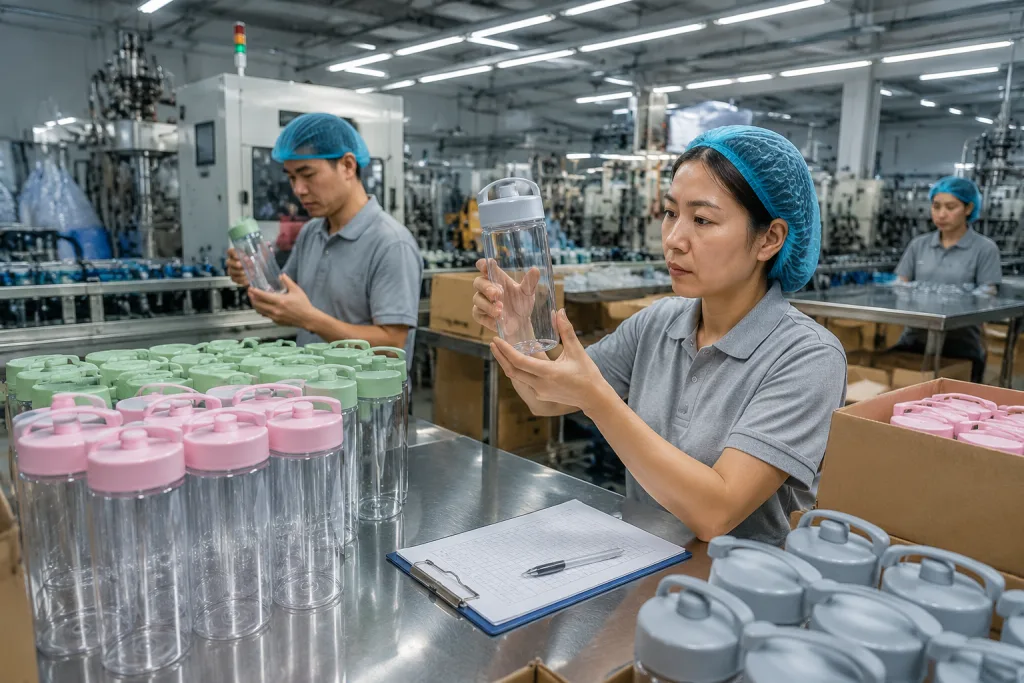
Key Takeaways
- A realistic MOQ for custom Tritan thermal bottles is 1,000-3,000 units per color, depending on lid tooling and logo process
- Tritan is useful for lightweight, clear, BPA-free bottles, but it does not replace stainless steel vacuum insulation
- Expect 25-35 days for repeat production after artwork approval, plus 7-10 days for pre-production samples
- For EU and North America, request LFGB/FDA food-contact reports, REACH screening, and AQL 2.5/4.0 inspection
A Tritan thermal bottle looks simple on a line sheet. Then the buyer starts comparing 2D drawings, lid threads, insulation test claims, logo artwork, and 5-ply carton specs from 6 China suppliers. We see the trouble late in the order: heat retention misses the claim by 3–5°C after 6 hours, the flip cap leaks at 0.8 bar, the silk-screen logo scratches after 50 tape pulls, or the export carton fails a 76 cm drop test before FBA check-in.
At BottleForge Industrial in Zhejiang, we run into the same mistake almost every month: picking the lowest FOB and hoping the factory sorts out the engineering. The math doesn't work. Your real decision sits in the details: Tritan grade, insulation structure, mold cost, decoration life, compliance files, and how the line controls leakage before packing. Last week QC pulled 32 samples from a 3,000 pcs pilot run because the buyer flagged a 0.4 mm mismatch on the lid gasket groove. Fix those points early, and a custom canteen program scales without ugly surprises.
Start With The Product Role
Before you ask a tritan thermal bottle manufacturer for a quotation, pin down the job this bottle has to do in your range. A school canteen promo bottle is usually built around price, safe edges, and a carton that survives student handling; a premium outdoor custom growler needs a tighter lid fit and a finish the buyer will inspect under a light box. Different product. We see this at RFQ stage all the time: one PO says “blue lid,” the artwork file says Pantone 2925C, and QC pulled the sample at 292C. If the role is loose, 3 suppliers will quote 3 different bottles and your comparison sheet will be useless.
The first call is insulation expectation. Tritan is a copolyester, valued because it is clear, impact-resistant, light, and BPA-free. It is not a thermal miracle. A true stainless vacuum bottle can hold hot water for 6-12 hours depending on capacity, wall thickness, lid design, and testing temperature. For Tritan thermal bottles, we usually quote one of these builds: double-wall Tritan with an air gap, Tritan outer shell with a 304 stainless liner, or Tritan bottle plus a neoprene or EVA insulated sleeve. The cost gap is not small. On the line, a 0.6 mm stainless liner changes tooling fit, leak testing, and lid torque; the buyer often flags this only after seeing the first sample.
The second call is sales channel. Canteen distributors need cartons that stack cleanly, scan-ready barcodes, color control within an agreed tolerance, and defect rates that pass AQL 2.5 without drama. Corporate custom drinkware buyers push us on logo approval speed, small mixed artwork batches, and whether 6 logo versions can run in one schedule. Online sellers care about FNSKU labels, master carton compression, and photo samples without dust trapped under the cap ring. We had one Amazon buyer reject 48 cartons because the FNSKU was 3 mm too close to the carton seam. Small detail. Big delay.
At our Hangzhou, Zhejiang facility, a normal production cell can assemble around 180,000-220,000 plastic and stainless drinkware units per month, depending on lid complexity. Capacity sounds good in a supplier deck, but this is the wrong question to ask first. The real question is whether sampling, BOM lock, and pre-production approval are controlled before the line starts. A factory with spare capacity can still ship the wrong lid color if the signed sample sits on one shelf and the latest spec sheet sits in WeChat. We run the order from product role first, then quote the structure, carton, testing, and schedule around that role.
Choose Tritan Structure Carefully
The material decision is where 6 out of 10 new buyers either overpay or under-spec. Tritan sells well because it stays clear, does not hold odor like cheaper PP blends, and survives daily drops better than brittle SAN or acrylic. For a canteen customizable program, that matters. On our line, QC pulled a 650 ml clear body after a 1.2 m drop test onto the epoxy floor; the body passed, but the printed logo scuffed because the buyer chose the cheaper ink. A clear bottle with a colored lid and printed logo can look above its FOB price.
Be careful with the word “thermal.” This is the wrong question to ask if the buyer only says, “Can Tritan keep water hot?” Ask whether the design uses vacuum stainless steel, foam insulation, air-gap double wall, or only a thick Tritan body. A double-wall Tritan bottle slows temperature change and cuts condensation, but do not sell it as a hot-water thermos unless the test sheet supports that claim. We usually tell buyers to avoid hot water above 80°C in full Tritan bodies; during lid torque checks at 12 kgf·cm, deformation risk changes fast with wall thickness, thread depth, and lid stress.
For most customized drinkware projects, we run these practical options:
- Single-wall Tritan: lowest cost and light weight, often used for 3,000–10,000 pcs sports bottles, school giveaways, and canteen promotional orders where freight weight matters.
- Double-wall Tritan: better hand feel and less condensation, but the mold cost and ultrasonic assembly step add real money; we have seen buyers push back when the quote moves up by USD 0.35–0.60 per pc.
- Tritan outer with stainless liner: stronger thermal claim and better for warm drinks, but it is heavier, costs more, and loses the full-clear look that retail teams often ask for.
- Tritan bottle plus neoprene or PU sleeve: good for custom canteen sets and seasonal promotions; check sleeve stitching, because one 2024 PO had the logo size typed as 80 mm instead of 60 mm and the sample looked oversized.
Ask for the material grade, not just “Tritan.” The resin supplier, batch traceability, and food-contact testing should be in the file before deposit, not chased after mass production. For North America, buyers ask for FDA food-contact compliance and BPA-free declaration. For Europe, LFGB testing and REACH screening are standard. A real canteen supplier in China should send recent third-party reports with matching item photos and batch notes; a blurry PDF from 2019 is how we have seen orders go sideways at final inspection.
Set Specs Before Pricing
FOB price without a locked spec is just a warm-up quote. We see this every week: one buyer sends “750 ml Tritan thermal bottle with logo” to 5 factories and gets prices spread by 35%. The gap is not magic. One line quotes 2.0 mm wall, silicone gasket, woven strap, color box, and AQL 2.5 inspection; another quietly uses a thinner body, loose PE bag, and no leak test.
For a serious RFQ, lock the spec sheet first: capacity tolerance, body diameter, total height, lid material, gasket material, wall thickness, logo size, Pantone or color chip reference, packaging, and inspection standard. For Tritan bodies, we usually run 1.8-2.5 mm wall thickness depending on the mold shape and injection gate position. Too thin feels cheap. QC can press the sample by hand and feel the sidewall flex inward. Too thick pushes cycle time up, burns more resin, and increases sink-mark risk near ribs or grip areas.
Lid design needs harder questioning. Buyers often chase bottle body price, then the lid ruins the shipment. Most leaks come from cap geometry, gasket compression, hinge fatigue, or straw valve tolerance; last month QC pulled a sample where the gasket was short by 0.4 mm and the bottle leaked after 20 seconds upside down. If your order is for a distributor growler or outdoor canteen customized project, the cheap flip lid is the wrong place to save money. Ask the manufacturer to run a leak test with the bottle filled, inverted, and shaken for 30-60 seconds. For kids or school use, ask about small parts, bite valves, and applicable ASTM or CPSIA considerations.
Packaging also moves the price. A bulk polybag pack works for a low-cost canteen promotional job, especially when the carton stays under the buyer’s freight limit. A retail color box with insert, barcode, and warning language can add USD 0.25-0.60 per unit, and we have seen POs delayed 3 days because the barcode digit was typed wrong. If you need Amazon FBA prep, spell out FNSKU label placement, suffocation warning on polybags, and carton weight below 15 kg where possible.
Good buying rule: freeze the specification sheet before you negotiate the last USD 0.05. Otherwise the supplier can win the price by quietly removing quality.
Match Decoration To Use
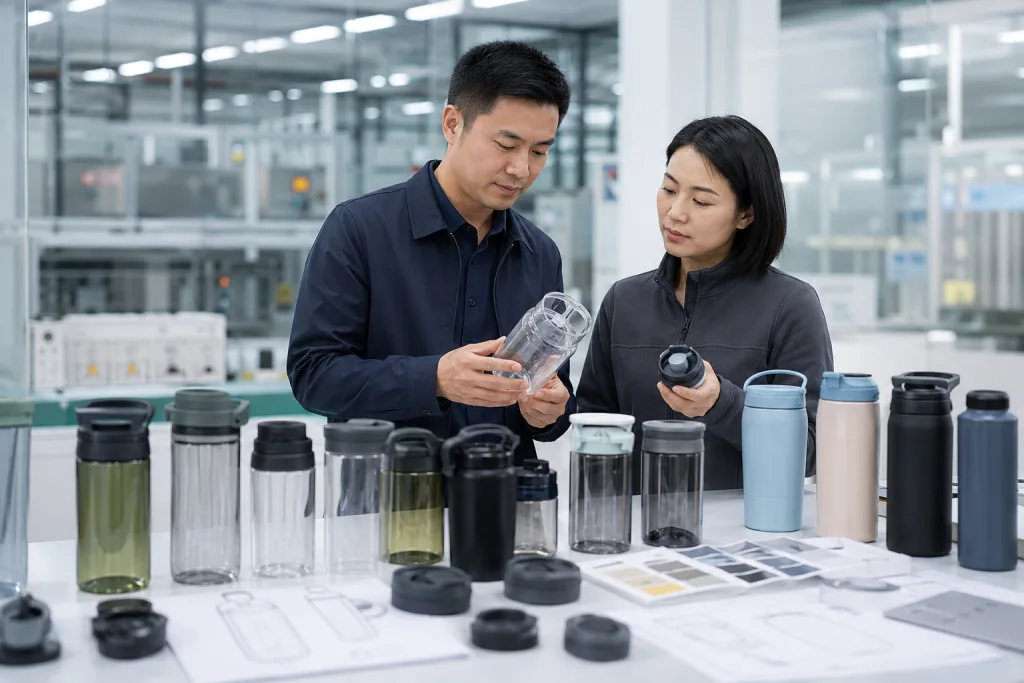
Custom drinkware gets judged by the logo first; the buyer has not even opened the bottle yet. With Tritan, we choose decoration by the bottle radius, body color, order quantity, dishwasher wording, and target cost. The cheapest print can become the expensive option after 20 rubs on a 3M tape test. We have seen this go sideways: QC pulled a smoke-gray sample where the black logo looked clean on the PDF but disappeared on the actual bottle.
Silkscreen printing fits simple one- or two-color logos on straight walls, especially on a custom canteen order above 1,000 units. Clean vector artwork matters. A 0.25 mm broken line in the AI file will show up on the screen plate. Pad printing is better on curved shoulders or uneven grip areas, but the print field is smaller, so a 65 mm wide logo often needs resizing. Heat transfer handles gradients and full-color artwork, but adhesion must pass before we run the line. For some lids or stainless components, laser engraving works; transparent Tritan will not engrave like coated stainless steel, and asking for that finish is the wrong question to ask.
If you are a canteen vendor selling to corporate buyers, ask for printed samples before mass production. A digital mockup is not enough. Pantone matching on translucent plastic is tricky because the body color changes the ink. For transparent smoke, amber, or blue Tritan, we often run a white underbase first. That adds one print pass and cost. Last month a buyer flagged PMS 186C on amber Tritan because it shifted closer to orange under a D65 light box; the PDF looked fine, the bottle did not.
For typical Zhejiang production, logo setup takes 3-5 days after vector artwork approval. Pre-production samples usually take 7-10 days if no new mold is involved. For a customized growler or unusual lid color, do not write “ASAP” on the PO and expect the math to work; a private resin color can push sampling to 14-18 days after chip approval. Our practical MOQ is usually 1,000 units per color for standard models and 3,000 units if you need a custom-molded lid, private color resin, or special packaging line setup. We also check the PO line by line—one buyer once typed “matte balck lid,” and the line almost prepared the wrong carton label.
Do not approve decoration only under office lighting. Check the sample in daylight, under warm retail lighting, and after a simple tape test. We run a quick cross-hatch with a 1 mm cutter and 3M 600 tape before signing off. For repeat orders, keep a signed golden sample at the factory and one in your office.
Understand Tooling And MOQ
MOQ is not a number a supplier throws out to irritate a buyer. We run it from resin bag minimums, purge loss during color change, pad-printing setup, line balance, carton MOQ, and QC hours at AQL 2.5. Last month QC pulled 32 pcs after a six-color 200-unit trial because the Pantone change left black specks in the Tritan barrel. The math doesn’t work. If a canteen factory accepts 200 units with six colors and three logos, they are either hiding the cost in the unit price or treating it as a paid sample run.
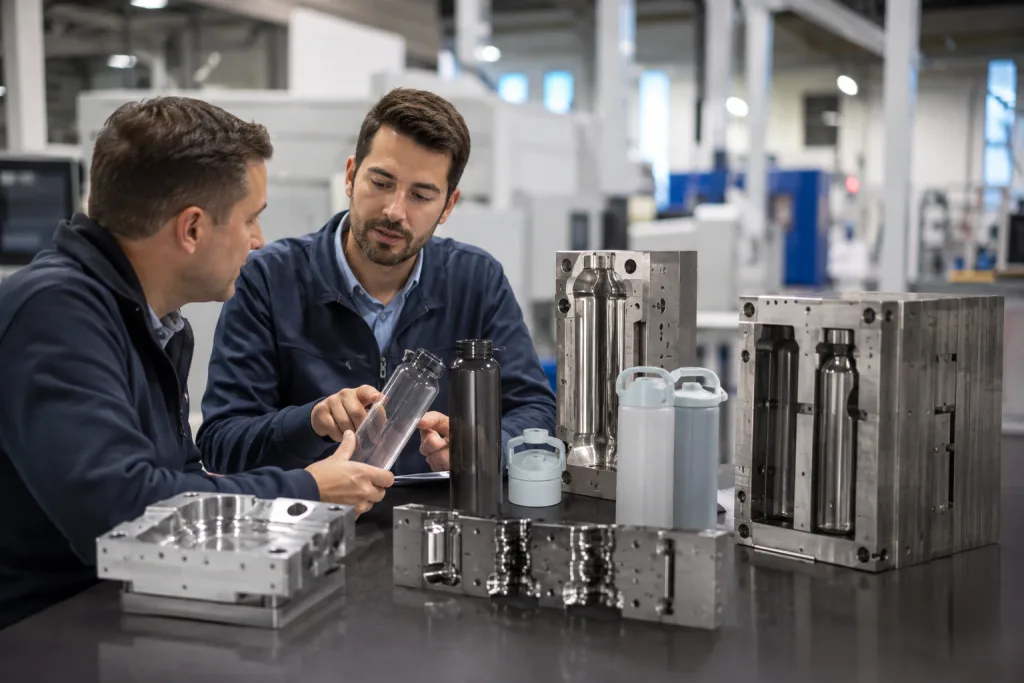
For standard Tritan bottles, a workable B2B MOQ is usually 1,000 units per SKU. If you need three body colors, plan for 1,000 units each unless the supplier already keeps that resin color beside the injection line. For custom lid molds, the economic MOQ moves toward 3,000-5,000 units because tooling, trial molding, and engineering time need to come back through the order. A new injection mold for a lid can cost roughly USD 2,000-8,000 depending on cavities, slider complexity, steel choice, and texture; our mold room checks the parting line with a 0.02 mm feeler gauge before T1. A new bottle body mold costs more and should not be started casually.
If your business is testing demand, use a standard body and customize color, logo placement, and packaging first, with exact Pantone and logo size locked on the PO. That is smarter than jumping into a fully customized canteen shape. We’ve seen this go sideways when a buyer approved a 620 ml sketch, then found the retail shelf only allowed 235 mm height. Once annual volume passes 20,000-30,000 units, private tooling starts making more sense because you can protect the shape and improve margin.
FOB pricing for Tritan thermal-style bottles varies widely, but a realistic range for standard custom drinkware is about USD 2.20-5.80 per unit at 1,000-3,000 units, depending on capacity, structure, lid, decoration, and box. A Tritan outer with stainless liner can move higher. If one quotation sits 25% below the group, ask what was cut: Eastman-grade resin or local resin, silicone gasket hardness at 55±5 Shore A, 1.2 mm wall thickness, inline inspection, or 5-ply export carton. Cheap has a source.
For canteen suppliers in China, clear MOQ planning keeps production scheduling clean. If you confirm artwork late, change Pantone after sampling, or split shipments into five 200-unit batches, the factory loses line efficiency and your lead time can move from 12 days to 18 days. The buyer flagged this once after a PO typo showed “matte blue” while the approved sample card said “matte black.” We ship faster when the order file is boring.
Control Compliance And Inspection
Compliance is decided before we open the material bin, not after the cartons leave Hangzhou. It changes the Tritan grade we run, the ink series on the pad printer, the warning text on the belly label, and the sales markets you can clear. A canteen manufacturer selling into Europe and North America should already know FDA, LFGB, REACH, and basic packaging rules. For children’s bottles, the scope gets tighter: CPSIA, ASTM F963 considerations, phthalates, lead, and small-parts review. QC once pulled a 7 mm silicone plug from a kids’ lid sample; that part changed the whole risk file.
Ask for test reports tied to the same material family and the same production process. A report for a random plastic bottle does not prove your Tritan bottle is compliant. This is where we see buyers get caught. For printed customized drinkware, inks and coatings need a separate look when the logo sits within 15 mm of the drinking lip or lands where fingers rub it 200 times a day. Last month a buyer flagged a black logo because the PO said “matte black,” but the approved ink chip was Pantone Black C gloss.
Inspection should be fixed before deposit. For most B2B orders, AQL 2.5 for major defects and AQL 4.0 for minor defects is a practical baseline. Critical defects such as sharp edges, contamination, severe leakage, or unsafe parts should be zero tolerance. The checklist should cover capacity check with a 1,000 ml measuring cylinder, lid torque, leak test, print position, color difference, carton drop condition, barcode scan, and random assembly fit. On the line, we run a 30-minute upside-down leak test after tightening the cap to the agreed torque; guessing by hand is how leakage claims start.
For a canteen distributor or distributor drinkware buyer, consistency beats one perfect sample. Request inline inspection photos at around 20-30% production and a final inspection when at least 80% is packed. If your order ships from Ningbo or Shanghai, both common ports for Zhejiang and eastern China factories, leave time for rework if inspection fails. Booking a vessel before QC is passed is gambling. We have seen this go sideways: 126 cartons were ready, QC found lid color drift under the D65 light box, and the sailing had to move from May 12 to May 18.
We prefer buyers to send their own checklist. It removes argument. If you do not have one, ask the canteen supplier to draft one, then add your market-specific requirements. A good checklist is not fancy; ours usually starts with SKU, carton mark, barcode, capacity, leak test, and logo position in mm. The wrong question is “Can you inspect it?” The right one is “What exactly fails the order?”
Decide The Right Supplier Fit
The best tritan thermal bottle manufacturer for you is not always the biggest factory or the lowest quotation. Supplier fit starts with your order pattern. A promotional agency usually needs 7-day sampling, artwork files checked against a Pantone book on the line, and lead times that do not turn into “next week” for 3 weeks. A retail brand needs color stability from batch to batch, packaging control down to the barcode position, and QC that repeats the same pull test every order. A canteen distributor needs 6 to 8 SKUs that stay open for several seasons, not a mold change after the first reorder.
Do not start with price only. This is the wrong question to ask. A serious canteen vendor will ask where you sell before quoting, split tooling cost from unit price, and explain why double-wall Tritan is not vacuum stainless steel with a plastic shell. They should send a written spec sheet covering resin grade, gasket material, lid construction, carton size, and AQL terms. Last month QC pulled a sample where the silicone gasket was 1.2 mm thinner than the approved counter sample; a trading desk would have forwarded photos and called it “same quality.”
A good canteen manufacturer in China should handle FOB Ningbo or Shanghai without drama, print export carton marks correctly, confirm HS codes before the PI, and keep signed samples in the sample room. BSCI or ISO 9001 paperwork has value, but it does not replace product-level checks. Audit documents show the system exists. Inspection data shows whether your order was made right. We run AQL 2.5 on finished goods, and the pass or fail often comes from small things: scratched lids, loose straws, or a carton mark missing “Made in China.”
For customized growler, customizable growler, or larger-capacity sports bottle projects, ask about cap fatigue testing and handle strength before you approve the mold. We like to see 5,000 open-close cycles on the cap and a 15 kg static load test on the handle, because big bottles get dropped into gym bags and school lockers. For canteen customizable programs with 4 or more SKUs, ask whether lids and gaskets are shared across models. Shared components cut spare-part headaches and usually take a reorder from 18 days down to 12 days if the resin is already in stock.
BottleForge Industrial is based in Hangzhou, Zhejiang, and works with buyers who want straight answers before deposit. If your target retail is USD 12.99, we will not pretend a complex double-wall bottle, full-color box, and premium lid can be built at the same cost as a basic single-wall model. The math doesn't work. We have seen this go sideways: the buyer flagged the lid after mass production, then the PO showed “matte black” while the approved sample tag said “soft-touch black.” That honesty saves time and keeps the argument out of the packing area.
Send Your Tritan Bottle RFQ For Review
Share capacity, target price, logo method, market, and annual volume. We will respond with practical specs, MOQ, and lead time options.
Frequently asked questions
What MOQ should I expect for a custom Tritan thermal bottle?
For standard models, expect 1,000 units per color as a normal starting MOQ. If you need a private resin color, custom lid, special strap, or retail packaging, 3,000 units is more realistic. New injection tooling usually pushes the first order toward 3,000-5,000 units because mold trials and line setup take time. For a canteen promotional job with one logo and stock colors, some factories may accept lower quantities, but the unit price will rise. If you are testing a new distributor canteen program, start with standard molds and customize logo, color, and carton first.
Is Tritan good enough for hot drinks?
Tritan is strong, clear, BPA-free plastic, but it is not the same as stainless steel vacuum insulation. We generally do not suggest positioning a full Tritan bottle as a hot-water thermos unless the exact structure has test data and usage warnings. Many Tritan bottles are better for cold water, sports drinks, school use, and light thermal comfort such as reduced condensation. If your product promise is 6-12 hours of heat retention, choose stainless vacuum construction or a Tritan outer shell with a stainless liner. Ask your canteen supplier for temperature test curves, not only marketing claims.
How long does production take after I approve the sample?
For a standard customized canteen using existing molds, plan on 25-35 days for mass production after deposit, artwork approval, and signed pre-production sample. Sampling normally takes 7-10 days if the logo method is straightforward. New lid tooling can add 20-35 days before the production clock really starts. Peak season before summer and Q4 can extend lead time by 7-14 days in China. If you need FNSKU labels, retail boxes, or multiple shipping marks for canteen distributors, confirm those files before mass production starts.
What tests should a B2B buyer request?
At minimum, request food-contact documentation for the target market: FDA-related compliance for the U.S., LFGB for Germany and many EU buyers, and REACH screening where applicable. For children’s products, ask about CPSIA and ASTM F963 risk points. On the order level, use AQL 2.5 for major defects and AQL 4.0 for minor defects, with zero tolerance for critical defects. Practical tests include leak testing, lid torque, print adhesion, capacity check, odor check, barcode scan, and carton drop review. For custom drinkware, do not skip logo durability checks.
Can one supplier handle canteen and growler programs together?
Yes, but only if the supplier has the right product range and component control. A canteen vendor that only makes simple plastic bottles may not be strong on customized growler or insulated stainless structures. Ask whether the factory manages Tritan molding, stainless assembly, lid sourcing, and QC under one system. For distributor growler and canteen customized lines, shared lids, gaskets, and packaging standards help reduce problems. A practical supplier should quote by SKU, show MOQ by component, and explain which parts are common. That is more useful than a broad catalog with no engineering detail.