Key Takeaways
- Tritan works best for lightweight cold-use bottles, usually 1,000-3,000 pcs MOQ per color
- True thermal performance still needs double-wall 304 stainless steel vacuum construction
- Hybrid Tritan-steel builds can reduce weight by 12-20% versus full stainless designs
- Plan 25-35 days for standard custom drinkware production after artwork approval
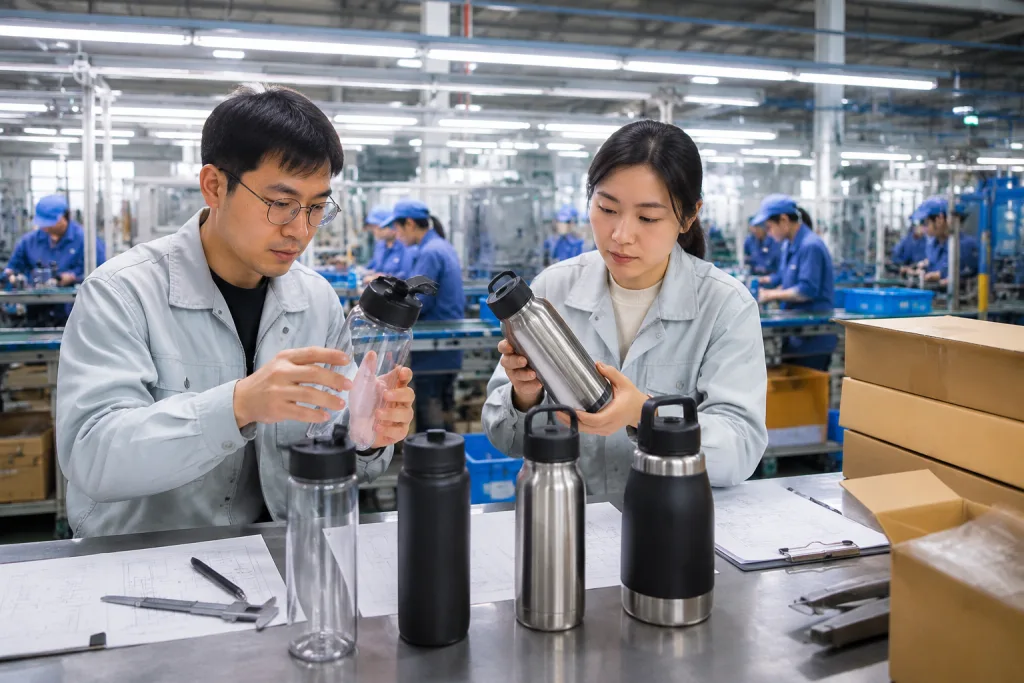
If you search for a tritan thermal bottle factory, you are probably past the catalog stage. You are checking whether Tritan fits the buyer brief, or whether the order should be 304 stainless steel vacuum, a custom canteen, or a promo sports bottle with a “thermal” look but no real insulation claim. This is the wrong question to ask if the customer expects 6-hour heat retention. The material decides the risk: soft temperature wording, pad-print logo misses, 5-ply carton crush, or a sample that QC pulled because the silicone gasket smelled after the 70°C water test.
At our Hangzhou, Zhejiang plant, we run Tritan, 304 stainless steel, and plastic-steel hybrid quotes side by side about 18 times a month. BottleForge Industrial produces about 600,000 drinkware units/month in China, with typical MOQ from 1,000 pcs per color for standard molds and 3,000 pcs for deeper customization. The line tells the truth fast. A buyer may want Tritan for lower freight weight, then flag that the retail label says “keeps hot 12 hours,” and the math does not work. Here is the practical head-to-head view.
The Spec Table Buyers Actually Need
Most sourcing calls start with the wrong question: “Can you make a Tritan thermal bottle?” Ask this instead: “Do we need real heat retention, drop resistance, logo area, or a USD 2.00 FOB target?” Tritan is a copolyester. It is BPA-free, clear, and tough enough for canteen promo orders, gym programs, school bottles, outdoor retail, and distributor drinkware lines. But Tritan is not vacuum insulation. We had one buyer flag this after QC pulled a 650 ml sample from the line and the water was already down 14°C after 2 hours.
Use this comparison before you ask a tritan thermal bottle factory, canteen supplier, or canteen manufacturer for a quotation. It saves 2-3 rounds of email, especially when the PO says “thermal bottle” but the artwork file shows a single-wall clear body:
| Spec | Tritan Bottle | 304 Stainless Vacuum Bottle | Hybrid Tritan-Steel Bottle |
|---|---|---|---|
| Best use | Cold water, sports, campus, giveaways; we run these for 500-750 ml promo programs | Hot/cold retail and premium corporate; better when the buyer expects coffee performance | Lightweight retail and outdoor sets; works when clear body design matters |
| Insulation claim | Low, unless foam or sleeve added; do not sell it as a coffee bottle | 6-12 hours hot, 12-24 hours cold | 2-6 hours depending on structure; check with a filled sample, not only CAD |
| Typical wall | 2.0-3.0 mm Tritan; 2.0 mm is common for cost-sensitive supermarket orders | 0.4-0.5 mm inner, 0.5-0.6 mm outer steel | 2.0 mm Tritan plus steel liner or base; watch the joint tolerance |
| Unit FOB range | USD 1.20-2.80; price moves fast if the lid has a flip lock or silicone straw | USD 3.20-7.50 | USD 2.60-5.20; the math gets tight below 3,000 pcs |
| Branding | Silkscreen, heat transfer, insert paper; insert paper needs a clean die line | Laser, powder coat, UV print | Mixed options; confirm logo position on a pre-production sample |
| MOQ | 1,000-3,000 pcs; custom color usually starts near 3,000 pcs | 1,000-2,000 pcs | 3,000 pcs often safer; small runs make assembly loss harder to absorb |
If your buyer brief says “thermal” because the bottle must hold hot coffee during a 45-minute commute, choose stainless vacuum. If “thermal” just means a clean reusable bottle for cold water, Tritan is often the better cost and weight choice. We’ve seen this go sideways when a buyer approved a clear Tritan body, then asked for 12-hour heat retention after the deposit. Wrong spec. Wrong factory line.
Tritan Wins On Clarity And Weight
Tritan gets underestimated by B2B buyers, and we see that during quote reviews. On a 650 ml bottle, a Tritan body may weigh 115-150 g before cap and packaging. A comparable stainless vacuum bottle often lands around 260-340 g. Big gap. When we ship 10,000 pcs into Europe or North America, that difference can change a carton from 9.8 kg to 14.6 kg depending on the cap set, and the freight math starts showing up fast. Last month QC pulled a 650 ml sample on the digital scale, and the buyer’s first pushback was not strength. It was carton weight.
For canteen distributors and distributor canteen programs, Tritan gives shelf appeal without extra decoration cost. You can run translucent smoke, amber, or blue bodies, then add fruit infuser baskets, 5 mm measurement marks, internal straw lids, and a clear liquid level. Those details sell in wellness, school, cycling, and office hydration channels because the end user understands them in 3 seconds. A customizable canteen in Tritan can look above its FOB price if the mold parting line is polished clean and the cap torque sits around 8-10 kgf·cm on the line.
The limits are plain. Tritan handles cold drinks and daily use well, but boiling-water claims are the wrong question to ask unless the full bottle structure, lid gasket, and usage label are built around hot fill. Some Tritan grades have good heat resistance, but repeated hot filling can still cause cap deformation, pressure leaks, or complaints if the venting is poor. We have seen this go sideways after a PO said “hot water OK” in one line, while the artwork file only said “cold drinks.” For North American retail, we normally recommend clear use instructions and ASTM-style drop testing from 1.0 m on filled samples. For EU orders, REACH and food-contact documentation should be checked before mass production, not after the deposit is paid.
So, Tritan is not “cheap stainless.” It is a different product category. Treat it as lightweight custom drinkware, not as a substitute for vacuum insulation. We run it best when the brief says clarity, low weight, visible volume, and clean cap fit from the start.
Steel Wins On Real Heat Retention
If the buyer writes “8 hours hot, 18 hours cold” on the spec sheet, steel is the straight answer. We run double-wall vacuum bottles in food-grade 304 stainless steel because the vacuum gap cuts heat transfer, not because the shell is bulky. The bottle does not need a heavy hand feel. On our Hangzhou line, 0.4 mm inner wall and 0.5 mm outer wall before forming is a normal starting point; for a 64 oz custom growler or customized growler, the engineer may move to 0.6 mm after checking the drawing with a digital caliper.
This is where sourcing goes sideways. A canteen vendor may quote a Tritan bottle with a “thermal” sticker because the cap has a silicone seal or the body has a fabric sleeve. That can cut sweating on the surface or slow warming for 30 to 45 minutes, but it will not fight a vacuum bottle in a hot-fill test. If your retailer wants hot coffee, soup, or winter outdoor use, approving Tritan-only to save USD 1.00 per unit is the wrong question to ask. QC pulled one sample last year that dropped from 95°C to 58°C in 4 hours; the buyer flagged it before the carton artwork was even signed.
Stainless also gives safer premium branding options. Laser engraving cuts through powder coating cleanly and does not wash off after 20 dishwasher simulation cycles when the coating system is right. We still run 3M tape tests on the logo area, especially on matte black and white bottles, because weak pretreatment shows up fast at the rim. For corporate customized drinkware, a laser logo on powder coating remains one of the lowest-risk looks. Simple sells.
The trade-off is cost and weight, plus denting if the bottle takes a hard drop. A stainless bottle can survive long use, but a dropped vacuum bottle may dent and lose shelf appeal before the customer ever tests performance. For Amazon FBA drinkware, we usually specify individual polybag, egg-crate divider or molded pulp tray, 5-layer export carton, and carton drop testing from 76 cm. FOB China price is only one line. Damage rate is the line that ruins margin, and we have seen a 2% dent claim wipe out the USD 0.40 saved on cheaper packing.
Hybrid Builds Sit In The Middle
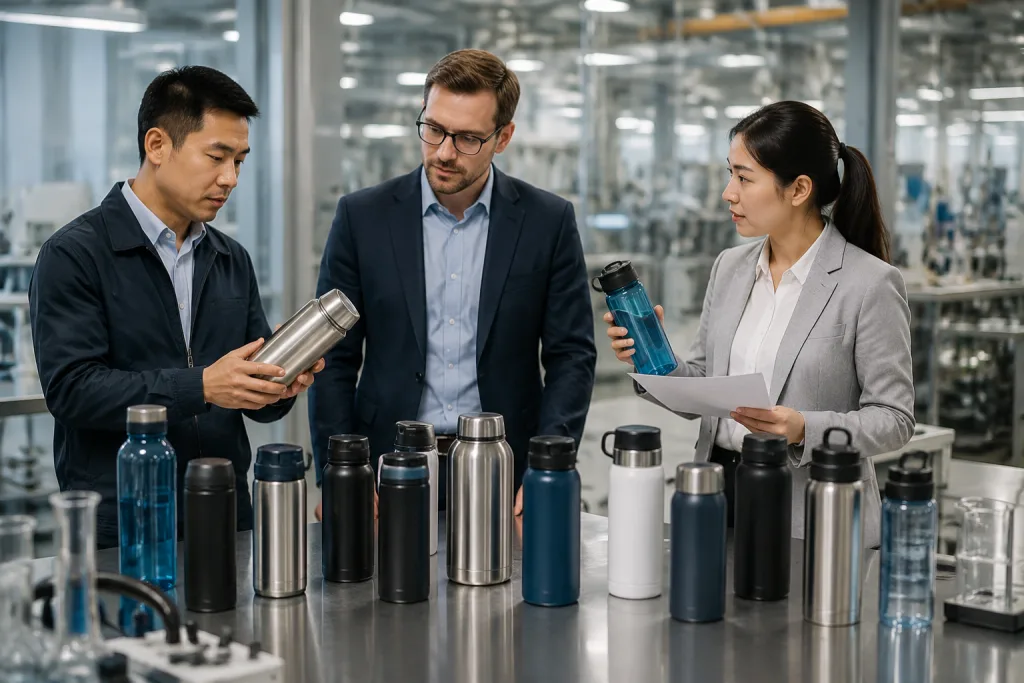
Hybrid Tritan-steel bottles sit between a clear sports bottle and a full vacuum flask. We run them when the buyer wants a lighter 650 ml bottle with a visible fill line, but still needs a “keeps warm” line on the carton. Usual builds are a Tritan outer body with a stainless liner, a stainless bottom cup with a Tritan reservoir, or a Tritan bottle packed with a 3 mm neoprene insulated sleeve. These fit outdoor gift sets and canteen customized programs where 6-hour vacuum performance is not the selling point. The math doesn’t work if the buyer expects vacuum flask results from this structure.
The win is shelf position. A hybrid bottle does not look like the same stock mold 12 vendors are quoting from Yongkang. That helps a canteen distributor avoid a race to the bottom on shape and lid color. For a customizable growler or distributor growler line, we can add a steel carry handle, stainless tea filter, or Tritan viewing window, but QC pulled the sample last month when the handle rivet sat 1.2 mm off center. Small detail. Big complaint. Done right, the bottle feels engineered, not just printed with a logo.
The weak point is production control. Mixed-material builds add tolerance risk because Tritan, stainless, silicone gaskets, PP caps, and ABS buttons do not move the same after cooling. A 0.3 mm mismatch around a threaded lid can mean leakage at 3 psi internal pressure. For China production, ask for pre-production samples from real mass-production tooling, not CNC mockups that look perfect on a desk. At BottleForge in Zhejiang, we normally run a pilot check of 80-120 pcs before full assembly on new hybrid structures, and the line uses a torque tester on the cap plus a water bath leak check before packing.
Hybrid builds also make compliance paperwork heavier. Each food-contact part needs its own file: Tritan body, silicone seal, stainless liner, PP straw, coating, printing ink. If you import into the EU, request LFGB or EU 10/2011 food-contact migration reports where they apply. For the United States, larger buyers usually ask for FDA food-contact material declarations before they release the PO. We’ve seen this go sideways when a buyer flagged the ink report at final inspection, even though the bottle body report was clean. Good canteen suppliers treat compliance as production control, not PDF decoration.
Branding Choices Change The Result
Decoration is not a small detail in custom drinkware. It decides whether the bottle looks shelf-ready or like promo bin stock. On Tritan, we run silkscreen, pad print, heat transfer, UV print, sleeve label, and molded color, but the right choice depends on body shape and logo artwork. Silkscreen is still the cleanest low-cost choice for one-color marks, usually adding USD 0.05-0.12 per position at volume. Heat transfer handles gradients and lifestyle graphics, but QC pulled one 750 ml curved-body sample last month after 3M tape lifted the edge near the seam.
For a canteen customizable program, ask the factory to confirm printable area in millimeters, not “large logo possible.” That phrase is trouble. A 650 ml Tritan bottle may allow a 70 x 90 mm front logo without distortion, while a tapered body may only allow 45 x 70 mm before the squeegee skips. If your brand guide has thin lines below 0.25 mm, some screens will fill in after 800-1,000 pcs on the line. If you use white ink on smoky transparent Tritan, the logo can turn gray unless we print a base layer first.
On stainless, laser engraving and powder coat hold up better for premium B2B orders. For a custom growler, laser on stainless or powder-coated steel is usually smarter than UV print because the product gets dragged outdoors and rubs against bags, ice chests, or vehicle holders. We have seen this go sideways when a buyer approved full-color UV on a 1.9 L growler, then flagged scratches after a sales team tossed samples into car cup holders. For a customized canteen going into corporate onboarding kits, UV print works if the buyer accepts a decorative finish, not a lifetime finish.
Do not approve decoration from digital mockups alone. Ask for a physical logo sample, then run tape test, alcohol rub test, and a 24-hour water soak around the printed area. We use 3M 600 tape, 75% alcohol, and a white cloth so ink transfer shows fast. For North American programs using FNSKU labels, confirm whether the barcode sits on the retail box, master carton, or polybag. A beautiful bottle with an unreadable barcode still causes warehouse chargebacks; the math does not work when Amazon rejects 36 cartons over a 2 mm barcode quiet-zone miss.

Use-Case Fit For Each Buyer
Different buyers should not buy the same bottle just because the MOQ looks easy. This is the wrong question to ask. A canteen promotional buyer usually needs low unit cost, a lead time the event team can live with, and a logo that passes basic tape-rub on the QC bench. Tritan fits that job. For a 5,000 pc event order, we run a 700 ml Tritan bottle with one-color print in about 25-30 days after sample approval if the resin color is standard and the artwork file is not missing the Pantone code.
A retail brand owner is buying margin and fewer bad reviews, not just a bottle. If the product page says thermal, stainless vacuum is safer. A 500 ml vacuum bottle at USD 3.80-5.20 FOB gives the brand stronger claims and better shelf value, and QC can check heat loss with a 95°C water test before packing. A distributor drinkware line serving outdoor stores can use hybrid designs, but the insulation wording must be conservative and backed by test data. We have seen this go sideways when a buyer wrote “keeps hot 12 hours” on a Tritan SKU.
Canteen manufacturers in Zhejiang and other China drinkware clusters usually offer three customization levels. Level one is logo and packaging on existing molds. Level two covers color, lid combination, straw, handle, and surface finish, with the line checking lid fit by go/no-go gauge before mass packing. Level three is private mold, which may cost USD 4,000-18,000 depending on complexity. For most canteen vendors and canteen suppliers, level two is the practical sweet spot because it creates a different SKU without locking cash into tooling.
If you are a canteen distributor selling to schools, avoid narrow cleaning openings below 45 mm and push-button lids with 6 small parts. Teachers complain about lost springs. If you are selling to corporate gift agencies, prioritize carton consistency and logo placement; the buyer flagged a 3 mm logo shift on a Hangzhou order last spring, and QC pulled the sample before we sealed the master cartons. If you are building a premium custom canteen line, spend more time on cap torque, gasket compression, and color matching than on adding another accessory. Buyers notice leaks faster than they notice an extra carabiner.
How To Qualify The Factory
A reliable tritan thermal bottle factory should answer technical questions without hiding behind catalog copy. Ask which Tritan grade they run, whether the resin is Eastman-origin or equivalent, which food-contact reports are on file, and whether injection, blowing, assembly, and packing stay inside the same plant. Ask for recent AQL results too. For drinkware, we usually see AQL 2.5 for major defects and 4.0 for minor defects, with leakage, odor, sharp edge, logo position, and carton strength written into the checklist. QC pulled one 650 ml sample last month with a 1.2 mm logo shift; small issue, but it tells you whether the line is measuring or just eyeballing.
Factory audits matter, but they are not magic. BSCI, ISO 9001, or a customer social audit can show process maturity, but order-specific controls still decide whether your shipment passes. Confirm cap assembly method, gasket material, torque standard, color tolerance, drop test height, and carton dimensions. For large distributor canteen orders, we normally recommend a pre-shipment inspection when at least 80% of goods are packed and 100% are produced. We run torque checks with a digital torque meter at assembly; if the cap spec says 8 kgf·cm and the line is closing by hand feel, we’ve seen this go sideways.
Commercial terms should be plain. For standard molds, BottleForge typically works from 1,000 pcs per color, 30% deposit, 70% balance before shipment, and 25-35 days production after artwork and sample approval. For private mold canteen customized projects, expect 45-60 days for tooling and first samples before mass production. FOB Ningbo or Shanghai is common from Zhejiang; EXW may look cheaper, but the math often fails once you add local trucking, warehouse handover, and missed cut-off risk. One buyer flagged a PO typo last quarter: “FOB Shanghai” in the email, “EXW Hangzhou” on the signed file. We fixed it before deposit.
The factory you want is not the one that says yes fastest. It is the one that corrects your spec when the spec is unrealistic. If you request a transparent Tritan bottle that keeps coffee hot for 12 hours, a good canteen manufacturer should push back and offer stainless or hybrid alternatives. This is the wrong question to ask Tritan. We ship Tritan for cold water, sports, and school bottles; for 12-hour heat retention, the vacuum stainless line is the safer call, and that pushback protects your purchase order.
Send Your Bottle Brief For Factory Review
Share target price, volume, market, and insulation claims. We will tell you whether Tritan, stainless, or hybrid construction fits the order.
Frequently asked questions
Can a Tritan bottle really be called thermal?
Only with careful wording. Tritan itself is not a vacuum insulation material, so a Tritan-only bottle should not claim 8-12 hours hot retention. It may reduce temperature change slightly if designed with a sleeve, thicker 2.5-3.0 mm wall, or hybrid liner, but it will not match double-wall 304 stainless steel. For B2B listings, we suggest terms like “cold-use Tritan bottle,” “insulated sleeve bottle,” or “hybrid thermal bottle” depending on the tested structure. If your customer needs verified hot performance, ask for a stainless vacuum sample and run a 95°C water test over 6 hours before confirming packaging claims.
What MOQ should I expect from a Tritan thermal bottle factory?
For existing molds, a realistic MOQ is usually 1,000 pcs per color for simple logo orders and 3,000 pcs if you need custom color matching, special lid combinations, or retail packaging. Private mold projects often need 5,000-10,000 pcs to make the tooling cost sensible, even if the factory technically accepts less. At our Zhejiang plant in China, standard custom drinkware lead time is usually 25-35 days after sample approval. Add 7-12 days for logo sampling and packaging proofing, especially if you need FSC paper box, barcode labels, or Amazon FBA carton marks.
Which is better for distributors: Tritan, stainless, or hybrid?
It depends on the channel. Canteen distributors selling school, gym, and event programs often do well with Tritan because the unit price can sit around USD 1.20-2.80 FOB and freight weight is lower. Retail distributors selling premium thermal bottles should choose stainless vacuum because performance claims are clearer and reviews are safer. Hybrid is useful for a differentiated distributor growler or outdoor set, but it needs tighter quality control. If you carry all three, separate the sales language: Tritan for lightweight hydration, stainless for true thermal retention, and hybrid for design-led mid-range products.
What compliance documents should I request before paying a deposit?
For Europe, request REACH and food-contact migration documents relevant to Tritan, silicone, PP, stainless steel, coating, and ink. LFGB or EU 10/2011 reports may be needed depending on the exact component and buyer requirement. For North America, FDA food-contact declarations and BPA-free documentation are common. If the order is for children, ask whether ASTM, CPSIA, or small-parts considerations apply. Also ask for BSCI or ISO 9001 audit status if your retailer requires social or quality-system review. The documents should match the actual materials in your order, not just a similar catalog bottle.
How do I reduce leakage and logo defects in mass production?
Start with a signed pre-production sample and a written QC checklist. For leakage, specify 100% leak testing where practical, or at least batch testing with inverted filled bottles for 30 minutes and pressure checks for straw or push-button lids. For logos, define position tolerance, usually within ±1.5 mm for most cylindrical bottles, and approve color by Pantone or physical sample. Use AQL 2.5 for major defects and 4.0 for minor defects at pre-shipment inspection. For a 10,000 pc customized drinkware order, do not rely only on final photos; inspect packed goods before balance payment.