Key Takeaways
- Typical MOQ is 1,000 units per color, with 25-35 day production after sample approval
- Tritan works best for clear, lightweight bottles; it is not a vacuum insulated steel substitute
- Budget USD 2.20-4.80 FOB China depending on cap, wall thickness, print, and packaging
- Use AQL 2.5/4.0 plus EU REACH or US FDA/LFGB-style food contact testing where required
A tritan thermal bottle custom project looks simple until the quotes land. One canteen supplier writes USD 2.10, another writes USD 3.40, and both promise food-grade material, leakproof caps, and fast delivery. Same bottle? Usually no. The difference often sits in resin grade, wall thickness in mm, cap tooling, silk-screen versus heat-transfer printing, test scope, 5-layer export carton packing, and how honestly the factory prices the reject rate after QC pulled the sample.
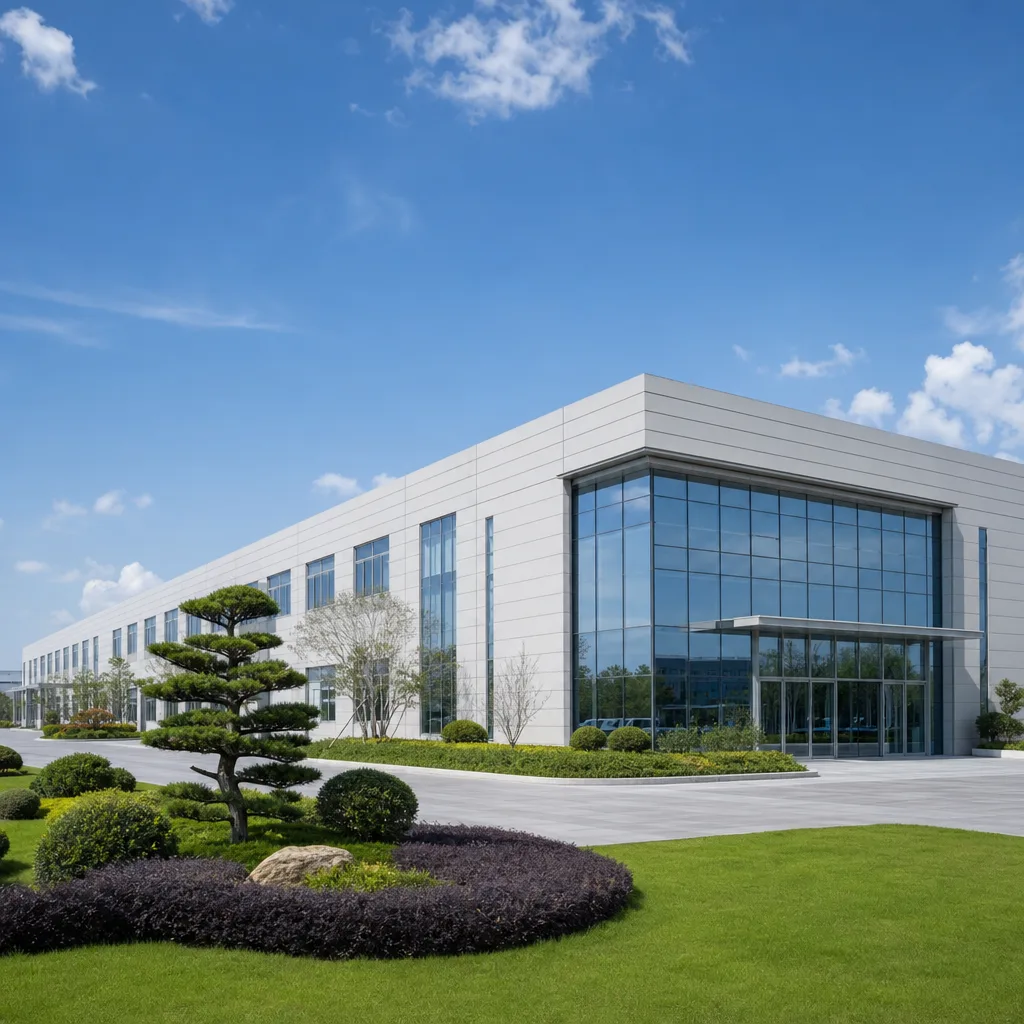
If you buy custom drinkware for retail, promotion, or distributor canteen programs, chasing the lowest line item is the wrong question to ask. Pick the construction, decoration level, compliance route, and supply model before artwork approval, or the math can go sideways after the buyer flags color drift on the first pre-production sample. BottleForge Industrial in Hangzhou, Zhejiang works with 80,000-120,000 drinkware units/month, with typical MOQ from 1,000 units per color for Tritan projects; on our line, we run color chips against the approved Pantone card before mass printing starts.
Start With Four Buying Decisions
Before you ask a canteen factory for a quotation, pin down 4 buying decisions: application, temperature claim, branding depth, and compliance market. Miss one and the quote sheet gets messy fast; last month we had a PO typed as “Trian” instead of “Tritan,” and our merchandiser had to stop the line art review for 6 hours.
Application means where the bottle will be sold or used. A canteen promotional giveaway for a 2-day software event does not need the same cap torque as a retail hiking bottle sold through a canteen distributor. A school bottle needs bite-valve safety and drop resistance; we run 1.2 m drop checks on sample sets before we trust the hinge. A gym bottle needs one-hand opening and low odor pickup after 24 hours with lemon water. A distributor drinkware buyer may ask for 6 mixed colors, EAN barcode labels, and carton marks that match warehouse pick-and-pack rules.
Temperature promise is the second decision. Tritan is a copolyester, not double-wall vacuum stainless steel. A single-wall Tritan bottle is clear, light, impact-resistant, and BPA-free, but it will not keep drinks hot for 12 hours. The math doesn’t work. A double-wall Tritan design can reduce sweating and give a better hand feel, but QC still checks it as a plastic bottle, not a true thermos, using a 90°C hot-water fill and cap leak test at the inspection table. If your sales copy says thermal, define it honestly: cold water comfort, no sweating, or short-term heat resistance around 90-100°C depending on the resin and cap parts.
Branding depth separates a simple custom canteen from a fully customized canteen. One-color silkscreen is cheap and fast; for 3,000 pcs, we usually sample it in 5-7 days after artwork approval. Full-wrap UV print, molded logo, private cap color, gift box with 350 gsm paper, and custom hangtag move the order into a more serious customized drinkware project. Sampling time changes too. We’ve seen this go sideways when the buyer approves the bottle logo but forgets the hangtag Pantone number.
Compliance market decides testing. Europe often needs REACH, LFGB-style food contact migration, and packaging checks. North America may require FDA food-contact expectations, California Proposition 65 screening, ASTM-related child-use review if marketed to kids, and CPSIA considerations for children’s products. QC pulled one sample in 2024 because the ink on a color sleeve rubbed off after 20 alcohol wipes; that kind of finding is cheaper to catch before bulk packing than after 48 cartons are sealed.
Choose Tritan For The Right Job
Tritan works when the buyer needs a glass-clear bottle that will not shatter in a carton drop test. We run it for retail hydration bottles because it is lighter than stainless steel and tougher than common SAN or acrylic. For one 700 ml canteen customizable project, QC pulled the sample after a 1.2 m drop on the concrete floor; the body passed, while the printed logo needed a thicker primer layer. That is the kind of job Tritan fits.
Heat retention is the catch. If your customer is asking for a vacuum flask, this is the wrong question to ask: use stainless steel. If they want a transparent sports bottle or an office hydration bottle with a clean shelf look, Tritan makes sense. We have seen this go sideways when a PO says “thermal bottle” but the buyer actually expects 6-hour heat holding; the line cannot fix that after the mold is cut.
For B2B orders, ask for the resin brand or technical data sheet, not just the word “Tritan.” Cheap quotes sometimes switch to generic copolyester or PC-like material, and the buyer flags odor or yellowing after the first 7-day aging check. In China, real Tritan versus substitutes can change the cost by USD 0.25-0.60 per 700 ml bottle, enough to explain a quotation that looks too good. The math doesn't work otherwise.
Wall thickness matters more than buyers expect. For a 650-750 ml bottle, we usually like 1.8-2.5 mm depending on the shape and grip area. Thin 1.3 mm walls feel cheap, deform during hot filling, and show stress marks near the shoulder after the injection machine is pushed too fast. Heavy 2.8 mm walls feel premium, but resin cost goes up and cycle time can move from 28 seconds to 36 seconds per shot.
Caps are where 6 out of 10 low-price canteen vendors try to save money. PP is common and cost-effective, but the silicone seal should be food-grade, removable, and checked with a simple pull test on the QC bench. If there is a straw, confirm PP, PE, or silicone on the BOM, and ask whether replacement straws are packed at 1:20 or sold separately. For a canteen customized for outdoor retail, we want the carry loop or handle hinge to survive at least 3,000-5,000 open-close cycles in our internal fatigue test.
Map Customization To Real Cost
Customization is not one thing. It is a cost ladder. Low steps move fast and carry less risk; high steps give the brand more control, but the line needs tighter engineering. We see buyers miss this at RFQ stage. Last month QC pulled a Tritan body sample where the logo sat 3 mm too close to the grip rib, and the buyer had already approved the PDF artwork. That is how small spec gaps turn into rework.
For most tritan thermal bottle custom orders, the practical options are:
- Silkscreen logo: best for 1-2 solid colors, usually USD 0.08-0.18 per position. We run this with a curved screen fixture, and artwork under 0.25 mm line width often fills in.
- Heat transfer: useful for gradients and multi-color artwork, usually USD 0.25-0.55 per bottle. The buyer flagged edge lifting on one 2024 order after 3M tape testing, so we now ask for coating details before quoting.
- UV digital print: good for short runs and full-color logos, but adhesion must pass rubbing and dishwasher simulation. QC usually checks 20 samples after 500 wet rub cycles.
- Embossed or debossed mold logo: cleaner for retail, but tooling may cost USD 600-2,500 depending on part complexity. A 0.4 mm depth looks safe on paper; on the mold, it can trap polish marks.
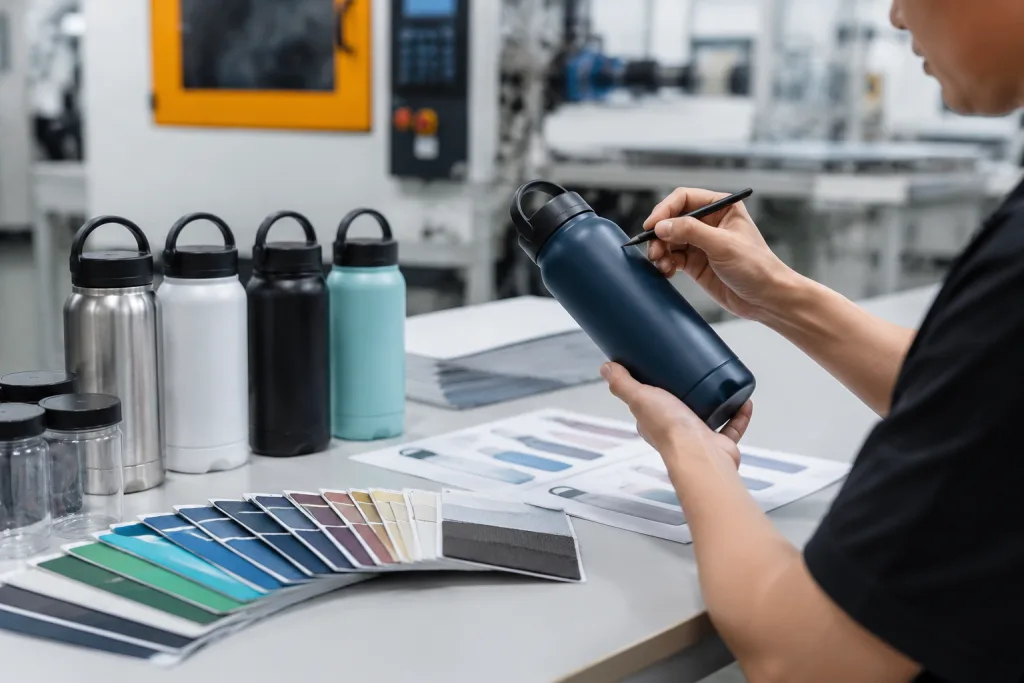
- Private color matching: usually requires 1,000-3,000 units per color and Pantone tolerance approval. We check chips under a D65 light box because warehouse lighting lies.
- Custom packaging: color box, insert card, FSC paper sleeve, or Amazon-ready carton labels. One PO came in with “matte lamination” typed as “mate lamination,” and prepress stopped it before 6,000 boxes went to print.
If you are testing a new distributor growler or customizable growler line, private tooling is the wrong first move. Use existing molds, private color, and stronger packaging first. Prove monthly sell-through for 2-3 reorder cycles, then put money into a unique cap or body profile. We ship trial orders like this often: 1,200 pcs, 2 colors, one sleeve label, standard carton.
For a custom growler, the math changes because capacity is higher and the product needs a stronger handle, larger mouth, and better drop performance. A customized growler in Tritan can work for cold brew, camping water, or gym hydration. Hot beer growler positioning goes sideways unless the material and closure system match the use. On our drop table, a filled 1.9 L sample hits the corner harder than a 650 ml bottle, and the handle pin area is usually where trouble starts.
A serious canteen supplier should return a quote sheet that separates bottle, cap, logo, packaging, testing, and inland freight. If everything is bundled into one vague FOB price, the comparison is fake. Ask your canteen vendor for the exact MOQ by color, logo method, carton quantity, gross weight, and estimated CBM before you compare landed cost. We run carton data from the packing line, not a guess from sales: 24 pcs per master carton, measured with a tape, then weighed on the platform scale.
Check Factory Control Before Price
Price means little until you know who owns the line. A trading office has its place, but repeat canteen distributors need eyes on injection molding, assembly, QC, and export packing. BottleForge Industrial runs from Hangzhou, Zhejiang, within a 2-hour truck run of plastic molding, silicone ring, and color-box suppliers; last month a buyer flagged a Pantone cap mismatch at 4 p.m., and the corrected masterbatch sample was back on our QC desk the next morning.
For a canteen manufacturer, ask for three factory numbers and make them answer in writing: monthly capacity by line, current utilization, and normal lead time by mold status. A straight answer looks like 80,000-120,000 units/month for mixed drinkware, 25-35 days production after signed PP sample, and 7-10 days for pre-production samples using existing molds. If a canteen factory promises 10,000 fully customized bottles in 12 days during peak season, this is the wrong question to ask; ask which curing rack, inspection table, or packing shift they plan to skip.
Write quality control into the purchase order. Use AQL, not “good quality.” We usually see AQL 2.5 for major defects and 4.0 for minor defects on export drinkware, with 125 pcs pulled for a mid-size lot depending on the inspection level. Critical defects, including leakage, contamination, sharp edges, wrong material, and unsafe small parts for children’s use, should be zero tolerance; QC pulled the sample once for a 0.6 mm burr inside a flip lid, and the buyer was right to reject it.
For Tritan bottles, inspection should include:
- Leak test upside down and side-rested for at least 30 minutes, using filled bottles from the packed-lot sample.
- Drop test from 1.0-1.2 m on a filled bottle, adjusted by product claim and cap structure.
- Print adhesion test by 3M tape or cross-hatch method where suitable, checked before carton sealing.
- Cap torque and thread fit check across random samples, especially after a new injection mold insert is fitted.
- Odor check after warm water soak, because buyers notice plastic smell before they notice a nice logo.
- Carton drop test for export packing, with gross weight and carton mark matched to the PO.
Factory audits matter too. BSCI, Sedex, ISO 9001-style process control, or customer audits are not window dressing. They reduce the chance that your order gets subcontracted to an unknown workshop in China without approval. We have seen this go sideways: the PO said Hangzhou production, but the carton stamp showed a different city, and the math did not work once the buyer checked the loading photos.
Set Compliance By Sales Market
Compliance is not the place to paste a certificate from last year’s sports bottle. The report has to match the actual order: Tritan body, PP cap, silicone seal, coating, ink position, and every food-contact part. We had QC pull a golden sample once where the logo sat 3 mm too close to the drinking lip; the buyer flagged it because the ink was not covered in the food-contact report.
For Europe, we usually set the file around LFGB-style sensory and migration testing, EU 10/2011 for plastic food contact where it applies, REACH SVHC screening, and packaging heavy metal limits. Retail chains also ask for BPA-free declarations, phthalate checks, and PAHs screening on black rubber-like parts such as soft grips or bite valves. Ask for the retailer’s restricted substances list before we cut the first sample. The math doesn’t work if we print 5,000 pcs with the wrong ink and then try to fix it after a failed lab report.
For North America, expect FDA food-contact positioning for plastic and silicone parts, California Proposition 65 risk review, and sometimes ASTM or CPSIA-related assessment if the bottle is sold for children. A kids’ custom canteen needs closer checks on decoration, small parts, bite valves, straps, and age grading than an adult office bottle. On the line, we check strap rivets with a pull gauge because one loose 8 mm part can turn a simple bottle order into a children’s product headache.
Do not assume “BPA-free” is enough. It sells well on a gift-box sticker, but it is not a compliance program. A canteen order for a bank conference may need less testing than a national retail launch, but you still need material declarations, batch records, and retained samples. We keep 3 retained samples per PO in the sample room, and yes, we have seen a buyer typo “PP lid” as “PC lid” on a PO and slow down approval for 4 days.
A practical budget is USD 250-700 for a focused third-party test package on one construction and one color family, depending on the lab and sales market. Add colors, coatings, or soft-touch parts, and the cost climbs fast. For distributor canteen programs with repeat orders, this is cheap insurance next to a recall, chargeback, or shipment hold; one held container at Ningbo can burn more than the full test fee in storage and delay costs.
Build A Landed Cost Model
FOB China is just line 1 on the costing sheet. For a tritan thermal bottle custom project, we price product, logo decoration, retail box, test reports, sample DHL, export cartons, Yiwu-to-Ningbo trucking, ocean or air freight, duty, warehouse handling, and FBA or retail labels. A USD 2.65 FOB Ningbo bottle often lands at USD 3.45-4.30 in Europe or North America, depending on July freight, carton cube, and the HS code your broker accepts. We run this in a 12-column Excel sheet before PI; last month QC pulled one 750 ml sample because the PO said “matte black” but the artwork file said “gloss black.”
Carton efficiency is where the math goes sideways. A 750 ml bottle packed 24 pcs/carton may use about 0.075-0.095 CBM per carton depending on body shape and retail box size. If the bottle has a wide handle or a thick gift box, you stop shipping bottles and start shipping air. That can add USD 0.20-0.60 per unit by sea, and much more by air. Ask for the master carton L×W×H in cm and gross weight in kg before deposit; our line usually confirms this from a packed blank sample, not from a drawing.
Payment terms change the risk profile. For new B2B buyers, 30% deposit and 70% balance before shipment is common in China. Larger distributor drinkware accounts may negotiate credit after 3-5 clean orders, but factories rarely offer open account terms on a first private-label order. We have seen this go sideways when a buyer plans on 60-day retail cash while the supplier needs balance payment before ETD. If cash flow is tight, discuss staged releases or split shipments early; MOQ 3,000 pcs can sometimes move in two lots if carton marks and labels are ready.
Build lead time backwards from the shelf date. Existing mold plus standard logo usually takes 7-10 days for sample, 25-35 days for bulk production, and 25-40 days ocean freight to many European and North American ports. Custom mold work adds 20-45 days before production. Peak season before summer and Q4 can add 7-15 days if artwork approval sits in someone’s inbox. On the factory floor, the pad-printing screen and color chip need sign-off before the line starts; 12 days vs 18 days on approval can decide whether you catch the vessel cutoff.
Cheap drinkware becomes expensive when it misses the retail window. Put approval dates, inspection dates, and booking dates on the same timeline as price.
Decide How To Approve Samples
Sample approval is where you stop problems, or you book them into bulk production. Do not approve a tritan thermal bottle custom sample from photos only if color, print, cap fit, or packaging matters. We ask for 2 physical samples as a minimum: 1 for your team and 1 sealed in our Hangzhou sample cabinet as the signed standard, with the item code and PO number written on the masking tape label.
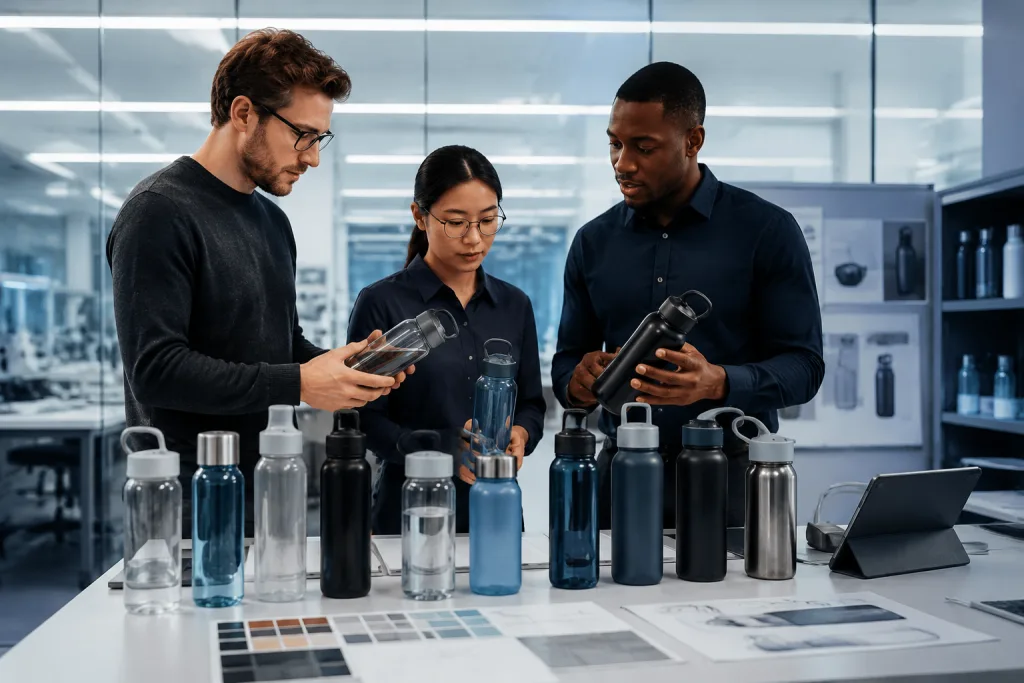
Your approval checklist should be short and strict. Confirm body clarity and tint under a D65 light box, capacity line, wall feel, cap alignment, leak performance, print size, Pantone match, barcode readability, retail box strength, and user instructions. If the order is canteen promotional, check whether the logo stays readable at arm’s length; we usually test at about 60 cm because that is how end users see it on a desk. If it is retail customized drinkware, put the sample beside 3 current SKUs and check shelf presence, not just the beauty shot.
Golden sample language belongs in the PO. Bulk goods must match the approved sample within agreed tolerances. For color, use Pantone plus a physical chip or approved plastic plaque; this matters because “blue like last order” has gone sideways for us more than once. For print, define position tolerance, for example ±1.5 mm on logo placement if the bottle shape allows it, and have QC check it with a vernier caliper on the line. For capacity, define whether 700 ml means brimful or practical fill line. These small details stop arguments after 86 cartons are packed.
For canteen distributors managing multiple SKUs, create a shared spec sheet for each item: item code, resin, cap material, silicone grade, capacity, net weight, dimensions, logo process, carton pack, barcode, FNSKU if needed, and test report reference. Keep it boring and complete. We run spec sheets against the PO before mass production, because one buyer once flagged a single digit typo in an FNSKU after labels were already printed.
Once the pre-shipment inspection passes, keep sealed retained samples for at least 12 months. If a customer later claims leakage, odor, or color mismatch, QC can pull the retained sample, run a 24-hour inverted leak check, and compare facts instead of trading opinions by email.
Send Your Tritan Bottle Brief For Review
Share capacity, market, logo method, MOQ, and target price. We will return practical options, not a vague catalog quote.
Frequently asked questions
What is the normal MOQ for a tritan thermal bottle custom order?
For existing molds, a realistic MOQ is 1,000 units per color and logo design. Some canteen suppliers will accept 500 units, but the unit price usually rises by USD 0.30-0.80 because printing setup, resin color change, and packing labor do not scale down cleanly. For private Pantone body color, expect 1,000-3,000 units per color. For a new cap or body mold, 5,000 units is a more practical starting point. If you are a canteen distributor testing a new market, start with standard mold, private logo, and retail packaging before paying for custom tooling.
Can Tritan bottles really be called thermal bottles?
Only if the claim is defined carefully. Tritan is not vacuum insulated stainless steel, so it should not be marketed as keeping drinks hot for 12 hours or cold for 24 hours. A double-wall Tritan bottle can reduce condensation and slow temperature change for short periods, often 1-3 hours depending on wall gap, cap design, liquid temperature, and room conditions. A single-wall Tritan bottle is better described as a clear hydration bottle or custom canteen. If you need strong thermal performance, choose stainless steel. If you need clarity, light weight, and impact resistance, Tritan is the better material.
What price should I expect from a canteen manufacturer in China?
For a 600-800 ml Tritan bottle using an existing mold, FOB China pricing often falls around USD 2.20-4.80. The low end usually means simple cap, standard color, one-color logo, and bulk carton packing. The higher end may include double-wall construction, carry handle, full-color print, retail box, better silicone, barcode labeling, and stricter inspection. A custom canteen with new tooling can add USD 600-3,500 in mold or fixture cost. Always compare full specifications, not just the FOB number, because cap construction and resin grade can easily change cost by 15-25%.
Which logo method is best for customized drinkware?
For simple corporate logos, silkscreen is still the safest and most economical method, usually USD 0.08-0.18 per position. For full-color artwork, heat transfer or UV digital printing gives better visual results, but you should require adhesion testing before mass production. Molded logos look premium and last the life of the bottle, but tooling cost and MOQ are higher. For distributor drinkware programs, we usually recommend silkscreen for first orders, then upgrade to molded logo or custom cap once reorder volume is stable above 3,000-5,000 units per SKU.
How do I compare canteen vendors without being misled?
Ask every canteen vendor for the same quote format: resin type, body weight, wall thickness, cap material, silicone grade, logo method, packaging, carton size, MOQ, lead time, test options, and AQL level. Require photos or videos of the canteen factory, not just a catalog. A serious canteen supplier in Zhejiang or elsewhere in China should be able to explain production capacity, sample timing, and defect controls. If one quote is more than 20% lower, ask what changed. It may be generic resin, thinner wall, cheaper cap, no testing, or weaker export carton.