
Key Takeaways
- Typical MOQ for a custom Tritan sport bottle is 3,000 units per color with 25-35 day production after sample approval
- Specify copolyester resin grade, wall thickness, cap material, and AQL level before comparing FOB prices
- A cheaper lid can save USD 0.12 per unit but create leakage claims that cost more than the bottle
- For EU and North America, plan testing for LFGB, FDA food contact, REACH, and drop performance
You are not buying only a clear plastic bottle. You are buying a SKU that has to pass a 1.2 m drop test, hold up under a dishwasher claim, survive retail shelf handling, take freight compression in a 14 kg export carton, and still look clean when the customer throws it into a gym bag on Monday morning. Tritan sport bottle wholesale sourcing looks easy until the quote sheet skips resin grade, cap wall thickness, carton burst strength, or the real logo area in mm.
At BottleForge Industrial in Hangzhou, Zhejiang, we see this mistake about 6 times a month with new importers: they ask for the “best wholesale drink bottle,” but the spec sheet is loose. Wrong question. China factories can run a clean bottle at scale, but your RFQ needs to lock the details before price talk starts; last week QC pulled a pre-production sample because the flip cap spring was 0.3 mm off and the buyer had not written the cap structure into the PO.
Start With Resin Grade
The first line on your spec sheet should not be color or logo. Put the resin first: Tritan copolyester, food-contact compliant, BPA-free, with documents ready for FDA and EU food contact review. Simple check. If the supplier writes only “plastic” or “PC-like material,” stop the RFQ. Last month we saw a PO with “Triton” typed in the material column, and QC pulled the pre-production sample before the mold trial because the resin bag label did not match the spec.
For tritan sport bottle wholesale projects, resin choice controls clarity, odor resistance, drop strength, heat tolerance, and the claims you print on the color box. Tritan gives glass-like transparency without glass breakage. It also holds up better than lower-grade PETG after repeated washing. That matters if you ship bulk drinkware to gyms, schools, outdoor chains, or corporate wellness buyers. On the line, we check haze against the approved sample under a 6500K light box, and a 0.3 mm tint drift is enough for the buyer to flag it.
Ask the factory to confirm the bottle body uses new resin, not recycled regrind. Some factories mix runner material back into production at 5-10% to cut cost. The math does not work for clear bottle bodies. Regrind can raise haze, black specks, and odor complaints, even if it looks fine during the first 20 shots. For BottleForge production in Zhejiang, our standard clear Tritan bottle body uses 100% new resin, with color masterbatch controlled by lot; the material bags are checked at the injection machine before we run mass production.
Buyer impact is simple: vague resin makes every quote look cheaper than it is. A USD 0.18 saving on material can turn into cloudy bottles, uneven tint, failed food-contact paperwork, or rejected goods at inbound inspection. We have seen this go sideways when a distributor approved price first and asked for compliance files 12 days later. Your RFQ should name the material, request compliance files, and require written approval before any resin substitution.
Capacity Is Not Just Volume
Capacity looks like a simple PO line: 500 ml, 650 ml, 750 ml, or 1,000 ml. It is not. We run different molds, different carton layouts, and sometimes a different cap set when the body height moves by 8-15 mm. A 750 ml Tritan bottle is usually the safer pick for sports and fitness shelves; our 750 ml line often passes bicycle-cage checks with a 73 mm lower body. A 1,000 ml bottle sells for outdoor and worksite users, but once filled it carries about 1 kg of water, and buyers have flagged the hand feel as “too top-heavy” during sample review.
Define whether capacity means brimful or usable capacity. Brimful volume is measured to the top lip on a graduated cylinder. Usable capacity leaves headspace under the cap, often 20-40 ml depending on neck design and silicone seal compression. QC pulled one 1,000 ml sample last year that held 960 ml comfortably but leaked at 985 ml after the 45° tilt test. If your packaging says 1,000 ml and the customer can only fill 930 ml without leaking, the math does not work.
Related product families cause trouble here. A bulk canteen, canteen wholesale project, or wholesale canteen order usually means a wider body, shoulder strap lugs, or a military-style profile; one buyer even sent us a PO with “sport bottle” in the title and “canteen bulk mold” in the remarks. A bulk growler or wholesale growler is built around beer or cold-fill beverage use, often 32 oz or 64 oz. A Tritan sport bottle should stay lighter, narrower, and easy to drink with one hand. Do not accept a canteen quote if your retail plan needs a bicycle-cage-friendly sport shape.
For freight planning, ask for filled dimensions and carton dimensions before artwork approval. A typical 750 ml single-wall Tritan sport bottle may pack 48 units per export carton, with carton weight around 9-11 kg depending on cap and packaging. We measure the packed carton with a tape and confirm gross weight on a 30 kg platform scale before sending the quote sheet. This number matters when you compare FOB China with delivered margin in Europe or North America.
Wall Thickness Controls Failure
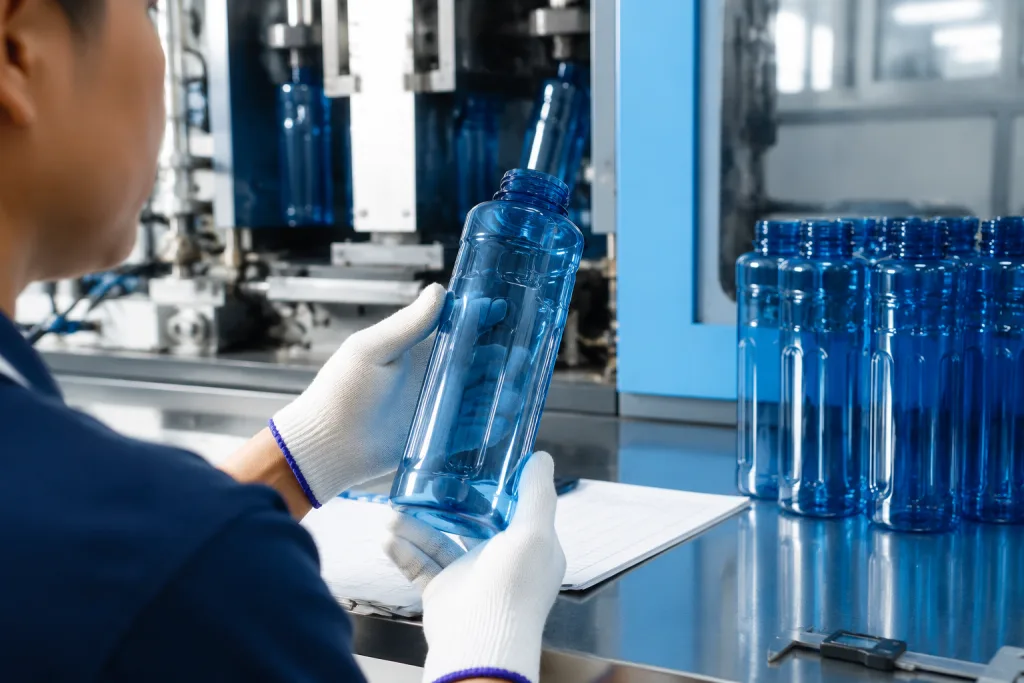
Wall thickness is where 6 out of 10 low quotes hide. A bottle can look fine in a catalog photo and still feel soft when QC squeezes the shoulder with a thumb. For most Tritan sport bottles, we run an average wall thickness around 1.2-1.6 mm, with more material at the base and shoulder; our inspector checks it with a Mitutoyo caliper after cutting the sample body. Lightweight promo models can run thinner, but don’t sell them as hiking bottles. The math doesn’t work.
The buyer impact is direct. Thin walls cut resin cost and shave cycle time, so the FOB price drops by USD 0.08-0.15 on a 750 ml bottle in some quotes we see. Drop resistance drops too, especially around the bottom edge and neck transition. If you sell into school, gym, or outdoor channels, specify a drop test. A practical baseline is 1.0 m drop height, filled with water, at room temperature, on bottom, side, and cap positions. For premium programs, test at 1.2 m. If using flip lids, test cap hinge fatigue as well; last April, QC pulled 32 samples and 3 hinges showed whitening after 3,000 open-close cycles.
Ask the supplier for weight per unit in grams. For example, a 750 ml Tritan sport bottle body and lid may weigh 125-165 g depending on design. If two factories quote the same bottle but one sample weighs 108 g and the other weighs 148 g, you are not comparing the same product. Simple check. Put the sample on a 0.1 g digital scale before price review. We’ve seen this go sideways when a PO typo changed “145 g target” to “125 g target,” and the buyer only caught it after the first carton arrived.
For drinkware wholesale, the spec line should read like this: “Tritan body, 750 ml usable capacity, average wall thickness 1.4 mm, unit weight target 145 g ±5%, no visible flow marks, black specks under 0.5 mm controlled by AQL.” That is not overengineering. That is how you stop arguments after production, especially when the line has already packed 3,000 pcs and the buyer flags soft sidewalls during pre-shipment inspection.
Cap Design Decides Complaints
The lid is where most Tritan sport bottle complaints start. Buyers often stare at the clear body because it looks good in a catalog, but the cap decides whether a customer’s gym bag stays dry. On our line, QC pulled 32 leaking samples last year from one 18,000 pcs order, and 27 were cap-related. Your spec sheet should name the cap type clearly: screw cap with thread pitch, flip straw with hinge design, push button with lock, chug lid with gasket seat, or carry-loop lid with load rating. Different cap types need different tooling, gasket fit, assembly steps, and leak-test pressure.
For a flip straw lid, check the straw material and bite valve hardness first, then look at the hinge pin diameter, spring return, and silicone gasket groove. Small parts matter. A low-cost lid can be USD 0.10-0.20 cheaper than a better one, but we have seen this go sideways: buttons loosen after 300 presses, hinge return gets lazy, straw smells after hot-water rinsing, caps crack at the pin hole, and bottles leak when inverted for 10 minutes. For premium bulk drinkware programs, we run 100% leak testing, or at minimum a tightened inline water test plus final AQL inspection.
Gasket specification matters more than buyers expect. Food-grade silicone is standard, usually 50-60 Shore A hardness depending on lid structure. Too soft, and it deforms after 70°C heat exposure in the test tank. Too hard, and the seal misses by 0.3 mm when the cap torque changes. If the factory writes “rubber ring” on the PI, push back and ask for the exact material. For North America and Europe, silicone documentation should be ready for food-contact review, not chased after the buyer flagged it during approval.
Some brands ask whether we can produce alcohol flask bulk, alcohol flask in bulk, alcohol flask wholesale, or alcohol flask wholesale bulk alongside sport bottles. Technically yes, but mixing the spec logic is the wrong question to ask. A flask is often stainless steel, so inspectors judge laser welding, inner surface finish, and leakage after alcohol exposure. A Tritan sport bottle gets judged on resin clarity, cap sealing, drop impact, and whether the straw still opens cleanly after the carton compression test. Keep these product families separate in your RFQ, even if we ship both in the same 40HQ from Ningbo.
Decoration Has Real Limits
Logo decoration is not “print my brand here.” Tritan gives you a smooth, clear wall, good on the shelf and unforgiving when the artwork file is sloppy. We run silk screen printing, heat transfer, UV printing, and sleeve labeling on some shapes, but laser engraving is rarely our first pick on clear Tritan because the mark looks weak next to 304 stainless. Last month QC pulled a 750 ml sample where the logo sat 2 mm off center because the buyer’s AI file had no bottle centerline. Small miss. Big argument.
For simple wholesale drinkware orders, one-color silk screen still wins. The math works. It is cheaper than UV on most runs, holds up through normal handwashing, and usually prints clean up to 80-120 mm wide depending on the bottle radius and jig position. Multi-color jobs need tighter registration, and this is where we see projects go sideways. If your logo has gradients, fine lines below 0.3 mm, or full-wrap artwork, ask for a printed pre-production sample, not a PDF mockup. On the line, our screen mesh and curved bottle fixture will tell the truth faster than any rendering.
Color matching is the spec line buyers skip until the sales sample lands on their desk. Body tint, cap color, strap color, and print ink come from different material systems, so one Pantone number does not lock everything perfectly under Costco-style LED lighting. We have seen a cap pass in daylight and look 1 shade too blue in a light box. For orders above 5,000 units, approve physical color chips or a sample made with production material. This is the wrong place to save 3 days.
At BottleForge Industrial in Hangzhou, Zhejiang, a normal custom logo Tritan order starts at 3,000 units per color. Standard lead time is 25-35 days after sample approval, and our monthly drinkware capacity is about 420,000 units across plastic and stainless categories. We ship sport bottles, drinkware bulk programs, beer tumbler bulk orders, and selected beer tumbler wholesale projects when the line schedule allows. If a PO says “navy cap” but the approved chip is PMS 2965C, our merchandiser flags it before tooling the cap mold or booking the print slot.
Testing Belongs In The Quote
If testing comes after price negotiation, someone pays for it and nobody smiles. Put it in the quote. For EU buyers, call out LFGB food-contact testing, REACH screening for restricted substances, and printed retail-box checks before we open the PI. Last month QC pulled a 720 ml Tritan lid set from the line and the buyer flagged the ink-rub result on the color box, not the bottle. For North America, ask for FDA food-contact documentation and a California Proposition 65 review if your channel needs it. Kids’ bottles may require ASTM or CPSIA checks.
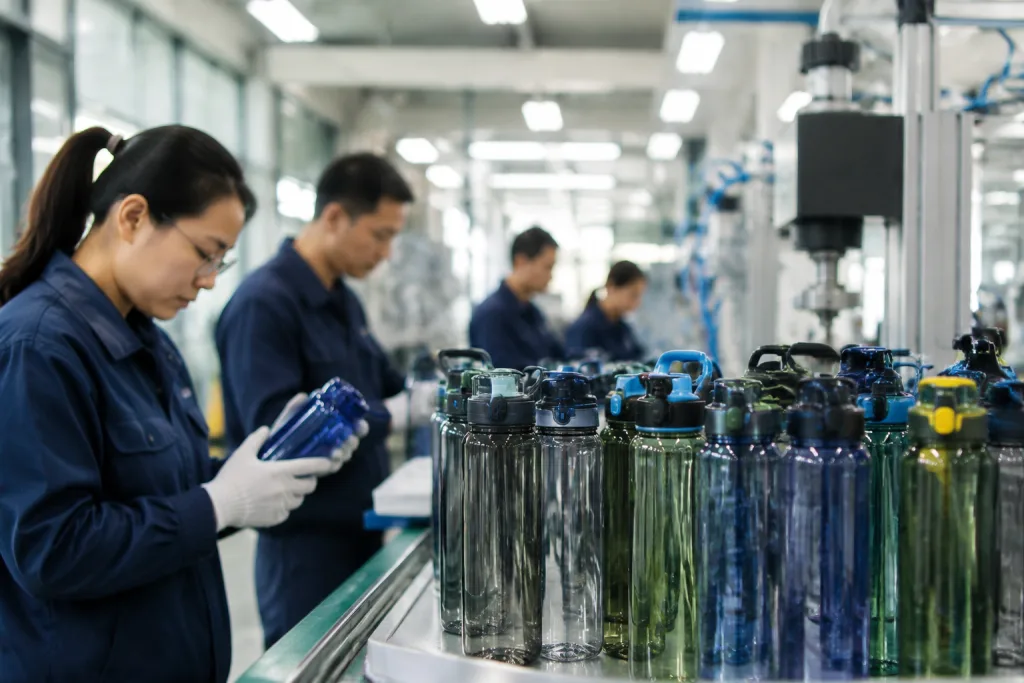
Quality control also belongs in the purchase order, not a WeChat message sent 2 days before shipment. We run drinkware wholesale inspection at AQL 2.5 for major defects and AQL 4.0 for minor defects, using general inspection level II. Critical defects stay at zero tolerance. Define leakage, odor, sharp edges, contamination, cap malfunction, wrong logo, and deep scratches as major or critical based on where you sell. Be clear. We have seen a PO with “logo: blue” while the approved sample was Pantone 2995C, and the line packed 38 cartons before QC stopped it.
For function testing, list the actual checks: capacity check with a measuring cylinder, torque check for screw caps, leakage test, drop test, odor check, print adhesion test, and barcode scan if you sell through retail or FBA. If the order includes mixed categories such as beer growler bulk, beer growler in bulk, beer growler wholesale, or beer growler wholesale bulk, write separate test criteria. A growler needs pressure-related caution and cold-fill handling. A Tritan sport bottle should not be marketed for carbonated beer storage unless it was designed and tested for that job. The math doesn't work when one carton spec tries to cover 2 product types.
We are blunt because claims cost more than inspections. A third-party final inspection in China may cost USD 250-350 per man-day. That is cheap beside a container of bottles leaking at 4% or arriving with the wrong FNSKU label. We have opened a master carton, scanned 12 labels with a Zebra handheld, and found 3 tied to the wrong Amazon child ASIN.
Packaging Changes Landed Cost
Packaging sits on the cost sheet, the damage report, and the buyer’s shelf plan. For tritan sport bottle wholesale, we run bulk polybag packing for club orders, white box for distributor stock, color retail box for shelf display, belly band or hang tag for low-cost branding, and e-commerce mailer cartons for single-piece shipping. Unit price alone is the wrong question to ask. Last month QC pulled 24 packed samples from the line and the cheapest box saved USD 0.07, then failed the corner drop on the second hit.
For distributors, bulk packing usually works: 48 units per export carton, each bottle in a clear polybag, with dividers only when the surface finish scratches under rub testing. For retail, a color box adds USD 0.18-0.45 per unit depending on board grade, printing, and quantity; our carton supplier measures board with a micrometer before mass cutting. For online orders, plan drop-tested mailer packaging and scannable FNSKU labels. Amazon-style fulfillment needs label placement and carton marks locked before packing starts, because we have seen a buyer flag 3,000 pcs after the PO had “FNSUK” typed wrong.
Carton strength needs a number. Ask for 5-ply export cartons, commonly 150-200 lb burst strength or equivalent edge crush performance depending on the carton design. For European distributors, palletization may be required; we usually see 1.1 m pallets requested with carton height capped so warehouse forks do not crush the top layer. Some North American buyers prefer floor-loaded containers to cut freight per unit. The math does not always work if unloading takes 4 extra hours and the bottom cartons arrive soft.
This is where assortment planning bites. If one purchase order combines wholesale growler, growler bulk, beer tumbler in bulk, beer tumbler wholesale bulk, and Tritan sport bottles, carton cube can become the real constraint before MOQ does. A clean FOB price from Zhejiang, China means little if container utilization drops from 86% to 72%. Ask for the packing list before deposit, not after goods are ready; on our floor, the merchandiser checks carton L x W x H in mm against the loading sheet before we release the PI.
Send Your Tritan Bottle Spec For Review
Share capacity, lid type, logo, packaging, and target market. We will flag weak specs before you place a wholesale order.
Frequently asked questions
What MOQ should I expect for tritan sport bottle wholesale?
For a custom Tritan sport bottle, a realistic MOQ is 3,000 units per color when using an existing mold. If you need a custom cap, new body shape, or exclusive mold, the MOQ often moves to 10,000-20,000 units because tooling and setup time are higher. For plain stock colors with a one-color logo, some China factories may accept 1,000-2,000 units, but unit price usually rises by USD 0.20-0.60. At BottleForge in Zhejiang, normal production lead time is 25-35 days after sample approval, with pre-production samples taking 7-10 days depending on artwork and color matching.
What is a fair FOB price range for a Tritan sport bottle?
For existing molds, most B2B Tritan sport bottles fall around USD 1.20-3.20 FOB China depending on capacity, lid structure, wall thickness, logo method, and packaging. A basic 650 ml screw-cap bottle with one-color print is near the low end. A 1,000 ml bottle with flip straw lid, silicone gasket, carry strap, color box, and heavier wall thickness sits higher. If a quote is 20-30% below the market, check resin grade, unit weight, cap gasket, carton strength, and whether testing is included. The cheapest quote is often a different spec, not a better deal.
Can Tritan bottles go in the dishwasher?
Tritan resin has better heat resistance than many clear plastics, but dishwasher claims should be treated carefully. The bottle body may tolerate top-rack dishwasher conditions, while the cap, straw, gasket, print, and color parts may not perform the same way. If you want to print “dishwasher safe,” run testing on the finished bottle, not just the raw material. A practical test is 20-30 dishwasher cycles, then check haze, deformation, leakage, odor, and print adhesion. Many brands choose softer wording such as “hand wash recommended” to reduce claims, especially for decorated bottles.
How do I compare suppliers for bulk drinkware programs?
Compare suppliers line by line, not by product photo. Ask each factory for resin grade, unit weight, wall thickness, cap material, gasket material, compliance documents, AQL standard, carton size, lead time, and payment terms. For bulk drinkware or wholesale drinkware programs, request 3-5 physical samples from actual production molds. Weigh them, fill them, invert them for 2 hours, drop test them at 1.0 m, and check odor after 24 hours closed. A serious supplier will answer these questions directly. A weak supplier will keep saying “same quality” while avoiding numbers.
Can I combine Tritan bottles with canteens, tumblers, or growlers?
Yes, combined orders are common, especially for distributors building a seasonal drinkware range. You can ship Tritan sport bottles with canteen wholesale items, beer tumbler wholesale products, or wholesale growler orders from the same China export shipment. The caution is specification control. A bulk canteen, alcohol flask wholesale item, beer growler wholesale item, and Tritan sport bottle have different materials, tests, packaging needs, and defect definitions. Treat them as separate SKUs under one purchase order. Also ask for carton dimensions early, because mixed drinkware bulk shipments can lose 8-15% container efficiency if packing is not planned.