Key Takeaways
- Start with bottle role, target price, test market, and packing before asking for FOB pricing
- A practical Tritan sport bottle MOQ is usually 3,000 pieces per color for custom production
- Expect 7-10 days for samples and 30-45 days for mass production after approval
- REACH, LFGB, FDA, ASTM, and AQL requirements should be confirmed before tooling starts
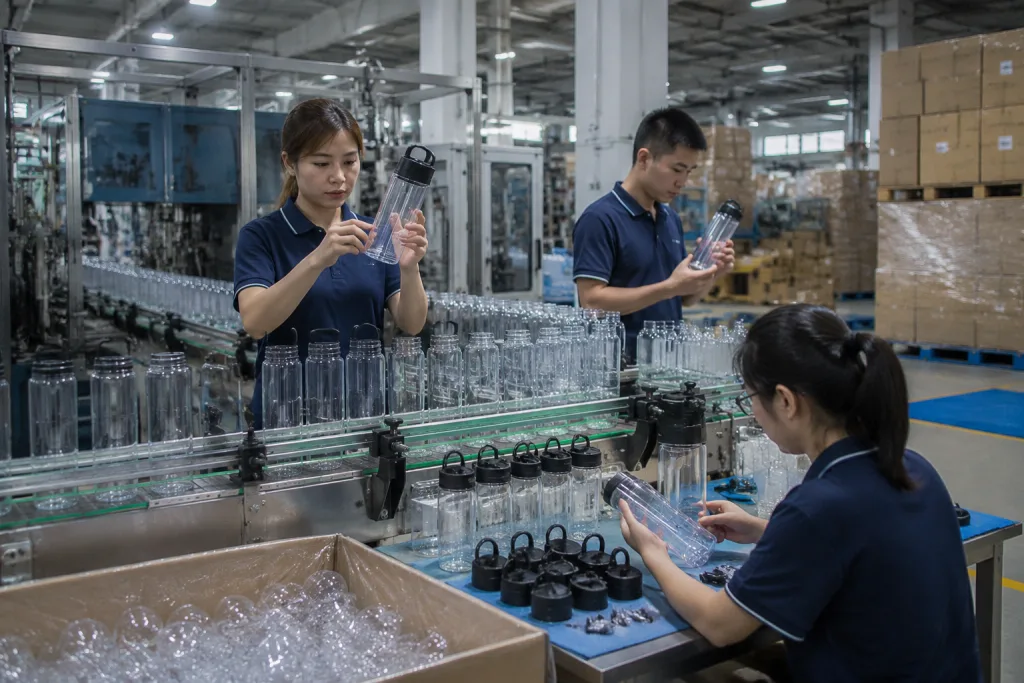
Most custom drinkware orders do not go wrong because the buyer picked blue instead of smoke gray. They go wrong because the tritan sport bottle supplier is chosen before the bottle role, test standard, printing process, and channel packing are fixed. Wrong order. A school retail bottle, a gym giveaway bottle, and a distributor canteen program can share the same 650 ml shape on a PDF, but we run different cap seals, wall thickness, drop-test height, carton board, and compliance files for each one. QC pulled one sample last month with a 0.6 mm shoulder wall; fine for a promo desk bottle, risky for a school bag.
At our Zhejiang production base, we see this with Europe and North America buyers about 7 times out of 10: the RFQ says “BPA-free sport bottle,” then the hard choices come later and push the order back by 10 to 20 days. One buyer flagged the carton after artwork approval because their club store needed 24 pcs per shipper, not 48 pcs; the math did not work after the insert tray was cut. Before you ask a canteen manufacturer or canteen supplier for a quote, fix the use case, tests, decoration, and packing first. You will get cleaner pricing and fewer ugly surprises on the line.
Decide The Bottle Job First
Do not start with capacity or logo. Start with the job the bottle has to do after it leaves Ningbo port. A retail sports bottle needs shelf-face color matching, EAN barcode checks, and a carton that passes a 76 cm drop on the corner. A canteen promo bottle for a 2-day event needs low unit cost and printing that our pad-printing jig can hold within 1.5 mm. A distributor range needs repeatable SKUs, spare caps in stock, and the same lid mold available for at least 12 months.
For Tritan, we usually run the clean B2B range from 500 ml to 1,000 ml. Below 500 ml, buyers start comparing it with kids bottles, and the math gets tight. Above 1,000 ml, the cap structure, grip width, and drop-test result matter more than the body resin. Ask for 1,500 ml with a flip straw lid and a thin carry handle, and our engineer should push back. We have seen this go sideways: QC pulled a 1,200 ml sample last season after the hinge pin cracked at the third 1 m drop test.
Use four questions before requesting a quote:
- Channel: retail shelf, corporate gift pack, Amazon FBA carton, school tender, gym chain, or distributor canteen line with repeat orders?
- Use case: cycling in a bottle cage, office desk hydration, camping pack, children’s bag, 1-day promotional event, or team sports sideline use?
- Target landed cost: for example, USD 2.20 FOB is a different mold, lid, and packing spec from USD 4.80 FOB.
- Compliance market: EU, UK, US, Canada, or mixed export program with separate test reports on the PO?
A good tritan sport bottle supplier quotes faster when these points are fixed. Without them, you get a cheap “maybe” quote that gets revised after artwork, carton size, or test standard appears. We see this often: the buyer flags the price change, then we check the PO and find “individual kraft box” added on line 14. For BottleForge in Zhejiang, standard MOQ for a canteen customized order is 3,000 pieces per color, with 7 to 10 days for pre-production samples and 30 to 45 days for mass production after sample approval.
Choose Tritan For The Right Reasons
Buyers ask for Tritan because the sales sheet says BPA-free and clearer than PP. Fair point. Still, this is the wrong question to ask first. We use Tritan when the brief needs glass-like clarity, better drop performance than acrylic, and a cleaner shelf look without glass breakage claims. It is not the low-cost plastic. Last April, one buyer pushed for Tritan on a 30,000 pcs school canteen giveaway, but after we put PP and Tritan samples side by side under the light box, the math did not work for a one-day promo bottle.
For sport bottles, we check resin grade, wall thickness, lid material, gasket quality, and thread design as one set, not five separate quote lines. On the line, our caliper check usually puts Tritan bottle walls around 1.2 mm to 1.8 mm depending on shape and capacity. Thin walls feel cheap. They also dent during carton compression; QC pulled a 650 ml sample last season after a 14 kg stack test left the shoulder slightly oval. Too thick, and the price climbs fast while the cap still cracks first in a drop test.
Ask your canteen vendor to list every food-contact material in the quote. The body may be Tritan, but the lid can include PP, silicone, TPE, stainless pins, and sometimes nylon. Each one needs to match your compliance route. For EU buyers, REACH and LFGB are common. For US buyers, retailers often ask for FDA food-contact compliance plus ASTM drop or mechanical checks. We once had a PO say “Trian lid” instead of “Tritan body”; the buyer flagged it during artwork approval, and it saved 12 days of rework before mold sampling.
Tritan fits customizable drinkware when the clear body must show printed measuring marks, fruit infusers, color-tinted resin, or internal straws. It shows the details. If you want a custom growler or customizable growler for beer or carbonated drinks, do not assume Tritan belongs there. Pressure, carbonation, and hot-fill behavior need a separate design review with the cap seal, thread pitch, and gasket compression checked together. We have seen this go sideways when a buyer tried to reuse a 700 ml sport bottle mold for sparkling drinks; the line rejected the sample after the silicone gasket lifted under pressure.
Lock Decoration Before Tooling
Logo method changes a Tritan bottle more than most buyers expect. A flat panel gives cleaner silkscreen work; a curved waist looks nicer on shelf, but large logos drift out of registration fast. Laser engraving works on 304 stainless, not on clear Tritan. On our line, we usually see silkscreen printing, heat transfer, UV printing, sleeve inserts, or molded logo details for B2B sport bottle orders.
If you are sourcing canteen custom or custom canteen programs, ask for the print area in millimeters, not “big logo possible.” A single-color silkscreen logo usually fits well at 60 mm x 90 mm on a straight body. Wrap graphics need artwork distortion checks before we release the file to printing. UV print can carry gradients, but it costs more and often needs adhesion testing, especially on frosted or soft-touch finishes. That is the wrong question to ask if you skip the finish test.
Color comes early too. Transparent blue, smoke gray, amber, and clear are standard Tritan shades, but each resin tint has to match your brand chip. Pantone on plastic is not Pantone on paper. For a canteen customizable order, we ask buyers to approve color chips or injection samples under D65 light. QC pulled a sample once that was only 5% off, and the distributor still flagged it because the bottle sat next to a matching growler set.
Tooling decides the pace when the bottle shape is exclusive. Existing molds move faster and cost less: no tooling fee, lower project risk, and samples in about 7 days if parts are ready. Private molds for a sport bottle body and cap set usually run USD 3,000 to USD 12,000, depending on cavity count, cap structure, and mold steel. In China, first trials usually take 25 to 40 days. If your launch date is fixed, do not start a private mold unless you can absorb one or two revisions; the math does not work otherwise.
Audit Caps, Threads, And Leaks
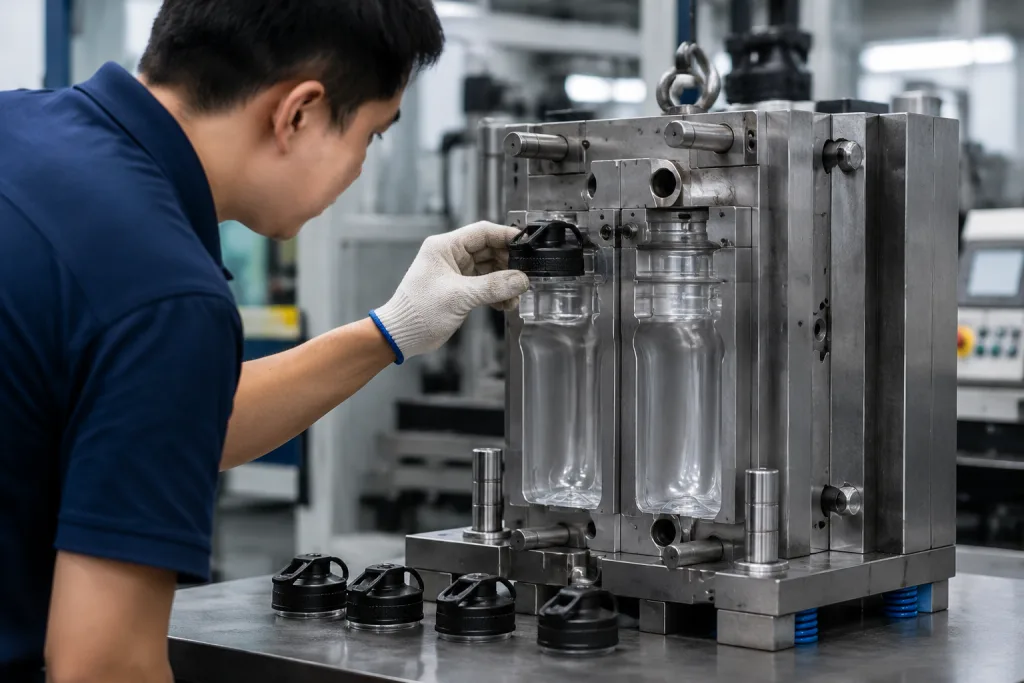
Most field failures start at the cap, not the Tritan body. Buyers often ask us about bottle clarity and gram weight first; this is the wrong question to ask if the lid has a weak seal. On our Hangzhou line, QC pulled 32 leaking samples last season, and 27 failed at the gasket seat or hinge area. Flip lids, chug caps, straw lids, push buttons, carry handles, dust covers: every extra part adds one more place for wobble, poor fit, or missed assembly. More parts need cycle testing. They also need a spare-parts plan before the PO is signed.
For a standard sport bottle, we run thread engagement checks with a go/no-go gauge, gasket compression checks at 0.6 mm to 0.9 mm, lid torque checks, hinge pin pull checks, straw fit checks, and air vent checks under water pressure. A lid can seal in the sample room and still leak after 20 dishwasher cycles or after a carton sits in a 45°C container for 30 days. We prefer silicone gaskets with stable compression and a clear assembly groove, because operators can see if the gasket is twisted before packing. Loose gaskets create random leakage, and a distributor drinkware buyer cannot diagnose that from 8,000 bottles already sitting in a warehouse.
Ask your tritan sport bottle supplier for shop-floor tests, not only certificates. We run a 1-meter drop test with water filled to 90% capacity, a 24-hour inverted leak test, 500 open-close cycles for flip lids, and carton compression testing for retail packs. For mass inspection, AQL 2.5 for major defects and AQL 4.0 for minor defects is common. Critical defects, such as sharp edges, contamination, or severe leakage, should be zero tolerance. One buyer flagged a tiny wet ring under the cap during pre-shipment inspection; the lab report looked fine, but the math didn't work once 12 cartons showed the same mark.
There is a trade-off. A simple screw lid is cheaper, easier to clean, and lower risk. A one-touch flip straw lid sells better for gyms and kids, but it adds QC time at hinge, button, vent, and straw assembly stations. If you are a canteen distributor building a long-term line, choose a cap platform that can be used across 500 ml, 750 ml, and 1,000 ml bodies. Shared caps reduce spare parts and make repeat orders easier for canteen distributors and retailers. We've seen this go sideways when a buyer approved 3 cap molds for one range, then asked for mixed spare lids after shipment.
Price The Whole Export Order
FOB unit price helps, but it is not the full order cost. A USD 2.65 FOB bottle can land higher than a USD 2.95 bottle if the K=K carton fails a 1.2 m drop test, the EAN-13 barcode scans wrong, or the supplier bills inner boxes, FNSKU labels, color masterbatch, and logo screens as extras. This is the wrong question to ask if you only compare the first line of the quote. When we run canteen quotes for export buyers, we ask purchasing to show every add-on before the PI is issued.
A practical quote should show bottle body material, cap material, capacity, unit weight, decoration method, number of print colors, MOQ, sample cost, tooling cost if any, packaging, carton quantity, carton size, gross weight, lead time, payment terms, and FOB port. From Hangzhou and wider Zhejiang, Ningbo and Shanghai are normal export ports; our warehouse team often checks carton CBM with a tape measure before booking space. For North America and Europe, freight swings can change your landed cost more than a USD 0.10 factory saving, especially when a 52 x 38 x 45 cm carton is packed with too much air.
Here is a realistic price structure for B2B planning, not a promise for every design. A 750 ml clear Tritan sport bottle with PP flip lid, silicone gasket, one-color logo, and bulk packing may sit around USD 2.20 to USD 3.20 FOB China at 5,000 pieces. Add individual color box, full-wrap UV print, spare straw, hang tag, or retail insert, and the range may move to USD 3.40 to USD 5.20. A private mold or complex canteen customized cap changes the math again; we have seen this go sideways when QC pulled the sample and found the straw 3 mm short after the buyer had approved the artwork.
For distributor canteen and distributor growler projects, ask whether repeat pricing is protected for 6 months and what triggers price review. Resin, exchange rate, and carton paper can move. A canteen vendor who hides that risk will surprise you later, and the math does not work when a PO says “matte black” but the approved sample card says PMS 426C gloss. We quote with clear validity, usually 15 to 30 days, then confirm mass production price after the approved sample and final packing method are locked.

Control Compliance And Documentation
Compliance is not a folder of PDFs. It has to match the market, material, and the claim printed on the bottle. For EU programs, buyers usually ask us for REACH and LFGB on food-contact parts. For US orders, we prepare FDA food-contact declarations and check the retailer protocol line by line. Kids products are a different job: CPSIA, ASTM F963, small parts, and warning-label rules can all come into play. This is where the math goes sideways. Last year QC pulled a 620ml tritan sample with an adult bite valve, then the buyer’s PO had “kids hydration bottle” in the item name. Wrong question to ask.
Factory audits matter when the end customer is a retailer, university, or corporate brand. BSCI, Sedex, ISO 9001, and social compliance files come up often in tender packs. They do not prove every bottle is perfect, but they show whether the canteen manufacturer has basic control over labor records, batch traceability, corrective actions, and the line schedule. BottleForge works from Zhejiang with partner lines capable of approximately 450,000 drinkware units per month across plastic, stainless steel, and glass categories. Still, capacity is not magic. We run peak-season molding slots on a booking board, and a 30,000pcs tritan order placed after May can move from 32 days to 45 days if caps are already tied up.
Before deposit, ask for the exact test plan and who pays. Put it on the PI, not in a WeChat promise. Some buyers accept existing material reports if the resin, color, and supplier are unchanged. Others need order-specific testing from SGS, Intertek, TÜV, or Bureau Veritas. Order-specific testing usually adds 5 to 10 working days and several hundred USD per material group. We have seen a 2-color lid treated as 2 material groups because the silicone ring came from a second supplier. Painful, but cheaper than rejected stock sitting at a warehouse with a failed intake report.
For customized drinkware, artwork and labeling are compliance points too. Capacity marks must be accurate. Recycling symbols should match the material. Country of origin should be correct. If you need Amazon FBA, confirm FNSKU labels, carton labels, suffocation warnings, and drop-test packaging before mass packing. The buyer flagged this on a 1,200 carton job when one carton file showed “Made in PRC” and the PO said “Made in China.” Small typo. Big delay. A canteen vendors list is not enough; you need one accountable supplier controlling the paperwork from sample approval to shipment.
Pick A Supplier You Can Reorder
A one-time order is easy to quote. A reorder program shows who is organized. If you are choosing a tritan sport bottle supplier for a brand line, check the boring records first: who owns the mold, which Tritan resin lot was used, whether the cap fits the same neck thread, where the Pantone card is stored, and whether spare straws or silicone seals are still on the shelf. We run every repeat item against the old PO, the mold number, and the injection line setting in mm before quoting again. A customized canteen that cannot be reordered in the same color six months later is not a product line. It was one lucky shipment.
Ask how the supplier stores golden samples. We keep the approved sample, color chip, packing photos, carton mark, and AQL 2.5 inspection points tied to the purchase order in one job folder. Basic work. It saves arguments when the second order ships 8,000 pcs and QC pulled the sample because the lid button looked 1.5 mm higher than last time. If your first order used a smoke-gray Tritan body with a black flip lid and white 2-color logo, the next order should not depend on a merchandiser’s memory or a blurry phone photo.
Communication speed matters, but yes-men cause trouble. You do not need a canteen supplier who approves every request in 10 minutes. You need one who says no early when the lid spring is risky, the MOQ is unrealistic, or the timeline cannot support testing. For normal custom drinkware orders from China, we prefer buyers to allow 60 to 75 days from RFQ to warehouse-ready goods if the project includes sample approval, compliance testing, production, inspection, and sea freight booking. Rush orders can work. Rushing artwork, LFGB testing, and cap validation in the same week is the wrong question to ask; we have seen that go sideways when the buyer flagged a logo typo on the PO after the mold trial.
If you manage canteen distributors or regional sales teams, standardize what you can. One bottle body in three colors beats three bodies in one color, because the line can stay on the same mold and swap masterbatch after cleaning the hopper. One cap platform also keeps spare parts simple; 5 decorative lids look nice in a catalog, then the math does not work when each lid needs its own MOQ and leak test. A supplier who understands distributor drinkware will help you trim the range, protect margin, and keep repeat orders moving instead of treating every PO as a new experiment.
Send Your Tritan Bottle RFQ For Review
Share capacity, logo, market, MOQ, and packing needs. We will flag cost risks before you commit to tooling or samples.
Frequently asked questions
What MOQ should I expect from a tritan sport bottle supplier?
For a normal custom Tritan sport bottle, 3,000 pieces per color is a practical MOQ when using existing molds. Some canteen suppliers may accept 1,000 to 2,000 pieces for plain stock colors, but the unit price usually rises and color choice becomes limited. For private mold projects, expect 5,000 to 10,000 pieces because tooling setup, resin color matching, cap assembly, and inspection time are higher. If you need a mixed-color canteen customized order, ask whether the supplier counts MOQ by body color, lid color, or total order quantity. That detail changes the quote.
Is Tritan better than stainless steel for custom drinkware?
Not always. Tritan is better when you want clear body appearance, lighter weight, visible water level, and lower cost than vacuum insulated stainless steel. A 750 ml Tritan bottle may weigh around 130 to 180 g, while a stainless vacuum bottle of similar capacity can be 350 g or more. Stainless steel is better for heat retention, cold retention, and premium gifting. For a sports bottle or canteen promotional program, Tritan is often the right balance. For a custom growler or customized growler requiring pressure resistance or beer service, stainless steel is usually the safer route.
How long does a custom Tritan bottle order take in China?
Using an existing mold, plan on 7 to 10 days for samples after artwork and color are confirmed. Mass production normally takes 30 to 45 days after sample approval and deposit, depending on quantity, decoration, and packing complexity. Add 5 to 10 working days if you need order-specific REACH, LFGB, FDA, or ASTM testing. Private mold development can add 25 to 40 days before the first trial sample. From Zhejiang, export through Ningbo or Shanghai is common, and sea freight timing depends on the destination port and season.
What should I check before approving a pre-production sample?
Fill the bottle to 90% capacity and test leakage upside down for 24 hours. Open and close the lid at least 100 times by hand, then inspect the hinge, gasket, straw, and locking button. Check logo position in millimeters against the approved artwork, not by eye only. Confirm body color, lid color, carton label, barcode, country of origin, and any FNSKU or retail label. We also recommend weighing the sample and recording the unit weight. If the approved sample is 160 g and mass production is 142 g, something changed.
Can one supplier handle sport bottles, canteens, and growlers?
Yes, but only if the supplier separates the technical requirements. A customizable canteen, Tritan sport bottle, stainless travel tumbler, and distributor growler do not use the same testing logic. Ask the canteen manufacturer which products are made in-house, which are partner-produced, and who controls final inspection. BottleForge coordinates plastic, stainless, glass, and packaging through China-based production networks, but we still assign different QC checklists by product type. That is what you want: one accountable export team, not one generic specification copied across every drinkware category.