
Key Takeaways
- For most Tritan sports bottles, 3,000 pcs is a practical MOQ for one body color and one logo method
- Ask for resin grade, wall thickness, cap material, gasket type, and test standards before comparing FOB prices
- AQL 2.5/4.0 inspection is normal for distributor drinkware orders, but leak testing needs its own line item
- Expect 30-45 days bulk lead time from China after PP sample approval, not after the first email
A tritan sport bottle manufacturer can send a price in 2 hours. That does not mean the order is under control. If the spec sheet only says “500ml, blue lid, logo print,” QC pulled the sample too late and you can still end up with loose flip caps, cloudy bodies, logo ink that fails a 3M tape test, or export cartons crushed after one 1.2m warehouse drop.
Read the product line like a factory engineer, not a catalog shopper. This is the wrong question to ask: “Which bottle is cheapest?” Ask wall thickness in mm, lid torque target, carton weight, and print method first. BottleForge Industrial in Hangzhou, Zhejiang works with B2B custom drinkware buyers who need repeatable China production: MOQ from 3,000 pieces, sample lead time 7-10 days, bulk lead time 30-45 days after artwork and deposit approval. We run the line against the approved sample, not the render.
Start With Resin Grade
The first line on a Tritan sport bottle spec sheet should not be capacity or color. It should be resin grade. Tritan is a copolyester, usually chosen because it is BPA-free, clearer than PP, tougher than SAN, and lighter than glass. For North America and Europe, ask the tritan sport bottle manufacturer for food-contact proof on both resin and finished bottle. “BPA free” in a sales email is not enough; we have seen buyers reject 3,000 pcs after QC pulled the sample and the resin lot number was missing from the file.
For serious B2B orders, request resin documents matched to FDA food-contact requirements, EU 10/2011 where applicable, LFGB if you sell into Germany, and REACH declarations for restricted substances. If you are a canteen distributor or distributor drinkware buyer, your customer may ask for these files 6 months after delivery, usually when their retail client starts an audit. Then the clock starts. You do not want to chase a canteen factory that only has a WeChat screenshot from a resin broker and a PO with “Tritain” typed wrong in the material column.
Buyer impact is simple: resin controls clarity, odor, impact resistance, dishwasher claims, and return risk. This is the wrong question to ask: “Does it look like Tritan?” A low-grade transparent plastic bottle may look close in a photo but crack around the shoulder after 8 drop tests from 1.2 m. Proper Tritan bodies handle normal gym, school, outdoor, and promotional use better than commodity plastics, but the line still needs stable barrel temperature, controlled injection pressure, and a cap that does not stress the neck thread.
At BottleForge in Zhejiang, China, we separate resin choice from decoration choice in the quotation. A 650 ml single-wall Tritan sports bottle might quote around USD 1.35-2.20 FOB Ningbo or Shanghai depending on cap structure, color, packaging, and logo method. If another quote is 20% cheaper, the math does not work unless something changed. Ask for the resin brand, cap weight in grams, test scope, and MOQ; on our side we run the quote sheet with resin line, cap BOM, carton spec, and logo process split out so the buyer can compare cleanly.
Capacity Is Not Just Milliliters
Capacity looks simple on a spec sheet: 500 ml, 650 ml, 750 ml, 1,000 ml. On the line, it is carton math. We have packed a 750 ml waisted bottle at 48 pcs per master carton, then fit a straighter 800 ml body at 60 pcs because the shoulder nested better in the divider tray. That changes freight fast. A 1,000 ml bottle sells well in outdoor copy, but QC pulled one sample last year that hit 285 mm overall height with the flip lid, and the buyer flagged shelf fit before we even talked color. It also missed a few bike cages. If you sell through canteen distributors, carton cube matters almost as much as bottle volume.
Ask for three measurements on every spec sheet: brimful capacity, practical fill capacity, and outer dimensions with lid assembled. Brimful is what the bottle holds to the lip. Practical fill capacity is usually 20-30 ml lower because the lid plug, straw, or ice insert takes space. We check this with a digital scale and room-temperature water, not by guessing from the CAD file. Small gap, big headache. If you sell a 700 ml custom canteen and the end user can comfortably fill only 660 ml, complaints are predictable, especially when the PO says “700ml” in the item description.
Wall thickness belongs on the drawing too. For many Tritan sport bottle bodies, a practical wall range is roughly 1.5-2.2 mm depending on shape, ribbing, and mold design. At 1.4 mm, we have seen panels flex after hot warehouse storage at about 42°C. At 2.3 mm, the math starts biting: FOB price rises, carton weight climbs, and the cooling cycle can shift from 12 seconds to 18 seconds on the injection machine. Buyers often ask for “premium heavy feel,” then push the factory for the lowest price. This is the wrong question to ask. You either change the design, reduce weight somewhere else, or accept margin pressure.
For canteen custom programs, we usually lock the body first, then adjust sleeve, lid, strap, and print. A new private mold can take 35-55 days and several thousand USD, and that is before texture approval, T1 samples, and the first leak test on the pressure jig. Existing mold customization is faster and safer for first orders. We ship more clean launches that way: same body, new color chips, custom silicone sleeve, and logo artwork checked against the 1:1 film before mass production.
Cap Design Carries The Risk
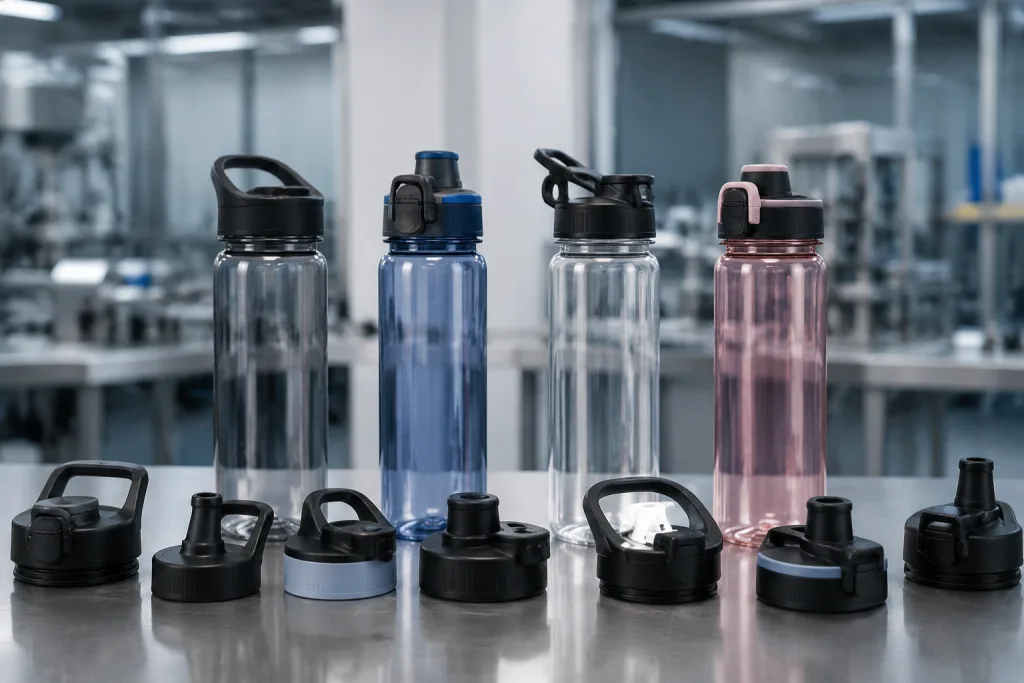
Most failures we see in customized drinkware are not in the bottle body. They are in the cap. Last month QC pulled 32 Tritan bottle samples from the line; 7 failed at the lid, and 0 cracked at the body. A tritan sport bottle manufacturer should write down cap resin, hinge pin size, gasket material, thread structure, straw material if used, and the real leak claim. Leakproof, spill-resistant, and splash-resistant mean different test standards. Buyers mix these words on POs. That is where trouble starts.
A screw cap with silicone gasket is safer than a flip cap loaded with a button lock, spring, straw, vent plug, and carry handle. Simple wins. That does not make flip caps bad; it means we run more tests before approval, usually 3 sample rounds instead of 1. We have seen a 0.8 mm spring sit slightly off-center after assembly, then the buyer flags “random leakage” after air shipment. For a canteen promotional order handed out at an event, a simple leakproof screw lid is often the better commercial call. For a retail fitness line, a one-touch cap can sell better, but the math does not work if you skip cap testing to save 5 days.
Use clear cap language in the purchase order. Write it like this: leakproof when inverted for 30 minutes at room temperature with still water. If you want carbonated drinks, hot water, dishwasher cleaning, or shaking during sports, say so on the PO, not after PP samples. We once had a buyer type “dishwasher safe cap” in an email but leave it off the signed PI; QC tested by hand wash only, and the issue came back 18 days later. Tritan bodies may handle warm liquids better than some plastics, but many sport caps are not built for boiling water or pressure from carbonation.
For canteen customizable projects, check gasket color and replacement policy before artwork approval. A black gasket hides tea stains; a clear gasket looks cleaner in product photos but can yellow after 90 days under warehouse light. If you are a canteen vendor or distributor canteen buyer, ask whether spare gaskets can ship at 1%-2% extra quantity. We usually pack them in a small PE bag inside the master carton, marked with a 20 mm white label. It costs little and prevents customer service arguments later.
Decoration Changes The Product
Logo method is not decoration we add at the end. It changes MOQ, lead time, cost, color accuracy, and scratch life. On Tritan sports bottles, we run silkscreen for straight walls, pad printing for caps and grip panels, heat transfer for wrap graphics, UV printing for short multicolor runs, laser marking on stainless clips or lids, and sleeve or insert paper when the design sits behind clear plastic. Each one changes the PO. Last month QC pulled 32 bottles from a 1,000 pcs pilot run because the buyer changed the logo from 1 color to 3 colors after the fixture was already made.
Silkscreen works well for one-color logos on a straight or mildly curved body. Good price. Clean edge. It is usually the right choice for canteen promotional orders where the target is under USD 2.00 FOB. Pad printing is better for smaller curved areas, such as caps or narrow panels, but the artwork area often stops around 35 x 45 mm before distortion shows. Heat transfer can carry full-color graphics, yet it adds cost and we always run 3M tape plus abrasion checks before mass production. UV printing looks sharp for 300-500 pcs short runs and multicolor logos, but confirm adhesion on the exact bottle surface. Not a spare sample from another mold. We have seen this go sideways when a frosted Tritan body passed the mockup stage, then failed after 50 rubs on the line.
For custom drinkware, Pantone matching is never magic. Transparent Tritan, frosted finishes, and colored bodies change the visible color. If your brand color matters, approve a physical pre-production sample, not only a digital mockup. Normal logo setup may cost USD 40-120 per color or position, depending on tooling and fixture requirements. For 3,000 pcs, that setup cost is small. For 500 pcs, the math hurts, which is why we push back on tiny custom runs. A buyer once flagged PMS 186C as “too orange” on a transparent red bottle; the ink was correct, but the base color shifted it under the D65 light box.
Customizable drinkware programs also need logo position tolerance written into the spec sheet. A practical tolerance might be ±1.5-2.0 mm for screen printing on curved bodies. If your artwork wraps around measurement marks, expect more rejects unless the fixture and artwork are designed together. This is the wrong question to ask: “Can you print it exactly on the line?” Ask how the bottle sits in the jig, where the seam lands, and what the inspector checks with the caliper. That is a factory issue and a buyer issue at the same time.
Color, Finish, And Mold Reality
Color on a Tritan bottle is not one line on a PO. We split it into body tint, cap color, strap color, silicone sleeve, printed logo, and carton label, each with a Pantone code or approved sample photo. “Blue bottle” has burned buyers before. Last April, QC pulled the golden sample because the PO said blue, the cap was Pantone 2925C, but the retail mockup showed a blue transparent body with a white cap.
Tritan body colors can be transparent, translucent, smoke, amber, or solid-looking depending on masterbatch dosage and wall thickness, usually 1.8-2.4 mm on our sport bottle line. Transparent colors show flow marks and scratches faster under the light box. Frosted finishes hide hand marks better but cut the glass-like clarity buyers often ask for. Solid color bodies look clean on shelf, but the fill level disappears. For a customized canteen used in schools or outdoor clubs, that is the wrong trade if users need to see the remaining 300 ml of water.
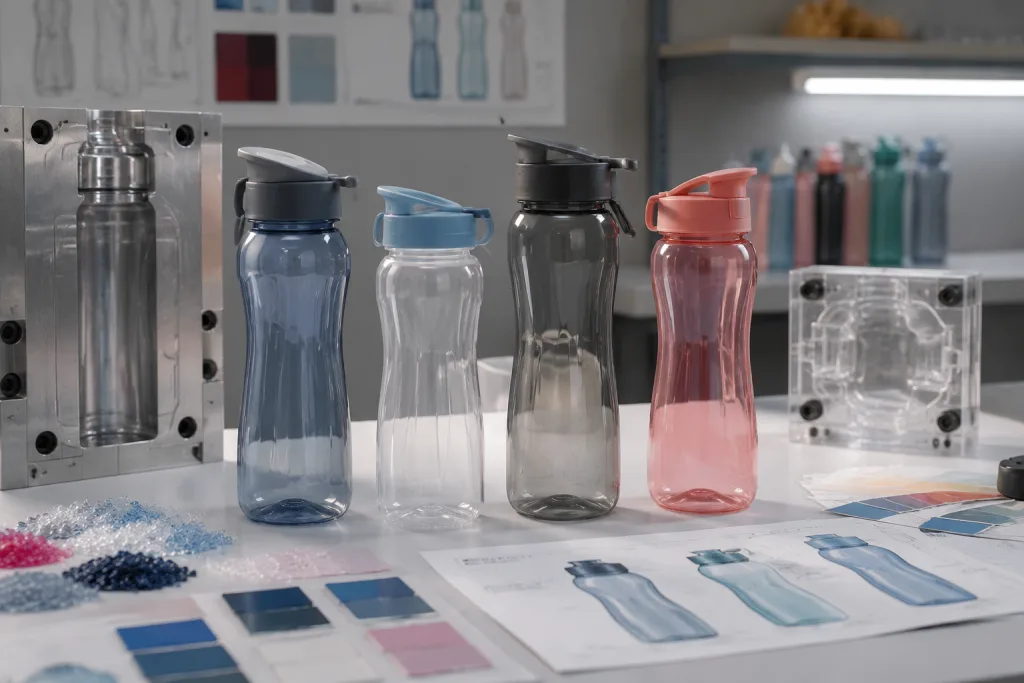
If you need a completely new silhouette, the private mold talk needs real numbers. A simple Tritan bottle mold may cost USD 6,000-15,000 depending on cavities, cap complexity, and surface finish. A bottle with flip cap, carry handle, internal straw, and silicone parts usually goes higher because the math does not work with one tool only. Mold lead time is often 35-55 days before stable sampling, and first T1 samples still need caliper checks on thread fit, hinge gap, and parting line flash. If your launch date is in eight weeks, use an existing mold and customize color, logo, sleeve, or packaging.
This is where a canteen supplier in China can save the project or quietly wreck it. Good canteen manufacturers will push back when a requested shape creates demolding risk, weak hinge points, or bad carton efficiency. We have seen round handles add 8 mm to carton width and cut container loading by 1,200 pcs. Weak suppliers say yes, then spend three weeks explaining late samples. At BottleForge in Hangzhou, Zhejiang, we would rather reject unrealistic tooling timelines before deposit than apologize after the line is already booked.
Testing Must Be Written Down
Quality control is not one checkbox. For a Tritan sports bottle order, we write the inspection plan before the line starts: appearance, capacity, dimensions, print adhesion, odor, lid fit, leakage, drop resistance, carton strength, plus barcode or FNSKU checks for Amazon and marketplace orders. QC pulled one 750 ml sample last month where the FNSKU scanned fine, but the side barcode was 2 mm too close to the carton edge for the buyer’s warehouse scanner. AQL helps with counting defects. It does not replace twisting the lid, filling the bottle, and checking whether it leaks on the bench.
For general inspection, 8 out of 10 B2B buyers we work with use AQL 2.5 for major defects and 4.0 for minor defects. Critical defects should be 0. Typical major defects include leaking, cracked body, missing gasket, wrong logo, blocked straw, and wrong capacity marking, but the list needs buyer approval on the golden sample sheet. Minor defects include light scuffs, small dust marks in printing, and slight color variation inside the approved Pantone range. Define these before production. We have seen this go sideways when a PO says “blue lid” and the approved sample says “navy blue lid.”
Leak testing needs a sample size and a written method. For example, test 80 pcs per batch by filling to practical capacity, tightening the lid to normal hand force, inverting for 30 minutes, then shaking 10 times over white tissue paper. Drop testing might use 1.0 m onto plywood or a concrete-like surface, depending on your sales channel. Retail packaging should pass a basic carton drop test, especially for distributor growler and distributor canteen customers moving goods through 3 warehouses before delivery. The math does not work if the bottle survives, but the master carton splits at the tape seam.
For EU and North American buyers, request product testing from a recognized lab when your retailer or importer of record requires it. For children’s products, ASTM and CPSIA considerations may apply in the United States. For adult sport bottles, food-contact and chemical compliance are usually the main focus, so we normally check the test request against material codes like Tritan body, PP lid, silicone gasket, and any printed ink area. A serious canteen vendor will not treat testing as optional decoration. Put the lab scope, sample quantity, and report name on the PO, or the buyer will flag it during shipment release.
MOQ, Packing, And Landed Cost
MOQ is not a factory mood. It comes from resin drying runs, masterbatch color mixing, cap assembly bins, silk-screen jig setup, labor shifts, and export carton ordering. For BottleForge Industrial, we run a normal MOQ of 3,000 pcs per design for a custom Tritan sports bottle. If the buyer accepts our stock body and stock cap colors, 1,000 pcs per color is sometimes workable. Private mold programs usually need 5,000-10,000 pcs, or the mold room math does not work after CNC time, trial shots, and 2 rounds of fitting checks.
FOB price is the wrong number to compare by itself. A 700 ml bottle may pack 48 pcs per export carton, while a wider bottle may pack only 36 pcs. We have seen a USD 0.06 cheaper item lose the quote after the buyer flagged 18 extra cartons per 3,000 pcs on the packing list. That changes sea freight, warehouse handling, and pallet count. If you buy as a canteen distributor, ask for carton size, gross weight, net weight, and units per 20 ft or 40 HQ container. Small carton differences hit landed cost fast.
Packaging drives returns, too. Bulk polybag packing is the lowest cost. White box adds roughly USD 0.08-0.18 per unit depending on size and paper. Color box can add USD 0.15-0.40 or more. If you sell customized growler, custom growler, or customizable growler lines alongside bottles, do not copy the same carton spec across categories. We ship heavier drinkware with stronger inner protection, and QC has pulled samples where a 5-layer carton passed drop test at 12 kg but corner-crushed at 16 kg.
Lead time should start after approvals, not after the first email. A normal China schedule is 7-10 days for sample, 3-5 days for buyer approval if the team replies cleanly, 30-45 days for bulk production, and 7-14 days for final inspection booking and export loading depending on season. Around Chinese New Year, add 15-25 days of buffer. We have seen this go sideways when a PO had one digit wrong in the Pantone code and the line sat for 2 days waiting for confirmation. That is not pessimism; it is how Zhejiang and broader China manufacturing calendars work.
Send Your Tritan Bottle Spec For Review
Share capacity, logo, target price, market, and testing needs. We will return a practical China factory quotation with risks marked clearly.
Frequently asked questions
What MOQ should I expect from a Tritan sport bottle manufacturer?
For a standard existing mold, 3,000 pcs per design is a realistic MOQ if you need one body color and one logo. Some stock programs can start around 1,000 pcs per color, but the unit price will be higher and decoration choices are limited. For a fully customized canteen with new cap, new body shape, or special silicone sleeve, expect 5,000-10,000 pcs. The MOQ is driven by resin color mixing, printing setup, cap assembly, and production line changeover. If you are testing a new canteen promotional program, use an existing mold first, then invest in private tooling after sell-through data is clear.
Is Tritan better than stainless steel for custom drinkware?
It depends on the job. Tritan is lighter, transparent, and usually cheaper than vacuum stainless steel, so it works well for sports, school, event, and distributor drinkware programs. A 650 ml Tritan bottle may quote around USD 1.35-2.20 FOB, while insulated stainless steel is usually higher because of welding, vacuum processing, and powder coating. Stainless steel wins on heat retention and premium perceived value. Tritan wins when you need visibility, low weight, and lower freight cost. Many canteen distributors carry both: Tritan for volume promotional channels, stainless steel for higher-ticket retail or corporate gifting.
Can you make a canteen customized with my brand color and logo?
Yes, but define each color location separately: Tritan body tint, cap, button, strap, gasket, sleeve, logo, and packaging. For a customized canteen, Pantone matching is easier on opaque caps than transparent bottle bodies because transparency changes how color appears under light. We normally recommend a physical pre-production sample for any brand-critical color. Logo methods include silkscreen, pad print, UV print, heat transfer, and laser marking on metal parts. Setup cost is commonly USD 40-120 per color or position. For 3,000 pcs, that cost is manageable; for very small test runs, stock colors are usually smarter.
What quality standard should I put on the purchase order?
Use AQL 2.5 for major defects and AQL 4.0 for minor defects as a baseline, with critical defects at 0. Then add functional tests separately. For Tritan bottles, list leakage, cap opening force, gasket presence, print adhesion, odor, capacity, and carton drop test. A practical leak test is filling to working capacity, inverting for 30 minutes, then shaking 10 times. Major defects should include leakage, cracked body, wrong logo, missing gasket, blocked straw, or wrong barcode. If your retailer requires REACH, EU 10/2011, LFGB, FDA, ASTM, or CPSIA documentation, include that requirement before sampling starts.
How do I compare canteen suppliers without choosing only the cheapest quote?
Build a comparison table with resin grade, capacity, wall thickness, cap material, gasket type, logo method, packaging, MOQ, sample lead time, bulk lead time, AQL plan, and FOB port. A quote that is USD 0.18 cheaper can lose money if it uses a thinner body, weaker cap, smaller carton, or no lab testing. Ask every canteen supplier for photos of mass production, not only showroom samples. Also ask for carton dimensions and units per carton so you can estimate landed cost. Good canteen vendors explain trade-offs. Weak vendors just repeat “same quality” without measurable specs.