Key Takeaways
- A practical MOQ for tritan sport bottle custom orders is 3,000 units per color for molded stock shapes
- Tritan usually wins for lightweight retail, while stainless wins for insulation and glass wins for taste neutrality
- Logo choice changes cost by USD 0.08-0.65 per unit depending on print area and color count
- For North America and Europe, ask for LFGB, FDA, REACH, and BPA-free documentation before deposit
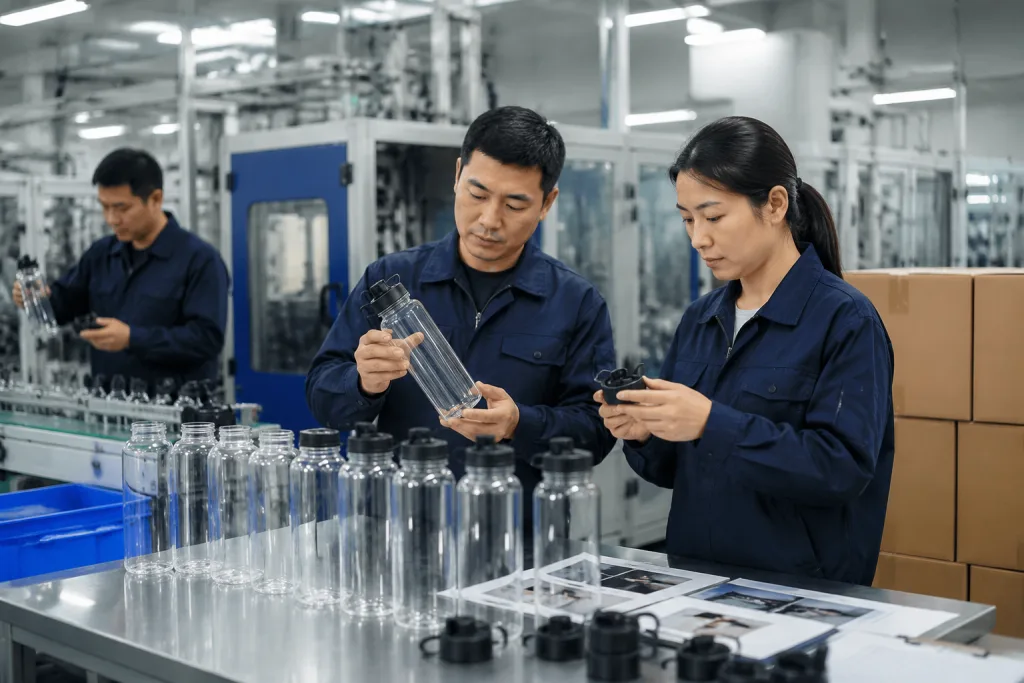
A tritan sport bottle custom project looks simple on the RFQ, then the buyer starts comparing flip lids, Eastman Tritan resin grades, 5-layer carton specs, logo positions, and LFGB test reports. A 650 ml bottle for a gym chain is a different job from a 1 L canteen promotional order for an outdoor retailer, even if both sit under “custom drinkware” on the same PO. We’ve seen this go sideways. Last month QC pulled a pre-production sample because the silicone seal sat 0.4 mm proud after the torque test, and that one small gap changed the lid choice.
You need a China supplier who can turn brand intent into production specs without hiding behind soft words like “premium quality.” BottleForge Industrial is based in Hangzhou, Zhejiang, and we run Tritan bottles as engineered export products: resin batch traceability, AQL inspection, controlled packing, and lead times we can defend. The math matters. If the order needs UV logo printing, color box packing, and a 3,000 pcs MOQ, don’t plan around 12 days when the line needs 18 days after artwork approval and deposit arrival.
Tritan Versus Other Bottle Builds
If your RFQ says tritan sport bottle custom, you are already pointing at a clear, light bottle that can take rough handling. That makes sense for fitness chains, school packs, travel promos, and distributor drinkware jobs where cracked cartons and air-freight weight get expensive fast. Tritan is a copolyester, not ordinary PC plastic, and buyers usually write BPA-free on the spec sheet. On our 0.01 g bench scale, a 650 ml sport bottle normally lands at 110-160 g before the polybag and color box; a similar stainless single-wall bottle comes in at 260-340 g.
The head-to-head decision is the wrong question to ask. Match the bottle to the sell-through story. Stainless steel wins when insulation or dent resistance carries the order. A custom growler or customized growler for beer, kombucha, or outdoor retail may need 18/8 stainless, vacuum insulation, and 24-hour cold retention claims. Glass feels cleaner for premium office kits or wellness sets, but the carton drop test is not kind to it; last month QC pulled 6 cracked glass samples after a 76 cm corner drop. Tritan sits between those two: clear, tough, lower cost, and quick on printing when the artwork is not overloaded.
Use this comparison before asking a canteen supplier for pricing. It saves two rounds of emails. We run these checks against the lid drawing, carton size, and decoration area in mm, because “same bottle, cheaper price” usually hides a weaker cap or thinner wall.
| Spec | Tritan sport bottle | Stainless canteen | Glass bottle |
|---|---|---|---|
| Typical capacity | 500-1000 ml | 500-1900 ml | 350-750 ml |
| Unit cost FOB China | USD 1.65-3.40 | USD 2.80-8.50 | USD 1.90-4.20 |
| Best fit | Gym runs, school kits, event giveaways | Outdoor retail and corporate sets | Office gifts and wellness packs |
| Main risk | Lid leakage and odor claims | Vacuum failure and transit dents | Breakage and freight damage |
For a canteen distributor or distributor canteen program, Tritan is a safer first order in 3,000-5,000 pcs than jumping straight into stainless tooling. You can test 2 colors, 2 cap styles, and logo placement before the buyer locks the annual range. We have seen this go sideways when a PO says “matte black lid” but the approved sample has a glossy PP lid; the line stops, and 12 days becomes 18 days.
Where Tritan Wins And Loses
Tritan wins when the bottle has to look clean on a retail shelf and still take daily abuse in a backpack. Drop test tells the story. We usually run 1.2 m drops on a loaded bottle, and Tritan handles impact better than low-cost PC-look plastics without the glass-style cracking that makes school buyers nervous. For a canteen customizable program, we can run transparent smoke, clear, blue, pink, amber, or a solid body, but color choice depends on MOQ and resin stock in the drying room. On stock molds, 3,000 units per color is a workable starting point; fully custom colors often need 5,000-10,000 units because the resin batch and masterbatch ratio have to stay locked.
It loses when buyers expect stainless-level hot-water performance. Wrong question to ask. Tritan is not the bottle I would choose for boiling tea water in a school bag, and we normally advise against filling it with boiling water. Most projects are built for cold or room-temperature drinks, with practical use below 80°C. Dishwasher claims need tight control too. QC pulled samples after top-rack cycles last year; the body passed, but one lower-grade lid showed slight oval deformation at the thread gauge. If your market requires dishwasher-safe labeling, specify the test method and cycle count before artwork approval.
The other weak point is the lid. Many canteen manufacturers can mold a clear body, but the complaint ticket usually comes from the gasket, hinge, straw, or push button. A USD 0.12 saving on the cap can create a 3% return rate, and the math does not work for Amazon FBA, retail replenishment, or a canteen promotional campaign with a fixed event date. We have seen this go sideways: the buyer flagged leaking cartons after the 24-hour inverted test, and QC traced it back to a soft silicone ring plus loose cap torque. For customized drinkware, I would rather see you spend on a better silicone seal and thicker hinge pin than overpay for a fancy carton.
Our Zhejiang factory network in China can produce about 450,000 plastic drinkware units per month across shared lines. We run the plastic line with 160-220 ton injection machines for caps and blow molds for bodies, so capacity moves when one buyer blocks a color or a PO has a typo in the Pantone code. For normal seasonal loads, sample lead time is 7-10 days and mass production is 25-35 days after deposit and artwork approval.
Spec Table Buyers Should Send
A loose RFQ gives you loose pricing. Ask five canteen vendors for a 750 ml customized canteen and you can get five quotes that sit in different buckets: one factory prices Eastman Tritan, one prices PETG, and one quietly assumes a PP lid with a thinner silicone ring. We see this on the line every month. The buyer thinks the cheapest quote won, then QC pulled the sample and found a 1.55 mm body wall instead of the 1.8 mm they expected. Send a locked comparison table. Let each canteen vendor fill only price, lead time, and exceptions.
For a tritan sport bottle custom project, your RFQ table should include these fields:
| Line item | Recommended spec | Why it matters |
|---|---|---|
| Body material | Eastman Tritan or approved copolyester equivalent | Stops material substitution before mold trial |
| Capacity | 650 ml, 750 ml, or 1000 ml to brim or fill line | Prevents volume disputes during measuring cup check |
| Wall thickness | 1.8-2.3 mm typical | Controls hand feel and drop strength |
| Lid material | PP lid with food-grade silicone gasket | Controls leakage and gasket odor |
| Leak test | Inverted 30 minutes, room temperature | Gives QC one clear bench test |
| Inspection | AQL 2.5 major, 4.0 minor | Sets shipment acceptance rules |
If you are sourcing customizable drinkware for 2 or 3 markets, write the packing spec into the RFQ as well: 1 pc/polybag or kraft box, 24 pcs/carton, 5-ply export carton, and target carton drop test from 76 cm. For FBA, ask for FNSKU labeling, master carton labels, and carton weight below 15 kg where possible. A canteen manufacturer in China can run this, but the details need to be on the PO before the proforma invoice is signed. We have seen this go sideways when a buyer flagged carton weight after assembly; changing carton structure after production starts usually adds 3-5 days and creates repacking cost that nobody budgeted.
Decoration Choices Under Real Cost
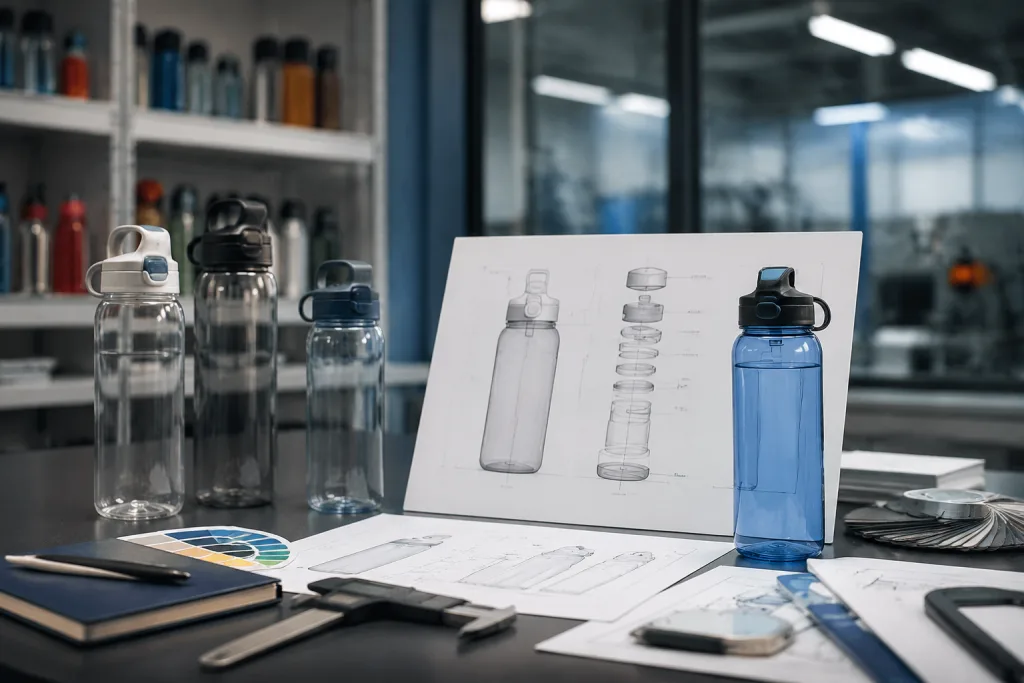
Logo method is where 7 out of 10 custom canteen projects get messy. The bottle is curved, often tapers 2-4 mm from shoulder to base, and some molds have grip ribs that break a print line. Simple wins. A clean one-color logo on a smooth panel sells better than a full-wrap design that misses registration by 1 mm. For tritan sport bottle custom orders, we run silk screen, heat transfer, UV print, sleeve insert, and molded color matching, but the line usually pushes back when artwork crosses the parting line.
Silk screen is the workhorse. For one color on one side, expect roughly USD 0.08-0.18 per unit depending on logo size and order quantity. Two or three colors may reach USD 0.20-0.35, and each color needs its own screen. On our Hangzhou floor, the screen frame sits in a curved bottle jig, and QC pulled the sample last month because the red Pantone 186C shifted after 300 pcs. It works for gym chains, schools, races, and canteen promotional programs where the logo must read cleanly from 2 meters away.
UV printing gives more color detail and supports gradients, but it needs a printable flat zone and a tight fixture, not a loose universal clamp. Budget USD 0.35-0.65 per unit for 4-8 cm mid-size designs. We ship this for brand owners selling customized drinkware online because product photos need to match the artwork, down to small shadow lines around letters. Heat transfer works for larger graphics, but this is the wrong place to save USD 0.04 if the bottle sits in backpacks all day. Ask for a 3M tape test and 100-cycle rub test; we have seen transfers pass visual inspection and fail after the first rubbing wheel check.
Laser engraving is not usually the first choice for Tritan because the mark looks softer than it does on stainless steel. If you need a premium permanent mark, stainless or a powder-coated custom growler is the better call. For a customizable canteen made from Tritan, lock the printable area in mm, Pantone references, logo tolerance within ±1.5 mm, and whether the logo must face opposite the volume scale. One buyer once wrote “opposite ml scale” on the PO, then sent artwork facing the scale in the AI file; that typo cost 2 extra approval days. Those small details decide whether your cartons look retail-ready or merely acceptable.
Compliance Is Not Optional Paperwork
For Europe and North America, compliance paperwork belongs on the table before we cut the first sample, not when 86 cartons are already taped. At minimum, ask a canteen supplier for a BPA-free declaration, FDA food-contact suitability for the US, LFGB or EU food-contact testing for Europe, plus REACH SVHC screening when the bottle has colored plastics, coatings, inks, or silicone parts. If the bottle targets children, add CPSIA and relevant ASTM checks. A generic report is not enough. We have had buyers send a PO with “Tritan bottle, blue cap” typed as “blue cup,” and QC pulled the sample because the test file only covered the clear body, not the cap color.
The usual problem is scope mismatch. A report can cover clear Tritan body material but miss the colored lid, silicone gasket, straw, printed logo ink, or carry strap. For customized canteen orders, every food-contact component should appear in the bill of materials with material name, color code, and supplier lot; on our line, we check this against the BOM sheet before the first 30 pcs trial run. If the gasket changes from translucent silicone to black silicone, that is a material change. If the logo ink changes from supplier A to supplier B, migration testing can change too. The math does not work if a buyer saves USD 0.03 on ink and then loses 12 days waiting for a fresh report.
A serious canteen manufacturer should also support factory audits when needed. BSCI is common for European retail. ISO 9001 tells you there is a quality management system, though it does not prove every bottle is good. For larger distributor drinkware programs, we recommend pre-shipment inspection by your own QC company or our internal QC under AQL 2.5/4.0. Inspection should check capacity, weight, color, logo adhesion, barcode scan, leakage, carton markings, and quantity per carton. On a 5,000 pcs order last March, our inspector used a 0.01 kg scale and 3M tape test; the buyer flagged one weak barcode, so we reprinted 42 labels before sealing the master cartons.
Hangzhou, Zhejiang is close to plastic molding and packaging clusters, so we can keep component sourcing inside China without chasing 6 suppliers across 3 provinces. That matters when you need the same resin, lids, gaskets, and cartons over repeat POs instead of one lucky shipment. We run resin batch checks, lid fit checks with a go/no-go gauge, and carton drop checks at 76 cm when the order calls for retail packing. This is the wrong question to ask: “Do you have a certificate?” Ask whether the certificate matches the exact bottle we ship.

Choosing The Right Supplier Type
Not every canteen supplier fits the same buying job. A trading company can move faster if your PO has 10 mixed promotional SKUs, three carton marks, and one ship date. A direct canteen factory is the better bet for repeat orders where the same Tritan body, PP lid, silicone seal, and color chip must match again six months later. We run injection machines on the bottle body, so if a buyer asks why the shoulder line moved 0.4 mm after sampling, our technician can check the mold, not just forward a complaint to another workshop.
If you are a canteen distributor, the bottle price is only one line on the risk sheet. You need repeatable specs, clean retail cartons, and a supplier who will not contact your customer when the order grows from 3,000 units to 30,000 units. Ask whether the supplier owns the mold, controls the injection machines, or buys the body from outside. Ask for current production photos from the line, not showroom images with perfect lighting. Ask how many QC staff check each lot and whether records are filed by lot number; on our side, QC pulled the sample last month because one lid gasket was 0.8 mm short, and that is the kind of finding you want before shipment. A fair answer beats a polished one.
For first orders, we usually suggest a stock mold with custom color and logo: MOQ 3,000 units, sample 7-10 days, mass production 25-35 days, and FOB Ningbo or Shanghai. For a new mold, budget USD 2,500-8,000 for tooling depending on lid complexity, handle design, and whether a straw system is involved. Tooling time is usually 25-40 days before pilot samples. The wrong question is “Can we make it fully custom?” Of course we can. The better question is whether the math works after mold fee, color testing, carton drop test, and a 2% spare-parts allowance are added. A fully customized growler or distributor growler project in stainless may need different tooling economics, but the rule is the same: prove demand before paying for engineering you do not need yet.
The best supplier fit is the one that tells you what cannot be done cheaply. If a canteen vendor promises any color, any logo, any test report, and 10-day mass production during peak season, be careful. We have seen this go sideways: the buyer flagged the Pantone number on the PO, the factory used a close masterbatch anyway, and 120 cartons sat in the warehouse while everyone argued by email. Real factories in China have capacity limits. Honest limits protect your launch date.
Send Your Tritan Bottle Spec For A Real Quote
Share capacity, logo, market, quantity, and target ship date. We will respond with MOQ, FOB pricing, sampling time, and compliance options.
Frequently asked questions
What MOQ should I expect for a tritan sport bottle custom order?
For BottleForge Industrial, the normal MOQ is 3,000 units per color for a stock Tritan sport bottle mold with one logo. If you need a custom Pantone body color, plan for 5,000 units because resin matching and machine setup create waste. A new private mold usually needs 10,000-20,000 units to make tooling cost sensible. Smaller test runs may be possible at 1,000-2,000 units, but the unit price can increase by USD 0.30-0.80 because setup, printing, and carton work do not shrink much.
Is Tritan better than stainless steel for promotional canteen programs?
Tritan is better when low weight, transparency, and lower FOB cost matter. A 750 ml Tritan bottle may land around USD 1.85-3.20 FOB China depending on lid and decoration, while a comparable stainless bottle often starts around USD 2.80 and climbs quickly with insulation. Stainless is better for hot/cold retention, outdoor retail, and premium corporate gifting. For canteen promotional use at races, gyms, schools, and events, Tritan usually gives you more visible branding area and lower freight weight.
Can you make a canteen customizable with my own lid design?
Yes, but the economics change. A custom lid normally needs injection tooling, gasket validation, and leak testing. Simple lid tooling may start near USD 2,500-4,000, while a push-button straw lid with hinge, spring, lock, and silicone parts may reach USD 6,000-8,000 or more. Development takes about 25-40 days before pilot samples, then another 25-35 days for mass production after approval. For most first orders, we recommend using a proven lid and customizing color, logo, and packaging first.
What test reports do canteen distributors need for Europe and North America?
For the US, request FDA food-contact documentation and BPA-free confirmation; for children’s products, add CPSIA and applicable ASTM checks. For Europe, ask for LFGB or EU food-contact migration testing and REACH SVHC screening. The report should cover the actual body, lid, silicone gasket, straw if used, and printed decoration where relevant. A generic report for clear resin is not enough if your order uses a colored cap and custom ink. For retail buyers, we can coordinate third-party testing before shipment.
How do I compare quotes from different canteen suppliers fairly?
Force every canteen supplier to quote the same spec sheet: material grade, capacity measurement, wall thickness, lid material, gasket type, logo method, packaging, AQL level, test requirements, Incoterm, and lead time. A quote at USD 1.70 may not beat USD 2.05 if it uses PETG instead of Tritan, a thin 1.4 mm wall, or no carton drop standard. Ask for FOB Ningbo or Shanghai pricing, sample timing, mass production days, and whether pre-shipment inspection is included or billed separately.