Key Takeaways
- A standard tritan sport bottle bulk MOQ is usually 3,000 units per color, with 5,000 units giving better FOB leverage
- Typical FOB China pricing runs USD 1.85-4.20 depending on capacity, lid structure, print method, and packaging
- Normal lead time is 30-45 days after deposit and artwork approval; new mold work can add 25-40 days
- REACH, LFGB, FDA, ASTM, and AQL inspection choices should be fixed before the purchase order, not after production
If you are buying tritan sport bottle bulk for a retail line, promotion, gym program, or outdoor brand, finding 20 factories on Alibaba is the easy part. The harder job is checking whether USD 1.38 is real, whether 25 days means 25 production days, and whether a lid color change will add USD 0.20 per unit. We run into this every week when QC pulls the first PP sample and the buyer flags a 1.5 mm gap between the flip cap and the silicone seal.
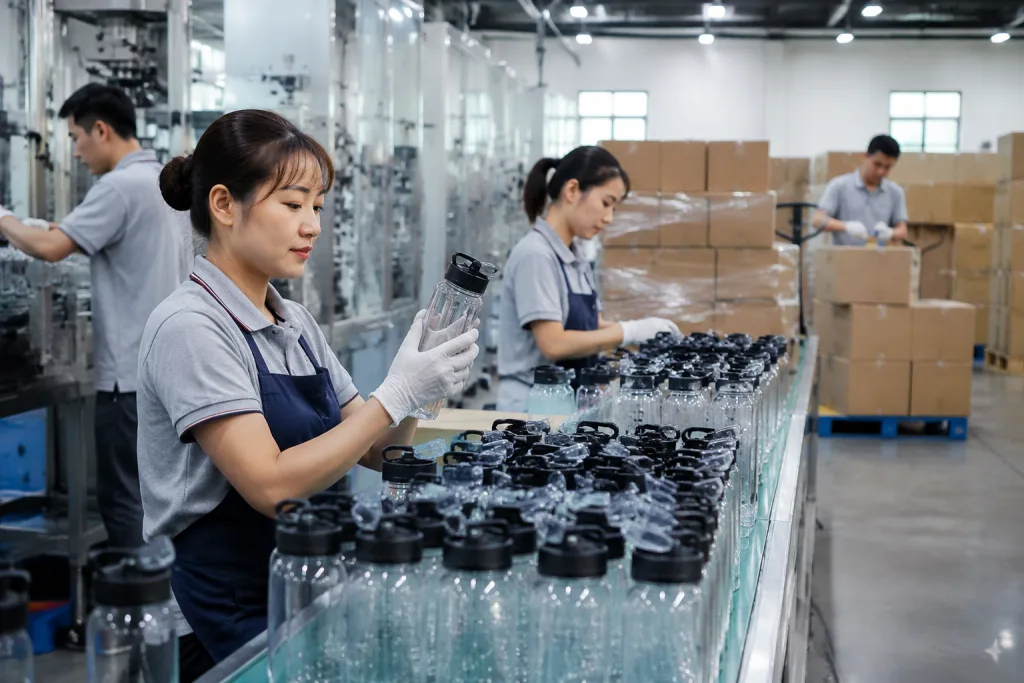
From our Hangzhou, Zhejiang production base, we see buyers put Tritan bottles, stainless steel tumblers, bulk canteen programs, and beer growler bulk orders into one sourcing sheet. The math doesn't work. Each format needs different molds, test reports, carton specs, and line setup. Tritan sport bottles look simple in a photo, but a 650 ml bottle with a carry loop, straw lid, and 1-color logo is not quoted the same way as a plain screw-cap promo bottle with 3,000 pcs MOQ.
Where The Bottle Cost Starts
For a tritan sport bottle bulk order, the cost starts at the resin hopper, then moves through mold cycle time, lid structure, and how many small parts the line has to touch before packing. Tritan is not the cheap plastic on our floor; last month our injection team ran a 68-second cycle on a 650 ml body mold, while a basic PP bottle body was closer to 42 seconds. Buyers choose Tritan for glass-like clarity, drop resistance, BPA-free positioning, and a better shelf feel than PP or AS. If your retail price target is tight, the fancy lid is usually where the math breaks.
A simple 650 ml flip-top bottle with a PP lid, silicone seal, wrist strap, and one-color screen print may quote around USD 1.85-2.40 FOB Ningbo or Shanghai at 5,000-10,000 units. That is the clean version. A 1,000 ml bottle with carry handle, time-marker print, dust cover, locking button, and retail color box can move to USD 2.80-4.20 because QC has to check the hinge, lock click, gasket seating, and print position on every pulled sample. If you add a straw lid, internal tube, spare gasket, and custom insert card, expect another USD 0.25-0.70 per unit; we have seen buyers flag this only after the PO was issued, which makes the quote argument messy.
Capacity changes the price, but not in a neat straight line. A 500 ml bottle uses less Tritan, yet the lid, labor, pad-print setup, barcode label, and carton handling still sit there on the cost sheet. A 1,500 ml gym bottle may need more resin plus a taller export carton; on one recent run, the carton changed from 58 cm to 72 cm high, and the container loading dropped by about 18%. Cheapest unit price is the wrong question to ask if the freight eats the saving.
We usually tell buyers in Europe and North America to separate factory price from program cost. Factory price is the bottle. Program cost covers Pantone matching, artwork proofing, compliance testing, AQL inspection, export cartons, pallets, FNSKU labeling if needed, and ocean or air freight. A clean RFQ should ask for these line by line before comparing suppliers in China; we once had a buyer send a PO with “Tritian” typed in the material field, and QC pulled the sample until the spec sheet confirmed Tritan.
MOQ Tiers That Actually Matter
MOQ is not a penalty. It is the point where resin buying, injection mold setup, Pantone color mixing, silk-screen printing, and QC hours stop fighting the cost sheet. For tritan sport bottle bulk, we usually run 3,000 units per color on existing molds. At 1,000 units, a factory can quote it, but the math gets ugly: the color masterbatch supplier still asks for a minimum bag, and the line still needs about 2 hours to purge the barrel and clean the hopper. You will pay more. Your lid and resin choices will usually stay inside stock black, white, clear, or whatever is sitting in the warehouse rack that week.
At BottleForge Industrial in Zhejiang, our typical monthly drinkware capacity is about 600,000 units across plastic, stainless steel, and glass lines. For Tritan sport bottles, a normal production slot lands around 20,000-80,000 units, depending on flip lid, straw lid, carry loop, and decoration. Smaller orders can run, but they must fit between larger bulk drinkware and drinkware wholesale schedules. This is where buyers sometimes push back: “Can you just squeeze in 1,500 pcs before Canton Fair?” Sometimes yes, but if QC pulled the sample and found a 0.3 mm parting-line flash on the lid, that small order loses its window fast.
- 1,000-2,999 units: good for a sample market test, but expect a higher unit price, limited custom colors, and no exclusive mold change unless you accept extra tooling cost.
- 3,000-4,999 units: realistic entry MOQ for custom logo and Pantone color on existing models; we can usually book one injection machine and one printing fixture without breaking the schedule.
- 5,000-9,999 units: better resin purchasing and steadier print cost; this tier works for canteen wholesale or retail launch programs where carton count and barcode accuracy matter.
- 10,000-30,000 units: stronger FOB pricing, carton customization, and tighter scheduling control; the line can plan resin drying, assembly, leak testing, and packing in one clean run.
- 50,000+ units: annual contract pricing, dedicated QC plan, and a serious private tooling discussion if the buyer can confirm forecast by quarter instead of sending vague “maybe repeat” emails.
If your brand also buys wholesale canteen, wholesale drinkware, or wholesale growler categories, do not force every product into one MOQ rule. That is the wrong question to ask. A stainless bulk growler or beer tumbler bulk order often uses welding, polishing, vacuum testing, and different decoration equipment, so the setup logic is not the same as Tritan injection molding. Tritan sport bottles move fastest when the mold already exists, the buyer accepts standard component geometry, and the PO does not arrive with “Trian” typed in the item description after the artwork has already been approved.
Tooling And Custom Parts
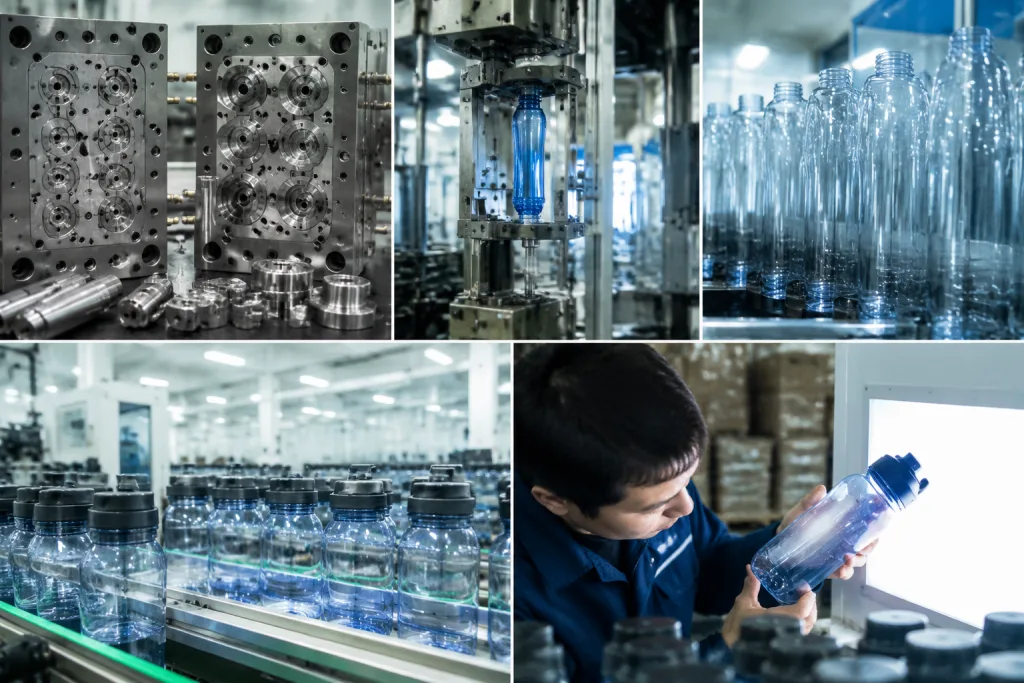
Most buyers do not need a new bottle mold. This is the wrong question to ask. We usually start by pulling 6-8 existing Tritan body molds from the rack, then checking wall thickness with a Mitutoyo caliper at the shoulder, waist, and base. For Tritan sport bottles, wall thickness commonly falls around 1.2-2.0 mm depending on capacity and shape. At 1.1 mm, the bottle feels soft when squeezed and QC pulled samples with oval mouths after hot warehouse storage. At 2.2 mm, the math gets worse: more resin, slower cycle time, higher carton weight.
Private tooling makes sense when the buyer needs a protected grip pattern, a handle shape tied to the brand, or a lid system the next seller on Amazon cannot copy in 30 days. A new Tritan bottle body mold can cost roughly USD 4,000-12,000. A more complex lid mold with multiple components can add USD 3,000-10,000. Development time is usually 25-40 days for mold build and first T1 samples, then another 7-14 days for adjustment. On the line, the risky part is rarely the bottle body; it is the hinge pin, silicone plug compression, and the 0.3 mm mismatch that makes the lid leak in carton drop testing.
Logo customization is cheaper and faster. One-color silk screen printing may cost USD 0.06-0.12 per unit after setup. Heat transfer or wraparound graphics can run USD 0.18-0.45. Laser engraving is not common on clear Tritan bodies but may work on stainless caps or metal badges. We had one PO where the buyer wrote 70 mm logo width, then sent artwork that needed 92 mm to stay readable around the curve. The buyer flagged it late. If you need the best wholesale drink bottle for a sports retailer, spend the budget on a lid that opens cleanly after 3,000 cycles, not only on a large print area.
Color matching is another cost driver. Transparent smoke, amber, blue, and pink are manageable, but translucent colors need batch discipline. We run an approved master color chip, then make a pre-production sample before mass production. China factories can match Pantone references, but plastic resin, bottle thickness, and lighting conditions change the final look. A 650 ml bottle at 1.6 mm wall reads darker than the same resin on a 350 ml cup at 1.2 mm. Approve real samples under D65 light, not only digital renderings.
A Realistic Production Calendar
A real schedule starts only after 3 items are closed: deposit received, artwork signed off, and sample or specification approved. Miss one, and the clock is not running. We had a PO last March with the Pantone code typed as 2925C in one place and 2955C in another; QC pulled the pre-production sample before the line opened, which saved 8,000 bottles from the wrong cap color. For an existing mold tritan sport bottle bulk order, a practical lead time is 30-45 days. Before summer and Q4 promotions, quote 45-60 days if you want the shipment date to survive.
A normal calendar looks like this: 2-5 days for quotation and specification lock, 5-10 days for custom sample if logo or color proof is needed, 3-7 days for buyer approval, 20-30 days for mass production, 2-4 days for final inspection, and 3-7 days for inland transport, customs paperwork, and vessel handoff. That is the clean version. On the floor, we run logo position with a 0.5 mm tolerance jig, then QC checks 32 pcs from the first finished carton before full packing starts. Air freight is faster, but the math usually does not work for low-margin drinkware bulk programs because bottles bill by volume, not only by kg.
Retail packaging can add 5-12 days. A white box is easy. A printed color box with barcode, warning text, recycling marks, French or German copy, and retailer compliance layout needs artwork checking against the cutter guide, usually a 1:1 PDF plus a folded box sample. If your order is for Amazon FBA, FNSKU labels and carton size limits should be confirmed before cartons are printed. We have seen this go sideways: the buyer flagged an FNSKU placed 18 mm too close to the carton seam, and repacking finished goods took 3 extra days plus new outer cartons.
Mixed product programs need tighter control. If you combine canteen bulk, alcohol flask bulk, beer growler wholesale, and tritan bottles in one shipment, the slowest product controls the container date. Stainless alcohol flask wholesale bulk orders may require mirror-surface inspection under a 600 lux lamp and separate leak testing. Beer growler wholesale bulk cartons are bulky; one 64 oz growler carton can eat the space of 2-3 tritan bottle cartons, so container utilization changes fast. Plan the shipment as a project, not a shopping cart.
Testing, Inspection, And Compliance
Tritan sport bottles touch drinking water, juice, and sometimes kids’ school bags, so compliance is not a box-ticking job. For North America, buyers usually ask for FDA food-contact conformity; 3 out of 10 retail buyers also ask us for ASTM-related physical tests when the bottle has a flip lid, straw, or carry loop. For Europe, REACH and LFGB are the normal starting point. If the bottle is for children, check migration, small parts, and age-grade rules before the PO is issued. We had one PO last May with “EU market” typed in the remarks, while the shipping mark said “CA”; QC pulled the sample file before production because the test scope would not match Canada.
Testing cost depends on the exact scope. A basic material report may already exist for the Tritan resin and silicone gasket, and we keep those reports by resin lot number in the material cabinet near the injection line. A full third-party test on the final product can cost USD 300-1,200 per model and color family. If your retailer has its own lab protocol, the math changes: plan 7-10 working days for normal testing, not 3 days after cartons are sealed. The factory should not guess. Send the manual, checklist, or test protocol before we open the mold trial sheet.
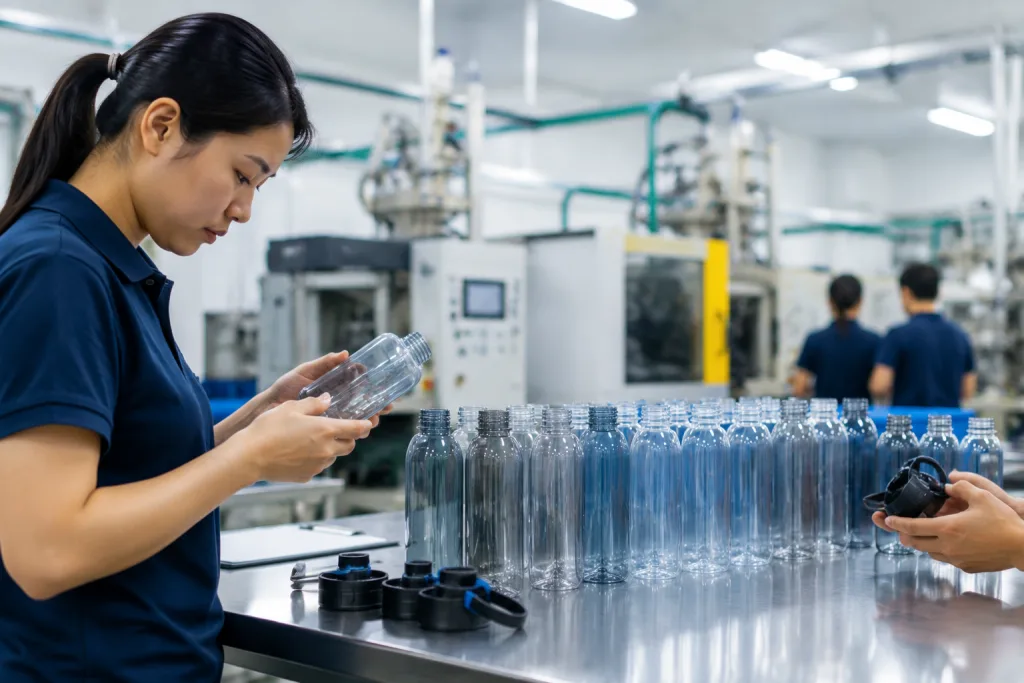
For production inspection, AQL is the language both sides can live with. A common setting is AQL 2.5 for major defects and 4.0 for minor defects. Critical defects should be zero. For Tritan bottles, inspectors should check capacity with a 500 ml measuring cylinder, then review appearance, color consistency against the Pantone chip, logo position in mm, lid assembly, strap pull strength, odor, leakage, drop performance, barcode readability, carton markings, and packing quantity. A leak test needs inverted bottles and shaking. A quick look is the wrong test; we have seen 12 bottles pass on the table and 3 leak after 30 seconds in the shaker.
We prefer pre-shipment inspection when goods are 100% finished and at least 80% packed. For orders above 30,000 units or strict retail launches, add an inline inspection around 20-30% production. It catches print alignment, lid fit, and gasket issues before 8,000 cartons are taped shut. The line supervisor can still adjust the pad-printing jig by 1-2 mm at that stage. This matters when your broader wholesale drinkware program includes different formats such as beer tumbler wholesale, growler wholesale, or alcohol flask wholesale in the same season, because mixed launch schedules go sideways fast when one SKU fails inspection.
How To Compare Supplier Quotes
Two quotes can look close on the first screen and still be 8–12% apart once we cost them properly. One quote may include Tritan body, PP lid, silicone seal, one-color logo, individual polybag, 5-layer export carton, and FOB Ningbo. The next one may skip the logo setup, use a 1.8 mm wall instead of 2.2 mm, quote EXW Hangzhou, and pack 36 pcs per carton instead of 48 pcs. We see this weekly. If you compare only the bold unit price, the math does not work.
Ask for a line-by-line quote. It should state material grade and supplier, capacity in ml, bottle weight in grams, lid material, gasket material, logo method with setup charge, packing method, carton size in cm, gross weight in kg, MOQ per color, sample time, mass production lead time, payment term, Incoterm, port, available FDA or LFGB reports, and quote validity. For a serious tritan sport bottle bulk RFQ, this is normal. QC pulled one sample last month where the buyer expected 650 ml, but the PO said 600 ml in one cell. If a supplier refuses to write bottle weight or carton dimensions, be careful.
Compare payment risk too. A standard China export term is 30% deposit and 70% balance before shipment after inspection, with AQL 2.5 written into the booking notes. For repeat orders above 20,000 pcs, we sometimes run staged payment or credit insurance, but only after 2–3 clean shipments. FOB is cleaner than EXW for most overseas buyers because the factory handles local export procedures to Ningbo or Shanghai port. If you need DDP, make the supplier write the HS code, duty responsibility, product classification, and destination delivery charges on the quote. We have seen DDP go sideways when “delivery included” meant only to the port warehouse.
Your adjacent categories can help you negotiate, but only if the forecast is real. If you buy beer tumbler in bulk, beer growler in bulk, canteen bulk, or alcohol flask in bulk, share the annual forecast by quarter and by SKU, not one round number. The line schedules Tritan resin, 304 stainless, cartons, and pad-printing plates around believable orders; a 10,000 pcs Q2 forecast gets treated differently from “maybe more later.” A vague promise of future drinkware bulk volume does not move today’s price much. The buyer flagged this last fair season, and honestly, he was right.
Freight Math Buyers Forget
Plastic bottles are light, but they eat space fast. That is the freight trap. We run a 750 ml Tritan sport bottle at about 140-220 g, yet the carton volume is what hurts air freight. On sea freight, the buyer should look at carton dimensions and container loading, not just unit FOB. QC pulled one retail-box sample last March where the bottle sat 9 mm off-center in the insert; that small gap wasted 15-25% of container space across the load.
For example, if one export carton holds 48 bottles and measures 58 x 42 x 52 cm, it is about 0.127 CBM. A 10,000-unit order would need roughly 209 cartons, or about 26.5 CBM before pallets. That can move as LCL or sit inside a mixed container. Add 1.1 x 1.1 m pallets, and volume rises. If the same bottle goes into a larger gift box, the shipment can jump 3-5 CBM with no change to unit FOB price; the math doesn't work when the buyer only compares bottle price.
Packaging design should happen before final quotation. Not after the PO. Retailers ask for color boxes, hang tags, belly bands, and inserts, but procurement teams still push for low landed cost. We ask both teams to sign off a packing target early, usually carton count, CBM, and drop-test level. For e-commerce, stronger K=K cartons reduce damage claims; for club or promotion orders, bulk master cartons often pass. We once had a buyer flag a 2 mm thin inner tray after the pre-shipment drop test, and changing it added 12 days vs 18 days if we had waited for new printed boxes.
If you are mixing Tritan bottles with beer tumbler wholesale bulk, beer growler bulk, bulk growler, wholesale growler, or alcohol flask wholesale, ask your supplier to calculate loading by SKU. Stainless items are heavier. Tritan items are bulkier. Glass bottles need more EPE or honeycomb board, and that changes the CBM quickly. In our Hangzhou loading sheet, we split each SKU by carton size, gross weight, and stack height before booking Ningbo or Shanghai space. Frequent Zhejiang port sailings help, but a good forwarder cannot fix a loose carton layout.
Get a firm Tritan bottle quote this week
Send capacity, target MOQ, logo method, market, and packaging needs. We will return practical FOB pricing and lead-time options from Zhejiang.
Frequently asked questions
What is a normal MOQ for tritan sport bottle bulk orders?
For existing molds, 3,000 units per color is a realistic starting MOQ. At 5,000 units, the FOB price usually improves because resin purchasing, color mixing, and printing setup are spread across more units. At 10,000 units or more, you can negotiate carton design, better scheduling, and sometimes lower logo costs. Orders below 3,000 units are possible only if the factory has stock components or accepts a small-batch surcharge. For a first retail test, many buyers choose 3,000 units in one color or 6,000 units split into two colors. If you need custom lid tooling, the factory may require 20,000-50,000 units to justify development.
How much should I budget per unit FOB China?
A basic 600-750 ml Tritan sport bottle with one-color logo usually lands around USD 1.85-2.80 FOB China at commercial MOQ. A larger 1,000 ml bottle with straw lid, handle, locking cap, time markers, and retail color box often runs USD 2.80-4.20. Premium packaging, full-wrap heat transfer, spare parts, or custom molds increase the number. Always ask whether the quote includes logo setup, inner packing, export carton, and test report support. If you are comparing against stainless canteen wholesale, beer tumbler wholesale, or alcohol flask wholesale, remember those products have different material and freight economics.
Can one supplier handle Tritan bottles and other wholesale drinkware?
Yes, if the supplier has a real multi-category supply chain and QC process. Many procurement teams source tritan sport bottle bulk together with wholesale drinkware categories such as bulk canteen, growler wholesale, beer growler wholesale, beer tumbler bulk, and alcohol flask bulk. The risk is not sourcing them together; the risk is assuming they share the same lead time. Tritan molding, stainless forming, powder coating, glass inspection, and leak testing run on different schedules. Ask for a SKU-level production calendar. For a mixed container, allow 45-60 days after approval unless all items are existing models with simple logos.
Which compliance documents should I request before placing a PO?
Request material declarations for Tritan, PP, silicone, and any coating or ink used on the bottle. For Europe, ask about REACH and LFGB suitability. For North America, FDA food-contact support is common, and ASTM checks may be relevant depending on the age group and retail channel. If your retailer has a specific protocol, send it before quoting. A final-product third-party test can cost about USD 300-1,200 and may take 7-12 working days. Do not rely only on old resin certificates if your order uses new colors, new inks, or a new lid construction.
What causes delays after the deposit is paid?
The most common delays are late artwork approval, unclear Pantone color standards, missing barcode files, packaging copy changes, and buyer-side testing decisions made after production starts. A standard existing-mold order needs about 30-45 days after deposit and approval, but that assumes the specification is frozen. New mold work can add 25-40 days before mass production. Retail color boxes may add 5-10 days if dielines or translations are not ready. If you need FNSKU labeling, pallet rules, or destination carton marks, confirm them before carton printing. Small details become expensive when 20,000 bottles are already packed.