Key Takeaways
- For a 750 ml custom thermos, realistic MOQ is 3,000-5,000 units per color when Tritan Renew parts are included
- 304 stainless steel at 0.45-0.55 mm wall thickness is the practical baseline for outdoor retail orders
- AQL 2.5 for major defects and AQL 4.0 for minor defects should be agreed before mass production
- Normal China factory lead time is 35-45 days after artwork, sample approval, and deposit
You are not just buying a bottle. You are putting retailer margin, a fixed campaign date, and post-sale complaint risk into one factory thermos order. For an outdoor retailer or promo brand, a stainless vacuum thermos with a Tritan Renew cup-lid looks clean on a spec sheet. The trouble shows up after the deposit: heat retention drops at the 6-hour test, the plastic cup turns hazy after 3 dishwasher cycles, the laser logo sits 2 mm off-center, or the quote leaves out LFGB/FDA testing. QC pulled one pre-production sample last month with a loose cup thread; the buyer flagged it before we ran mass production. Good catch.
We’ll run one real order from RFQ to shipment: 5,000 pieces of a 750 ml custom thermos, stainless body, Tritan Renew cup-lid, two colors, laser logo, packed for European and North American distribution. BottleForge Industrial is based in Hangzhou, Zhejiang, China, with stainless drinkware capacity around 450,000 units/month. The numbers below are the numbers you should ask any tritan renew thermos supplier to confirm before you pay a deposit, including MOQ, mold cost, AQL level, carton drop test, and whether testing is inside the unit price. If the supplier answers only with “best price,” this is the wrong question to ask; the math doesn’t work when a 12-day sample delay turns into an 18-day launch slip.
Start With The Actual Use Case
The buyer scenario matters more than the catalog photo. For this order, the bottle is going to outdoor retailers and promotional brands, so we spec it for backpacks, pallet stacking, shelf rub, and the customer who fills it with boiling water at 7:00 a.m. and cracks it open at 2,000 m six hours later. We have seen this go sideways when the stopper vent is treated like a small detail; QC pulled one sample after a pressure check because the lid spat steam on opening.
A clean starting spec is a 750 ml double-wall vacuum stainless thermos with 304 stainless steel inside and outside, a screw stopper, and a Tritan Renew outer cup or lid component. For most retail and promotional thermos programs, 750 ml sells better than 1,000 ml because it still feels solid without turning into a brick in the hand. Finished weight usually lands around 420-520 g, depending on wall gauge and lid design; on our line, a 0.45 mm outer shell with a standard cup-lid usually sits near the middle of that range.
Define the target channel early. A distributor thermos going into outdoor stores needs stronger retail carton graphics and tighter surface standards than a trade show giveaway, where the buyer often pushes back on logo position, PMS color matching, and ship date first. This is the wrong question to ask: “Can you make it premium?” Tell the thermos manufacturer in China whether the carton faces a retail shelf, a corporate gift table, or a warehouse pick bin, then the cost goes into the right places. We run different surface checks for that choice; retail stock gets closer attention under the 6500K light box.
For this order, we would write the RFQ like this: 5,000 pcs total, 2 colors, 2,500 pcs per color, 750 ml capacity, 304 stainless steel, vacuum insulation, Tritan Renew cup-lid, laser engraved logo, individual kraft box, master carton 24 pcs, FOB Ningbo or Shanghai. That level of detail lets a thermos supplier quote cleanly instead of hiding assumptions in the small print. One buyer once sent “carton 24” on the PO but meant 24 kg max gross weight; the math did not work until we resized the master carton and changed the packing mark.
Do not ask five suppliers for thermos pricing with five hidden specs. You will get five prices, not five comparable offers.
Confirm Materials Before Design Work
Buyers ask for Tritan Renew when they want a recycled-content claim without switching to glass or soft low-heat plastics. On a stainless thermos, we usually run it on the cup, lid window, carry handle, straw, or push-button drinking part. Not the vacuum body. The body stays stainless steel, and QC should see that split on the BOM, sample tag, and compliance file before the first PP sample leaves the line.
For the stainless body, specify 304 stainless steel on all food-contact surfaces. We still see 201 outside and 304 inside on lower-cost quotes; last month a buyer flagged this after our caliper check showed a 0.42 mm outer shell instead of the quoted range. That build can work for a budget thermos custom program if the PO says it clearly, but the math doesn't work for outdoor retail claims. For a stronger manufacturer thermos spec, use 304 inside and outside, 0.45-0.55 mm sheet thickness, copper-plated vacuum layer for higher heat retention, and food-grade silicone gaskets.
For Tritan Renew parts, ask the thermos vendor for the resin grade, recycled content claim, and the papers behind it. “Eco plastic” is not a material name; we reject that wording on our internal spec sheet. For Europe, your file may need LFGB, EU food contact declaration, REACH/SVHC screening, and packaging documentation. For the US, ask about FDA food-contact compliance and California Proposition 65 risk review when the channel needs it. If the bottle targets kids or family outdoor programs, discuss ASTM and CPSIA before tooling, because one wrong cavity insert can cost 7-9 days to remake.
At BottleForge in Zhejiang, China, our rule is simple: material claims come before sampling. QC pulled a lid sample in March where the PO said “Tritan Renew 50%,” but the resin lot sticker only supported a different claim. If you approve artwork and retail packaging first, then find the Tritan Renew part cannot support the exact marketing line, you lose 10-15 days changing copy, cartons, and purchase documents. We've seen this go sideways. It is an avoidable delay.
Build The Costed Specification
A reliable bulk thermos quote is built line by line. If a thermos suppliers quote says only “750 ml vacuum bottle, USD 5.20,” push back. That price tells you almost nothing. Ask for the costed spec behind it, the same sheet our costing team checks against the 0.45 mm body sample, lid BOM, carton size, and logo artwork.
For this 5,000-piece order, a realistic FOB China price range might be USD 5.10-7.20 per unit, depending on stainless gauge, lid complexity, coating, logo method, packaging, and testing. Powder coating costs more than basic spray paint, but our QC pulled the sample after 30 minutes on the cross-hatch tape test and the difference was easy to see. Laser engraving is stable and clean for outdoor brands. Silk screen works for larger colorful logos if it passes rub testing. Heat-transfer printing suits full-color promotional thermos designs, but we have seen it go sideways on curved bodies when the film edge shifts 1.5 mm during setup.
The MOQ depends on color and component availability. For a standard stainless thermos manufacturer line, 1,000-2,000 pcs may be possible for plain stock colors. For a customized thermos with Tritan Renew parts, PMS coating, and retail packaging, 3,000 pcs per color is a more honest starting point. If you need 5 colors at 1,000 pcs each, expect a surcharge or a scheduling gap; last month the buyer flagged 12 days vs 18 days after adding two PMS colors to the PO.
Write the purchase spec with measurable items. No guessing. We run this against calipers, a 95°C water test, a 3M tape pull, and the packing mockup before the line starts.
- Capacity: 750 ml nominal, tolerance ±5%, checked with a graduated cylinder.
- Insulation: water at 95°C, tested after 6 hours and 12 hours, with room temperature recorded on the QC sheet.
- Body: 304 stainless steel, 0.45-0.55 mm sheet, confirmed by micrometer before forming.
- Coating: powder coat, cross-hatch adhesion test target 4B or better, using 3M tape.
- Logo: laser engraving, position tolerance ±2 mm, approved against the printed artwork.
- Packing: 1 pc/kraft box, 24 pcs/master carton, drop test agreed, with carton weight marked before shipment.
This is where a thermos distributor can save money without making the product worse. Cut the color count, keep one lid structure, use a standard body mold, then spend the savings on coating and QC. Buyers often do the opposite. The math does not work when a 5,000-piece order needs 5 lids, 5 coatings, and 5 sets of barcode stickers because someone typed “matte balck” on the PO.
Sample Like You Mean It
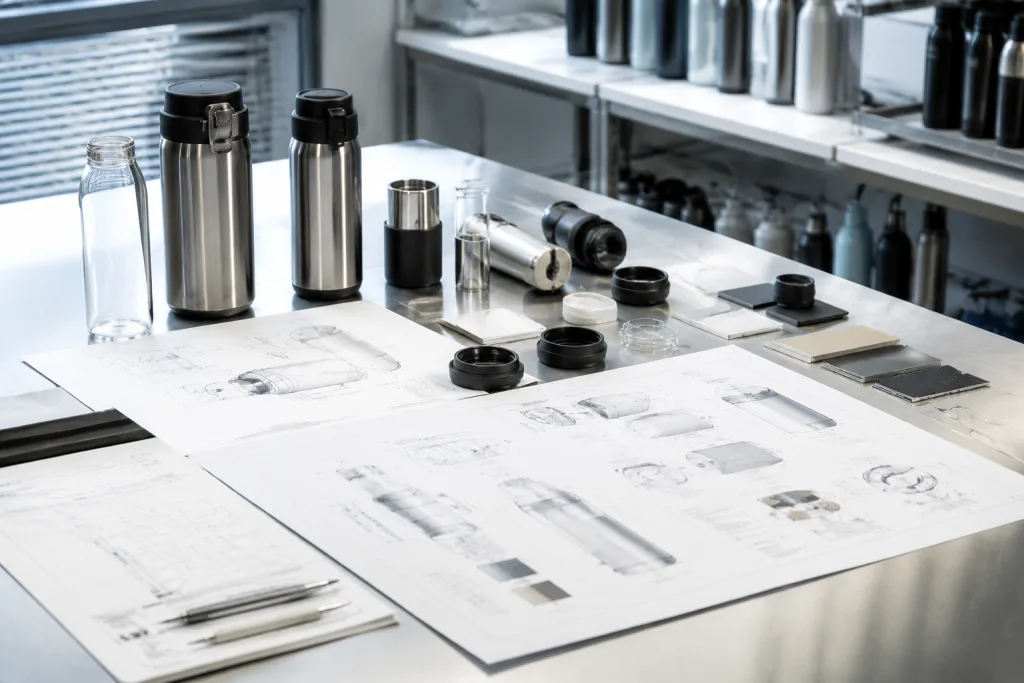
Sampling is not a souvenir stage. It is where we catch the expensive mistakes while they still cost USD 80, not USD 8,000. For this customizable thermos order, ask for three sample types with clear jobs: a material/color chip checked against a Pantone book, a logo sample measured with calipers for height and depth, and a pre-production sample built with final components and export packaging. QC pulled one sample last month where the PO said matte black but the artwork file named “gloss black”; that typo would have hit 3,000 pcs on the line.
A first custom thermos sample from China usually takes 7-12 days if the body mold exists and the lid structure is standard. If you need a new Tritan Renew lid mold, add 20-35 days for tooling and adjustment. Tooling cost can range from USD 1,200 for a simple insert to USD 6,000 or more for a complete drinking lid set. Do not approve mass production from a 3D print or non-final resin sample unless the schedule matters more than the risk. We’ve seen this go sideways: the SLA lid looked fine on the desk, then the injection part shrank 0.35 mm and the thread felt gritty after 20 open-close cycles.
For the scenario order, the sample review checklist should include hand feel, lid thread smoothness, cup fit, stopper sealing, logo size, logo depth, coating color under D65 light, carton strength, barcode scan, and printed claims. Don’t just tick boxes. Open the cup, torque the stopper by hand, scan 10 barcodes with a Honeywell gun, and drop one packed carton from 76 cm if the buyer’s protocol allows it. If the order is for distributors thermos programs across several retailers, check whether each retailer needs different carton labels, FNSKU, suffocation warnings, or country-of-origin marks.
Heat retention should be tested on the sample, but the wrong question is “did one cup pass?” A 750 ml stainless vacuum thermos may hold water above 60°C after 12 hours under controlled conditions, but results move with fill temperature, ambient temperature, lid design, and test method. Put the exact method in writing: start water at 95°C, fill to 750 ml, room at 20°C, measure with a calibrated probe after 12 hours. “Keeps hot 24 hours” printed on packaging without a defensible lab method is a complaint waiting to happen, and the buyer will flag it during claim review.
Lock Artwork And Packaging Early
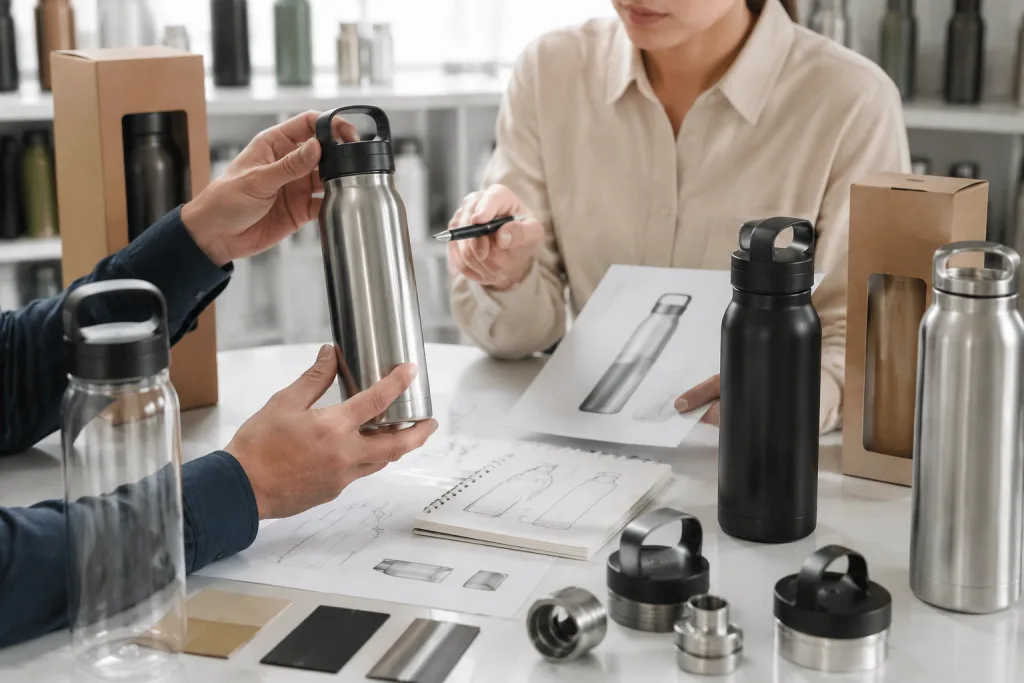
Artwork delays are still the top reason we see thermos bulk orders miss the vessel cut-off. In our Hangzhou line, steel can be booked, coating slots can be held, and carton knives can be prepared only after the print file is stable. Last month QC pulled a pre-production sample where the logo was approved, but the carton warning text was still sitting with a different brand manager. That order lost 6 days. For promotional thermos projects, the logo, carton, and compliance copy often pass through 3 separate desks, and that is where the schedule gets eaten.
For this order, send vector logo files in AI, PDF, or EPS format, with Pantone references where color is required. For laser engraving, confirm logo size in millimeters and the position from a fixed point, such as 42 mm down from the lid seam and centered on the handle axis. Do not just write “centered” on the PO. We have seen that go sideways. A 1.5 mm shift may pass on a large retail carton, but on a small front logo, the buyer will flag it during shelf-sample review.
Packaging should be treated as part of the product. A supplier thermos quote may include a thin white box by default, often around 250 gsm, because it keeps the first price low. For outdoor retail, the math does not work if the box crushes in the distributor warehouse. A practical retail box might use 350 gsm kraft or coated paperboard, E-flute if the box is larger, and a master carton using 5-ply corrugated board. If the cartons travel by ocean freight and then through North American or European distributor warehouses, do not use weak export cartons to save USD 0.06 per unit. We ship enough cartons to know that corner dents become chargebacks.
Labeling depends on sales route. For Amazon-style fulfillment, you may need FNSKU labels and carton labels sized to the warehouse spec, often 50 x 30 mm or 100 x 100 mm. For retail distribution, you may need EAN/UPC barcodes, item numbers, batch codes, and country of origin. Marking “Made in China” is normal, but placement should be approved before printing; one buyer once sent a PO with “Made is China,” and our packing team caught it before the label film was made. A good thermos manufacturers team will ask these questions. A weak one will print whatever you send and let you find the problem at receiving.
Run Production With Checkpoints
After deposit and sample approval, we usually book 35-45 days for a customized thermos order from Zhejiang. That timing assumes standard lids, frozen artwork, and no failed FDA or LFGB retest. If a factory thermos supplier says 20 days for 5,000 units with custom coating, Tritan Renew parts, logo, retail packaging, and inspection, ask which station they plan to skip. The math doesn't work. Last month a buyer pushed for 22 days; our line planner showed the Gantt sheet, and coating alone needed 6 calendar days because the spray booth had two color changes and one oven maintenance slot.
A practical production timeline looks like this: 3-5 days for material purchasing, 7-10 days for stainless forming and welding, 5-8 days for vacuuming and leak testing, 5-7 days for coating, 3-5 days for logo and assembly, then packaging and final inspection. Some work overlaps. Not all of it. We run inner bottle welding on the TIG line before vacuuming, and the helium leak tester will not clear a batch just because the sales order is urgent. If artwork arrives 3 days late or the PO has “matte balck” instead of “matte black,” the line stops until somebody confirms it.
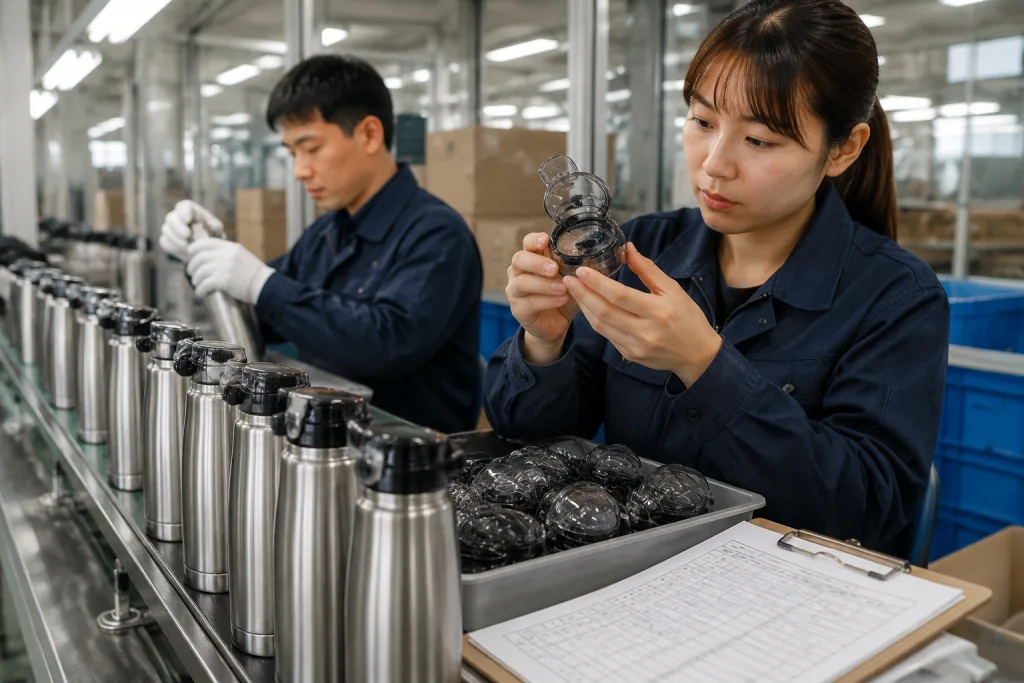
You should ask for production photos, but photos are not QC. Ask for checkpoint data. How many inner bottles passed vacuum testing? What was the coating defect rate after spraying? Were Tritan Renew parts checked for cloudiness, black dots, short shots, and fit? For a 5,000-piece order, a normal in-process rejection rate may be 2-5% depending on finish complexity. If the reported defect rate is always zero, the factory is probably counting cartons, not defects. QC pulled the sample tray from our injection room last week and found 14 cloudy Tritan Renew lids in 600 pieces, all from one cavity with a 0.3 mm fit drift.
For a distributor thermos program, carton count and labeling control matter as much as bottle quality. Mixed colors, wrong barcodes, or missing retailer labels can cost more than a small scratch. Before packing starts, send a packing matrix: SKU, color, logo version, barcode, inner box artwork, carton mark, units per carton, pallet requirement if any. Basic work. It saves money. We've seen this go sideways when a buyer changed a barcode by email but not on the packing file; the warehouse flagged 38 cartons, and nobody wanted to pay for relabeling.
Inspect Before The Balance Payment
Run final inspection when at least 80% of the cartons are packed and 100% of the order is produced. We usually set the carton stack aside by PO line, then the inspector pulls samples under ANSI/ASQ Z1.4 or ISO 2859-1. AQL 2.5 for major defects and AQL 4.0 for minor defects is a workable baseline. For high-end retail, tighten surface scratches, color dots, and logo ghosting; for low-cost promotional thermos orders, cosmetic tolerance can be wider. Not leakage. Not burrs. Not odor. Not fake material claims. Last month QC pulled 32 pieces from a 3,000 pcs run and rejected 5 for sharp lid threads, which is exactly why balance payment should wait.
Inspection needs to cover appearance, capacity, weight, dimensions, lid fit, leakage, vacuum performance, coating adhesion, logo position, barcode scanning, carton drop, and quantity. Break the checklist into stations, or the inspector will miss something by hour 3. For leakage, fill the thermos with water, tighten the lid, invert it, then shake for 30 seconds over kraft paper so one drop is visible. For vacuum performance, we run hot water at 95°C, close the lid, and record the temperature drop after 6 hours on a digital probe. Lab-grade insulation testing is better, but a controlled line test still catches dead vacuum pieces before the container is booked.
For Tritan Renew components, check clarity, odor, gate trimming, stress marks, and fit after hot-water exposure. Cold plastic lies. A flip lid can look clean at 23°C, then show a 0.6 mm warp after boiling-water contact and start rubbing against the stainless neck. We check the gate area with a fingernail and caliper, because buyers have flagged cloudy lids and small trimming tails in retail returns. A tritan renew thermos supplier needs plastic molding knowledge and stainless vacuum assembly control, not just a trading desk buying finished bottles from a side workshop.
Payment terms vary, but 30% deposit and 70% before shipment is still common for new custom orders in China. If inspection fails, releasing the balance because the vessel closes on Friday is the wrong call. Ask for sorting, rework, replacement quantity, and photos or re-inspection. We have seen this go sideways: one PO had the color code typed as PMS 548C instead of PMS 5483C, and the buyer only caught it during pre-shipment review. A professional thermos manufacturer will hate the delay, but they know the process protects both sides.
Send Your Thermos Spec For A Factory Review
Share capacity, lid style, logo, target MOQ, and destination market. We will check cost, lead time, compliance, and production risk.
Frequently asked questions
What MOQ should I expect from a tritan renew thermos supplier?
For an existing 750 ml stainless body with a standard Tritan Renew lid or cup, expect 3,000-5,000 pieces per color for a proper custom order. If you accept stock colors and one-color laser logo, some suppliers thermos programs can start around 1,000-2,000 pieces, but the unit price will be higher. New plastic tooling changes the discussion. A new lid mold can require 5,000-10,000 pieces to make the economics reasonable, plus USD 1,200-6,000 in tooling depending on complexity. For outdoor retail, it is usually smarter to start with one standard body and one standard lid, then customize coating, logo, and packaging.
Can Tritan Renew be used for the whole thermos body?
Not for a vacuum stainless thermos body. The insulated body is made from double-wall stainless steel, normally 304 stainless steel for food-contact surfaces. Tritan Renew is used for plastic parts such as the cup, lid, drinking spout, handle, or transparent insert. If a supplier calls the whole product a Tritan Renew thermos, ask them to clarify the material breakdown by component. Your compliance file should separate stainless steel, silicone, coatings, and Tritan Renew plastic parts. This matters for REACH, LFGB, FDA food-contact documents, recycled-content claims, and packaging copy.
How long does a custom thermos order take from China?
For a normal customized thermos order from China, plan 7-12 days for sampling and 35-45 days for mass production after deposit and final approval. Add 20-35 days if you need new plastic tooling for a Tritan Renew lid. Sea freight to Europe or North America can add roughly 25-45 days depending on port, season, and routing. Air freight is possible for urgent promotional thermos deadlines, but it often damages the landed cost. If your campaign date is fixed, start the RFQ at least 90 days before the goods need to be in your warehouse.
Which logo method works best for outdoor retail thermos orders?
Laser engraving is the safest choice for stainless outdoor products because it does not peel, has low setup cost, and handles abrasion well. It works especially well on powder-coated bodies, where the laser exposes the base layer. Silk screen is better when you need a solid colored logo, but it should pass tape and rub testing. Heat-transfer printing is useful for full-color promotional designs, though it needs tighter process control on curved surfaces. For a 5,000-piece order, ask for a logo sample before mass production and define position tolerance, usually ±2 mm.
What QC failures are most common in bulk thermos orders?
The most expensive failures are leakage, poor vacuum performance, coating scratches, wrong logo placement, and carton labeling errors. Leakage and vacuum failure are major defects and should not be accepted. Cosmetic scratches can be controlled with clear AQL limits and approved samples. For bulk thermos orders, also check mixed SKUs and barcode accuracy because distributors may reject cartons that scan incorrectly. A normal final inspection should use AQL 2.5 for major defects and AQL 4.0 for minor defects, plus functional tests on selected samples from different cartons.