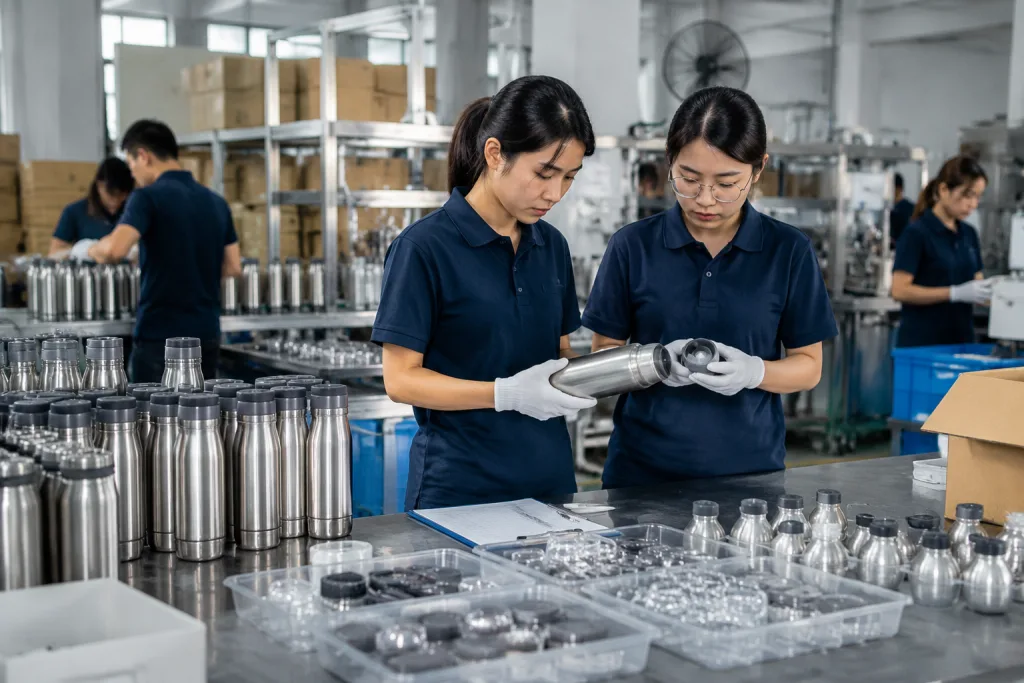
Key Takeaways
- Tritan Renew is best used for lids, straws, infusers, and clear components, not the vacuum stainless body
- A realistic MOQ for customized thermos orders is 1,000-3,000 units per color depending on decoration
- 304 stainless steel at 0.4-0.5 mm inner wall thickness suits most outdoor retail thermos programs
- Plan 35-50 days for mass production after artwork, sample approval, and deposit
If you are searching for a tritan renew thermos factory, you are probably not buying a pure Tritan bottle. Most RFQs we see are stainless vacuum thermos bodies with Tritan Renew lids, straws, infusers, or clear viewing windows. Big difference. The 304 stainless body controls heat retention, dent marks after a 1.2 m drop test, and unit cost, while the Tritan Renew parts carry the recycled-content claim, color matching, compliance paperwork, and shelf look. QC pulled a 500 ml sample last month where the buyer loved the smoky lid, then flagged a 0.4 mm wobble at the flip cap hinge.
For outdoor retailers and promotional brands, “which bottle looks good” is the wrong question to ask. Before asking for a thermos bulk quote, lock the body size, lid system, recycled-content claim, decoration method, and inspection plan with real specs on the PO. We run these checks in Zhejiang before the line opens: 350 ml or 750 ml body, MOQ 3,000 pcs per color, laser logo or powder coating, AQL 2.5 for final inspection. These five choices decide whether we ship clean in 38 days or spend 90 days chasing lid revisions, carton changes, and buyer pushback on a missing Tritan Renew wording line.
Start With The Material Truth
Start with the honest material split. Is the selling point recycled plastic, stainless durability, or a mix of the two? A tritan renew thermos factory should say this clearly on the BOM, not blur it in the sales deck. Tritan Renew does not replace stainless steel in a vacuum thermos. It is a certified recycled-content copolyester for transparent or molded plastic parts. On our line, the insulated body is still normally 304 stainless steel inside and 201 or 304 stainless outside; QC checks the inner cup with an XRF gun before the first 20 pcs go into vacuum welding.
For outdoor retail, we usually spec 304 stainless steel inner wall and 201 stainless outer wall for mid-range programs. Full 304 stainless fits premium channels and food-service buyers who push back on 201 even when it never touches liquid. Inner wall thickness is commonly 0.4 mm, with 0.5 mm used on stronger designs or larger capacities. Thicker steel improves dent resistance, but the math does not work for every order. A 500 ml bottle in 304/201 may land around 260-310 g before lid; full 304 can add 15-30 g depending on shape. Last month, a buyer flagged a 28 g weight jump after their drop test passed, because their retail carton was already at the 12 kg limit.
The Tritan Renew component makes sense when your brand wants a recycled-content story without moving to aluminum or glass. We use it for flip lids, straw tops, tea infusers, transparent carry caps, and modular accessories, but each part needs its own resin record and mold code. Small detail. Big headache if missed. If a thermos manufacturer says the whole vacuum flask is Tritan Renew, ask for the material breakdown and certification at once. We have seen this go sideways when a PO typo said “Tritan body” and the buyer meant “Tritan lid.”
Practical rule: let stainless steel do the insulation work, and let Tritan Renew support the lid function and recycled-content message.
In China, material claims need resin documentation, incoming material records, and test reports such as LFGB, FDA, REACH, or EU 10/2011 depending on your market. A serious thermos supplier will send this paperwork without acting surprised. We run incoming checks by batch number, match the resin COA to the warehouse label, and keep the file with the pre-shipment inspection photos. If the supplier cannot show the trail for 500 kg of lid resin, do not print the recycled-content claim yet.
Choose Capacity Before Decoration
Most buyers start with the logo. Fair enough. Still, capacity sets the job sheet before artwork does: tooling availability, carton size, freight cost, lid fit, and shelf price. A promotional thermos for events usually sits at 350-500 ml; we run these in 24 pcs/carton, and the buyer often pushes back once the gross weight hits 10 kg. Outdoor retailers usually sell stronger at 500-750 ml. For trail, camping, and winter sports channels, 900 ml to 1.2 L can work, but the math changes fast on freight and shelf turns.
For a custom thermos program, choose from an existing mold family first. New mold first is the wrong question to ask unless the capacity or shape is doing real selling work. Existing mold means lower MOQ, faster sampling, and fewer sealing risks; QC pulled 12 samples last month where the new lid thread was 0.3 mm tight after polishing. At BottleForge Industrial in Hangzhou, Zhejiang, our active stainless thermos capacity is about 480,000 units/month across bottle, tumbler, and thermos lines, but new tooling still needs 25-35 days before pilot samples. Existing mold samples normally take 7-10 days with logo decoration.
Here is the decision trade-off:
- 350-500 ml: lowest unit cost and easier thermos bulk shipping for promotional brands; less premium in hand, especially when the shell diameter drops below 68 mm.
- 500-750 ml: safest retail size for outdoor buyers, with enough insulation volume and more lid choices; we usually check lid torque with a 0.6 N·m gauge before packing.
- 900 ml-1.2 L: stronger camping positioning and higher retail price; heavier cartons raise drop-test pressure, and thin wall stock is where we have seen dents go sideways.
Do not approve a capacity from a rendering. Ask for filled weight, mouth diameter, carton quantity, and drop-test result. A bottle that looks compact in a PDF may feel awkward with 750 ml of liquid inside and 24 pieces packed per export carton. The buyer flagged this once after a PO typo listed 500 ml while the approved sample was 750 ml. Your thermos vendor should give real dimensions in millimeters, not just “standard size.”
Decide Your Lid System Early
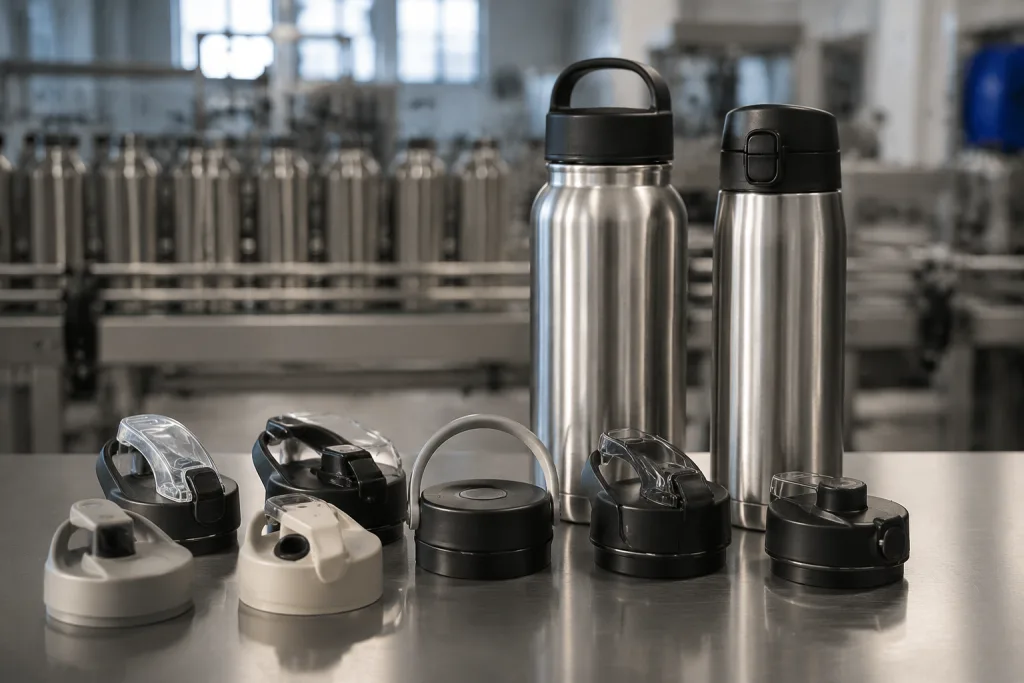
The lid is where 7 out of 10 customized thermos projects get into trouble. Stainless bodies behave predictably once we lock the vacuum brazing curve and check shell runout with a 0.02 mm dial gauge. Lids bring the messy parts: gasket compression measured in mm, hinge pin bite after assembly, straw ID fit, leak paths around the vent hole, drinking angle on a 30° tilt board, dishwasher heat, and plastic color shift after UV exposure. If your project uses Tritan Renew, decide the lid system before you argue about logo size. We’ve seen this go sideways.
A customizable thermos can use screw lids, one-touch flip lids, cup lids, straw lids, or tea infuser lids. For outdoor retail, we run screw lids and cup lids more often because they handle temperature swings and rough carton packing better. For promotional thermos orders, flip lids look cleaner on the shelf, but the math does not work if QC is loose. QC pulled one flip-lid sample last month after the hinge pin walked out 1.2 mm at 500 open-close cycles; the sample room passed it, but resin drying time and assembly pressure on the line were off.
Ask your thermos factory for three lid details before approving a quote. For gasket material, food-grade silicone is standard, and 50-60 Shore A hardness covers most seals we ship. For Tritan Renew, ask for the plastic grade and recycled-content documentation tied to the batch number, not a generic PDF. For leak testing, we use inverted static testing plus pressure-assisted sampling on selected models, with the jig set at the actual fill volume instead of a “looks full” guess. A typical internal standard is 100% visual and fit check, with AQL 1.5 for critical leakage during final inspection; if the PO says “leak proof” but the drawing says “spill resistant,” the buyer flagged it for a reason.
There is also a branding issue. Transparent Tritan Renew parts show tea stains and coffee residue faster than opaque PP, especially around the straw seat and silicone ring groove after 24 hours of warm brew contact. That is not a defect. It still hurts reviews. If your audience drinks coffee, choose smoke gray or amber instead of crystal clear; we rejected a crystal-clear lid run once because the color looked premium in the lightbox but dirty after one espresso test. A good thermos manufacturer should tell you this before production, not after returns start.
Match Decoration To Sales Channel
Match the decoration to the sales channel. A distributor thermos for corporate gifting is usually judged by logo accuracy, MOQ, and whether the gift box survives courier handling. A retail outdoor bottle sitting on a peg hook has a different job: coating wear, shelf consistency, barcode position, and carton presentation. Last month QC pulled 32 samples from a 3,000 pcs run because the EAN sticker sat 6 mm too low and the buyer flagged it before shipment.
For stainless thermos custom work, we run laser engraving, silk screen printing, heat transfer, water transfer, powder coating, and UV printing on the line. Laser engraving is durable and clean, but no buyer should expect Pantone color from it. Silk screen works well for one or two colors, usually adding USD 0.08-0.25 per print area depending on size. Heat transfer carries complex artwork, but we still do a 3M tape pull and abrasion check before bulk. Powder coating gives a better grip and stronger shelf color, usually adding USD 0.35-0.90 per unit compared with plain stainless, depending on finish and order volume.
For promotional brands, I normally push buyers away from oversized all-around artwork unless the campaign truly needs it. This is the wrong question to ask if the only target is “make the logo bigger.” Large prints increase rejection risk because even a 1 mm registration shift shows on cylindrical surfaces, especially after the bottle passes the rotary screen jig. For outdoor retail, a smaller laser logo plus strong color coating usually looks cleaner and brings fewer QC disputes.
If you need a thermos promotional program under a tight deadline, choose an existing powder color and single-position laser engraving. We can often sample that in 5-7 days instead of 12-15 days for a custom Pantone coating. If you need a retail launch with custom Pantone coating, plan one extra sample round. Color matching on stainless is not the same as matching on paper; the gloss meter and light box will catch differences the PDF proof hides. A ΔE tolerance under 1.5 is possible but expensive; ΔE 2.0-3.0 is more realistic for bulk production in China.
Price The Whole Landed Program
A low FOB price can still lose money. Ask the thermos supplier for the full landed cost sheet: unit price, tooling, sample fee, decoration charge, packaging, inner carton, export carton, spare parts, inspection, freight assumptions, and label work. We run this check in Excel against the packing spec and dieline, because a USD 0.40 gap often means the cheap quote skipped powder coating, used a 300 gsm kraft box instead of 350 gsm, or left out FBA carton labels. We have seen this go sideways.
For a 500 ml stainless vacuum thermos with a Tritan Renew lid component, realistic FOB Ningbo or Shanghai pricing often sits around USD 3.20-6.80 depending on steel grade, coating, lid complexity, and order volume. Simple promotional thermos models can sit below that range if the lid is stock and the logo is one-color silk screen. Premium full 304 stainless bodies with powder coating, custom lid, and retail packaging can exceed USD 7.50. MOQ is usually 1,000 units for stock color with logo, 3,000 units per color for custom powder coating, and 5,000-10,000 units if new plastic lid tooling is required. On the line, QC pulled one Tritan lid sample last month because the buckle gap measured 0.8 mm over spec with a feeler gauge.
Outdoor retailers should calculate carton efficiency before approving the quote. A 750 ml thermos packed 24 pieces per carton may look fine until the carton exceeds 18 kg and your warehouse pushes back on manual handling. For e-commerce or distributor thermos programs, 12-piece master cartons often cut dents and corner crush during sorting, even if carton material cost increases by USD 0.06-0.10 per unit. The math still works when UPS drops the carton from 76 cm during the lab test.
Payment terms matter too. Standard China export terms are 30% deposit and 70% before shipment after inspection. For repeat buyers, terms can move after 2-3 clean orders, but first orders should stay simple. If a thermos supplier offers unusually long credit on a first order, this is the wrong question to ask; check whether the price carries 4-6% finance cost or whether the schedule quietly shifts from 35 days to 50 days. We once had a PO typo showing “70% after shipment,” and the buyer flagged it before the deposit hit.
Set Inspection Rules Before Deposit
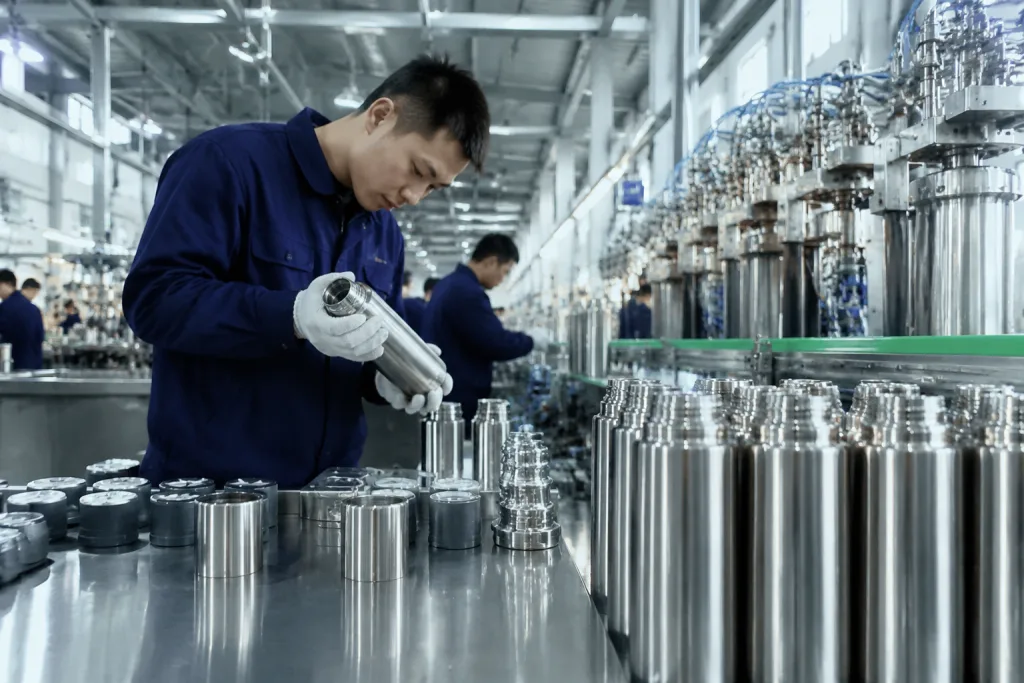
QC should start before the deposit leaves your account. After goods are finished, your choices shrink to rework, discount, or a missed vessel date. Set the inspection checklist and AQL levels on the PI, not in a WeChat argument 3 days before packing. For stainless thermos orders, we run checks on vacuum retention, leakage, coating adhesion, odor, lid fit, logo position, capacity, carton drop strength, barcode scan rate, and packing accuracy. Small detail, big problem: QC once pulled a 500 ml sample where the laser logo sat 4 mm off-center, and the buyer flagged the whole carton photo set.
A working inspection plan should include incoming material checks, in-line vacuum testing, 100% leak screening on risky lid designs, and final random inspection under ANSI/ASQ Z1.4 or ISO 2859-1. About 8 out of 10 retail buyers we ship for use AQL 0 for critical defects, AQL 1.5 for major defects, and AQL 4.0 for minor defects. For retail orders, add a thermal retention check: fill with 95°C water, close for 6 hours, and record the temperature drop on sampled units with a probe thermometer. The pass level depends on order volume and mouth design, but a decent 500 ml vacuum thermos should usually keep water above 55-65°C after 6 hours at room temperature. We’ve seen this go sideways when a wide-mouth sample passes leak testing but loses heat faster than the approved PP sample cup on the bench.
Compliance is not optional. For Europe, ask about LFGB, REACH, EU 10/2011 for plastic contact parts, and packaging requirements. For North America, FDA food-contact expectations and California Proposition 65 screening may apply. Kids or family-oriented products need stricter checks on small parts and ASTM-related safety expectations. On Tritan Renew lids, our lab usually cuts 2 contact-part samples from each colorway, because a transparent smoke-gray lid and a clear lid can come from different resin lots.
A reliable manufacturers thermos partner will accept third-party inspection by SGS, TÜV, Intertek, or your appointed inspector. Discuss it before production starts. If you add an inspection standard after goods are packed, expect arguments. The math doesn’t work: opening 120 export cartons after sealing means new tape, new carton marks, extra labor, and often a 1-day slip on the booking. Put the standard on the PO, even if the PO has a typo in “vacuum”; the line follows the signed paper.
Plan The Launch Calendar Backward
The last decision is timing. Missed launch dates usually start before the line is even booked: artwork sits for 4 days, the packaging PDF has no bleed, compliance is requested after deposit, or the buyer changes from PMS 5483C to PMS 5493C after PP samples. We run decorated samples in our Zhejiang facility in 7-10 days, buyer review takes 3-5 days when the approval sheet is clean, and mass production needs 35-50 days after deposit and final approval. Sea freight to Europe or North America adds 25-40 days port to port; during Ningbo port congestion we have seen 32 days become 46 days.
Work backward from your retail shelf date or promotion date. Simple math. If goods must reach a U.S. warehouse by September 1, sample approval in late July is too late unless your margin can carry air freight. For Amazon or distributor programs, add 5-7 days for FNSKU labels, carton marks, pallet specs, and photo samples. A thermos distributors order with 6 colors and mixed cartons needs packing instructions down to carton sequence and inner box label position; one buyer flagged this after QC pulled the sample carton and found “blue” printed on the black SKU.
The safest project file includes a signed quote, product specification sheet, artwork file, Pantone reference, packaging dieline, compliance list, inspection checklist, shipping marks, and spare-parts requirement. Boring work. Still necessary. We prefer one locked folder before opening the mould-room schedule, because a 1 mm logo shift or a missing silicone gasket line on the PO can turn into 2 rounds of emails and 3 lost production days.
When you compare thermos manufacturers, asking only for the lowest price is the wrong question to ask. Ask who can point out the weak spots before the deposit lands: color tolerance, MOQ by color, lid fit, carton drop-test risk, or whether the handle screw passes torque after 24 hours in a hot-water test. That is usually the difference between a supplier thermos transaction and a long-term factory thermos relationship.
Send your thermos brief for a factory review
Share capacity, lid type, logo method, target MOQ, and market. We will return a practical quote with risks, lead time, and options.
Frequently asked questions
Can a stainless thermos really be made with Tritan Renew?
Yes, but only certain components normally use Tritan Renew. The vacuum insulated body is stainless steel, usually 304 inside and 201 or 304 outside. Tritan Renew is used for molded parts such as lids, straws, infusers, clear caps, or viewing components. If a factory says the whole thermos body is Tritan Renew, that is not a stainless vacuum thermos. Ask for a bill of materials showing each material, recycled-content certification for the Tritan Renew resin, and food-contact reports for the finished component. For Europe, check LFGB, REACH, and EU 10/2011 where applicable. For North America, ask for FDA food-contact support and any retailer-specific restricted substance testing.
What MOQ should outdoor retailers expect for a custom thermos?
For an existing stainless thermos mold with a stock color and laser logo, 1,000 units is usually realistic. For custom powder coating, expect 3,000 units per color because coating lines need setup, color change, and rejection allowance. For a new Tritan Renew lid mold, MOQ can move to 5,000-10,000 units, and tooling may cost USD 3,000-12,000 depending on lid complexity. If you need only 300 units, use stock goods with simple laser engraving. A serious thermos supplier should not pretend that deep customization is economical at tiny quantities. The setup loss will simply be hidden in a higher unit price.
How long does a customized thermos order take from China?
For existing molds, plan 7-10 days for logo samples and 35-50 days for mass production after sample approval and deposit. Add 25-40 days for sea freight to many Europe or North America destinations, plus customs and inland trucking. If you need custom lid tooling, add 25-35 days for mold development before production samples. A practical first-order calendar is 80-110 days from confirmed design to warehouse arrival by sea. Air freight can rescue a deadline, but it may add USD 1.50-4.00 per unit on a 500-750 ml stainless thermos, depending on volume and destination.
Which decoration method is best for promotional thermos orders?
For promotional thermos orders with tight timing, laser engraving is usually the safest choice. It is durable, clean, and avoids ink curing problems. Silk screen printing works well for one-color logos and can cost around USD 0.08-0.25 per position, but curved surfaces and large artwork increase alignment risk. UV printing and heat transfer are better for full-color branding, though they need abrasion and adhesion testing before bulk production. If your event date is fixed, choose a stock powder color plus one-position laser logo. If your brand campaign needs exact Pantone coating and full-wrap graphics, allow at least one extra sample round.
What quality tests should I require before shipment?
At minimum, require leakage testing, vacuum insulation testing, coating adhesion, logo position check, odor check, capacity verification, carton drop review, and final AQL inspection. A common final inspection setup is AQL 0 for critical defects, AQL 1.5 for major defects, and AQL 4.0 for minor defects under ISO 2859-1 or ANSI/ASQ Z1.4. For insulation, sampled 500 ml units filled with 95°C water should usually remain above 55-65°C after 6 hours at room temperature, depending on mouth diameter and lid design. If your order uses Tritan Renew parts, include plastic food-contact documentation and color consistency checks.