Key Takeaways
- Use Tritan Renew for lids or clear components; use 18/8 stainless steel for the vacuum body
- A realistic custom thermos MOQ is 1,000 pcs per color, with 35–45 days mass production
- For outdoor retail, specify 0.45–0.55 mm inner wall and 0.50–0.60 mm outer wall stainless steel
- QC should include AQL inspection, vacuum retention testing, coating adhesion, and carton drop testing
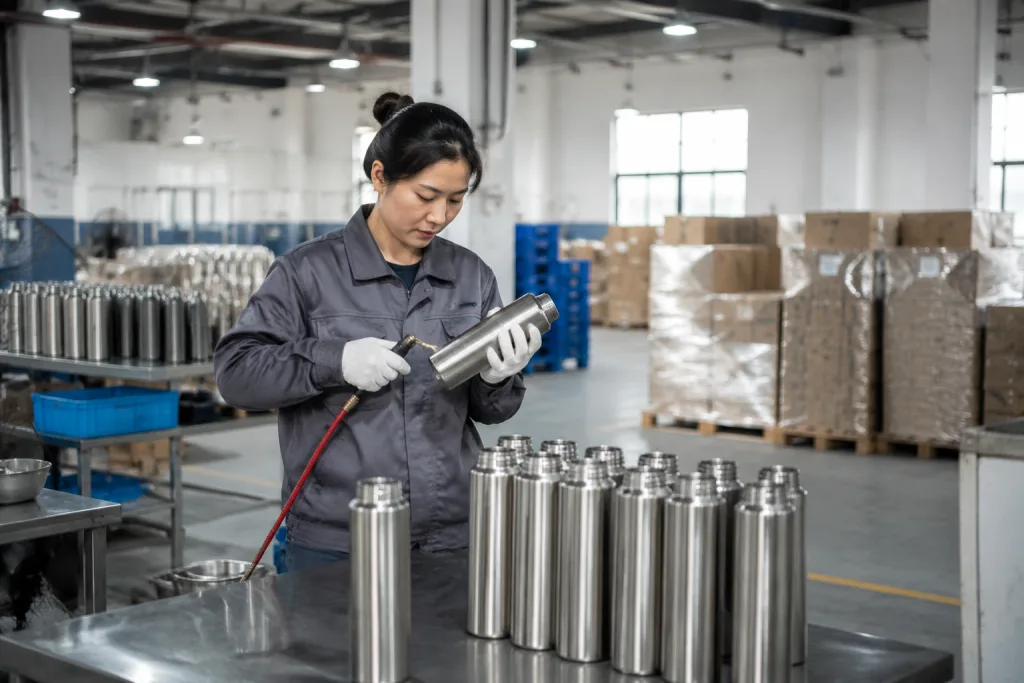
You asked for a tritan renew thermos custom product, so let’s fix the spec first: Tritan Renew is not stainless steel. It is a recycled-content copolyester we use for clear bottle bodies, lid windows, flip lids, straws, and infusers. The vacuum body is usually 18/8 stainless steel, drawn on the hydraulic press and checked with a 0.02 mm caliper at the mouth before welding. If a quote says “Tritan Renew stainless thermos,” push back and ask which part is Tritan Renew and which part is steel. We’ve seen this go sideways when a buyer expected a clear Tritan body, but the PO only said “stainless thermos.”
Here’s a real buyer case. An outdoor retailer needed a 750 ml customized thermos for a spring camping promo: Tritan Renew flip lid, powder coating, retail carton, and EU/US compliance. BottleForge Industrial in Hangzhou, Zhejiang runs about 420,000 drinkware units/month, with stainless thermos MOQ from 1,000 pcs per color and normal lead time of 35–45 days after sample approval. QC pulled the first pre-production sample because the lid hinge pin was 0.6 mm short, and the buyer flagged a typo on the carton barcode file. Small stuff, until it delays vessel booking.
Start With The Actual Use Case
Assume you are buying 3,000 pcs of a 750 ml bulk thermos for an outdoor retail chain and a promotional brand partner. The end customer will carry it on 6-hour hikes, weekend car-camping trips, ski buses, and Monday commuting. Broad brief? Yes, but enough to lock the build. We would run a one-hand flip lid, silicone seal checked on the air-pressure tester, powder coating with a 3M cross-hatch tape check, and a 5-layer export carton for distributor thermos warehousing.
The proposed build is a stainless vacuum body with a Tritan Renew flip lid, not a full Tritan Renew bottle. For the body, specify SUS304/18-8 stainless steel for both inner and outer shells. A common wall setup is 0.45 mm inner wall and 0.55 mm outer wall. If your retail price target is low, some thermos manufacturers will push thinner steel; below about 0.40 mm inner wall, QC starts pulling samples for dent marks near the bottom radius after polishing. We have seen this go sideways when a buyer saved USD 0.18 per pc and then rejected 11 cartons at final inspection.
For capacity, 750 ml is the practical outdoor size. It gives enough volume for a long morning and still fits most backpack side pockets we measure at 78–85 mm opening. If you want thermos promotional giveaways for events, 500 ml is cheaper and lighter. If you want a premium shelf product, 900 ml or 1,000 ml works, but the math changes fast: carton volume jumps, and a 40HQ fills by cube before weight. A 750 ml factory thermos with powder coating, one-color logo, Tritan Renew lid component, and individual color box often lands around USD 5.20–7.40 FOB Ningbo or Shanghai depending on finish, lid complexity, and packing.
Before requesting samples from a thermos supplier in China, write the use case in one paragraph. Include capacity, retail channel, target FOB price, logo method, carton type, compliance market, and launch date. Good manufacturers thermos teams can quote from that. Vague requests get vague pricing. Last week we had a PO typo showing “Trian Renew” instead of “Tritan Renew,” and the buyer flagged it only after artwork approval; fix those details before the line opens a sample mold.
Build The Specification Sheet First
A custom thermos project goes sideways when the buyer approves a photo instead of a spec sheet. We see it on sampling calls almost every month. For this order, write the basics in black and white: 750 ml nominal capacity, double-wall vacuum insulation, SUS304 inner and outer body, Tritan Renew lid insert or drinking spout where applicable, silicone sealing ring, PP structural lid parts if needed, and no BPA in food-contact plastics. If you sell in the EU, request REACH and LFGB food-contact documentation before the first 12 pcs samples leave Hangzhou. For the US, ask for FDA food-contact material declarations and, for kids-adjacent campaigns, review applicable CPSIA concerns even if the item is not a toy. QC pulled one sample last season where the PO said “TR lid,” but the supplier read it as transparent regular plastic. Bad shortcut.
Insulation claims need numbers. This is the wrong question to ask: “How many hours hot?” A better target for a 750 ml stainless thermos is hot water starting at 95°C, held at 60°C or above after 12 hours at room temperature around 20°C. We run this with a calibrated probe thermometer, not by touching the cup wall after lunch. Some premium models can beat that, but do not let a thermos vendor print “24 hours hot” unless the test method supports it. Retail customers notice when the claim is inflated, and the buyer flagged it fast when our test showed 12 hours vs the carton artwork saying 18 hours.
For the lid, ask exactly where Tritan Renew is used. Tritan Renew makes sense for a clear sip cover or molded drinking part because it gives clarity and recycled-content claims. The paperwork still matters. Do not accept a generic “eco plastic” statement. Ask for material grade, recycled-content declaration, and food-contact confirmation. A manufacturer thermos factory in Zhejiang should trace these documents if the material is genuinely specified. If the line cannot match the resin lot number to the lid injection batch, the math doesn't work, and we have seen this go sideways during AQL 2.5 inspection.
Finish requirements should also be measurable. Powder coating thickness often sits around 60–90 microns, and we check it with a coating thickness gauge before packing starts. For adhesion, request a cross-hatch tape test equivalent to ASTM D3359, with no major flaking. For logo placement, define size in millimeters, not “small on front.” Example: front logo, 38 mm wide, centered 82 mm from base, white silkscreen, Pantone matched within reasonable tolerance. Simple line drawing, fewer arguments.
Quote The Order Like A Buyer
Send the RFQ like a buyer, not like a catalog browser. A clean thermos custom inquiry might read: 3,000 pcs total, 1,500 pcs matte forest green and 1,500 pcs matte black, 750 ml, 304 stainless vacuum body, Tritan Renew flip lid component, one-color logo at 45 mm wide, individual retail box, 24 pcs per export carton, FOB Ningbo, delivery needed by May 15. Ask for tooling fees, sample fees, production lead time, carton dimensions, gross weight, and HS code. We also ask buyers to attach the logo AI file, because our pre-press guy once caught a PO that said “mate black” while the Pantone sheet showed gloss black.
For this case, a serious thermos factory quote from China may look like this: MOQ 1,000 pcs per color, pre-production sample 7–10 days after artwork confirmation, mass production 35–45 days after deposit and sample approval, payment 30% deposit and 70% before shipment, FOB Ningbo or Shanghai. Custom lid tooling, if required, can run USD 1,200–4,500 depending on part count and mold complexity. If we run an existing lid with a Tritan Renew component, there may be no new mold charge. QC pulled the sample last month and measured the lid buckle gap at 0.35 mm with a feeler gauge; that tiny number decides whether the buyer gets a clean leak test or a wet carton.
Price gaps usually come from four places: steel thickness, lid design, coating process, and packing. A thermos bulk price of USD 4.80 may look sharp until you find a 0.40 mm outer shell, basic PP lid, white box, and a 5-layer carton that crushes at the corners after 18 kg stacking. A USD 6.30 quote may include stronger steel, better leak testing, Tritan Renew content documentation, retail carton, and AQL inspection support. The cheapest line is the wrong question to ask. You are buying fewer returns and fewer angry distributor emails.
If you are comparing several thermos suppliers, lock every quote to the same spec: capacity, wall thickness, coating, lid materials, logo size, packing, and Incoterm. Put it in one comparison sheet. We ship cleaner when the buyer writes “750 ml, powder coating, 24 pcs/ctn, FOB Ningbo” on every line instead of letting 4 suppliers guess. Otherwise the cheapest supplier thermos quote wins on paper and loses in the warehouse when QC opens carton 7 and finds mixed lids.

Approve Samples Without Guesswork
Sampling is where we catch problems while they still cost RMB 80, not a 3,000 pcs rework. For this customizable thermos order, we ask buyers to approve 3 sample types: a blank construction sample to check the body, a decorated sample with the logo, and a packing sample if the carton or retail box will sit on shelf. Tight schedule? We sometimes ship the blank sample first by DHL and approve the logo from 6 close-up photos taken beside a Pantone book. The risk is real. For outdoor retail and promotional thermos launches, the better call is usually 7–10 days for one correct decorated pre-production sample, especially when the line is running powder coating and laser engraving in the same week.
Check the sample like our QC desk checks it, not like a catalog buyer. Fill it with hot water, close the lid, invert it for 10 minutes, then shake it gently over a dry paper towel. QC pulled one sample last month where the sip lid passed standing leak test but left 2 drops after a backpack shake test. That goes sideways fast. A single drip may pass for some sip lids, but a thermos customized for backpacks should not leak under normal movement. Measure capacity to the fill line, not to the brim. Check mouth diameter; 52–58 mm is common for easy ice filling and cleaning. Run your fingernail across the cap threading, because rough threads become warranty claims after 30–50 opens.
For logo approval, inspect under daylight and indoor light. We use a D65 light box when the buyer flags color, because office LED can make dark green look black. Laser engraving is durable and clean on stainless or coated bodies, but it can look too quiet on matte powder coating. Silkscreen gives stronger color, but the math does not work if the ink fails the 3M tape pull after curing. Heat-transfer printing handles complex artwork, though outdoor users are hard on it. For most distributor thermos programs, one-color silkscreen or laser engraving is the safer choice.
Send written sample comments. Do not just say “make lid better” or “color too dark.” Say “increase lid closing force slightly,” “Pantone 5605 C is too dark by visual check; adjust closer to approved swatch,” or “logo should move 12 mm higher.” One buyer once wrote “logo higher” on the PO, and the factory read it as 5 mm; we had to remake 12 samples before the production meeting. Zhejiang factories are used to export sampling, but they still need measurable instructions.
Lock Compliance And Claims
The word “renew” gives your marketing team a good hook, but it also puts pressure on the file behind the order. For a tritan renew thermos custom program, we want the resin grade sheet, supplier declaration, food-contact statement, and a traceable lot record before bulk production starts. Paper matters. Last March, QC pulled a lid sample from line 3 and the carton label showed “Tritan” while the PO said “Tritan Renew”; that 1-word mismatch held the shipment for 2 days. Retailers in Europe and North America now ask for claim support on almost every recycled-content project. A PDF with no grade number, no issue date, and no link to the molded lid used in production will not pass a serious buyer review.
For EU sales, ask your thermos manufacturer for LFGB or EU food-contact test reports covering stainless steel, plastic lid components, silicone gaskets, and coating where relevant. REACH SVHC screening is also commonly requested by importers and promotional agencies. For US sales, request FDA food-contact compliance support for the materials. If the product will sit in a kids’ outdoor set or school promotion, confirm whether ASTM or CPSIA-related review is needed for your channel. We’ve seen this go sideways when the buyer approved a 500 ml bottle for adults, then the retailer listed it under youth camping gear without telling the factory. The exact legal obligation depends on product positioning, age grading, and market, so your compliance team should make the final call.
Factory audits matter, but certificates are not magic. BSCI, Sedex, ISO 9001, or a customer audit can reduce risk because they show the thermos factory has a management baseline. They do not prove the next 3,000 pcs shipment is clean. We still run incoming material checks with a handheld XRF gun for stainless grade, in-process leak checks on the line, and final AQL 2.5 inspection before loading. One clean audit will not catch a gasket hardness change from 55 Shore A to 65 Shore A unless someone checks the parts in production.
Be careful with insulation and recycled-content claims on packaging. “Made with Tritan Renew lid component” is safer than “made from recycled thermos material” if only the lid component uses Tritan Renew. “Keeps hot up to 12 hours under test condition” is safer than a loose “all day hot.” This is the wrong place to be creative. Last year a buyer flagged a gift-box line that said “recycled bottle” while only the flip lid used Tritan Renew, and we had to reprint 8,000 color boxes before shipment. Honest claims protect your brand and make the supplier relationship easier because everyone knows what must be proven.
Inspect Production Before Shipment
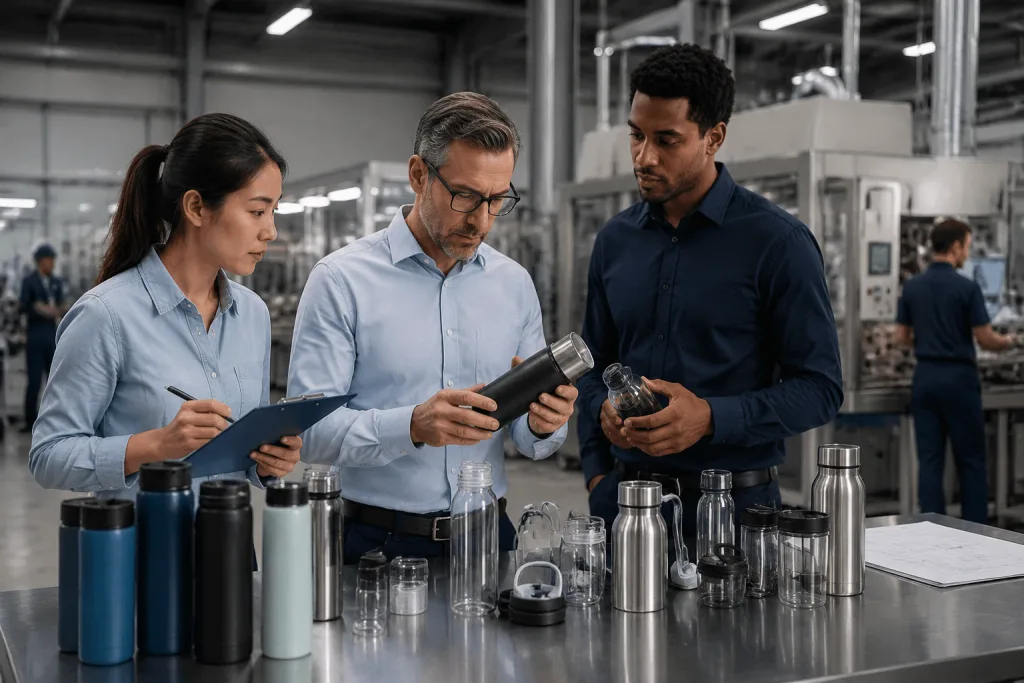
For a 3,000 pc order, do not wait until cartons land in Rotterdam, Hamburg, Los Angeles, or Toronto to learn the lids leak. Run an AQL final random inspection before balance payment. A common setup is General Inspection Level II, AQL 2.5 for major defects and AQL 4.0 for minor defects. Critical defects such as sharp edges, contaminated interiors, or severe leakage should be zero tolerance. Simple rule. QC pulled 125 pcs on one 3,000 pc job last spring, and 7 lids failed the upside-down shake test after the silicone gasket sat 0.6 mm proud.
Your inspection checklist should cover appearance, capacity, weight, lid fit, leak testing, vacuum performance, coating adhesion, logo accuracy, barcode scanning, carton drop condition, and packing count. Do not just ask, “Does it look good?” That is the wrong question to ask. We run capacity with a measuring cylinder, check unit weight on a 0.1 g scale, and use 3M tape for coating adhesion on printed Tritan Renew parts. For vacuum testing, factories often use a quick hot water or vacuum detector method during production, then a retention test on sampled units. For a retail order, pull at least 8–13 pcs across different cartons for extended hot-water retention checks, usually 95°C water checked after 6 hours and 12 hours. If the order is high value, request 20 pcs.
For Amazon or marketplace fulfillment, add FNSKU labels, suffocation warnings for polybags if used, master carton labels, and carton weight limits. A 24 pc carton for 750 ml thermos units gets heavy fast; keeping gross weight under about 15–18 kg is sensible for warehouse handling. We have seen this go sideways when a buyer approved 19.6 kg cartons and the 3PL flagged manual handling risk at receiving. For traditional thermos distributors, outer carton strength matters more than fancy retail packing. Five-layer corrugated cartons are safer than thin three-layer cartons for export, and we usually spec 6 mm BC flute when the route includes LCL handling.
At BottleForge Industrial in Hangzhou, Zhejiang, we prefer buyers to approve a golden sample and a packing standard before production starts. Then QC has something physical to compare against on the line. China production is fast, but speed cuts both ways: if a wrong carton mark or logo position enters mass production, 3,000 mistakes can be made before lunch. We once caught a PO typo where “matte black” became “mate black” on the carton artwork; small typo, big headache. Lock the standard early. The correction is cheaper before the first carton is taped.
Plan Freight And Reorders Early
After inspection passes, freight is where the quote starts to wobble. A 750 ml stainless thermos is bulky for its unit value. If each unit with color box takes about 0.0035–0.0045 CBM, a 3,000 pc order sits at roughly 10.5–13.5 CBM before pallets, corner guards, and stretch film. Last month QC pulled 12 cartons from the line and the packed height was 312 mm, not the 300 mm shown on the first carton drawing. That 12 mm gap matters. Sea freight is usually the right call for bulk thermos orders; air freight only works for 200–500 launch units or replacement stock when the buyer has a shelf date they cannot miss.
Set FOB, CIF, DDP, or EXW before you compare prices. FOB Ningbo is the normal choice for a Zhejiang manufacturer thermos shipment because the truck run from Hangzhou to Ningbo port is about 2.5–3.5 hours, and export handling is routine. If one thermos vendor quotes FOB and another quotes DDP, this is the wrong question to ask: you are comparing factory cost against factory cost plus freight, customs clearance, duty, VAT, and last-mile risk. Outdoor retailers with their own forwarder usually prefer FOB. Promotional brands without import staff may ask for DDP, but the buyer still needs to check the HS code and delivery address. We have seen a PO typo change “DDP warehouse” to “DDU warehouse,” and the argument cost 6 days at destination.
Start reorder planning before the first shipment leaves China. Keep the mold number, Pantone color, logo AI file, carton dieline, inspection report, and approved sample photos in one shared folder. Use names people can read. On our side, the line records the lid mold code and silicone ring size in the production sheet, because one 0.3 mm gasket change can turn into a leak complaint after hot-water testing. If the first run sells well, a repeat order can move faster: sample confirmation can drop from 12 days to 3 days, and mass production can stay around 30–40 days if steel, lids, coating powder, and color boxes are available. Change the lid material, coating color, or carton structure, and we treat it as a fresh approval.
A good thermos manufacturers relationship is not about squeezing USD 0.08 out of every line. The math does not work if the cheaper supplier misses the ship date or packs 24 pcs per carton when your warehouse system expects 20 pcs. We ship better when the buyer gives clear artwork, stable forecasts, and one approved sample to match against. If something goes wrong, fast corrective action matters more than a pretty first quote; QC should pull the sample, check the defect rate, and send photos before the full lot moves to packing. For outdoor retailers and promotional brands, that reliability beats a slightly cheaper opening price.
Send Your Thermos Spec Before You Quote
Share capacity, lid concept, logo, quantity, compliance market, and launch date. We will return a practical FOB China quote and sample plan.
Frequently asked questions
Can a stainless thermos actually be made from Tritan Renew?
Not the vacuum body. A real stainless thermos uses stainless steel, usually SUS304/18-8, for the inner and outer shells. Tritan Renew is a copolyester used for plastic parts such as clear lids, sip components, infusers, or viewing windows. For a tritan renew thermos custom order, the accurate specification is normally stainless steel vacuum body plus Tritan Renew lid component. Ask the thermos supplier to identify the exact part, resin grade, and recycled-content declaration. If a factory says the whole thermos is Tritan Renew and also vacuum insulated stainless steel, the wording is wrong. Fix the specification before paying for samples.
What MOQ should I expect for a custom thermos order?
For BottleForge Industrial in Zhejiang, standard stainless custom thermos MOQ is usually 1,000 pcs per color when using existing molds. A 3,000 pc order split across two colors is realistic: 1,500 pcs matte green and 1,500 pcs matte black, for example. If you need a new lid mold, special shape, or exclusive body tooling, the MOQ can move to 3,000–5,000 pcs because setup time, tooling, and material procurement increase. For promotional thermos projects, do not plan around 100–300 pcs unless you are buying stock blanks with local decoration.
How long does production take after sample approval?
For an existing 750 ml stainless thermos mold with custom logo and retail box, normal production lead time is 35–45 days after deposit and approved pre-production sample. Sampling usually takes 7–10 days after artwork and specification confirmation. Add another 3–7 days if you need a custom color powder coating match. If a new mold is required for a Tritan Renew lid component, tooling and trial runs can add 20–35 days before normal production starts. China factories can move fast, but rushing coating cure time, leak testing, or packing checks is a bad trade.
Which logo method is best for outdoor retail thermos products?
For outdoor retail, laser engraving and silkscreen are the two safest choices. Laser engraving is durable, clean, and good for premium stainless or powder-coated products, but the mark can look subtle depending on coating color. Silkscreen gives stronger logo visibility and Pantone color control, but it should pass adhesion testing on the coating, especially for backpack use. For a 3,000 pc distributor thermos order, one-color silkscreen is often cost-effective, while laser engraving suits higher retail price points. Complex full-color artwork is possible with heat transfer, but it needs stronger abrasion review before approval.
What should be included in final QC for thermos bulk shipments?
Use AQL final inspection before shipment, commonly General Inspection Level II with AQL 2.5 for major defects and 4.0 for minor defects. Critical defects, including sharp edges, dirty interiors, unsafe materials, or severe leakage, should be zero tolerance. The checklist should cover appearance, logo position, capacity, unit weight, lid threading, leak test, vacuum heat retention, coating adhesion, barcode scan, retail box, carton marks, and drop-test condition. For a 3,000 pc thermos bulk shipment, pull samples across multiple cartons and colors. Do not inspect only the top cartons near the factory door.