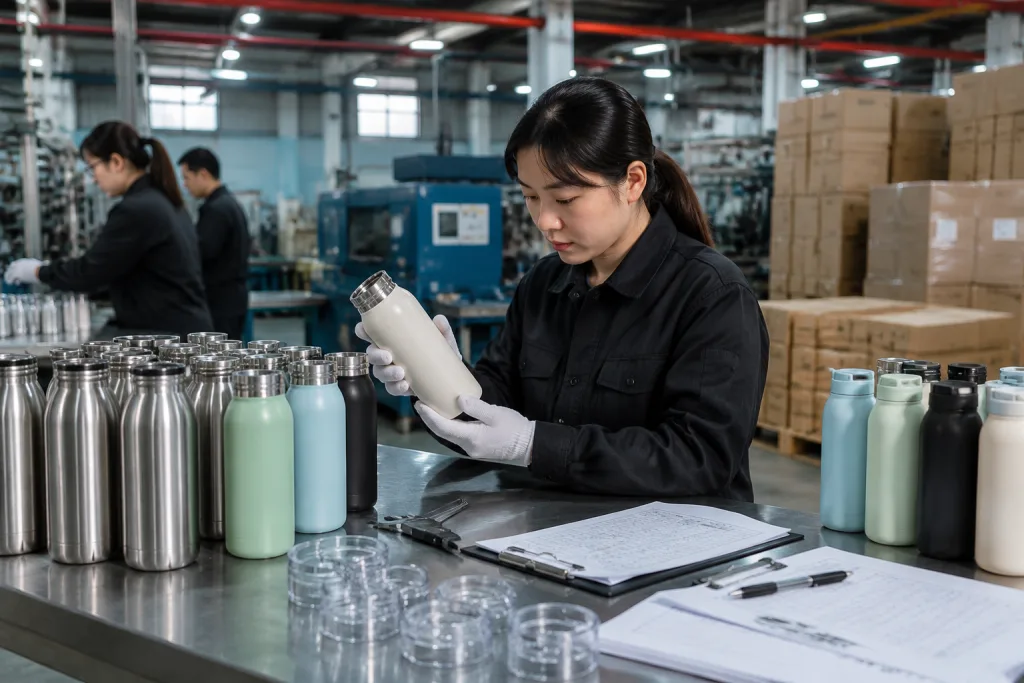
Key Takeaways
- Use 304 stainless steel at 0.45-0.55 mm wall thickness for most vacuum thermos bulk orders
- Tritan Renew works best for lids, straws, infusers, and transparent components, not the vacuum body
- A practical custom thermos MOQ is 1,000 units per color with 35-45 day production after approval
- Inspect by AQL 2.5/4.0 and run 6-hour heat retention, leak, drop, coating, and logo adhesion checks
Your brief says tritan renew thermos bulk, then the retail buyer asks for 6-hour vacuum insulation, a heavier hand feel, and a logo that will not scrape off after trail use. That mix needs a hard spec sheet, not loose wording. Tritan Renew fits clear lids, straws, tea infusers, and some cold cups; the insulated thermos body we run is normally 304 stainless steel, double-wall vacuum, with a 0.4 mm inner wall and 0.5 mm outer wall. Last month QC pulled the sample because the PO said “Tritan body,” while the drawing showed a stainless vacuum flask. That small wording gap can hold production for 3 days.
At our Hangzhou, Zhejiang factory, we see around 14 of these mixed-material inquiries each month from outdoor retailers and promo brands. Buyers want the recycled-material story, a custom thermos look, and FOB China pricing that will still work at 3,000 pcs MOQ. The right question is not “Can the whole thermos be Tritan Renew?” The math and performance do not work for hot drinks. Define which parts use Tritan Renew, which parts use 304 stainless steel, and which checks the line must pass before balance payment: vacuum test, lid fit, logo adhesion, carton drop, and AQL 2.5 inspection.
Start With The Real Brief
A buyer brief often lands on our desk like this: outdoor retail program for tritan renew thermos bulk, 12,000 units, two colors, retail sleeve, one-color logo, ship to Hamburg before Week 38. The first trap is the wording. Tritan Renew is a copolyester resin tied to recycled-content allocation; it is not the vacuum body material. If we quote it word for word, the product is wrong. If we delete the sustainability part, the buyer flags it in the first sourcing call.
The workable spec is usually mixed material: stainless steel vacuum body, Tritan Renew on clear food-contact lid parts, and packaging copy that supports the recycled-content claim without stretching it. For a 500 ml or 750 ml bottle, we run 304 stainless steel on the inner wall, 304 or 201 stainless steel on the outer wall depending on target FOB, silicone sealing rings, and a PP or Tritan Renew lid structure. QC pulled one lid sample last month where the PO said “Trian Renew”; that typo held the material confirmation for 2 days.
For outdoor retail, going too thin is the wrong question to ask. A 0.38 mm outer wall can survive a desk-use promotional thermos order, but it dents fast once cartons move through camping and field-sports channels. We prefer 0.45-0.55 mm stainless for this SKU type. On the drop table, the 0.38 mm sample showed a flat spot near the shoulder after 3 drops from 1.2 m.
Before sampling, lock four points in writing: capacity tolerance, lid material, insulation target, and logo method. Without those four points, a supplier thermos quote is just a guess with a unit price attached. In Zhejiang and nearby China manufacturing hubs, I can name 30 factories that will show a similar sample by Friday, but the confirmed material stack is what protects your margin when the line starts welding bodies.
Spec The Body And Lid
For a thermos manufacturer, the body drawing drives the bill. A 500 ml model with narrow mouth, powder coating, and a laser logo usually lands around USD 3.20-4.40 FOB Ningbo or Shanghai at 5,000 units, based on lid parts, vacuum yield, and the weekly steel quote we get from the coil supplier. A 750 ml customized thermos with handle lid, Tritan Renew transparent sip part, and color box can move into the USD 4.60-6.20 range. We check this on the line with a caliper: a 0.1 mm wall change sounds small, but across 5,000 pcs the math shows up fast. These are not promises. They are procurement ranges before tooling, artwork plates, and compliance testing.
The body should use SUS304 for the inner wall because it touches beverages and needs corrosion resistance. For the outer wall, SUS304 fits premium retail; SUS201 cuts cost for promotional thermos programs where the shell does not touch liquid. If you choose SUS201 outside, write it clearly on the PO, not buried in an email thread. We once had a buyer flag a pre-production sample after QC pulled the sample and the magnet test felt different from the signed spec. Hidden material switching is how a weak thermos vendor wins a low bid, and we do not like that game.
Lids need more attention than buyers expect. Tritan Renew makes sense for a clear flip lid, a measuring cap with ml marks, a straw cover that needs visibility, or an infuser chamber where the customer wants to see tea leaves. Stainless steel still carries the insulation job. Silicone gaskets should be food-grade, with shore hardness that seals without making the lid painful to open; we usually see problems when the gasket groove is off by 0.3 mm. For sports and outdoor channels, ask for spare gasket availability. Losing a USD 0.04 gasket can create a product complaint on a USD 18 retail bottle.
For the customizable thermos surface, powder coating is still the safer outdoor choice. Paint film thickness is commonly 60-90 microns. Too thin scratches after a few passes in the cross-hatch tape test; too thick can chip around the base and mouth when cartons take a corner hit. If the brief asks for a soft-touch coating, test abrasion and hand-oil staining before approving mass production. We have seen this go sideways after 12 days on a sales sample table, not 18 months in the market.
Build The Quote Backwards
Do not send ten thermos suppliers a “best price” message and line up the spreadsheets. Start with the selling channel. If the outdoor retailer needs a USD 19.99 shelf price, and your distributor thermos margin target is 35%, the landed cost ceiling usually sits around USD 6.50-7.50 after ocean freight, duty, domestic freight, and handling. Work backwards from there. On a 480 ml stainless thermos we ran last month, the carton was 58×39×25 cm for 24 pcs; that cube pushed the FOB China target under USD 4.80-5.50 depending on port and delivery address. Asking for “best price” first is the wrong question.
For a promotional brand, the math changes. The end client may care more about logo accuracy, event deadline, and carton labeling than shelf margin. A thermos promotional order can use a simpler body if the branding holds up and the delivery date is real. We have seen this go sideways when a buyer approved the bottle but missed a typo on the PO carton mark, then QC pulled the sample two days before loading. The same factory thermos base model may need two quotes: a retail version with color box, barcode, user manual, and tighter coating inspection; or an event version with bulk pack, lower packaging cost, and faster line setup. If the lid uses Tritan Renew, call that out on the quote line, not buried in an email thread.
Here is a practical quote structure you can request:
- MOQ: 1,000 units per color for existing mold, 3,000-5,000 units for custom lid tooling. For mixed colors, ask if the line accepts 500 pcs color splits or charges a setup fee.
- Sample time: 7-10 days for logo sample, 20-25 days for new plastic lid prototype. We run the logo sample after artwork size is locked in mm.
- Mass production: 35-45 days after approved pre-production sample and deposit. If the coating line is full before Christmas season, ask for the slot date, not only the lead time.
- Capacity: BottleForge output is about 450,000 stainless drinkware units/month across bottle, tumbler, and thermos lines. Capacity only matters if your order has a reserved line plan.
- Payment: Usually 30% deposit, 70% before shipment after passed inspection. We ship after the inspection report matches the approved pre-production sample.
Use one comparison sheet, but include material grade, wall thickness, coating type, lid material, carton size, and inspection standard. Add real fields: inner wall thickness in mm, powder coating code, Tritan Renew lid resin note, master carton kg, and AQL level if you use one. Otherwise the cheapest thermos supplier is often just deleting details you did not specify. The buyer flags it later. By then, the math does not work.
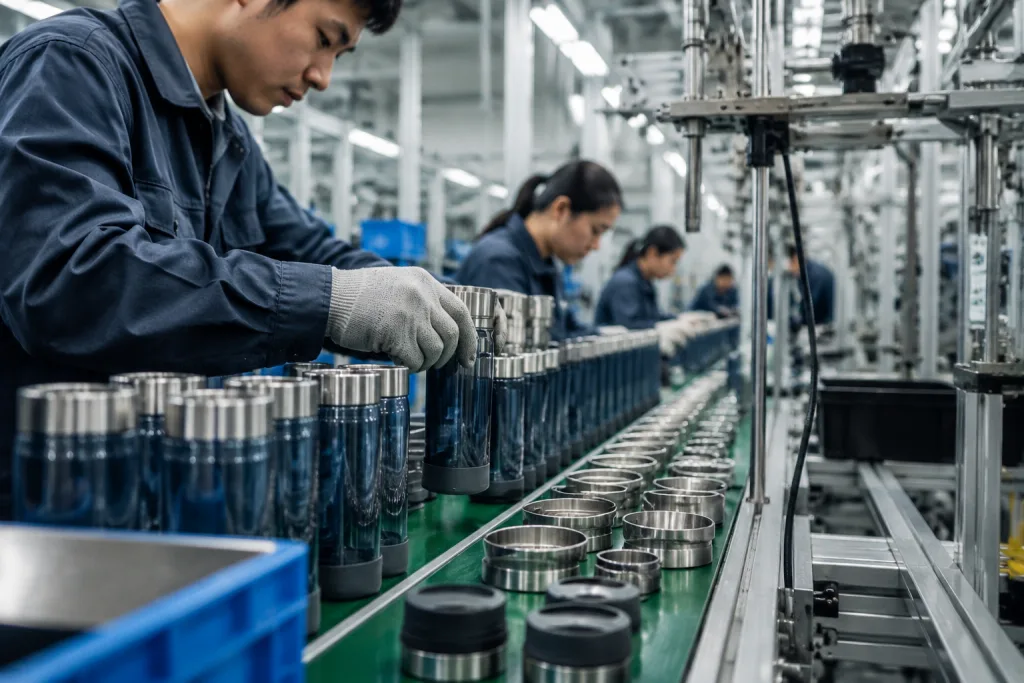
Approve Samples Like Production
The sample stage is where custom thermos programs either lock in cleanly or start leaking money. A nice-looking sample is not enough. We ask for one signed pre-production sample that matches the bulk run: 304 stainless body, Tritan Renew lid parts, logo position, coating finish, lid assembly, gasket color, retail box, and barcode placement. QC pulled a sample last month where the barcode sat 6 mm too low and scanned only after the gift box was flattened. That goes sideways in Amazon FBA. If the sample uses a hand-polished body or a temporary lid material, write it on the approval sheet and ask for a corrected sample before bulk thermos production.
For a customized thermos order with Tritan Renew components, ask the manufacturer thermos team for resin documents from the plastic component supplier. Keep it tight. We usually collect 3 files: material declaration, food-contact statement, and batch traceability plan tied to the injection lot number on the carton label. For Europe, discuss LFGB, EU 10/2011 for plastic parts, and REACH/SVHC expectations. For North America, review FDA food-contact requirements and, for children’s products, CPSIA and ASTM where applicable. If it is not a kids bottle, do not dress it up as one; the math does not work when testing fees jump by USD 800 to 1,500 per SKU.
Logo approval needs discipline. Laser engraving holds well on powder coating because it cuts through the coating and shows the metal underneath. Silkscreen works for 1- or 2-color logos, but we run 3M tape adhesion and a 24-hour water soak on textured finishes before signing off. Heat transfer gives more color. It also adds cost and more failure points. For a thermos custom program going into outdoor retail, laser or proven screen print usually beats a fragile full-wrap graphic unless the design team refuses to move.
Measure the sample. Do not trust catalog copy. Capacity should be checked to the fill line with a digital scale and room-temperature water, not guessed from the sales sheet. A 500 ml bottle that only holds 465 ml will bring complaints, and the buyer will flag it after their own lab pours the first unit. We normally allow about +/-5% capacity tolerance unless the buyer needs a stricter retail claim.
QC Before Balance Payment
For thermos bulk shipments, QC should start when at least 80% of goods are packed and before balance payment is released. Use AQL, not “open a few cartons and have a look.” We usually run AQL 2.5 for major defects and 4.0 for minor defects, with critical defects not accepted. For large retail programs, AQL 1.5 major is fine, but the math must be clear: on a 20,000 pcs order, stricter sorting can add 1-2 working days on the line if QC pulls coating chips or crooked logos from the packed cartons.
The checklist has to match the order risk. For a stainless steel and Tritan Renew customizable thermos, we check dents under a 6000K inspection lamp, coating scratches, color difference against the approved swatch, logo position in mm, logo adhesion with 3M tape, lid fit, gasket presence, thread smoothness, capacity, odor, leak test, heat retention, barcode scan, carton drop, and shipping mark accuracy. A leak test should include inverted bottles with water for at least 30 minutes. For flip lids, we also test side pressure and repeated opening; we have seen this go sideways when one gasket batch was 0.3 mm thin and QC pulled the sample before packing finished.
Heat retention claims need honest numbers. Around 7 out of 10 retail listings we review push the figures too far. A reasonable test is filling with 95°C water, closing the lid, and measuring after 6 hours at room temperature with a calibrated probe thermometer. Depending on capacity, mouth diameter, and lid design, a well-made stainless vacuum thermos may retain 65-75°C after 6 hours. If a supplier promises 12-hour café-hot performance at a low FOB price with a wide-mouth plastic-heavy lid, this is the wrong question to ask; ask for lab-style data before those numbers go on packaging.
Do not forget carton specifications. Export cartons should normally use 5-ply corrugated board for heavier stainless thermos shipments, and we check burst strength and carton weight before sealing the master cartons. A 24-unit master carton may be efficient for 500 ml bottles, while 12 or 16 units may be safer for larger 1 L models. If you ship to Amazon FBA or a retailer DC, FNSKU labels, carton weight limits, and barcode placement need confirmation before packing starts, not after the container is booked; one buyer flagged a PO typo where the carton mark said “Tritan New” instead of “Tritan Renew,” and repacking 312 cartons was not funny.
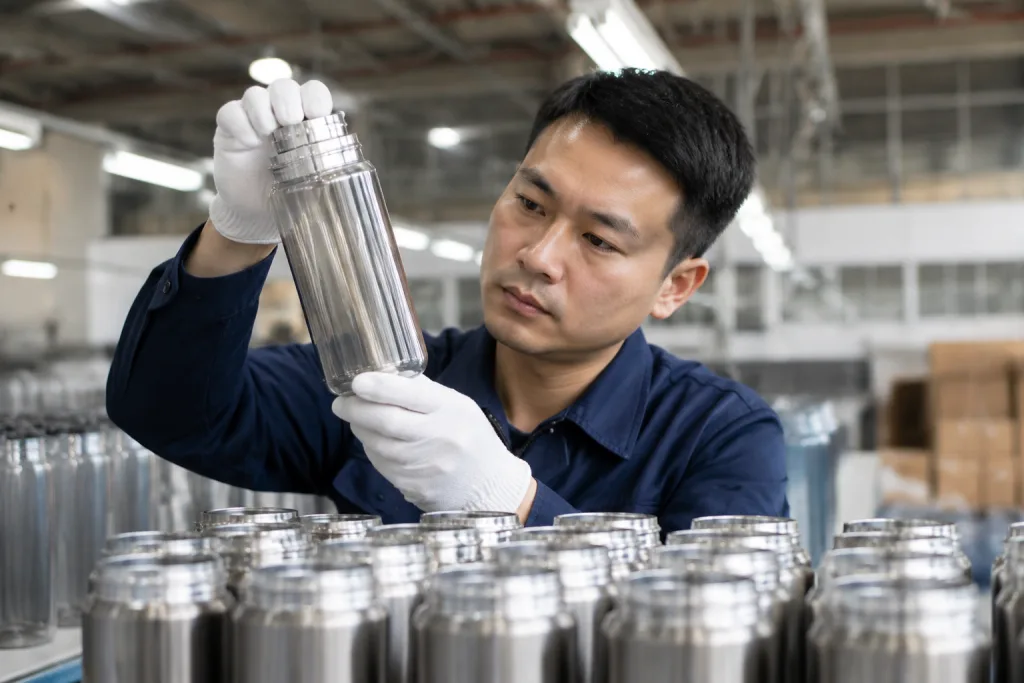
Control Compliance And Claims
Sustainability claims sell, but control the wording. If your product is listed as tritan renew thermos bulk, the carton, color box, hangtag, and product page should name the exact part using Tritan Renew, usually the lid shell or clear insert, not the 304 stainless vacuum body. Say it plainly. Do not call the full bottle “Tritan” when the cup body is stainless steel. Do not print “100% recycled” unless the resin certificate, batch allocation, and component BOM support that exact claim. We had one buyer flag a color box proof because the designer wrote “recycled bottle” on the front panel; QC pulled the sample, and the claim only applied to a 38 g lid part. The math doesn’t work if marketing gets ahead of the documents.
For factory audits, ask what the customer actually requires before collecting certificates. BSCI, Sedex, ISO 9001, and retailer-specific audits show up often, but not every program needs the full stack. BottleForge Industrial operates from Hangzhou, Zhejiang, with export processes built around North American and European documentation, but the final compliance pack should match your destination market and sales channel. A distributor thermos order for a 6,000 pcs regional outdoor chain may need REACH and food-contact reports. A national retailer may also ask for social audit documentation, product liability insurance, and packaging recyclability data. We run into this on kickoff calls when the buyer says “send all compliance,” then their PO only lists LFGB and carton drop test; that mismatch costs 5 to 7 working days.
Testing should be assigned by component. Stainless steel can be tested for heavy metals and food contact. Plastic lid parts can be tested under EU 10/2011 or FDA food-contact frameworks. Silicone rings require their own food-grade confirmation. Coatings may need migration and adhesion checks, especially powder coating around the lip within a 12 mm drinking zone. If you place one vague line on the PO saying “must meet EU and US standards,” you have not managed compliance; you have pushed confusion onto the factory. We’ve seen this go sideways when SGS asks for sample mapping and the PO has no part code, no material grade, and one typo in the lid drawing revision.
For promotional thermos programs, watch the artwork too. Some logos use metallic inks, neon pigments, or large coverage areas that change the testing risk. If the imprint contacts the mouth area, treat it differently from a 35 mm logo on the outer wall. A good thermos manufacturer will push back on unsafe or unstable decoration requests, even if that makes the first email less comfortable. On the line, our pad-printing tech checks ink adhesion with 3M 600 tape after curing; if the edge lifts near the rim, we reject it before mass production, because a cheap logo problem becomes a retailer claim in 30 days.
Ship Without Surprises
After QC releases the lot, shipping comes down to paperwork discipline. Lock Incoterms, carton count, gross weight, CBM, HS code, and booking date before the cartons leave our Hangzhou line. We run the final packing data off a calibrated floor scale and carton gauge, not from an old quote sheet. Most stainless thermos exports from China ship under HS codes for vacuum flasks or stainless drinkware, but your customs broker must confirm the right code for your market. FOB Ningbo or FOB Shanghai works well for Zhejiang factories. EXW looks cheaper on paper, but we have seen first-time buyers burn 3 days chasing truck pickup, export docs, and warehouse cut-off times.
For a 12,000-unit thermos distributor order, build the calendar backwards. If the retail launch is September 1, goods should reach your warehouse by August 10. Ocean freight to the US West Coast can be roughly 18-25 days port to port, while customs clearance and inland delivery can add 7-14 days. Europe may be 30-40 days by sea depending on port and route. Short schedule? Say it early. The buyer once flagged a June 28 approval date for an August promo, and the math did not work after we added 2 days for final AQL 2.5 inspection and 1 day for palletizing.
Packaging decides damage rate and shelf condition. Outdoor retailers reject crushed color boxes because the bottle cannot go straight onto a peg wall or shelf display. Promotional brands get angry about mixed cartons because fulfillment teams lose 20-30 seconds per pick, which adds up fast on 12,000 units. Use inner dividers or paper sleeves where the lid finish can rub, and do not let the factory change carton size without approval. QC pulled one tritan renew thermos bulk sample last season with a 2 mm corner crush on the color box; that was enough for the buyer to ask for thicker outer cartons. A 5% carton cube increase can raise freight cost enough to hurt the order margin.
The last habit is a shipment file. Keep the approved sample photos, PO, proforma invoice, packing list, inspection report, test reports, artwork files, and carton label proof in one folder. Small detail, big save. When you reorder six months later, this file prevents the usual headache: the second order looks close, but the lid color, logo height, or gasket fit has drifted. We have seen this go sideways from one typo on a PO, with “matte black lid” copied as “black lid” and the line using the wrong finish. Good thermos manufacturers in China can repeat a program well, but only when the buyer controls the spec.
Send Your Thermos Spec For A Factory Quote
Share capacity, lid concept, logo artwork, target price, and destination market. We will return a practical MOQ, lead time, and QC plan.
Frequently asked questions
Can the whole thermos be made from Tritan Renew?
No, not if you need real vacuum insulation. Tritan Renew is a plastic material used for clear or molded components such as lids, straws, infusers, and caps. The insulated body should be double-wall stainless steel, usually 304 inner wall with 304 or 201 outer wall. For a tritan renew thermos bulk program, the honest specification is a stainless vacuum body plus Tritan Renew parts where plastic is needed. This gives you the sustainable material story without sacrificing heat retention. Ask your thermos supplier to identify the exact component weight and material documentation so your product page and packaging claims stay accurate.
What MOQ should I expect for a custom thermos order?
For an existing stainless thermos mold, a realistic MOQ is 1,000 units per color with one logo. If you need a new lid tool, special handle, unique Tritan Renew transparent part, or private body shape, expect 3,000-5,000 units minimum and tooling charges. A simple laser logo sample usually takes 7-10 days. Mass production is normally 35-45 days after sample approval and deposit. For mixed-color thermos bulk orders, confirm whether the factory counts MOQ per color or per total order. Per-color MOQ is more common because coating lines need setup time.
Which logo method is best for outdoor retail thermos products?
Laser engraving is usually the safest for outdoor retail because it is permanent and handles abrasion better than most ink methods. On powder-coated stainless steel, laser removes the coating and exposes the metal underneath. Silkscreen is good for simple one- or two-color logos, but you should run tape adhesion and abrasion checks. Heat transfer allows more complex graphics, but it adds cost and may fail faster on curved or textured surfaces. For a promotional thermos used at events, silkscreen can be fine. For a premium customized thermos sold through outdoor retailers, laser or tested screen print is the better default.
What QC tests should I require before shipment?
Use AQL inspection, commonly AQL 2.5 for major defects and 4.0 for minor defects. Check dents, scratches, color match, coating thickness, logo position, logo adhesion, capacity, odor, lid fit, gasket presence, and carton labeling. Run leak tests with filled bottles inverted for at least 30 minutes. For insulation, fill with 95°C water and measure after 6 hours; many good stainless vacuum models retain about 65-75°C depending on volume and lid design. For bulk thermos retail shipments, also scan barcodes and check master carton strength because packaging errors can delay warehouse receiving.
How much does a stainless custom thermos cost from China?
For a 500 ml stainless custom thermos using an existing mold, powder coating, and laser logo, a practical FOB China range is about USD 3.20-4.40 at 5,000 units. A 750 ml model with a handle lid, Tritan Renew transparent part, retail color box, and stricter QC may land around USD 4.60-6.20 FOB. Final price depends on steel grade, wall thickness, lid tooling, packaging, test requirements, and order quantity. If one thermos vendor is 20% lower than every other quote, check whether they reduced wall thickness, changed 304 to 201 steel, or removed packaging details.