Key Takeaways
- Tritan Renew is usually worth it when you need BPA-free, high-clarity custom drinkware with better impact resistance than basic copolyester.
- A real canteen supplier in Zhejiang should quote MOQ, lead time, and monthly output clearly; 3,000 pcs MOQ and 25–35 days is common.
- Ask for compliance files up front: REACH, LFGB if needed, FDA food contact, and ISO 9001 plus AQL inspection detail.
- Decoration and mold capability decide whether your canteen custom program becomes a distributor drinkware line or a slow-moving sample project.
If you are comparing a Tritan Renew drinkware supplier, price is the wrong first question. Start with the job the bottle must pass: FDA or LFGB food-contact paperwork, 1.2 m drop test results, cap torque around 8-10 kgf.cm, shelf look under retail lighting, and whether your first run is 3,000 pcs or 30,000 pcs before cash gets tight. On our Hangzhou line, QC pulled a 750 ml sample last month because the injection gate mark was 0.6 mm too proud. A decent supplier will say what is molded in-house, what goes to an outside printing shop, and where the trade-off sits.
For B2B buyers, finding a canteen manufacturer in China or Zhejiang is not the hard part. Sorting a real canteen factory from a trading layer is where deals go sideways. We have seen buyers flag a quote that looked 12% cheaper, then lose 18 days chasing REACH files, lid leakage videos, and a PO typo that changed “clear body” to “clear lid.” If you sell to retail, Amazon, or distribution, weak QC shows up fast as carton damage, return claims, and dead stock. That is the decision that matters.
Start With the Use Case
Before you compare unit prices, decide where the bottle will sit on shelf or in use. A canteen promotional item for a 2-day trade show does not need the same spec as a customized growler for outdoor retail, and neither matches a canteen distributor program for supermarkets with 12-carton replenishment orders. We run different drop tests for these. For a 650 ml Tritan Renew bottle, QC usually checks the shoulder and base after a 1.2 m drop onto concrete. Tritan Renew makes sense when the buyer wants clear walls, decent impact strength, and a better hand feel without paying for glass.
Ask two blunt questions first. Is this custom drinkware for logo exposure, or a refill bottle someone carries 5 days a week? After that, ask how much clarity matters after 30 dishwasher cycles, because cloudy walls are where buyers start sending complaint photos. The answer decides wall thickness, lid style, and printing method. We have seen this go sideways when a PO says “clear bottle” but the approved sample was light smoke; the buyer flagged it only after mass production photos came back from the line.
For a distributor canteen line, I would keep the SKU count tight: one body size, two lid colors, and one artwork method such as silk screen or UV print. That keeps inventory sane. A 3,000 pcs MOQ split across 9 variants sounds flexible, but the math does not work once you add color change time, spare lids, and carton label control. For a custom growler or customized growler program, more size and cap variation can work because the order value is higher. A canteen vendor pushing 6 lid options before you have sell-through data is usually protecting margin, not your shelf result.
Check Compliance Before Price
If a supplier dodges compliance in email 1, move on. For Europe, ask for REACH and a clear food-contact declaration; for North America, ask for FDA food contact references and the migration test basis. If the bottle has 304 stainless pins, a silicone straw, or a PP flip lid, the standards must cover the full assembly, not only the Tritan Renew resin. We had a buyer flag this after QC pulled a 650 ml sample and found the lid insert listed nowhere on the report.
For Tritan Renew, ask for resin traceability, batch records, and third-party test reports for total migration, heavy metals, and odor. We run this check against the resin lot number on the carton label, not a sales brochure PDF. A solid canteen manufacturer in China will send the file within 24 to 48 hours. A weak canteen supplier says, “same as other orders.” That answer is trouble. We’ve seen this go sideways when the PO says Tritan Renew but the incoming material tag only says copolyester.
For private label work, I also want ISO 9001 on file and an AQL inspection plan written into the order confirmation. Typical export buyers use AQL 2.5 for major defects and 4.0 for minor defects, but the real point is repeat control. If you are building a canteen customized or customized drinkware program for 12 distributor accounts, one weak batch hits every account downstream. On our line in Zhejiang, QC checks the signed sample, barcode position within 2 mm, and carton mark spelling before mass packing starts because Europe and North America ask for the paper trail every time.
Do not buy a premium resin and then save money by skipping documents. The math does not work.
Judge Factory Capability, Not Sales Talk
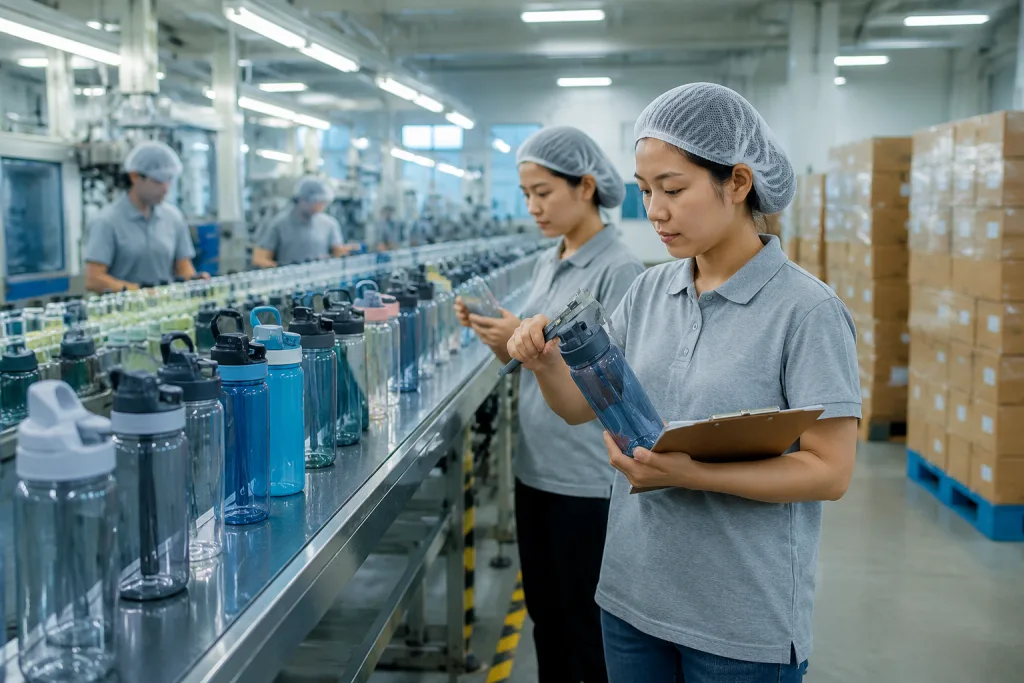
China has 200+ drinkware sellers calling themselves canteen suppliers, but a good share are trading desks. For stable delivery, ask for press count, mold maintenance schedule, assembly line count, and monthly output in finished units. A serious canteen factory in Zhejiang may run 600,000 to 900,000 units per month across multiple lines, with 18 injection machines, 2 ultrasonic welding stations, and a packing team that checks carton drop marks before sealing. We run this check with buyers all the time. If a vendor cannot state capacity in units per month, or only says “no problem,” they probably do not control production.
Look at the order profile too. A canteen distributor buying 20,000 pcs per month needs replenishment planning, spare lid stock, and color repeatability; a brand owner placing a 3,000 pcs launch order needs lower MOQ discipline and faster artwork approval. Ask whether the factory can handle custom canteen tooling, Pantone color matching on Tritan Renew resin, and 3% spare lids packed by SKU. Last month QC pulled a sample because the lid thread was 0.35 mm tight after cooling, and that is the kind of detail a catalog seller misses. If they only do standard blanks, your “customizable canteen” is just a logo job.
The same check applies to canteen manufacturers and canteen vendors claiming broad category coverage. If they say they can do a canteen promotional run, a custom canteen retail line with retail-ready barcode stickers, and a customized canteen with mixed straps, lids, and gift boxes, ask for case photos, mold trial records, and packing specs from a shipped PO. Real factories in China will show you molded parts on the line, print samples with adhesion test tape marks, and carton specs such as 48.5 × 33 × 42 cm. Average ones show you a showroom and a promise. The math does not work if they claim everything but cannot show one production record.

Choose Decoration That Survives
Decoration is where 6 out of 10 solid bottle projects turn into weak SKUs. Tritan Renew shows print defects fast because the body is clear; a 0.3 mm logo shift or one dust dot under UV ink is easy to spot on the QC table. For simple branding, we still run silk screen because the cost works and the line is stable. For fine logos, serial codes, or metallic effects, laser engraving on compatible caps or stainless trim gives cleaner edges. If you are building a distributor drinkware program for 3 retailers, the decoration has to pass washing, carton rub, and basic warehouse handling.
Do not overbuild the first run. A canteen manufacturer can offer wrap print, single-color print, heat transfer, or body-plus-lid marking, but each extra process adds scrap at the jig, drying rack, or packing bench. We had one buyer ask for 4 logo positions on a 3,000 pcs canteen custom order; the math did not work after the second trial run. I would rather ship one durable logo in the right place than three branding marks that start peeling after 20 dishwasher cycles.
If you are selling a customized growler or custom growler for outdoor or beverage channels, check lid torque and seal fit after decoration. Heavy ink near the neck can change fit when cure time is loose; QC pulled one sample at 1.8 N·m torque where the cap felt tight but still leaked on the 45-degree shake test. Ask for pre-production samples, not renderings. A canteen supplier that accepts that request usually knows export work.
Price Is Only Half The Story
For Tritan Renew, pricing comes from resin grade, mold structure, lid count, print area, and carton spec. A plain custom drinkware bottle can land around USD 2.10 to 3.80 FOB for mid-volume orders, while a canteen customized set with a flip lid, silicone straw, and gift box can sit 18% to 35% higher. The gap is not just material. On the line, QC pulled 47 scratched bodies from a 3,200 pcs trial because the transfer jig was set 1.5 mm too low; that cost shows up somewhere.
MOQ matters more than most buyers admit. We run 3,000 pcs per SKU for standard colors, 5,000 pcs for special Pantone matching, and 1,000 pcs for reorders if the mold is already proven. Lead time is often 25 to 35 days after sample approval, plus 7 to 10 days for sea freight depending on destination. If a canteen vendor promises 10 days for a new mold and full print run, the math doesn't work. Last month a buyer flagged this exact promise on a PO, and the factory had not even cut the T1 mold insert.
Think in channel economics. A canteen distributor wants cash conversion they can forecast; a canteen promotional buyer wants speed with fewer complaint tickets. A canteen manufacturer with tight process control can support both, but the same price structure will not fit a 1,200 pcs test order and a 40,000-unit annual program. That is normal. In Zhejiang, a serious factory will say it plainly, often with the packing table open and the carton CBM circled in red pen.

Build A Shortlist That Holds Up
Once the quote sheet arrives, score each supplier on four points: compliance documents with real test report numbers, factory control over molding and assembly, decoration results after 3M tape and dishwasher checks, plus reply speed. If a tritan renew drinkware supplier cannot answer within 24 hours on resin origin, mold ownership, and packaging spec, they will drag their feet when a shipment issue appears. We see it on the line. Last month QC pulled a 750 ml sample where the lid gasket was 0.4 mm short, and the slow supplier needed 3 days just to confirm the silicone spec.
Request these items before you narrow the field: factory profile, BSCI or similar social compliance if your channel needs it, REACH or food-contact declarations, sample photos, packing photos, and a production timeline with mold, printing, packing, and final inspection dates. For a canteen distributor or distributor canteen program, ask for carton drop-test standards and barcode placement too. For Amazon or retail, you may also need FNSKU labeling and case pack details. Ask for one packed carton photo with the shipping mark visible. It sounds small, but we once caught a PO typo on a 48 pcs carton label before 312 cartons left Hangzhou.
My practical rule: choose the supplier that gives the clearest answer, not the lowest headline number. The lowest quote often hides a weak carton, a thinner straw, or a 12-day promise that becomes 18 days after artwork approval. A solid canteen factory in China will tell you what is fixed, what is negotiable, and what will delay the job. That honesty is worth money. It helps you scale from one canteen customized launch into a repeat canteen manufacturers partnership without rebuilding the program every season.
Get a supplier quote that stands up
Send your target size, artwork, and monthly volume. You will get a clear OEM plan, MOQ, and lead time from a Zhejiang factory team.
Frequently asked questions
What is the usual MOQ for Tritan Renew bottles?
For a standard Tritan Renew program, many factories in China set MOQ around 3,000 pcs per SKU. If you need special Pantone colors, custom tooling, or mixed lids, 5,000 pcs is more common. Reorders can sometimes drop to 1,000 pcs if the mold and decoration are already validated. The right answer depends on whether you are buying a canteen custom launch or a repeat distributor canteen line.
How do I verify a supplier is a real factory?
Ask for mold photos, production line photos, and a monthly output figure. A genuine canteen factory should be able to state capacity in units per month, usually with a range like 600,000 to 900,000 units across multiple lines. Also ask for business license, export history, and sample lead times. A trading company usually struggles when you ask about machine count, assembly steps, and QC checkpoints.
What compliance documents should I request?
For Europe, request REACH-related declarations and food-contact suitability. For North America, ask for FDA food-contact references and migration test reports if available. If your retailer or marketplace requires them, also ask for ISO 9001, BSCI, and an AQL inspection plan. For Tritan Renew, resin traceability is important, especially if you are building custom drinkware for retail or private label.
How long does production usually take?
For an approved sample and normal order, 25 to 35 days is a realistic lead time for many canteen suppliers in Zhejiang or elsewhere in China. New molds, unusual decorations, or special accessories can add 10 to 20 days. If shipping by sea, budget another 7 to 10 days for nearby Asian lanes and longer for North America or Europe depending on port congestion.
Can one supplier handle canteen, growler, and bottle programs?
Yes, but only if the factory has separate tooling and decoration capability. A strong canteen manufacturer may also support custom growler and customizable growler lines, plus broader customizable drinkware programs. The question is not whether they say yes; it is whether they can show working samples, stable QC, and enough capacity to serve a canteen distributor without delaying the rest of your line.