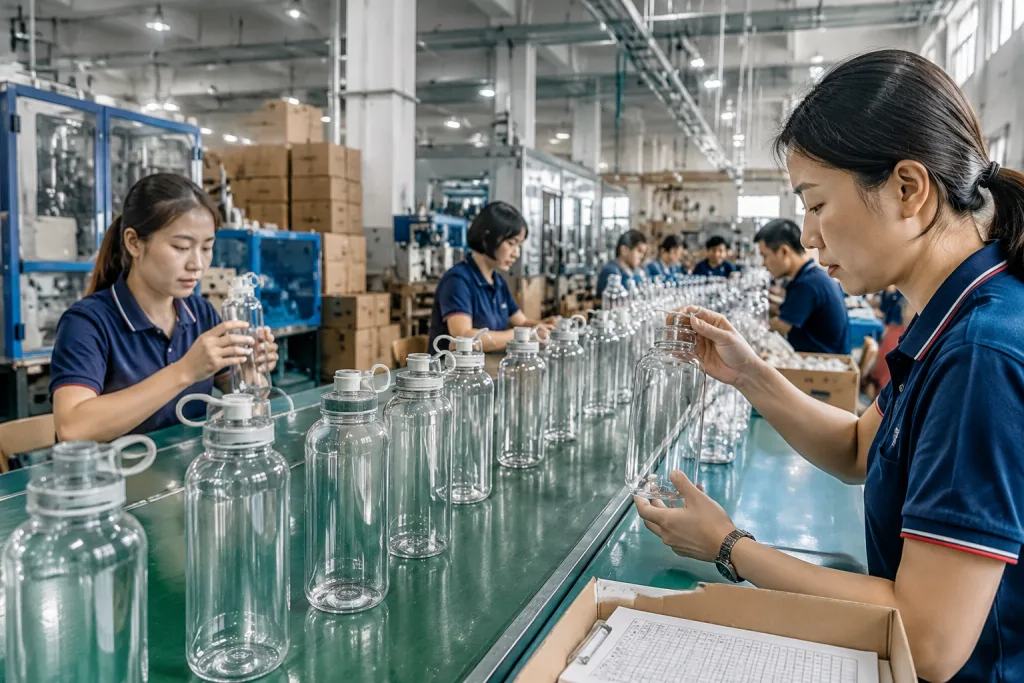
Key Takeaways
- Typical MOQ for a customized canteen is 3,000 units per color, or 5,000 units for special molded parts
- Standard sampling takes 7-12 days after artwork and Pantone color approval
- Mass production normally needs 30-45 days after deposit, pre-production sample, and packaging confirmation
- Use AQL 2.5/4.0 inspection plus EU REACH, LFGB, or US FDA documentation before shipment
Buying from a tritan renew drinkware manufacturer is a different job than picking standard plastic bottles from a catalog. You are asking the factory to hold recycled-content resin, ΔE color drift, cap torque, print adhesion, and export documents in one run. Miss one item and the math doesn't work: a 30,000 pcs launch can slip from 12 days to 18 days because QC pulled the sample after a 0.35 mm cap mismatch.
We manufacture custom drinkware in Hangzhou, Zhejiang, and we hear the same 3 questions from Europe and North America: will Tritan Renew pass my market checks, what MOQ can the line run without wasting resin, and how do I judge a canteen supplier in China before sending a deposit? Fair questions. Last month one buyer flagged “Tritan New” typed on a PO instead of Tritan Renew, and that small wording issue held artwork approval for 2 days. Here is the practical version.
What Are You Really Buying?
Searching for a tritan renew drinkware manufacturer does not mean you are just buying a molded bottle body. You are buying repeatability. The resin, cap fit, thread tolerance, gasket compression, and packing method all have to hold across 10,000 or 50,000 units, not just one good sample on a sales desk. Tritan Renew is a copolyester made with certified recycled content through molecular recycling, so it gives brand teams a cleaner sustainability claim than virgin plastic while keeping the features buyers ask us about every week: clear appearance, low odor, impact strength, and dishwasher tolerance on the right construction. QC pulled one 750 ml sample last month with a 0.35 mm ovality shift at the mouth; the cap still closed, but the leak test failed after 3 minutes. That is the part buyers do not see in a rendering.
For a procurement manager, the first question is blunt: which exact parts are Tritan Renew? This is the wrong question to ask only at final sample stage. Some canteen manufacturers use recycled-content material for the main body only. Caps may be PP, silicone, stainless steel, or another resin. Straws and seals may carry separate compliance files, and handles or sleeves often come from a different subcontracted line. Ask your canteen vendor for a component-level bill of materials, not a loose "eco bottle" claim. We run BOM checks against the PO because one buyer once approved “TR body + PP lid” in email, then their PO typo said “TR lid”; that mismatch delayed artwork approval by 4 days.
At our Zhejiang factory, we normally quote Tritan Renew bodies from 550 ml to 1,200 ml, with wall thickness around 1.6-2.2 mm depending on shape. A lightweight fitness bottle can work at 1.6 mm if the shoulder radius is friendly and the mold cooling is stable. A hiking-style custom canteen with a wide shoulder and carry handle usually needs more resin at the base and thread area, often closer to 2.1 mm after the first T1 mold trial. The math does not work if the product ships through e-commerce and the buyer is chasing USD 0.06 per unit in resin savings. We have seen this go sideways: 6 cartons dropped at 76 cm, 2 cracked bases, and the buyer flagged it before AQL 2.5 inspection even started.
Do not approve a canteen customized only from a rendering. Ask for filled-weight handling, cap leakage testing, and carton drop testing before mass production.
Material Claims Need Paper
Buyers like Tritan Renew because the recycled-content story is simple enough for a shelf tag. Retailers and importers still ask for paper. We see this every week. A canteen manufacturer should send a resin declaration, current food-contact test reports, and recycled-content support from the material supplier, not a screenshot from a brochure. For European buyers, you may need EU 10/2011, REACH SVHC screening, LFGB for Germany, and packaging compliance if the order goes into a chain with its own vendor manual. For the United States, FDA food-contact suitability and California Proposition 65 review may be requested. Last month QC pulled the sample file for a 650 ml bottle and found the resin lot number missing on page 2; that one detail delayed the quote by 3 days.
Here is the checklist we run before quoting a customized drinkware project:
- Market: EU, UK, US, Canada, or mixed shipment, because one PO can split 40% EU and 60% US cartons.
- Contact parts: body, lid, straw, gasket, infuser, tea filter, or stainless base; we mark each part on the BOM before testing.
- Use condition: cold water only, hot-fill, dishwasher top rack, freezer, or carbonated drinks, with the temperature written in °C on the spec sheet.
- Decoration: silkscreen, heat transfer, UV print, sleeve, or laser on metal accessory; ink brand and curing time matter here.
- Retail channel: promotional giveaway, retail shelf, Amazon FBA, club store, or corporate program, since carton drop tests and barcode checks are not the same.
The answer changes the test plan. A canteen promotional order for a 2-week corporate event does not carry the same risk as a distributor program rolling for 18 months. We are based in Hangzhou, Zhejiang, but the compliance target is your destination market, not China. If a canteen factory says one old test report covers every color, lid, and decoration, push back. The math does not work. Color masterbatch, coating, and print ink can change migration and heavy-metal risk; we have seen a black gasket pass while the same design in red failed on the first AQL 2.5 incoming check because the supplier swapped pigment without telling the line.
MOQ, Price, And Tooling Questions
The real MOQ comes down to mold status. If we run an existing body and cap, 3,000 pieces per color is workable for a custom canteen with logo printing. For translucent custom colors, we push buyers to 5,000 pieces because the dehumidifying dryer, Pantone resin match, and first-shot purge usually eat 35-60 kg of material before the color settles. New tooling changes the math. A simple lid mold usually starts around USD 3,000-8,000, while a full bottle set with multiple cavities can exceed USD 15,000; last quarter QC pulled a T1 sample where the cap thread was off by 0.18 mm, so we had to cut steel again before quoting mass production.
FOB Ningbo or FOB Shanghai pricing for Tritan Renew drinkware sits above standard plastic because certified recycled-content resin costs more and scrap cannot be mixed back casually. A 750 ml canteen customizable with one-color print and PP flip lid may sit around USD 2.20-3.40 FOB at 5,000 units, depending on lid complexity and packaging. A larger custom growler or customizable growler with handle, silicone boot, and retail box can move to USD 4.80-7.50 FOB. We’ve seen this go sideways when a buyer compares our 680 g packed weight quote against another supplier using a thinner 560 g carton pack; the math doesn’t work once the line starts packing drop-test cartons.
Do not compare quotes only by unit price. This is the wrong question to ask if Amazon prep, retail display, or inspection is part of the order. On one PO, the buyer typed “color box” in the email but “kraft box” on the signed PI, and QC flagged it only after the golden sample was sealed. Ask whether the price includes:
- Pre-production sample with your logo, Pantone color, and signed golden sample tag.
- Individual polybag, kraft box, color box, or PDQ display, with material thickness confirmed before printing plates are made.
- Inner carton and export master carton with 5-ply board, including carton size and gross weight.
- Third-party inspection support under AQL 2.5/4.0, with defect photos taken at the packing table.
- FNSKU labels, carton labels, and pallet labels for e-commerce shipment, checked by scanner before loading.
Our current monthly drinkware capacity is about 450,000 units across plastic, stainless, and glass lines in Zhejiang, China. It sounds big. It is not unlimited. Production slots close fast before March retail launches and September holiday programs, especially when 4 injection machines are already booked for repeat Tritan Renew orders. Reserve capacity after sample approval, not after your marketing team finishes the final brochure; we ship on confirmed artwork, approved sample, and deposit, not on a nice launch calendar.

Customization That Does Not Fail
Customization is where 6 out of 10 drinkware projects lose margin. A logo on a flat stainless tumbler is easy; we run that job on the semi-auto screen table before lunch. A logo on a curved Tritan Renew canteen with ribs, texture, and a 14 mm shoulder taper needs tighter artwork control. If you are buying customizable drinkware for retail, the decoration has to survive shelf handling, dishwasher tests, and 5-layer export carton rub. If you are buying canteen promotional stock, a simpler print may pass, but the logo still needs to land within ±1.5 mm every time. Crooked prints get flagged fast.
For a canteen custom program, the main choices are silkscreen printing, pad printing, UV printing, heat transfer, in-mold color, and accessory customization such as lid color or silicone strap molding. Silkscreen works for 1–3 spot colors on a smooth window; our line usually keeps this area under 70 x 90 mm on ribbed Tritan Renew bodies. Pad printing handles smaller curved panels, but a 55 mm round logo can stretch at the edge. UV print gives full-color graphics, but adhesion must be tested on the actual resin and coating with a cross-cut tape test, not just a desktop sample. Heat transfer can look premium. The math does not work on 1,000 pcs if the film setup is built for 5,000 pcs.
A practical artwork checklist:
- Send vector AI, EPS, or PDF files, not only PNG mockups; one buyer once sent a 600 px logo and asked for a 95 mm print.
- Specify Pantone Solid Coated colors and acceptable Delta E tolerance, such as Delta E ≤ 2.0 for retail shelf matching.
- Confirm print size in millimeters, not "large logo" or "front center"; we need numbers like 42 x 28 mm.
- Mark the seam line, handle direction, and drinking spout orientation so the jig can be set before pre-production.
- Approve one physical gold sample before releasing mass printing; QC pulled the sample if the PO name or logo file code does not match.
Customized growler and distributor growler orders need extra attention because larger surfaces show color banding and flow marks faster under a light box. On translucent bodies, some color shift is normal between resin lots; we have seen a clear smoke body move from L* 62 to L* 58 after a new batch of pellets. A good canteen supplier should say this before you promise exact shade matching to a retailer. We ask buyers to set a control sample and keep three signed pieces: one at the factory, one with the buyer, and one with QC. Small habit. It saves 12 days of email arguing versus 18 days of re-sampling after the buyer flagged "color not same" with no reference sample.
Quality Checks Before You Pay
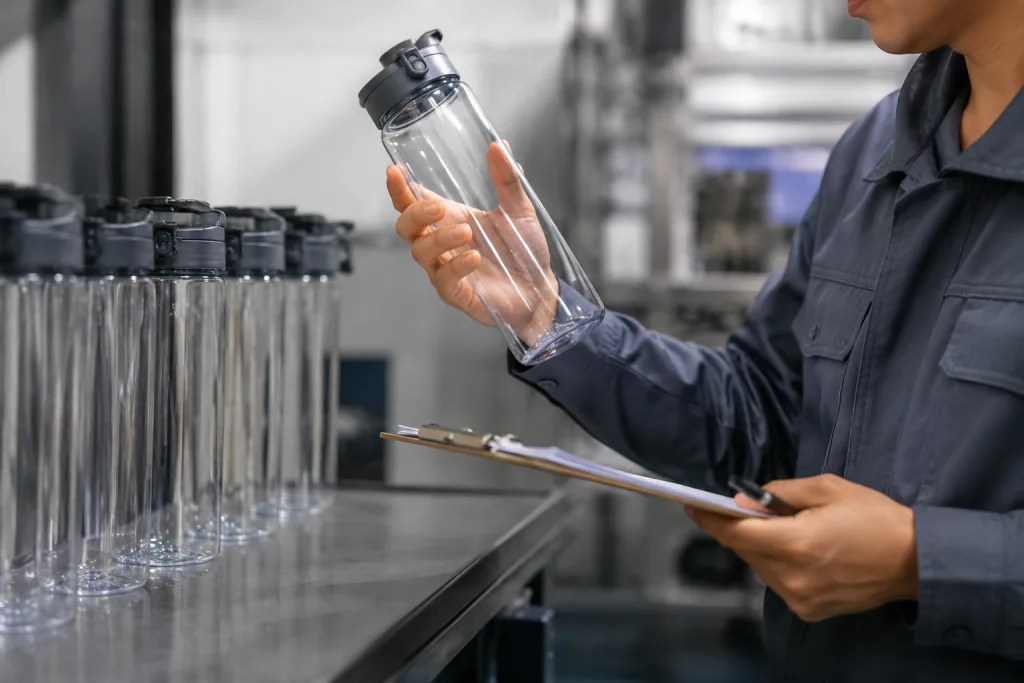
A canteen vendor can hand over clean showroom samples and still ship bulk goods that fail on the line. We see it often: sample room runs 30 pieces slowly, then mass production runs 3,000-5,000 pieces per shift on a rotary welding station. Different story. Your QC plan needs to hit the defects users complain about first: leaking caps, sharp mouth threads, weak logo adhesion, body scratches, ΔE color drift, plastic odor, and cartons crushed after 6 handlings. QC pulled one Tritan Renew bottle last month with a 0.4 mm burr on the drinking lip. Small defect. Big complaint.
For Tritan Renew drinkware, we run these factory checks before shipment:
- Leakage: 100% water leak test for flip lids, straw lids, and screw caps, with bottles inverted for 30 minutes after the lid jig is tightened.
- Drop test: filled bottle dropped from 90-100 cm on base, side, and cap, depending on product claim; the buyer should confirm whether “drop resistant” means desk height or outdoor use.
- Torque: cap open and close torque checked against approved sample, normally with a digital torque meter so the line does not over-tighten soft silicone seals.
- Print adhesion: 3M tape test and alcohol rub test for decorated areas; we reject prints that lift at the logo edge after 10 rubs.
- Appearance: AQL 2.5 for major defects and AQL 4.0 for minor defects, with scratches checked under 600-800 lux inspection lights.
- Packaging: ISTA-style carton drop test if shipping direct to distributor warehouse or FBA, especially for 12 kg master cartons with printed retail boxes inside.
If you use third-party inspection, book it when production is at least 80% finished and 100% packed. Inspecting at 40% is the wrong question to ask; the cartons are not sealed, mixed-lot risk is still open, and the math does not protect you. For distributor canteen programs, request inline inspection after the first 500-1,000 pieces. That catches cap fit or logo position problems before 20,000 pieces are printed. We once stopped a run after the buyer flagged a PO typo: logo position listed as 18 mm from the base instead of 28 mm.
Our factory QC team in China keeps inspection records by order number, material batch, and carton range. Ask any canteen supplier for the same traceability. If they cannot trace a defect back to a resin lot, injection machine number, or night-shift record, they will repeat the same defect on your reorder. We ship reorders every month, and we have seen this go sideways when a supplier only writes “passed” on a paper checklist.
Choosing The Right Supplier
The cheapest canteen manufacturer is the wrong question to ask. You need a Tritan Renew drinkware factory that answers export emails clearly, keeps compliance files ready, and can repeat the same color after the first PO ships. The difference shows up fast: a retailer asks for a new warning label, your forwarder needs pallet dimensions by 3 p.m., or your sales team adds 2,000 units in a second color after the first lab dip is approved. We run into this on the line when a lid insert changes by 0.3 mm and the old carton knife line no longer fits. A trading-only canteen vendor works for basic stock goods; customized canteen work needs factory control.
Use this buyer checklist before selecting canteen vendors. Our merchandiser keeps the same list beside the Pantone book because one missed FNSKU sticker can hold 38 cartons at final inspection:
- Can they show BSCI, ISO 9001, or equivalent audit records without sending expired PDF files?
- Can they separate material cost, molding charge, logo setup, inner box, master carton, and packing labor in the quote?
- Do they provide realistic lead time, such as 7-12 days for samples and 30-45 days for production?
- Can they support FOB, CIF, DDP discussion, plus export carton marking with gross weight, net weight, and carton size in cm?
- Do they understand retailer documents, FNSKU labeling, mixed-SKU packing, and the headache of a PO typo in the barcode field?
- Can they explain why a design is risky instead of accepting every request, such as a thin handle wall under 1.8 mm?
For canteen distributors and brand owners, the best supplier relationship is boring: stable samples, signed drawings, locked specifications, predictable inspection, and no surprise material swaps. Boring ships. If you are comparing canteen manufacturers in China, ask for a short engineering call, not just a price sheet. QC pulled the sample last month because the silicone gasket measured 48 Shore A instead of the approved 55 Shore A, and that one detail mattered more than 20 polished catalog pages. A 10-minute talk about thread design, gasket hardness, and dishwasher claims will tell you who actually controls the product.
We prefer to quote fewer projects with cleaner specifications because the math does not work when every buyer request is left open. Send the target capacity, market, logo method, annual forecast, and packaging requirement. If the MOQ is 3,000 pcs per color and the buyer wants four translucent colors with different sleeve artwork, we will say it early. A good canteen supplier comes back with workable choices, clear risk points, and a price range your team can use for planning.
Send your Tritan Renew canteen brief today
Share capacity, quantity, market, logo, and packaging needs. We will return a practical FOB quote with MOQ, lead time, and risks.
Frequently asked questions
Is Tritan Renew suitable for a premium custom drinkware line?
Yes, if your product is positioned around clear appearance, impact resistance, and a better recycled-content story than standard plastic. Tritan Renew works well for sports bottles, hydration canteens, kids bottles, and some custom growler concepts for cold beverages. The key is defining the use conditions. We do not recommend vague claims like boiling-water safe unless the exact structure has been tested. For premium retail, request material declaration, food-contact test reports, dishwasher guidance, and artwork durability testing. A 750 ml customized canteen with a flip lid, silicone seal, and one-color logo usually needs 3,000-5,000 units per color to run efficiently.
What information should I send before asking for a quote?
Send capacity in ml or oz, target market, estimated order quantity, logo artwork, Pantone colors, packaging type, and required compliance standard. If you have a target FOB price, share it. It saves time. For example, a buyer asking for a 1,000 ml canteen customized for the EU market with kraft box packaging, LFGB testing, and 10,000 units will get a much more accurate quote than a buyer asking for an "eco bottle price". If you are a canteen distributor, include your annual forecast and expected reorder pattern. A supplier can then recommend existing molds, color strategy, and production slots more honestly.
Can you make a completely new custom canteen shape?
Yes, but the cost and timeline are different from logo customization. A new body mold, lid mold, and handle mold can take 35-60 days for tooling, first samples, modification, and re-sampling. Tooling cost may range from USD 8,000 to USD 25,000 depending on cavities, cap mechanism, and surface finish. For a new shape, we usually suggest a 2D drawing first, then 3D design, then prototype review before steel tooling. MOQ is normally 10,000 units or higher because the factory must recover setup time and stabilize the molding process.
How do I compare two canteen suppliers in China?
Do not compare only the first unit price. Ask both suppliers for the material grade, wall thickness, lid material, gasket material, packaging specification, test standard, MOQ, sample fee, lead time, payment terms, and inspection plan. One quote may include a 5-ply export carton and AQL inspection support; another may include only loose bulk packing. Also ask where the factory is located and whether production is in-house or outsourced. A Zhejiang canteen factory with molding, assembly, and QC under one roof usually gives better control than a supplier who cannot show production records.
What lead time should I plan for a distributor drinkware launch?
For an existing mold, plan 7-12 days for decorated samples, 3-5 days for buyer approval, 30-45 days for mass production, and 2-6 weeks for ocean freight depending on destination. That means a safe launch calendar is often 75-110 days from artwork confirmation to warehouse arrival. If you need retail packaging, third-party testing, or mixed-color packing, add 7-14 days. For a distributor growler or custom drinkware program with new tooling, add another 45-60 days before mass production. Rushing is possible sometimes, but rush orders usually reduce your room for quality corrections.