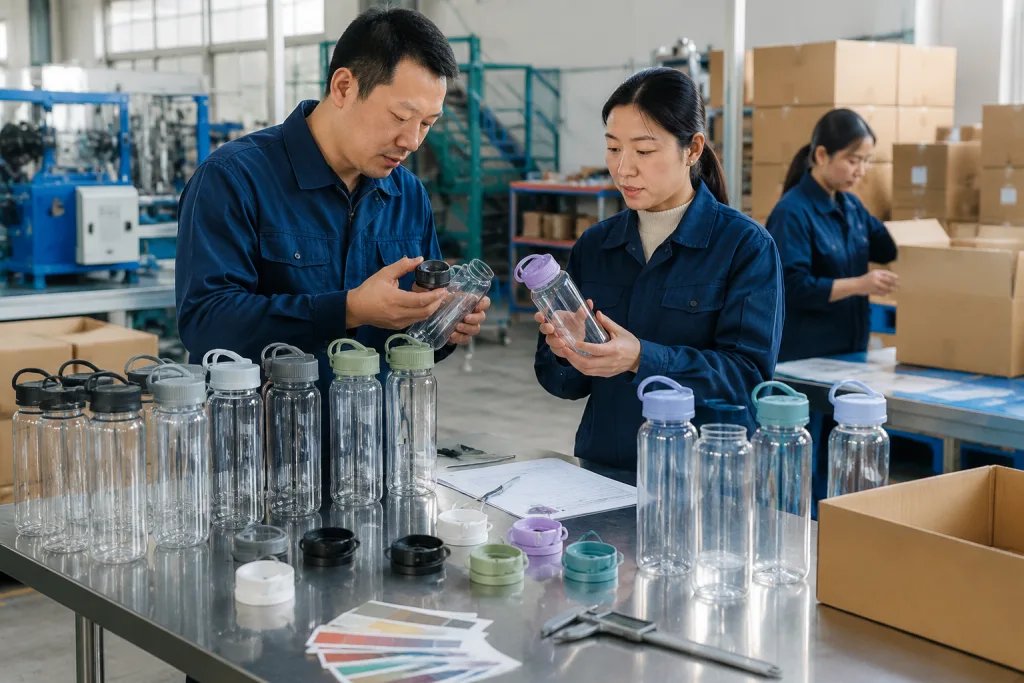
Key Takeaways
- Set RFQ specs with capacity tolerance, resin claim, logo area, cap material, carton pack, and target FOB price before asking for 3,000 units
- Tritan Renew claims need supplier documentation, not just a recycled-looking color card or marketing sentence
- For custom canteen orders, expect 25-35 days for bulk production after sample and deposit approval
- Use AQL 2.5/4.0 inspection, retained golden samples, and PO line items to control defects before shipment
A Tritan Renew order looks simple until the RFQ turns into 14 half-answered emails: resin grade, recycled-content wording, cap material, logo method, carton marks, test standard, and who pays when the first sample comes back wrong. If you buy custom drinkware for Europe or North America, these details decide whether a launch ships in 32 days or sits in the forwarder’s warehouse because the LFGB file is missing. We’ve seen this go sideways. QC pulled one 500 ml sample last month with the logo 3 mm off-center, and the buyer flagged it before we even packed the counter sample.
As a Zhejiang drinkware exporter, we see this pattern in about 7 out of 10 new inquiries. Buyers ask for a canteen customized for retail, promotion, or distributor drinkware programs, but the first PO only says “500 ml bottle with logo.” That PO is not a spec. The line needs resin code, lid drawing, color chip, print position in mm, MOQ, packing method, and the exact test standard before we run the pre-production sample. A serious China factory needs a tight path from RFQ to sample sign-off to AQL 2.5 bulk inspection, or the math doesn’t work.
Start With A Usable RFQ
Your RFQ should not read like a product sketch. It should read like a buying instruction the line can cost without guessing. For a Tritan Renew drinkware factory, the first workable RFQ gives capacity, bottle weight target, lid structure, resin requirement, color count, print method, packing, compliance market, and delivery term. Send only a photo with “best price” and the math goes bad fast. Last month QC pulled a 650 ml sample that came in at 612 ml because the buyer never stated fill volume or brimful volume.
For BottleForge Industrial in Hangzhou, Zhejiang, a clean RFQ for a canteen custom project usually includes: 500 ml or 750 ml capacity, +/-5% capacity tolerance, 1.8-2.2 mm body wall target, screw cap or flip cap, silicone seal color, one-color silkscreen or laser-marked stainless accessory, retail box or bulk carton, and whether you need REACH, LFGB, FDA, or California Proposition 65 support. We also ask North American buyers where the bottle will sell: Amazon FBA, club retail, school promotion, or distributor canteen program. Different channels change the carton. For FBA, we run the carton through a 76 cm drop-test check before mass packing, not after the buyer flags crushed retail boxes.
Put the commercial target in the RFQ too. If your landed price requires FOB Ningbo at USD 2.20, say it. Then a canteen supplier can quote a simpler lid, cut one print position, or switch to bulk carton packing instead of pretending a premium build fits. For a standard custom canteen, our practical MOQ is 3,000 units per color for regular molds, with trial orders sometimes starting at 1,000 units when decoration is simple and material is in stock. We’ve seen this go sideways when a PO says “black lid” but the approved sample used Pantone Black 6C; that one typo delayed seal matching by 4 days.
Suggested RFQ line items:
- Item: 650 ml Tritan Renew sports canteen, clear smoke body, black screw lid, target body weight 92-105 g.
- Decoration: 1-color silkscreen, 70 x 45 mm, front center, artwork supplied as AI or PDF vector file.
- Packaging: 1 pc/polybag, 48 pcs/export carton, carton drop-test suitable, max carton weight under 15 kg.
- Market: EU retail, REACH and LFGB documentation required, buyer to confirm language layout for retail box.
- Incoterm: FOB Ningbo, target lead time 30 days after deposit, based on approved PP sample and artwork.
Check Material Claims Before Sampling
Tritan Renew is not just “eco plastic.” It is a copolyester resin with certified recycled content allocated through mass balance. That detail matters because buyers want sustainable drinkware copy on hangtags, websites, and retailer sell sheets, then QC gets asked to back it up at pre-shipment. We had one PO last April where the buyer wrote “50% recycled plastic” in the artwork file, but the resin COA only supported Tritan Renew by mass-balance allocation. Wrong claim. Do not print recycled-content wording on packaging unless the canteen manufacturer can provide resin-related documents.
Ask your canteen vendor for the resin grade, food-contact suitability, recycled-content support, and lot-by-lot purchase records. In China, we see about 30 factories mold clear copolyester bottles in Zhejiang and Guangdong, but maybe 8 keep the paperwork clean enough for distributor drinkware programs in Europe and North America. The chain should match resin supplier invoice, factory production batch, and finished goods shipment. Simple file check. On our line, QC pulled the sample carton label and matched it against the injection batch card before sealing the master carton.
At RFQ stage, split the documents into three buckets with names, dates, and test scope. Food-contact documents show the material is suitable for drinkware. Recycled-content documentation supports the marketing claim. Finished-product tests check migration, odor, colorfastness, print adhesion, and lid leakage on your actual customized drinkware, not a bottle from last year’s mold. We run 3M tape on the logo after printing and a 24-hour inverted leak check at room temperature. One generic PDF for all of this is the wrong answer.
PO wording should be direct. For example: “Body material: Tritan Renew copolyester, clear, BPA-free, food-contact grade. Supplier to provide resin documentation and finished-product test report suitable for EU market before balance payment.” If your project is a customized growler or custom growler with a larger 1.5 L or 2 L body, add drop and handle-strength expectations because larger capacity changes stress points. We usually call out 1.2 m drop test and handle pull load in kg on the spec sheet, otherwise the buyer flags it only after the sample cracks near the neck. A canteen supplier arguing against documents at this stage is saving its own time, not protecting your order.
Lock The Sample Like A Contract
The sample is not a desk trophy. It is the physical contract between you and the tritan renew drinkware factory. Once you approve it, the line will copy it unless your PO gives a different written spec. Check it like QC does: weight on a 0.1 g scale, rated capacity with a measuring cylinder, lid fit, gasket material, logo position in mm from the base, color, surface finish, packaging, and barcode or FNSKU placement if needed. Slow down here. We have had a buyer approve a nice-looking PP sample, then flag the bulk because the logo sat 4 mm higher than the sell sheet.
For a canteen customizable project, we run sampling in two steps. The first is a blank structure sample from an existing mold, used to check hand feel, cap function, leakage, and bottle clarity. The second is a decorated pre-production sample with your logo, target color, and retail box. A simple logo sample takes about 5-7 days after artwork confirmation. A new mold or special lid can add 15-25 days before first sample, especially if the cap includes a carry loop, push button, or multi-part silicone seal. The buyer often asks, “Can we skip the blank sample?” For a stock lid, maybe. For a new cap with a 1.8 mm silicone seal groove, the math doesn't work.
Keep the approved sample and require the factory to keep one identical retained sample. We label ours with the PO number, date, PMS color, and a signed QC sticker, then lock it in the sample room. Write this into the PO: “Approved PP sample dated 2026-03-05 is the golden sample for bulk production. Any change in resin, colorant, cap structure, silicone gasket, logo size, or packaging requires buyer written approval.” That sentence stops a common mess: a canteen manufacturer swaps a small component to relieve production pressure, then the bulk product no longer matches your sell sheet. We've seen this go sideways over a gasket that looked the same but failed the leak test.
Sample checking should be boring and measured. Fill the bottle to rated capacity, invert it for 30 minutes, shake it 20 times, check odor after warm water exposure, rub the print with 3M tape or alcohol if specified, and compare color under neutral light. QC pulled one sample last month because the barcode was 6 mm too close to the box seam, even though the bottle itself passed. If your customer is a canteen distributor or retail chain, photograph every sample decision and store it with the PO. Disputes come later. Memory is useless; dated sample records save the order.

Build A Real PO
A usable PO does more than show item name, quantity, and price. It should close the gaps that turn into chargebacks, debit notes, or a 9 p.m. argument before loading. For customized canteen orders, spell out the product spec, approved artwork file name, Pantone code, packaging layout, test requirement, AQL 2.5 inspection standard, payment term, shipment window, and spare parts policy. Small details matter. Last March, QC pulled a PP sample because the PO said “blue lid” while the signed sample card showed Pantone 2925C; that 1-line miss cost 4 days on the line. If a canteen vendor cannot work from that level of detail, they are not ready for distributor orders.
Here is a PO structure we run for a 3,000-unit custom drinkware order from China: item code, product description, capacity, material, color, decoration, unit price, total price, packaging, carton size target, gross weight target, compliance documents, inspection method, shipment port, and latest delivery date. Put the numbers in writing. For example, “3,000 pcs, 750 ml Tritan Renew customized canteen, transparent blue body, white flip lid, 1-color logo, FOB Ningbo USD 2.65/pc, bulk packed 48 pcs/ctn, production lead time 30 days after deposit and PP sample approval.” We also like to see a carton target such as 56 × 38 × 42 cm and gross weight under 13.5 kg, because the buyer flagged oversize cartons on 2 past LCL shipments.
Payment terms should match risk. For regular molds, 30% deposit and 70% before shipment after passed inspection is common. For new tooling, pay tooling before mold cutting, then approve the sample before bulk production. The math does not work if the buyer wants new mold risk carried inside a small trial order. If the order includes retailer packaging, barcodes, FNSKU labels, or mixed-carton distributor canteen assortments, list those as separate PO line items; we have seen this go sideways when a PO typo changed “label on each unit” into “label on each carton” two days before container loading.
Do not hide forecast volume. If you plan to reorder 20,000 units per quarter, say it, but do not ask for that price on a 500-unit test order. That is the wrong question to ask. Our Hangzhou team quotes differently when we can reserve Tritan Renew resin, lid colors, silk-screen fixtures, and 5-layer export cartons across repeat orders. BottleForge’s normal drinkware output is about 450,000 units/month across stainless, plastic, and glass lines, but production slots still need booking before peak season in Zhejiang and wider China export calendars; in May, the same plastic line slot can be 12 days out versus 18 days after Yiwu-side packaging plants get full.
Control Decoration And Packaging
Decoration is where a 20,000-piece bottle order can turn into a claims file. Tritan Renew bodies are clear and tough, but ink adhesion, lensing on curved walls, and logo height still need control at the pad-print bench. For canteen promotional orders, we run one- or two-color silkscreen when the buyer wants clean cost and fast setup; a 180-mesh screen and PU ink usually beat fancy artwork that misses the budget. Heat transfer gives better retail graphics, but unit cost goes up and QC needs a real scratch check with a 3M tape pull after 24 hours. Laser engraving belongs on stainless lids, badges, or metal handles, not the plastic body. Don’t spec it as the main decoration for a transparent canteen.
Send artwork as vector files with Pantone references. Small text is trouble. We reject anything below 5 pt on curved surfaces unless the buyer signs off on the risk, because one legal line can blur after the second pass on the fixture. A 70 x 45 mm logo area may look generous on a flat PDF proof, then stretch on a 650 ml cylindrical bottle when the bottle wall catches light. Ask the canteen factory to confirm printable area on the actual mold with a caliper and sample jig, not on a shared template from another SKU. If you buy customizable drinkware for several corporate clients, lock the same logo zones across SKUs; we’ve seen reorders go sideways because one PO said “front center” and the old sample sat 12 mm lower.
Packaging has its own traps. A distributor growler or customizable growler needs stronger dividers because the filled carton weight climbs fast; on our line, 5-layer K=A cartons with 3 mm EPE sleeves survive better than thin egg-crate dividers for heavy sets. A lightweight canteen promotional item can ship in bulk cartons for event giveaways, but retail shelves need a color box, hangtag, or belly band with the barcode placed where the store scanner can catch it. If you need Amazon FBA handling, specify FNSKU label size, suffocation warning on polybags where required, master carton weight below your warehouse limit, and carton marks on at least two sides. The buyer flagged this last season: one missing “Made in China” mark held 86 cartons for relabeling.
Quality requirements belong in the PO, not in a late email after production starts. Use wording such as: “Print adhesion: 3M tape test, no major peeling. Logo position tolerance: +/-2 mm. Color tolerance: approved Pantone under D65 light, Delta E target under 2.5 where applicable. Carton compression and drop test suitable for export handling.” QC pulled the sample before packing and checked logo offset with a steel ruler; that is normal work, not a special service. These are basic controls, and the math doesn’t work if packaging gets treated as an afterthought after 12,000 bottles are already printed.
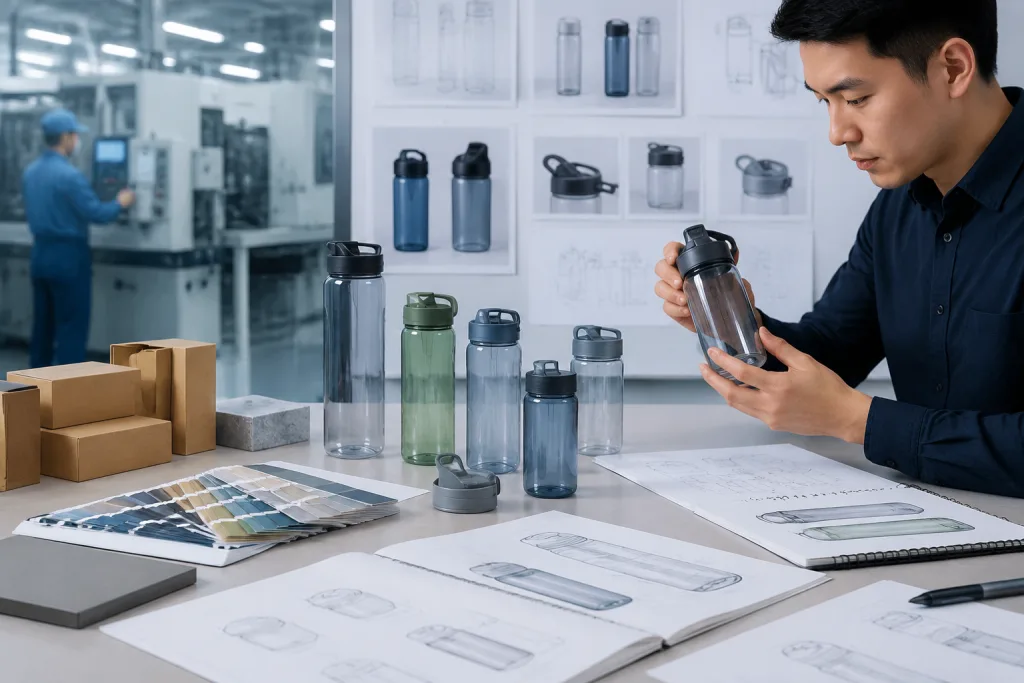
Inspect Before Balance Payment
Do not skip inspection just because the supplier sounds confident. Confidence will not catch blocked air holes, loose silicone gaskets, mixed lid shades, scratched bodies, or cartons printed with the wrong distributor name. We have seen a PO where “Tritan Renew” was typed as “Triton Renew” on the side mark, and QC pulled the sample before the cartons reached the pallet wrap machine. For bulk customized drinkware, final random inspection should happen when at least 80% of goods are packed and 100% are produced. Good timing. The inspector can open finished cartons, scan barcodes, check polybag warnings, and still leave the line enough hours to rework defects.
A practical inspection plan uses AQL 2.5 for major defects and AQL 4.0 for minor defects, unless your retailer requires stricter limits. Critical defects should be zero tolerance: unsafe sharp edges, chemical odor, severe leakage, contaminated material, wrong food-contact marking, or missing warning labels. For a 3,000-piece order, an inspector may check 200 pieces depending on the selected inspection level. We run leak tests with filled bottles inverted for 30 minutes, then lay them on kraft paper so small seepage shows fast. This is not perfect, but it beats finding the problem after customs clearance, when the math does not work and nobody wants to pay for domestic sorting.
Your inspection checklist should match the approved sample and PO line items. Check capacity by water fill in ml, weight range on a 0.1 g scale, color under a D65 light box, cap torque, gasket presence, leakage, straw length if used, logo size, barcode scan, carton count, carton marks, and drop resistance. For a custom growler or customized growler, add handle pull testing and filled-weight carrying tests; we use a 10 kg hanging load on the sample handle when the buyer asks for a retail shelf claim. For kids or school canteens, add bite-valve checks, small-part risk review, and any ASTM or CPSIA-related requirements if the product is marketed to children in the United States.
Balance payment should follow passed inspection and document review. The document pack normally includes commercial invoice, packing list, test reports if required, resin documentation, BSCI or factory audit files if requested by your buyer, and shipping booking details. The buyer flagged this once because the packing list showed 24 pcs per carton while the line packed 36 pcs per carton; the CBM changed, and the forwarder had to amend the booking before cutoff. A good canteen vendor will not be offended by this process. In China export manufacturing, clear inspection gates protect both sides because they stop emotional arguments at the loading dock.
Plan Reorders Before Launch
The cheapest sourcing mistake is also the one we see about 6 times a month: the first shipment leaves Hangzhou, then the buyer asks how to control the reorder. Too late. If your tritan renew drinkware factory will support your brand beyond one PO, open the reorder file during the first production run, not after it. We run it with the resin lot reference, final BOM, approved artwork, print screen number, carton layout, test reports, inspection result, and any deviations accepted by you. QC pulled one sample last quarter where the PO said “matte blue” but the signed sample was glossy blue; that 2-word mismatch delayed packing by 3 days.
For canteen distributors, this matters because buyers rarely repeat the same order line by line. One school buyer wants a canteen customized with a new logo and the same 650 ml body. A retail buyer asks for the same bottle in four PMS colors, 3,000 pcs per color. Another asks for a custom canteen with a different lid and a 35 mm retail band. If the factory keeps a clean BOM, those changes stay controlled on the line. If not, the math doesn't work; every reorder turns into a fresh development job with new tooling checks, new artwork proofing, and the same old mistakes.
Forecast planning hits price too. Resin, color masterbatch, caps, silicone rings, and cartons move with order timing, and carton mills do not care that your buyer meeting is next Friday. A canteen manufacturer holds pricing with less drama when you share a 90-day forecast and approve repeat artwork early. At BottleForge, repeat orders using existing molds and approved decoration files usually need 20-28 days after deposit, compared with 25-35 days for first bulk runs. During the pre-holiday China production rush, add 7-10 days rather than gambling on a last-minute slot; we have seen this go sideways when a buyer flagged a barcode after the shrink-wrap film was already on the packing table.
Put reorder assumptions into your vendor scorecard. Track on-time delivery, defect rate, document accuracy, reply time in hours, and how the supplier handles small changes such as a 1 mm logo shift or a new inner box sticker. The best canteen manufacturers are not always the cheapest on the first quote. We ship cleaner repeat orders with suppliers that keep the second, third, and fourth shipments boring. For a brand owner or canteen distributor, boring repeatability is where margin survives.
Send Your Tritan Renew RFQ For A Practical Quote
Share capacity, quantity, logo file, market, and target FOB price. We will reply with MOQ, lead time, sample plan, and PO notes.
Frequently asked questions
What MOQ should I expect from a Tritan Renew drinkware factory?
For existing molds, a realistic MOQ is usually 3,000 units per color for a custom canteen with logo printing. Some canteen suppliers in China will accept 1,000 units for a trial order if the body color is stock clear or smoke and packaging is bulk carton. New colors, custom lids, retail boxes, or a customized growler shape often push MOQ to 5,000 units because resin, color masterbatch, and setup loss become more expensive. If a factory quotes 300 units at a very low FOB price, check whether it is trading stock goods rather than true customized drinkware production.
How long does sampling and bulk production usually take?
For a regular mold, blank samples normally take 3-5 days and logo samples take 5-7 days after artwork approval. Bulk production for a first canteen customized order usually takes 25-35 days after deposit and pre-production sample approval. Repeat orders can be 20-28 days when resin, lids, artwork, and cartons are unchanged. New tooling is different: allow 25-40 days for mold development before you even approve the first sample. Zhejiang and wider China factories get especially tight before Chinese New Year, so add at least 7-10 days if your shipment falls near that period.
Can I make recycled-content claims on packaging?
Only if your supplier provides documentation that supports the claim. Tritan Renew uses recycled content allocated through mass balance, so you should ask for resin-grade information, purchase traceability, and any available certification or supplier statement tied to the material lot. A generic “BPA-free eco bottle” statement is not enough for serious retail packaging. Your finished custom drinkware should also have market-appropriate food-contact testing, such as LFGB or REACH-related checks for the EU and FDA-relevant support for the US. Keep these files with the PO, inspection report, and shipment documents.
Which logo method is best for promotional canteen orders?
For most canteen promotional projects, one-color silkscreen gives the best balance of cost, clarity, and speed. It works well for logos around 60-80 mm wide on a 500-750 ml bottle. Heat transfer is better for full-color retail graphics but increases setup cost and needs stronger scratch testing. Pad printing is useful for small curved areas, but not ideal for large branding. Laser engraving is only suitable for metal parts, such as a stainless cap plate, not the Tritan body. Put logo size tolerance, Pantone color, and adhesion test into the PO.
What should I inspect before paying the balance?
Inspect against the approved sample and PO, not against a general product photo. Check capacity, weight, bottle clarity, cap fit, gasket presence, leakage, odor, logo position, print adhesion, barcode scan, carton count, and carton marks. Use AQL 2.5 for major defects and AQL 4.0 for minor defects unless your retailer sets a stricter rule. Critical defects, including leakage, unsafe edges, contamination, or wrong food-contact labeling, should be zero tolerance. For a 3,000-piece distributor canteen order, final inspection should occur when 100% is produced and at least 80% is packed.