Key Takeaways
- A practical Tritan Renew drinkware custom MOQ starts at 3,000 pieces for stock molds and 10,000 pieces for new color runs
- FOB China pricing usually ranges from USD 1.85-4.80 per piece depending on capacity, cap, decoration, and packaging
- Lead time is commonly 25-35 days for repeat stock-mold orders and 75-100 days for new mold development
- Plan 3-5 days for artwork proofing, 7-12 days for pre-production samples, and AQL inspection before balance payment
Ask us for Tritan Renew drinkware custom pricing and the first FOB number is only a starting point. The wrong question is “what is your cheapest bottle?” Resin percentage, cap structure, carton spec, logo process, color matching, and testing can shift the FOB cost by 20-45%. Last month QC pulled a 750 ml sample because the flip cap pin sat 0.4 mm off center; that small cap change added cost before the buyer even saw the mockup. For retail, promotion, or distributor programs, these details beat a nice rendering.
We run these projects every week from our Hangzhou, Zhejiang line for Europe and North America. A simple canteen promotional order can ship in 25-35 days if the PO, artwork, and color chip arrive clean. A new mold customized growler with PCR documentation, REACH review, and retail packaging can take 75-100 days; we have seen this go sideways when the buyer flags the carton drop test after mass production. The buyer who understands the cost stack gets fewer surprises.
What You Are Actually Buying
Tritan Renew is not a premium-sounding plastic name. It is a copolyester made with certified recycled content under a mass-balance system, so you are buying two things at once: bottle performance and a claim that must survive document review. The bottle still has to pass impact, odor, dishwasher, and migration requirements. Last month QC pulled 32 samples from a 650 ml run and found 2 lids with slight gasket smell after the 70°C hot-water test. That matters. The sustainability story only works when the test reports, recycled-content certificate, and invoice wording match.
For custom drinkware, we split the buying scope into four parts: bottle body, lid system, decoration, and compliance file. A 650 ml custom canteen with a standard screw lid is not the same job as a 1,000 ml canteen with a carry loop, silicone boot, straw lid, and individual kraft box. The PDF quote can make them look close. The line feels the difference: one needs a single lid torque check with a digital torque meter, the other adds silicone fitting, straw cutting, carton drop-test risk, and more hands on the packing table.
If you are a canteen distributor or promotional buyer, push back on the word “custom.” This is the wrong question to ask unless the supplier defines the work. “Custom” can mean a one-color logo on a stock bottle, or it can mean Pantone body color, private mold, custom cap, retail barcode, FNSKU label, and ISTA carton requirement. We have seen this go sideways when a PO said “blue bottle” but the artwork file listed Pantone 2925C and the buyer flagged the shade after pre-shipment photos. A serious canteen supplier should lock the scope before quoting final FOB price.
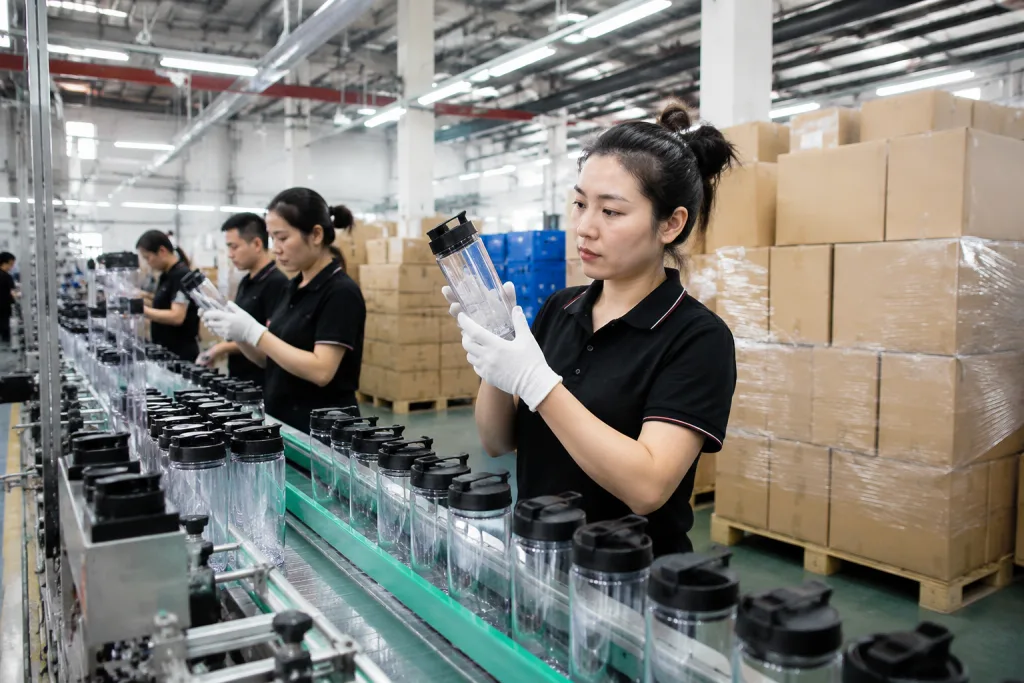
At our Zhejiang facility, stock-mold Tritan Renew bottles run at about 450,000 units/month across drinkware lines. For stock shapes, MOQ can be 3,000 pieces per SKU with logo decoration. For matched body color, expect 10,000 pieces because resin purging and color stability create real waste below that number. We run the first 8 kg of colored resin as purge on some molds before the body color settles, and the math does not work for tiny batches.
FOB Cost Drivers That Matter
Resin is not where most Tritan Renew drinkware custom quotes move. The bigger swings come from the lid set, print method, packing spec, and scrap allowance we build into the line. A plain 600-750 ml bottle in a stock clear body may quote around USD 1.85-2.60 FOB Ningbo or Shanghai. Change it to a 1,000 ml body with a straw lid, silicone grip, and 2 extra mold inserts, and the project can land at USD 3.20-4.80. QC pulled one 750 ml sample last month with a 1.8 mm body wall and a loose flip button; the buyer thought resin caused the price gap, but the cap tooling was the real driver.
Here is the cost logic we run when a buyer brief hits our desk:
- Capacity: 500-650 ml is the sweet spot for resin weight, carton count, and packing speed. A 1,200 ml custom growler or distributor growler needs more Tritan Renew resin, larger 5-layer cartons, and slower hand packing, so the math changes fast.
- Wall thickness: common Tritan bodies are around 1.5-2.2 mm. Thicker walls feel better in hand, but they add cycle time; on our injection machine, even 3-4 seconds per shot matters across 20,000 pieces.
- Lid parts: a one-piece screw cap is cheap. A straw lid with PP, silicone, pin, spring, and dust cover can add USD 0.45-1.10, and the line needs extra checks for spring tension and straw length.
- Decoration: one-color silkscreen is normally USD 0.08-0.18. Multi-color wrap print or heat transfer can add USD 0.25-0.75, especially when the buyer flags logo drift over 1 mm during pre-production approval.
- Packaging: bulk pack is cheapest. Retail color box, insert card, barcode label, and master carton drop-test spec can add USD 0.20-0.60; one PO typo on carton size can waste a full afternoon with the packing supplier.
A canteen manufacturer that quotes in 30 minutes is probably guessing. Ask whether the price includes master carton marks, polybag, spare straws, user manual, FBA carton weight control, and third-party inspection handling. These look small on one sample. On 20,000 pieces, they turn into real money, and we have seen this go sideways when a buyer compares a clean FOB quote against a bare-bones one.
MOQ Tiers And Price Movement
MOQ is not a punishment. It is the break-even line where setup scrap, color purging, mold hours, logo jigs, and printed cartons stop eating the order. On our Tritan Renew canteen line in Hangzhou, one color change can burn 18-25 kg of resin before the shot looks clean in the hopper dryer record. Low MOQ is possible, yes, but the math does not disappear. It comes back as a higher unit price, 2-3 stock colors only, or a production slot pushed 12 days instead of the normal 6 days.
For a stock-mold canteen customized with one logo, 3,000 pieces is a realistic MOQ. At that level, we run one silk-screen fixture, the buyer gets basic bulk packing or a simple white box, and QC usually checks print position with a 0.5 mm tolerance gauge. At 5,000-8,000 pieces, pricing settles down because the printing setup and assembly labor spread across enough cartons. At 10,000 pieces, Pantone body color becomes practical. At 30,000 pieces and above, resin purchasing, cap injection, and carton printing can be planned as one full production lot.
Typical FOB movement for a 750 ml customizable canteen might look like this: USD 2.95 at 3,000 pieces, USD 2.65 at 5,000 pieces, USD 2.42 at 10,000 pieces, and USD 2.28 at 30,000 pieces. Use these as planning ranges, not promises. Last March, a buyer flagged a quote because the lid had a flip lock, silicone ring, and stainless pin; the bottle body dropped 11 cents, but the lid assembly barely moved. If the lid is complicated, the curve is flatter because hardware and hand assembly do not fall as fast as bottle-body cost.
For a private-mold customized canteen, MOQ is a different conversation. Tooling may cost USD 6,000-18,000 for bottle and lid sets, depending on cavities and cap complexity. A new customized growler with handle geometry and leak-proof lid may require 60-90 days of tooling and sample adjustment before mass production; our mold shop still measures the first T1 sample with calipers before anyone talks about carton artwork. This is where we have seen projects go sideways. Canteen vendors quoting “5,000 pieces private mold” are usually modifying an existing mold, skipping part of the tooling cost, or hoping the buyer will not ask where the real economics went.
Lead Time From Brief To Ship
Lead time starts when the brief is complete, not when the first email lands in our inbox. For Tritan Renew drinkware custom work, we need capacity in ml, target FOB, lid style with straw or flip cap, body color by Pantone code, logo file in AI or PDF, packaging style, test market, and delivery term. No brief, no real schedule. Last month a buyer sent “blue bottle, urgent” and QC later pulled a sample that matched 2925C, while the PO showed 2935C; that one typo cost 4 days on the line.
For a standard Tritan Renew drinkware custom order using an existing mold, we run 3-5 days for quote confirmation and artwork proof, 7-12 days for pre-production samples, 3-5 days for sample approval, 18-28 days for mass production, and 2-3 days for final inspection and booking. That puts the real window at 35-50 days before vessel departure if artwork, deposit, and color approval come back on time. The heat-transfer jig and logo pad both need sign-off before bulk decoration starts, so “approve after production” is the wrong question to ask.
Repeat orders move faster. If the material, color, logo, and packaging spec are locked, production can finish in 25-35 days after deposit. For a canteen promotional order tied to an event date, we still add a 10-day buffer because we have seen this go sideways: 6 cartons failed a drop test, one cap supplier was short by 8,000 pcs, and a carton mark had the buyer’s SKU printed as “TR-750B” instead of “TR-750R”. Small errors eat calendar days.
New mold projects need more patience. Industrial design and DFM review take 7-14 days, usually with calipers on the lid thread, wall thickness checks around 2.2 mm, and one uncomfortable meeting about whether the handle radius can survive a 1.2 m drop test. Tooling can take 35-55 days. First T1 samples often need 7-15 days of corrections for parting line, lid fit, leakage, or shrinkage. After final sample approval, mass production still needs 25-35 days. A private customized drinkware launch from China should be planned at 75-100 days; use 120 days if retail compliance testing is heavy.
Decoration Choices And Hidden Risk
Decoration is where 7 out of 10 custom drinkware projects look fine in the PDF proof and start giving us trouble on the line. Tritan Renew has a smooth surface, but ink adhesion still depends on flame treatment, the ink system, curing time, and the shape of the print area. Flat panel? Easy. A full-wrap logo across a tapered bottle with ribs and 50 ml volume marks is the wrong place to save testing cost; QC pulled samples last month where the print broke at the rib after a 3M tape test.
For simple logos, silkscreen is still the best value. We run it for one to three colors on canteen customized orders for schools, outdoor clubs, and corporate programs, usually with a 0.15 mm screen tolerance on logo position. Laser engraving is not our first choice on Tritan bodies; it belongs more on stainless steel. Heat transfer gives sharper graphics, but we test dishwasher resistance before mass production. UV print works for short runs and detailed images, but the math does not work well on 20,000-piece orders when each bottle needs slower jig loading and extra curing time.
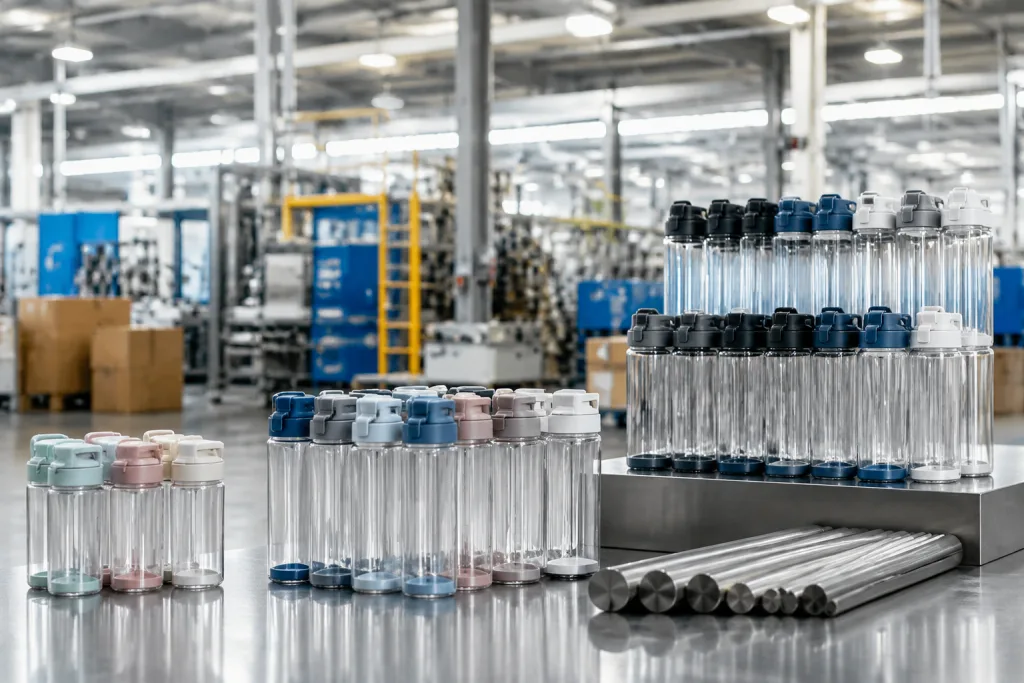
Color matching needs discipline. A Pantone number on paper will not look the same inside translucent Tritan Renew resin. We have had buyers flag “same Pantone, different bottle” even when the spectro reading was within Delta E 1.5 on the color chip. If you need an opaque look, the resin formula changes, light transmission changes, and recycled-content appearance may vary slightly between lots. A solid canteen supplier sends color chips or bottle samples, not only a digital proof.
For North America, decoration should be checked against applicable food-contact and heavy-metal limits. For Europe, we usually discuss REACH, LFGB or EU food-contact requirements depending on the market. If your custom canteen is for children, ASTM F963, CPSIA, small parts, and labeling rules may come into play. These tests cost money, usually USD 250-1,200 depending on scope, but failed goods cost more; we have seen one PO typo on “children’s bottle” turn into a retest request after cartons were already marked.

Quality Control Before Balance Payment
A serious canteen vendor should welcome inspection. If they push back on AQL, carton drop checks, or leak testing, we treat it as a red flag. Tritan Renew bottles are simpler than electronics, but bad parts show up fast on the shelf: lids seep at the thread, bodies pick up rub marks, rims go oval by 0.6 mm, colors drift between cavities, and packing dust gets trapped inside the bag. QC pulled one 750 ml sample last season where the cap passed by hand, then leaked after 18 minutes upside down.
For most distributor canteen orders, we run final random inspection under ANSI/ASQ Z1.4 with AQL 2.5 for major defects and 4.0 for minor defects. Critical defects stay at zero. The checklist should cover filled capacity by scale, lid torque with a torque meter, upside-down leakage for 30 minutes, print rub test with 3M tape, barcode scan on 20 cartons, carton count, carton dimensions, and gross weight. If the order goes into Amazon FBA or a retail DC, carton labels and FNSKU placement need the same attention as the bottle. We have seen a clean product lot held because the PO said white label, but the packing line used yellow thermal stock.
During production, we do first-piece approval at injection, decoration first-article approval, and packing-line spot checks. Basic factory discipline. Not an upsell. In Zhejiang, our QC team keeps golden samples at the line and checks color, logo position within 1 mm, and packaging layout every shift with a Pantone book and caliper. For customized drinkware with 4 to 12 SKUs, this stops cap mixing and wrong insert cards before the master cartons are sealed.
Do not release the balance payment just because photos look fine. This is the wrong question to ask. Photos miss scratches, odor, lid fit, and carton compression strength. A third-party inspection in China may cost USD 220-350 per man-day. On a USD 40,000 order, the math works. We ship better when the inspection date is locked into the production schedule, usually 2 days before loading, not argued about after the cartons are already stacked at the dock.
How To Compare Supplier Quotes
Do not compare canteen suppliers by the final FOB line alone. Compare the assumptions. We have seen quote A include Tritan Renew material documentation, 350gsm retail box, spare straw, AQL inspection support, and 2-side export carton marks. Quote B was only a bare bottle in a 5-layer bulk carton. It looked USD 0.18 cheaper until the buyer flagged missing straws during pre-shipment QC. The math does not work if your warehouse has to repack 8,000 pcs after arrival.
Send every canteen manufacturer the same quote sheet. Ask for material grade with document source, recycled-content claim basis with certificate name, capacity tolerance in ml, bottle weight in g, wall thickness range in mm, lid material, silicone grade, MOQ per color, sample lead time, mass production lead time, payment terms, packing method, carton size, HS code, and nearest port. For China exports from Zhejiang, FOB Ningbo and FOB Shanghai are both common. On our line, a 650ml Tritan Renew bottle might run 118g with a 1.8-2.2mm wall range, and QC will pull the sample if the shoulder sinks by 0.5mm. Freight matters. Wrong specs cost more.
Ask who owns the tooling if you pay for it. For private custom growler or customizable growler projects, tooling ownership, maintenance cost, storage location, and exclusivity need to sit inside the proforma invoice or supply agreement, not in a WeChat note. We had one PO with the mold number typed as TR-750 instead of TR-705, and that small typo stopped approval for 3 days. If exclusivity matters, define the sales region, contract term, annual minimum order, and the result if the MOQ is missed.
A strong canteen factory asks questions before quoting. Good. If a buyer sends only “quote 1L custom canteen, logo print,” we push back for lid style, drop-test target, carton pack, and whether the artwork needs dishwasher-safe ink. That can feel slower, but it protects both sides. If you are sourcing a distributor growler line, a retail custom canteen, or a canteen promotional project, the best quote matches the cartons you need to receive. Cheap errors still clear customs, then land on your claim sheet.
Get a costed Tritan Renew project quote
Send your bottle brief, quantity, logo file, and target market. We will return MOQ, FOB range, sample timing, and compliance notes.
Frequently asked questions
What is the normal MOQ for Tritan Renew drinkware custom orders?
For stock molds, the practical MOQ is 3,000 pieces per SKU with a one-color logo. If you need Pantone-matched body color, plan for 10,000 pieces because resin changeover, color tuning, and production loss are higher. For private-mold custom canteen or custom growler projects, MOQ usually starts around 10,000-20,000 pieces after tooling. Some canteen vendors accept smaller orders, but the unit cost can rise 15-35%, and color or packaging choices may be limited.
How much should I budget per bottle FOB China?
A simple 600-750 ml Tritan Renew bottle with stock mold, screw lid, one-color logo, and bulk packing usually falls around USD 1.85-2.60 FOB China. A 1,000 ml customized canteen with straw lid, silicone parts, retail box, and multi-color decoration often lands around USD 3.20-4.80. Larger customized growler designs can go higher because resin weight, carton volume, and lid tooling all increase. Always ask whether the quote includes packaging, carton marks, and inspection support.
Can Tritan Renew drinkware pass EU and US compliance requirements?
Yes, if the correct material grade and additives are used, but you should not assume every quote includes testing. For Europe, buyers often request EU food-contact, LFGB depending on destination, and REACH screening. For the US, FDA food-contact positioning, CPSIA for children’s products, and ASTM F963 where relevant may apply. Testing typically costs USD 250-1,200 per project scope. A responsible canteen manufacturer in China should provide material declarations and production samples for lab testing before mass shipment.
What lead time should a distributor drinkware buyer plan?
For repeat orders using approved artwork and packaging, 25-35 days after deposit is realistic. For a first order using a stock mold, allow 35-50 days before vessel departure because sampling, artwork approval, and carton confirmation take time. For a private-mold customizable drinkware project, plan 75-100 days, including design review, tooling, T1 samples, corrections, and mass production. Add ocean freight separately: roughly 25-35 days to the US West Coast and 30-45 days to many European ports.
What should I send to get an accurate factory quote?
Send capacity, target quantity, lid type, body color, logo file in AI or PDF, decoration position, packaging style, destination market, required tests, delivery term, and target launch date. If you are comparing canteen manufacturers, use the same brief for all of them. Also state whether you need FNSKU labels, retail barcodes, BSCI factory audit status, or special carton limits such as under 15 kg. A complete brief can cut quote revisions from 5-7 emails to 1-2 rounds.